A blog focusing on 1/64 diecast from such popular brands as Hot Wheels, Matchbox, Johnny Lightning, M2 Machines, GreenLight, Tomica, Yat Ming, Majorette, MotorMax, Siku, Corgi, Guisval, Playart, Ertl, Zylmex, Racing Champions, & many more. Swifty's Garage features a daily Car Of The Day and news updates from your favorite brands!
Showing posts with label Maisto. Show all posts
Wednesday, September 5, 2012
SUV Of The Day: September 5, 2012
Today's car of the day comes from Dean-O-mite's collection and is Maisto's 2002 Chevrolet TrailBlazer.
The Chevrolet TrailBlazer is a mid-size sport utility vehicle produced by the Chevrolet division of American automaker General Motors. The TrailBlazer nameplate was introduced in 1999 as an upscale trim line of the Blazer. In 2002, the TrailBlazer turned into a separate model. Production of the Blazer overlapped with the TrailBlazer until 2005, when the 2-door was sold at dealers while the 4-door was fleet only (until the 2004 model year).
For more information and pictures of the real car please visit: Chevrolet Trailblazer
This version of Maisto's TrailBlazer was part of a 2002 Salt Lake City Winter Olympics Torch Relay commemorative set. I already really liked this casting, but the added tampos make this one even more interesting. I got the set second-hand, so I don't know how they were marketed, if they were available at retail and I just missed them, or if possibly they were a special fundraiser or promotional item for the Torch Relay. If anyone knows about the set, I would enjoy getting more information.
The first-generation TrailBlazer is based on a truck platform called GMT360, with all models having four-wheel drive as an option with both automatic engagement and the more traditional "4 High" and "4 Low" gearings, except the SS model which features an All wheel drive system. The next generation TrailBlazer was to be built on an upgraded version of the current GMT360 platform called the GMT361. It was scheduled to be launched in spring 2007, but in January 2006, GM decided to just refresh the current platform and call the vehicle a GMT360NG. However, in June 2006, GM announced that the GMT360NG program was also canceled due to the large investment. GM decided to keep the current TrailBlazer until the 2009 model year. Buick instead got the Enclave, a GM Lambda platform-based crossover SUV to replace the Rainier (along with the Rendezvous and the Terraza minivan), while GMC got the GM Lambda platform-based crossover SUV Acadia to replace the Envoy. The Trailblazer, along with the Chevrolet Uplander minivan, were replaced by the Chevrolet Traverse. GM had closed the Moraine plant on December 23, 2008, ending production of all GMT360 products. The last Chevrolet TrailBlazer rolled off the Moraine line on December 16, 2008, a week before the plant's closure.
The Olympic torch relay is the ceremonial relaying of the Olympic Flame from Olympia, Greece, to the site of an Olympic Games. It was first performed at the 1936 Berlin Games, and has taken place prior to every Games since. The 2002 Winter Olympics torch relay was a 65 day run, from December 4, 2001 to February 8, 2002, prior to the 2002 Winter Olympics. The runners carried the Olympic Flame throughout the United States - following its lighting in Olympia, Greece to the opening ceremony of the 2002 games at Rice-Eccles Stadium in Salt Lake City, Utah. The 2002 torch relay was also the 50th anniversary of the Winter Olympic torch relay, which was first run during the 1952 Winter Olympics.
Saturday, June 16, 2012
Car Of The Day: June 16, 2012
Today's car of the day comes from craftymore's collection and is Maisto's 2005 Toyota Celica GTS.
The Toyota Celica name has been applied to a series of sports compact coupes made by the Japanese company Toyota. The name is ultimately derived from the Latin word coelica meaning "heavenly" or "celestial".
Throughout its life span the Celica has been powered by various four-cylinder engines. The most significant change occurred in August 1985, when the car's drive layout was changed from rear wheel drive to front wheel drive. During the first three generations, American market Celicas were powered by various versions of Toyota's R series engines. The four-wheel drive turbocharged model (designated All-trac in the United States or GT-Four elsewhere) was produced from 1986 to 1999. Variable Valve Timing came in late 1997 Japanese models, and became standard in all models from 2000 on. Through seven generations, the model has gone through many revisions and design forks, including the Toyota Celica Supra (later known as the Toyota Supra). The Celica was available as notchback and liftback coupes, as well as a convertible.
In late 1999, Toyota began production and sales of the seventh generation Celica. It closely resembled the XYR concept with the exception of the front bumper and rear spoiler. The 2000 model year Celica was an element of Toyota Project Genesis, an effort to bring younger buyers to the marque in the United States. Toyota took time to lighten the car and lower cost whenever possible. Power window and door lock controls were placed in the center console so only 1 set was necessary for both doors. Initial moonroofs were made of polymer plastic instead of the traditional glass.
In the US and Canada, two models were offered; the base model GT and the sportier GT-S. All models are in liftback only body shape. In the interest of light weight, optional sunroofs were polymer plastics instead of glass. In later models, the sunroofs were made of glass, probably for cost reasons. All models featured dual front airbags, daytime running lights (DRL) with auto-on parking and headlights, and 4 cup holders; two in the front and two in the rear. Rear seats were contoured for only 2 passengers and can split down 50/50 to increase cargo capacity. Two-speed front wipers had variable intermittent adjustment. The rear wiper had a single speed and fixed intermittent speed. Windshield and rear window washers were also standard. Options include ABS, rear spoiler, fog lights, HID low beam headlights, upgraded JBL stereo system, 6-disc CD changer, leather seat surfaces, side-impact airbags, floor mats, vehicle intrusion protection (VIP) alarms with door lock/unlock feature, cargo net, and hatchback cargo cover. The Celica had a center-mounted stack for the windows and locks to make it cheaper for young buyers.
The GT-S was powered by the 2ZZ-GE engine rated at 180 bhp (134 kW; 182 PS) at 7600 rpm and 133 lb·ft (180 N·m) torque at 6800 rpm. The engine featured Toyota’s VVTL-i (Variable Valve Timing and Lift control with intelligence). A second stage valve lift control for intake was added to the variable intake cam phase timing. This is similar to Honda’s VTEC but was more advanced because of the variable phase timing that Honda had not yet released (i-VTEC). Variants of this engine were offered in the Matrix XRS, Corolla XRS and the Lotus Elise (with a Lotus ECU which added 10 bhp). Buyers had the option of a 4-speed automatic or 6-speed manual transmissions. The base tire size was 205/55/15 but the optional size offered was 205/50/16. The tire upgrade was merely US$42 so most GT-S models had the optional wheels and tires. All GT-S models had 4-wheel disc brakes and metal pedals. Manual transmission shifters and all steering wheels were upgraded to leather. Hatchback cargo covers were standard along with fog lights for models without the “Action Package.”
Imagine for a moment if Ford discontinued their iconic car, the Mustang. It might send the entire brand in a downward spiral image wise. I think in a highly simplified statement this occurred with Toyota after discontinuing the Celica upon the end of the 7th generation in 2006. Instead of designing a new Celica, Toyota launched a new youth aimed brand called Scion and released the tC in 2005. In my view, Toyota never recovered image wise from this move.
Friday, May 25, 2012
Car Of The Day: May 25, 2012
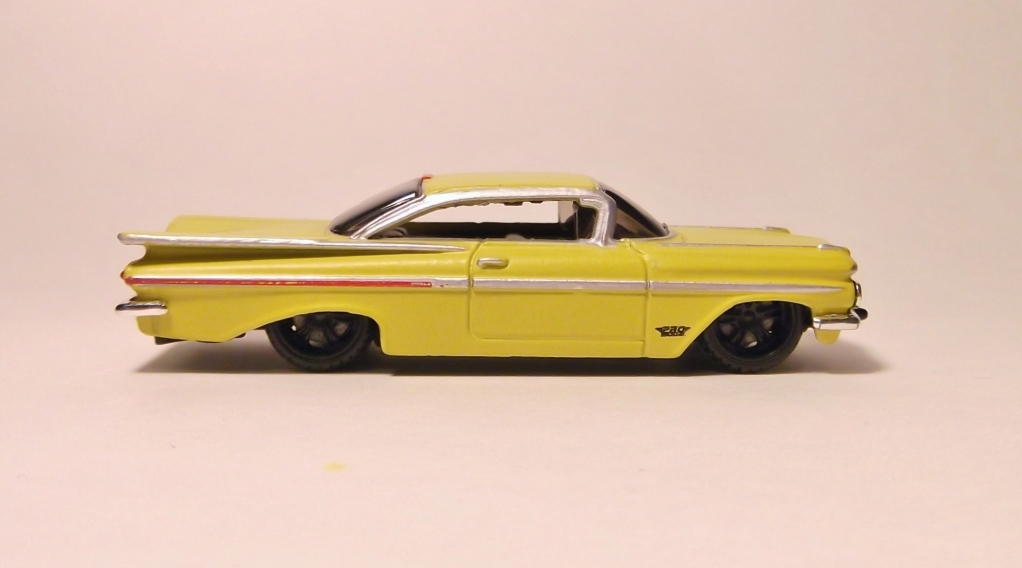
Today's car of the day comes from Firehawk73's collection and is Maisto's 1959 Chevrolet Impala.
The Chevrolet Impala is a full-size automobile built by the Chevrolet division of General Motors introduced for the 1958 model year. Deriving its name from the southern African antelope, Chevrolet's most expensive passenger model through 1965 had become the best-selling automobile in the United States, competing against the Ford Galaxie 500 and the Plymouth Fury when full-size models dominated the market. The Impala was distinguished for many years by its symmetrical triple taillights. The Caprice was introduced as a top-line Impala Sport Sedan for the 1965 model year becoming a separate series positioned above the Impala in 1966, which itself remained above the Bel Air and Biscayne. The Impala continued as Chevrolet's most popular full-size model through the mid-1980s. Between 1994 and 1996, Impala was revived as a muscular 5.7-liter V8–powered version of the Caprice Classic sedan. In 2000, the Impala was re-introduced again as a mainstream front-wheel drive full-size sedan.
Ed Cole, Chevrolet's chief engineer in the late 1950s, defined the Impala as a "prestige car within the reach of the average American citizen."
For more information and pictures of the real car please visit: Chevrolet Impala
The 1959 Chevrolet Impala was radically reworked sharing bodyshells with lower-end Buicks and Oldsmobiles as well as with Pontiac, part of a GM economy move, Chevrolets rode a wheelbase 11/2 inches longer than before. Atop a new X-frame chassis, roofs sat three inches lower, and bodies measured more than two inches wider overall. The growing size contributed to increased curb weight, one more trend of the times. Its tailfins protruded outward rather than upward. Auto tester Tom McCahill, of Mechanix Illustrated, declared that a Chevy's decklid had "enough room to land a Piper Cub." Chevrolet eschewed the triple-taillight rear style this year with a very large, single controversial "teardrop" taillight at each side.
Impala was now a separate series, including a four-door hardtop and four-door sedan, as well as the two-door Sport Coupe and convertible. Sport Coupes featured a shortened roofline and wrap-over back window, promising a "virtually unlimited rear view" to complement the car's new compound-curve windshield. The hardtop Sport Sedan had a huge, pillar-free back window and "flying wing" roofline. Base V8 was the carryover 283 cu in (4,640 cc), at 185 hp (138 kW) horsepower. Performance fans could select 280 cu in outputs to 290 hp (220 kW) – or turn to the big-block 348 cu in (5,700 cc) V8 up to 315 hp (235 kW). With a V8, the Impala convertible listed at $2,967, but a six-cylinder version saved the customer $118. Impala interiors flaunted their top-of-the-line status, offering front and rear armrests, an electric clock, dual sliding sun visors, and crank-operated front ventipanes. A contoured instrument panel held deep-set gauges residing below hoods to prevent glare. A Flexomatic six-way power seat was a new option, as was "Speedminder" (a device which allowed the driver to set a needle at a specific speed; a buzzer would sound if he exceeded this pre-set speed).
Saturday, May 5, 2012
Today's car of the day comes from Derby Driver 60's collection and is Maisto's 2010 Mercedes-Benz GLK 350.
The Mercedes-Benz GLK (codename X204; Geländewagen Luxus Kompaktklasse) is a compact luxury crossover released as a 2009 model elsewhere and as a 2010 model in North America after its public debut at the 2008 Beijing Auto Show alongside the competing Audi Q5.
The GLK-Class was launched in 2008 and is built in Bremen (Germany), the first Mercedes SUV to be built there. Its design is heavily influenced by the C-Class.
The GLK was presented for the first time in 2008 in Detroit under the form of the Mercedes-Benz Vision GLK Freeside concept.
MBUSA partnered with four tuners to develop custom designs for the newly released GLK for the 2008 SEMA show in Las Vegas. Boulevard Customs, Brabus, RENNtech and Legendary Motorcar Company were the four tuners that had this unique opportunity to design their vision.
The GLK-Class shares the C-Class (W204) platform, and production plans continued after the demise of the similar Smart Formore.
For more information and pictures of the real car please visit: Mercedes-Benz GLK 350
Monday, April 16, 2012
Car Of The Day: April 16, 2012
Today's car of the day comes from Firehawk73's collection and is Maisto's 2000 Volkswagen Jetta.
The Volkswagen Jetta is a compact car, produced by German automaker Volkswagen Group for the Volkswagen Passenger Cars marque since 1979. Positioned to fill a saloon/sedan niche above the firm's Golf hatchback offering, it has been marketed over six generations variously as the Atlantic, Fox, Vento, Bora, City Jetta, Jetta City, GLI, Jetta, and Sagitar The Jetta was originally adapted by adding a conventional trunk to the Golf hatchback, and some distinctive styling (usually the front end, and sometimes slight interior changes). It has been offered in two- and four-door saloon (sedan), and five-door estate (station wagon) versions - all as five-seaters. As of 2005, over 6.6 million cars have been sold worldwide, over one-third in the United States alone. Since the original version in 1980, the car has grown in size and power with each successive generation. By mid 2011, almost 10 million Jettas have been produced and sold all over the world.
The Jetta nameplate is a reference to the Atlantic 'jet stream', reflecting the period in Volkswagen's history when it named its vehicles after prominent winds. These also included the Volkswagen Passat (after the German word for trade wind), Volkswagen Bora (after bora), and Volkswagen Scirocco (after sirocco).
For more information and pictures of the real car please visit: Volkswagen Jetta
Production of the fourth generation car began in July 1999. Carrying on the wind nomenclature, the car was known as the Volkswagen Bora in much of the world. Bora is a winter wind which blows intermittently over the coast of the Adriatic Sea, as well as in parts of Greece, Russia, Turkey, and in the Sliven region of Bulgaria. In North America and South Africa, the Jetta moniker was again kept on due to the continued popularity of the car in those markets.
The Mk4 debuted shortly after its larger sibling, the Passat, with which it shared many styling cues. The rounded shape and arched roofline served as the new Volkswagen styling trademark, abandoning traditional sharp creases for more curved corners. A distinguishing feature of the Mk4 is its Whiptenna, a trademark for the antenna on the rear end of the roof, which claims to incur less drag than traditional antennas due to its short length and leeward position. For the first time, the rear passenger doors differed from those of a 5-door Golf. The car was also offered as an estate/wagon (whose rear doors are also non-interchangeable with the others). New on this generation were some advanced options such as rain sensor controlled windshield wipers and automatic climate control. However, being a Volkswagen, these were expensive extras and many buyers did not specify them on their cars; as a result the used market is full of sparsely equipped models.
Although slightly shorter overall than the Mark 3, the fourth generation saw the wheelbase extended slightly. Some powertrain options were carried over. Nevertheless, two new internal combustion engines were offered, the 1.8-litre turbo 4-cylinder (often referred to as the 1.8 20vT), and the VR5 (a 5-cylinder derivative of the VR6 engine). The suspension setup remained much as before. However, it was softened considerably in most models to give a comfortable ride, which was met with some criticism as it was still quite hard in comparison with rivals such from French makers.
Tuesday, February 14, 2012
Car Of The Day: February 14, 2012
The Pontiac Firebird was built by the Pontiac division of General Motors between 1967 and 2002. The Firebird was introduced the same year as the automaker's platform-sharing model, the Chevrolet Camaro. This coincided with the release of the 1967 Mercury Cougar, which shared its platform with another pony car, the Ford Mustang.
The vehicles were powered by various four-cylinder, six-cylinder, and V8 engines sourced from several GM divisions. While primarily Pontiac-powered until 1977, Firebirds were built with several different engines from nearly every GM division until 1982 when GM began to discontinue engines it felt were unneeded and either spread successful designs from individual divisions among all divisions or use new engines of corporate architecture.
For more information and pictures of the real car please visit: Pontiac Firebird
The first generation Firebirds had a characteristic Coke bottle styling. Unlike its cousin, the Chevrolet Camaro, its bumpers were integrated into the design of the front end and its rear "slit" taillights were inspired by the Pontiac GTO. Both a two-door hardtop and a convertible were offered through the 1969 model year. Originally the car was a "consolation prize" for Pontiac, who had initially wished to produce a two-seat sports car of its own design, based on the original Banshee concept car. However, GM feared such a vehicle would directly compete with Chevrolet's Corvette, and the decision was made to give Pontiac a piece of the pony car market by having them share the F-body platform with Chevrolet.
The base model Firebird came equipped with the OHC inline-6 and a single-barrel carburetor. The next model, the Sprint, had a four-barrel carburetor, developing 215 hp (160 kW). Most buyers opted for one of the V8 engines: the 326 CID (5.3 L) with a two-barrel carburetor producing 250 hp (186 kW); the "H.O." (High Output) engine of the same displacement, but with a four-barrel carburetor and producing 285 hp (213 kW); or the 400 CID (6.6 L) from the GTO with 325 hp (242 kW). A "Ram Air" option was also available in 1968, providing functional hood scoops, higher flow heads with stronger valve springs, and a different camshaft. Power for the Ram Air package was the same as the conventional 400 H.O., but the engine peaked at a higher RPM. The 230 CID (3.8 L) engines were subsequently replaced by 250 CID (4.1 L) ones, the first developing 175 hp (130 kW) using a single-barrel carburetor, and the other 215 hp (160 kW) with a four-barrel carburetor. Also for the 1968 model, the 326 CID (5.3 L) engine was replaced by one with a displacement of 350 CID (5.7 L). An "H.O." version of the 350 CID with a revised cam was also offered starting in that year, developed 320 hp (240 kW). Power output of the other engines was increased marginally. In 1969, a $725 optional handling package called the "Trans Am Performance and Appearance Package,", named after the Trans Am Series, which included a rear spoiler, was introduced. Of these first "Trans Ams," only 689 hardtops and eight convertibles were made. There was an additional Ram Air IV option for the 400 CID engine during that year, complementing the Ram Air III; these generated 345 and 335 hp (250 kW) respectively. The 350 "H.O." engine was revised again with a different cam and cylinder heads resulting in 330 hp (250 kW). During 1969 a special 303 cu in (5.0 L) engine was designed for SCCA road racing applications that was not available in production cars.
The styling difference from the 1967 to the 1968 model was the addition of Federally mandated side marker lights: for the front of the car, the blinkers were made larger and extended to wrap around the front edges of the car, and on the rear, the Pontiac (V-shaped) Arrowhead logo was added to each side. The front door vent-windows were replaced with a single pane of glass. The 1969 model received a major facelift with a new front end design made of an Endura bumper housing the headlights and grilles. The instrument panel and steering wheel were revised. The ignition switch was moved from the dashboard to the steering column with the introduction of GM's new locking ignition switch/steering wheel.
Due to engineering problems that delayed the introduction of the all-new 1970 Firebird beyond the usual fall debut, Pontiac continued production of 1969 model Firebirds into the early months of the 1970 model year (the other 1970 Pontiac models had been introduced on September 18, 1969). By late spring of 1969, Pontiac had deleted all model-year references on Firebird literature and promotional materials, anticipating the extended production run of the then-current 1969 models.
Friday, February 10, 2012
Convertible Ute Of The Day: February 10, 2012
Today's car of the day comes from Firehawk73's son Jacob's collection and is Maisto's 2003 Chevrolet SSR.
The Chevrolet SSR (Super Sport Roadster) is a retractable hardtop convertible pickup truck manufactured by Chevrolet between 2003 and 2006.
The truck was based on the long-wheelbase Chevrolet TrailBlazer EXT's platform, and featured "retro" styling and a steel retractable hardtop designed by ASC. The production model was based on the SuperSport Roadster concept car shown at the 2000 Detroit Auto Show. An early-production SSR was the pace car for the 2003 Indianapolis 500 auto race.
The 2003 and 2004 models used General Motors' Vortec 5300 engine, a 5.3 L 300 hp V8. Performance was 7.7 s to 60 mph (97 km/h) with a 15.9 s/86.4 mph quarter mile run. The 2005 SSR used the 390 hp (291 kW) LS2 V8 also found in the C6 Corvette and Pontiac GTO, and also offered a manual transmission (the six-speed Tremec) for the first time, as an option. For the 2006 model year, the LS2 engine featured minor modifications that boosted its output to 395 hp (automatic transmission) and 400 hp (manual transmission), respectively. In addition, GM badges were added to the vehicle.
For more information and pictures of the real car please visit: Chevrolet SSR
The 2004 model sold below expectations with under 9,000 sales at US$42,000 each. Citing a 301-day supply of SSRs, General Motors in December of that year announced five weeks of layoffs at Lansing Craft Centre, the factory that made the SSR. On November 21, 2005, GM announced that it would close the Craft Centre in mid-2006, spelling the end for the SSR. The final SSR, a unique black-on-silver model (Highest VIN 1GCES14H06B124112), was built on March 17, 2006. Analysts estimate that 24,150 SSRs were produced in total. Of the total production, 24,112 were available for sale to the public.
Tuesday, February 7, 2012
Car Of The Day: February 7, 2012
Today's car of the day comes from Firehawk73's son Jacob's collection and is Maisto's 1993 Chevrolet Corvette ZR-1.
The Chevrolet Corvette (C4) is a sports car produced by the Chevrolet division of General Motors for the 1984 through 1996 model years. The editors of Consumer Guide stated: "The first fully redesigned Corvette in 15 years was more sophisticated and more practical than the beloved Shark. And like previous generations, the new C4 only got better in time." The convertible returned, as did higher performing engines, exemplified by the 405 hp (302 kW) LT5 found in the ZR-1. In early March 1990, the ZR-1 would set a new record for the highest 24 hour-5,000 mile land-speed by going over 175 mph (282 km/h). Though prices rose even as sales declined, the fourth generation Corvette won its own loyal following as one of the world's most desirable sports cars. The last C4 was produced on June 20, 1996.
For more information and pictures of the real car please visit: Chevrolet Corvette ZR-1
During 1986, General Motors acquired Group Lotus, the UK based engineering consulting and performance car manufacturing firm. The Corvette division approached Lotus with the idea of developing the world's fastest production car, to be based on the C4 generation Corvette. With input from GM, Lotus designed a new engine to fit in place of the L98 V8 that was powering the standard C4. The result was what GM dubbed the LT5, an aluminum-block V-8 with the same bore centers as the L98, but with four overhead camshafts, 32 valves. Lotus also designed a unique air management system for the engine to provide a wider power band by shutting off 8 of the 16 intake runners and fuel injectors when the engine was at part-throttle, while still giving the ZR-1 375 hp (280 kW) when at wide open throttle. In addition to the engine, Lotus helped GM design the ZR-1's upgraded braking and steering systems, and helped them pick the settings for the standard "FX3" adjustable active ride control that Chevrolet was fitting to the car, helping to ensure that the vehicle was more than just a modern-day muscle car with a big engine and no real capability on the track.
GM found that the engine required special assembly, and that neither the Corvette plant in Bowling Green, Kentucky nor any of their normal production facilities could handle the workload, so Mercury Marine corporation of Stillwater, Oklahoma was contracted to assemble the engines and ship them to the Corvette factory in Bowling Green where the ZR-1s were being assembled.
The vehicle went on sale in 1990 and was available only as a coupe. It was distinguishable from other Corvette coupes by its wider tail section, 11" wide rear wheels and its new convex rear fascia with four square shaped taillights and a CHMSL (center high mounted stop lamp) attached to the top of the hatch glass instead of between the taillights.
The ZR-1 displayed stunning ability both in terms of acceleration and handling capabilities, but carried with it an astonishingly high price. MSRP for the ZR-1 in 1990 was $58,995, almost twice the cost of a non-ZR-1, and had ballooned to $66,278 by 1995; some dealers successfully marked units as high as $100,000. Even at base MSRP, this meant that the ZR-1 was competing in the same price bracket as cars like the Porsche 964, making it a hard sell for GM dealers.
In 1991, the ZR-1 and base model received updates to body work, interior, and wheels. The rear convex fascia that set the 1990 ZR-1 apart from the base model found its way to all models, making the high-priced ZR-1 even less distinguishable. Further changes were made in 1992, including extra ZR-1 badges on the fenders and the introduction of Acceleration Slip Regulation (ASR) or traction control. For model year 1993, Lotus design modifications were made to the cylinder heads, exhaust system and valvetrain of the LT5, bringing horsepower up to 405. In addition, a new exhaust gas recirculation system improved emissions control. The model remained nearly unchanged into the 1995 model year, after which the ZR-1 was discontinued as the result of waning interest, development of the LS series engines, cost and the coming of the C5 generation. A total of 6,939 ZR-1s were manufactured over the six year period. Not until the debut of the C5 platform Z06 would Chevrolet have another production Corvette capable of matching the ZR-1's performance.
Although the ZR-1 was extremely quick (0-60 mph in 4.4 seconds, and onto 180+ mph), the huge performance of the LT5 engine was matched by its robustness. As evidence of this, a stock ZR-1 set a number of international and world records at a test track in Fort Stockton, Texas on March 1, 1990, verified by the FIA (Fédération Internationale de l'Automobile), including seven new international records.
Monday, February 6, 2012
Car Of The Day: February 6, 2012
Today's car of the day comes from Firehawk73's son Jacob's collection and is Maisto's 1969 Dodge Charger.
The Dodge Charger is an American automobile manufactured by the Dodge division of Chrysler. There have been several different Dodge vehicles, built on three different platforms and sizes, all bearing the Charger nameplate. The name is generally associated with a performance model in the Dodge range; however, it has also adorned subcompact hatchbacks, full-sized sedans, and personal luxury coupes.
For more information and pictures of the real car please visit: Dodge Charger
The 1969 model year brought few modifications. Exterior changes included a new grille with a center divider and new longitudinal taillights both designed by Harvey J. Winn. A new trim line called the Special Edition (SE) was added. This could be available by itself or packaged with the R/T, thus making an R/T-SE. The SE added leather inserts to the front seats only, chrome rocker moldings, a wood grain steering wheel and wood grain inserts on the instrument panel. A sunroof was added to the option list as well, and saw only 260 sold installations. The bumble bee stripes returned as well, but were changed slightly. Instead of four stripes it now featured one huge stripe framed by two smaller stripes. In the middle of the stripe an R/T cutout was placed. If the stripe was deleted, a metal R/T emblem was placed where the R/T cutout was. Total production was around 89,199 units.
Bo & Luke Duke popularized the 1969 Dodge Charger in The Dukes of HazzardThe television series The Dukes of Hazzard (1979–1985) featured a 1969 Dodge Charger that was named The General Lee. "The General" sported the Confederate battle flag painted on the roof and the words "GENERAL LEE" over each door. The windows were always open, as the doors were welded shut. The number "01" is painted on both doors. Also, when the horn button was pressed, it played the first 12 notes from the de facto Confederate States anthem "Dixie". The car performed spectacular jumps in almost every episode, and the show's popularity produced a surge of interest in the car. The show itself purchased hundreds of Chargers for stunts, as they generally destroyed at least one car per episode.
Sunday, February 5, 2012
Car Of The Day: February 5, 2012
Today's car of the day comes from Firehawk73's son Jacob's collection and is Maisto's 2000 Buick LaCrosse concept.
The Buick LaCrosse is a mid-size entry-level luxury sedan produced by General Motors. It replaced the Buick Century and Regal in North America beginning in the 2005 model year.
For more information and pictures of the real car please visit: Buick LaCrosse
Subscribe to:
Posts (Atom)