Showing posts with label NASCAR. Show all posts

Friday, March 30, 2012

Race Car Of The Day: March 30, 2012


Today's car of the day is Racing Champions' 2001 Chevrolet Monte Carlo NASCAR stock car (Jimmie Johnson).


From 1972 until the cars end of production, the Monte Carlo was a solid success in NASCAR racing. The big (1973–1977) bodied cars were the dominant body style through the years until 1980, when NASCAR mandated the move to the smaller (110-inch-wheelbase) cars being built by Detroit. The 1981 and 82 stock (referred to as the "flat-nose") Monte Carlo was raced by very few teams and as such only won three races in those years. Starting in 1983 with the addition of the SS nose, the Monte Carlo SS became the dominant body style in NASCAR through the rest of the decade when the car went out of production. The car came back to racing in 1995 when Chevy brought the car back into production and it sparked a mild bit of controversy as NASCAR allowed the car to have wider rear fenders, and as such deviated from factory sheetmetal, that up until that time the race spec cars had to use. The car brought Chevy repeated NASCAR Manufacturers Cup awards until it again was discontinued from production, and was replaced by the Impala for racing.


For more information and pictures of the real car please visit: Chevrolet Monte Carlo & Jimmie Johnson


This is one of the many cars I received as a Christmas RAOK from James (thank you!).  It's the only Jimmie Johnson car in my collection as I stopped collecting NASCAR before he started racing in the Cup series.


Jimmie Kenneth Johnson (born September 17, 1975) is an American NASCAR Sprint Cup Series race car driver. He currently drives the No. 48 Lowe's Chevrolet for Hendrick Motorsports.
Johnson was born in El Cajon, California, and began racing motorcycles at the age of five. After graduating from Granite Hills High School he competed in off-road series. He raced in Mickey Thompson Entertainment Group (MTEG), Short-course Off-road Drivers Association (SODA) and SCORE International, winning rookie of the year in each series. In 1998, Johnson and his team began stock car racing. He moved to the national American Speed Association (ASA) series for late model touring cars, and won another rookie of the year title. In 2000, he switched to the NASCAR Busch Series (now Nationwide Series).

He moved to Hendrick Motorsports in the Sprint Cup Series in 2002. After finishing fifth in the points in his first full season, he was second in 2003 and 2004 and fifth in 2005. Johnson won his first Cup series championship in 2006 and with further wins in 2007, 2008, 2009 and in 2010 became the only driver in NASCAR history to win five consecutive championships. During the 2011 season, Johnson finished sixth in points. Between 2002 and 2011, Johnson has recorded 55 wins, 228 top-tens, and 25 pole positions.
Johnson became the first racing driver to become Associated Press Male Athlete of the Year (U.S.) in 2009, and has won Driver of the Year four times, most recently in 2010.

Wednesday, March 21, 2012

Car Of The Day: March 21, 2012


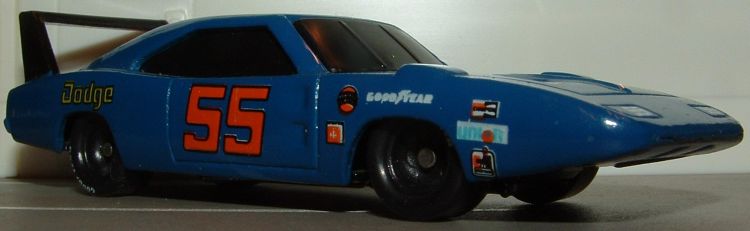
Today's car of the day is Racing Champions' 1969 Dodge Charger Daytona NASCAR stock car (Tiny Lund).


Dodge, an American automobile brand, has produced three separate vehicles with the name Dodge Charger Daytona, all of which were modified Dodge Chargers. The name is taken from Daytona Beach, Florida, which was an early center for auto racing and still hosts the Daytona 500, one of NASCAR's premier events. The first use of the Daytona name on a car was on a version of the Studebaker Lark. The Daytona was the performance model of the compact Lark and it was produced from 1963-1966.

With the failure of the 1969 Dodge Charger 500 on the highbanks of the superspeedways (tracks of a mile, or more in length), the 1969 Dodge Charger Daytona was created. It was intended to be a high performance, limited edition version of the Dodge Charger produced in the summer of 1969 for the sole purpose of winning high profile NASCAR races. It won its first race out, the inaugural Talladega 500 in the fall, although it was a rather hollow victory as all of the top names had left the track on Saturday in a boycott of the 1969 Talladega race. Buddy Baker in the #88 Chrysler Engineering Dodge Charger Daytona was the first driver in NASCAR history to break the 200  mph mark on March 24, 1970 at Talladega. The 1969 Dodge Daytona managed to win 2 races in 1969 and another 4 in 1970 for a total of 6. It's successor, the 1970 Plymouth Superbird managed to win 8 races - all in 1970. (In a bit of irony, in 1969 a Daytona won at Talladega, and a Ford Torino Talladega won at Daytona.) These compare with 29 NASCAR victories for the 1969 Ford Torino Talladega, and 8 for the 1969 Mercury Cyclone Spoiler II. Ironically, the 1969 Dodge Charger 500 managed to win 22 NASCAR races over the 1969 and 1970 seasons; however, all but one of those victories came on the short tracks - several of which were still being run on dirt at the time.
One of the five famous aero-cars, the Dodge Daytona featured special body modifications that included a 23 in (584 mm) tall stabilizer wing on the rear deck, a special sheetmetal "nose cone" that replaced the traditional upright front grille, a flush rear backlight (rear window area), a 'window cap' to cover the original Charger's recessed rear window, specific front fenders and hood that were modeled after the upcoming 1970 Charger, stainless steel A-pillar covers and fender mounted tire clearance/brake cooling scoops. The Daytona was built on the 1969 Charger's 500 trim specifications, meaning that it carried a heavy-duty suspension and brake setup and was equipped with a 440 CID Magnum engine as standard. Of special note to collectors is the optional 426 CID Hemi V8 engine, which only 70 of the 503 Daytonas carried. It had a corporate cousin in the "one year only" 1970 Plymouth Superbird.

The "Winged Warriors", as they were affectionately known, did not compete for long in NASCAR's top Cup series. Because of their exceptional speed and performance, NASCAR subsequently changed the rule book, effectively banning all five of the Aero Cars from Dodge, Ford, Mercury, and Plymouth from competition by the end of 1970. See also Plymouth Superbird, Ford Torino Talladega and Mercury Cyclone Spoiler II for additional information about the aero cars.


For more information and pictures of the real car please visit: Dodge Charger Daytona & Tiny Lund


This may not be a very highly detailed replica, but as far as I know it's the only one available of this car.  I wish that Racing Champions had offered these with an interior and clear glass.


DeWayne Louis "Tiny" Lund (November 14, 1929–August 17, 1975) was a NASCAR driver. He was ironically nicknamed "Tiny" due to his rather large and imposing size.

Lund started racing at a young age on a motorcycle, then moved up to midget cars and sprint cars. He served in the Korean War in the United States Air Force, and in 1955 decided to try stock car racing.
It is also noted that as an adult, Lund stood 6-feet-5-inches-tall and weighed about 270-lbs.

Lund went south with a 1955 Chevrolet and competed in the Lehi, Arkansas, event, with sponsorship from Carl Rupert and his safety belt company. The race was dominated by Speedy Thompson and his Pete DePaolo-owned Ford. Lund qualified mid-pack but his event ended in an accident on lap 65. Lund's flipped end over end and his safety belt broke. He was bruised and had a broken arm.

For 1956, Lund teamed up with Gus Holzmueller, and their best result was a fourth-place finish at Columbia, South Carolina. Lund also ran a few events for A.L. Bumgarner. In 1957 Lund split between Bumgarner's Pontiacs and a Petty Enterprises Oldsmobile. With Bumgarner Lund nearly won an event at the Cleveland County Fairgrounds. He won the pole position, and was leading until a right rear axle gave out. Lund had two other poles on the season. Lund left Bumgarner and became a journeyman for 1958. He won a pair of pole positions at Gastonia and Hillsboro. In 1959 he fielded self-owned Chevrolets. Lund did not have major success, and he was rideless by 1963.

In February 1963, Lund went down to Daytona shopping around for any ride. Lund's friend Marvin Panch, the driver for the Wood Brothers racing team, had an accident while testing an experimental Ford-powered Maserati sports car for the second Daytona Continental three-hour sportscar race (a precursor to the Rolex 24). Panch's car swerved out of control, flipped over and burst into flames. Lund ran into the inferno and managed to pull Panch out of the wreckage. For his actions, Lund was awarded the Carnegie Medal of Honor.

Panch, in hospital, asked Lund to race his car and Glen Wood agreed. He timed in fourth in individual qualifying trials, and finished sixth in the second qualifying race. Lund took the green flag from 12th on the grid.

The start of the race was delayed due to heavy rains, and then the first 10 laps were run under caution. As the green flag waved on the Great American Race, it was Fireball Roberts on pole and "Flying" Fred Lorenzen outside of him. Lorenzen led the race. Lund worked his way through the field. The Wood Brothers team had an ace up their sleeve - they planned to complete the race on one stop less than the field. Lund managed to take the lead very late in the race. Lorenzen passed Lund with 10 laps left to go, but Lorenzen ran out of gas and had to dive down pit road out of contention. Then Ned Jarrett made the pass on Lund for the top spot but with three to go he also ran out of gas. Lund's car ran out of fuel on the final lap, but he managed to coast home to win the 1963 Daytona 500.

Lund's victory jumpstarted what had been a dead career. Lund stayed in the Wood Brothers Ford for several races after Daytona, and came close to another victory in the Southeastern 500 before his motor gave out. Marvin Panch returned and Lund was without a ride. Holman-Moody gave him a car for several big races at Atlanta, Daytona and Charlotte without success. For 1964 he was back to journeyman status. He hooked up with a series of lesser known owners before vaulting into the lead in the Columbia 200 before overheating. Late in the year, he settled in with Lyle Stelter and despite little success they continued their partnership into the 1965 season. With Stelter Lund got his second career victory in that year's Columbia 200, qualifying in fourth and taking the lead from Ned Jarrett before rains came and washed out the second half of the event. In 1966, he continued his partnership with Stelter. Lund was leading at Spartanburg before a differential failed and at Manassas before his engine blew up. Lund did win at Beltsville Speedway. Lund had 21 Did Not Finish (DNFs) that season.

For 1967, he teamed once again with Stelter for the majority of the year but it was with Petty Enterprises in the #42 Plymouth with which he had most of his success. Lund finished fourth in the Daytona 500 despite running out of fuel with a lap to go behind the Ford factory contingent of USAC star Mario Andretti and Fred Lorenzen, handing third to perennial independent James Hylton. Lund finished fifth in the World 600 in that same ride. He struggled in Stelter's Fords despite a promising run in Fonda, New York, where he qualified second and lead some before an axle broke. Lund and Stelter parted at season's end.

For 1968, he teamed with Big Bud Moore and his Mercury's. Lund also ran Moore's cars in the new NASCAR Grand American division designed for pony cars like Mustangs and Camaros. Lund finished fifth in the Firecracker 400 and a fourth in Rockingham highlighted his short Grand National season, but he won the Grand American championship. In 1969, he continued to race in the Grand American division and ran one Grand National race, guesting for Bill France, Sr. in the inaugural Talladega 500. The race was known for a driver's boycott over tire safety protests. Lund drove into the lead but his clutch packed in and he was classified ninth.

In 1968, Lund appeared as one of the race drivers in the racing scene of the MGM movie 'Speedway' which starred Elvis Presley and Nancy Sinatra.

After 1971, Lund began to fade from the Grand National limelight and moved to the new Grand National East Division (the replacement for the Grand American Series) and short track Late Model Sportsman (now Nationwide Series). Lund won the Sportsman season opener at Daytona twice and continued to rack up victories on short tracks that he had raced on as a youth. In 1975, he entered an A.J. King Dodge in the Talladega 500 as first alternate; when Grant Adcox's car was withdrawn from the event, Lund was in and after a short track event that Saturday was flown down in Bobby Allison's private airplane. The race was delayed a week by heavy rains but on August 17 the green flag was waved by Juan Manuel Fangio.
On the seventh lap, Lund and J. D. McDuffie collided on the backstretch; Lund and McDuffie spun down the track as it turned into chaos behind them. Rookie Terry Link was spun straight into the drivers' door of Lund's Dodge and Link's Pontiac exploded in flames. Two spectators in the infield climbed over the catch fence, and with help from driver Walter Ballard, pulled Link from his car and managed to revive him. Lund, however, was pronounced dead at the scene. Drivers in race were not informed of the tragedy.

Friday, February 24, 2012

Race Car Of The Day: February 24, 2012


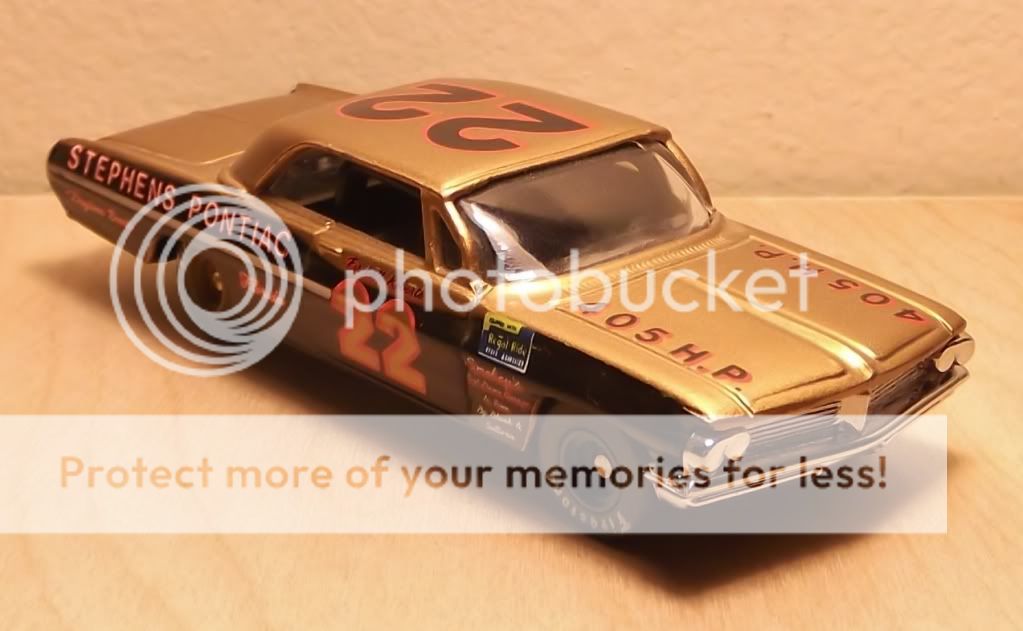
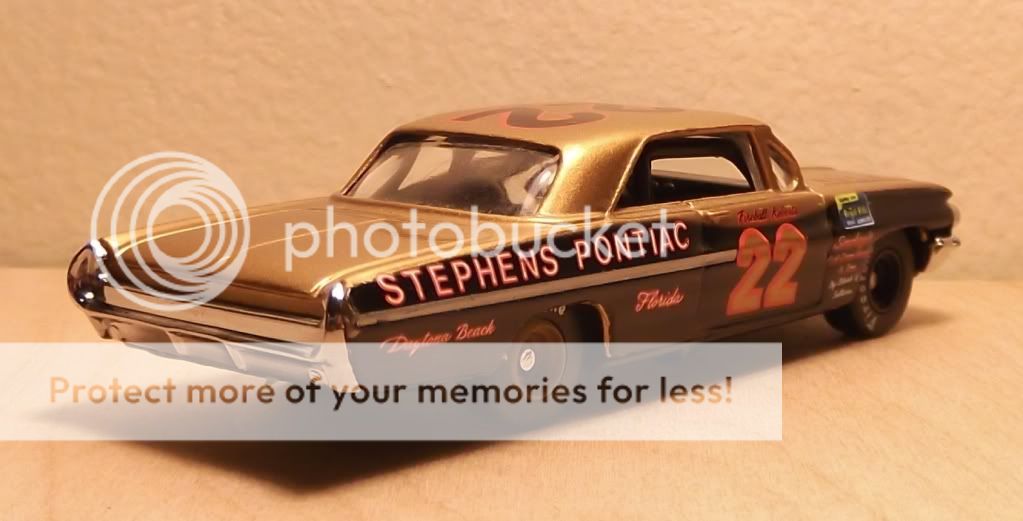
Today's car of the day comes from Firehawk73's collection and is RCCA's 1962 Pontiac Catalina NASCAR stock car (Fireball Roberts).


The 1961 full-sized Pontiacs were completely restyled with more squared-off bodylines, the reintroduction of the split grille first seen in 1959 and dropped for 1960 and an all-new Torque-Box perimeter frame with side rails replacing the "X" frame chassis used since 1958. The new frame not only provided greater side-impact protection than the "X" design but also improved interior roominess.
Rooflines were more squared off on four-door models with the six-window styling dropped on pillared sedans and wider C-pillars with flat rear windows on four-door hardtops. A revised version of the 1959-60 "bubbletop" roof was used on two-door hardtops. Wrap-around windshields were dropped in favor of flatter glass work for improved entry and exit to the front seat.

The new body was somewhat smaller and lighter than the 1960 model with wheelbase down three inches (76 mm) to 119, overall length reduced by the same to 210 in (5,300 mm) and width dropping nearly two inches to 78.2 from 80 in (2,032.0 mm) 1960. The front and rear track of the '61-62 Pontiac was reduced to 62.5 in (1,590 mm) front and rear. The new '61 Pontiac was advertised as "All Pontiac...On a New Wide Track."

All engines were again 389 cu in (6.4 l) V8s as in previous years. Standard engines were two-barrel units rated at 215 hp (160 kW) with the three-speed manual transmission or 267 hp (199 kW) with the optional Hydramatic, with a 230 hp (170 kW) regular-fuel economy V8 offered as a no-cost option with the Hydramatic. Offered as extra-cost options were more powerful versions of the 389 including a 303 hp (226 kW) version with four-barrel carburetor or 318 hp (237 kW) Tri-Power option. New to the option list were two higher performance versions of the 389, including a four-barrel 333 hp (248 kW) unit and a 348 hp (260 kW) Tri-Power option, both with higher 10.75:1 compression ratios. A 363 hp (271 kW) engine was offered to drag racers. Late in the '61 season the 421 cu in (6.9 l) Super Duty was released for sale.
A new three-speed Roto Hydramatic automatic transmission replaced the previous four-speed unit for 1961. The new transmission was slimmer and lighter than the older four-speed Hydramatic, which was continued on the larger Star Chief and Bonneville models. Also new for 1961 was a four-speed manual transmission with Hurst floor shifter, available on special order.

The 1962 Pontiacs received a heavy facelift of the 1961 design with more rounded body contours and new rooflines on two-door hardtops featuring convertible-like bows. Catalina sedans and coupes got a 1-inch (25 mm) wheelbase increase, after spending 1961 on a 119-inch (3,000 mm) length shared with full-sized Chevys (Safari wagons retained the 119-inch (3,000 mm) wheelbase through 1964).
Most regular engine/transmission offerings were carried over from 1961 with the 389 cu in (6.4 l) Trophy V8, ranging in power ratings from 215 hp (160 kW) to 348 hp (260 kW). A small number of 1962 Catalinas and other Pontiacs were built with a "non-streetable" 421 cu in (6.9 l) Super Duty V8 with two four-barrel carburetors and 405 hp (302 kW), as a US$2,250 option (when the base Catalina listed at US$2,725), along with various "over the counter" performance options offered by Pontiac including aluminum bumpers and even lighter frames with drilled holes (which were dubbed the "Swiss Cheese" frames).

For 1963, Catalinas and other full-sized Pontiacs featured cleaner, squared-off bodylines and vertical headlights flanking the split grille, but retained the same dimensions and basic bodyshell of 1961-62. Engine offerings were revised as the 333 hp (248 kW) and 348 hp (260 kW) versions of the 389 V8 were dropped in favor of "production" versions of the larger 421 cu in (6.9 l) rated at 338 horsepower (252 kW) with four-barrel carburetor, 353 hp (263 kW) with Tri-Power, or a 370 hp (280 kW) "HO" with Tri-Power . The 405 hp (302 kW) Super Duty 421 was still offered to racing teams during the early portion of the model year but discontinued after General Motors ordered Pontiac (and Chevrolet) to "cease and desist" from factory-supported racing efforts in February 1963. New options for 1963 included a tilt steering wheel that could be adjusted to six different positions, AM/FM radio and cruise control.

A 1963 Catalina convertible modified by California hot-rodder Bill Straub was used as a tow vehicle in the NASA M2-F1 program.

Mild facelifting including new grilles and taillights highlighted the 1964 full-sized Pontiacs. Engine/transmission offerings were unchanged from 1963 except for a new GM-built Muncie four-speed manual replacing the Borg-Warner T-10 unit. Also new for 1964, was the 2+2 option package available on Catalina two-door hardtops and convertibles that included bucket seats, heavy-duty suspension and other performance equipment, along with the same selection of 389 cu in (6.4 l) and 421 cu in (6.9 l) V8s found in other Catalinas.

Throughout most of the 1960s when Pontiac annually captured third place in industry sales, behind Chevrolet and Ford, the Catalina was also often the industry's third best-selling full-sized car behind the first-place Chevrolet Impala and second-place Ford Galaxie 500. The Catalina's success in the low-medium priced field led many competitors to respond with similar products such as the 1961 Chrysler Newport, a less-expensive Chrysler that was priced lower than base models bearing the Chrysler nameplate in recent previous years; and the 1962 Dodge Custom 880 and 1963 Mercury Monterey, both of which were introduced as full-fledged low-medium priced full-sized cars in size and power that followed unsuccessful efforts by Mercury and Dodge to bring out downsized full-sized cars.

In 1964, even Pontiac's mid-priced rivals within General Motors responded to the Catalina's success in the marketplace as well as to capture Chevy Impala owners "trading up" to cars from upscale GM divisions. Buick took its lowest-priced big car, the LeSabre, and lowered the base sticker price further by substituting a smaller 300 cu in (4.9 l) V8 engine and two-speed automatic transmission from its intermediate-sized cars in place of the 401 cu in (6.6 l) V8 and three-speed automatic used in other big Buicks. Oldsmobile went even further by creating a whole new full-sized series, the Jetstar 88, which was $75 lower than the Dynamic 88 series (but still a few dollars higher than comparable Pontiac Catalina models) and also got a smaller engine - a 330 cu in (5.4 l) V8 and two-speed automatic transmission from the intermediate F-85/Cutlass line, along with smaller 9.5 in (240 mm) brake drums (also from the GM intermediates) compared to the 11–12 in (280–300 mm) drums still found on all other GM full-sized cars from the bare-bones six-cylinder Chevrolet Biscayne to the Cadillac 75 limousine. And since the Catalina was still priced lower than the Jetstar and LeSabre, the lowest-priced full-sized Pontiac was often perceived by buyers as a better value in the marketplace due to its larger standard V8 engine and three-speed automatic transmission, and (in comparison to the Jetstar 88) bigger brakes.


For more information and pictures of the real car please visit: Pontiac Catalina & Fireball Roberts


Edward Glenn Roberts, Jr. (January 20, 1929 – July 2, 1964), nicknamed "Fireball", was one of the pioneering race car drivers of NASCAR.

Roberts was born in Tavares, Florida, and raised in Apopka, Florida where he was interested in both auto racing and baseball. He was a pitcher for the Zellwood Mud Hens, an American Legion baseball team, where he earned the nickname "Fireball" because of his fast ball, not his driving style, which is sometimes disputed. He enlisted with the Army Air Corps in 1945, but was discharged after basic training because of asthma.
He attended the University of Florida and raced on dirt tracks on weekends. In 1947, at the age of 18, he raced on the Daytona Beach Road Course at Daytona for the first time. He won a 150-mile race at Daytona Beach the following year.

Roberts continued to amass victories on the circuit, despite the changes in NASCAR as it moved away from shorter dirt tracks to superspeedways in the 1950s and 1960s. In his 206 career NASCAR Grand National races, he won 33 times and had 32 poles. He finished in the top five 45 percent of the time. He won both the Daytona 500 and Firecracker 250 events in 1962 driving a black and gold 1962 Pontiac built by car builder legend Smokey Yunick.

In 1961 Roberts, temporary President of the Federation of Professional Athletes was in dispute with NASCAR President Bill France over the Teamsters' Union affiliate - the FPA - which he and Curtis Turner had helped organize and France was trying to kill. Unlike the banned Curtis Turner and Tim Flock, Roberts soon returned to the NASCAR fold.

On May 24, 1964, at the World 600 in Charlotte, Roberts had qualified in the eleventh position and started in the middle of the pack. On lap 7, Ned Jarrett and Junior Johnson collided and spun out and Roberts crashed trying to avoid them. Roberts' Ford slammed backward into the inside retaining wall, flipped over and burst into flames. Witnesses at the track claimed they heard Roberts screaming, "Ned, help me!" from inside his burning car after the wreck. Jarrett rushed to save Roberts as his car was engulfed by the flames. Roberts suffered second- and third-degree burns over 80 percent of his body and was airlifted to a hospital in critical condition. Although it was widely believed that Roberts had an allergic reaction to flame-retardant chemicals, he was secretly an asthmatic and the chemicals made his breathing worse.

Roberts was able to survive for several weeks, and it appeared he might pull through. But Roberts' health took a turn for the worse on June 30, 1964. He contracted pneumonia and sepsis and slipped into a coma by the next day. He died on July 2, 1964.

Roberts' death, as well as the deaths of Eddie Sachs and Dave MacDonald at the Indianapolis 500 six days later, led to an increase in research for fire-retardant uniforms. It also led to the development of the Firestone RaceSafe fuel cell, and all race cars today use a foam-backed fuel cell to prevent severe fuel spillage of the massive degree that Roberts had. Also, fully fire-retardant coveralls would be phased in leading to the now mandatory Nomex racing suits. Roberts had just lost close friend Joe Weatherly in the January Motor Trend 500 at Riverside, California, making 1964 a black year for major league auto racing.
Prior to his death, there were many sources that Roberts was retiring, since he had taken a prominent public relations position at the Falstaff Brewing Company and the race in which he was killed was to be one of his final races of his career.

Despite having his career cut short and having never won a Grand National title, Fireball Roberts was named one of NASCAR's 50 Greatest Drivers.

Other career awards he won include induction into the International Motorsports Hall of Fame in 1990, and the Motorsports Hall of Fame of America in 1995.

In 2000 the city of Concord, North Carolina named a street near Charlotte Motor Speedway in his honor.
Ned Jarrett has stated that his decision to retire was prompted by Roberts' death.

After Roberts' death, NASCAR mandated that all drivers must wear flame retardant coveralls while on track. They also instituted the five point safety harness, and the special, contoured drivers seat, all three of which are still requirements on all NASCAR entrants.

Wednesday, February 1, 2012

Race Car Of The Day: February 1, 2012


Today's car of the day comes from Firehawk73's collection and is RCCA's 1965 Ford Galaxie NASCAR stock car (Wendell Scott).


The 1965 Galaxie was an all-new design, featuring vertically stacked dual headlights in what was becoming the fashionable style in a car somewhat taller and bulkier than the previous year's. The new top-of-the-line designation this year was the Galaxie 500 LTD. Engine choices were the same as 1964 except for an all-new 240 cu in (3.9 L) six-cylinder and 1965 289 cu in (4.7 L) engine replacing the 50s-era 223 "Mileage-Maker" six and the 352 being equipped with dual exhausts and a four-barrel carburetor.
Suspension on the 1965 models was dramatically redesigned. Replacing the former leaf-spring rear suspension was a new three-link system, featuring all coils. Not only did the ride improve, but handling also got a boost, and this system was used for NASCAR in the full-size class. Interiors were like the 1964 models, but a new instrument panel and two-way key system were introduced.

A new model was introduced for 1966; the Galaxie 500 7 Litre, fitted with a new engine, the 428 cu in (7.0 L) Thunderbird V8. As the name suggests, this engine was also available on the Ford Thunderbird and was a response to a demand for a more docile, tractable engine than the racing-built 427. The 1966 bodystyle was introduced in Brazil (Ford do Brasil) as a 1967 model; it had the same external dimensions throughout its lifetime until Brazilian production ceased in 1983. In response to safety concerns, U.S. Government regulations for 1966 required seat belts front and rear to be fitted to all new cars sold domestically. The Galaxie 500 would be the #3-selling convertible in the U.S. in 1966, with 27,454 sold; it was beaten by the Mustang (at 72,119, by more than 2:1) and by the Impala at 38,000. A parking brake light on the dash and a AM/FM radio was optional.

In 1967, the 7 Litre model no longer carried the Galaxie name; it was to be the last year of it being separately identified. That identification was mainly trim such as horn ring and dashboard markings as well as the "Q" in the Vehicle Identification Number. The 7 Litre in '67 was basically a trim and performance option on the XL model. Little else changed except for trim and the styling; the same engines were avaialable, from the 240 six-cylinder to the 428 V8. Modifications to the styling included adding a major bend in the center of the grille and making the model less "boxy" than the 1966 model. The 1967 LTD dropped the Galaxie name, a harbinger of changes to come. An 8-track became and option.

In 1967 all Fords, including the Galaxie, featured a large, padded hub in the center of the plastic steering wheel, along with an energy-absorbing steering column, padded interior surfaces, recessed controls on the instrument panel, and front outboard shoulder belt anchors. Another safety related change was the introduction of the dual brake master cylinder used on all subsequent Galaxies (and other Ford models).
The 1968 model had a new grille with headlights arranged horizontally, although the body was essentially the same car from the windshield back. The 'long hood, short deck' style was followed too, as was the new trend for concealed headlights on the XL and LTD. One other change for 1968 was that the base V8 engine increased from 289 to 302 cu in (4.9 L).

The 1968 models featured additional safety features, including side marker lights and shoulder belts on cars built after December 1, 1967. The 1967 model's large steering wheel hub was replaced by a soft "bar" spoke that ran though the diameter of the wheel (and like the '67 style, was used throughout the Ford Motor Company line). A plastic horn ring was also featured.


For more information and pictures of the real car please visit: Ford Galaxie & Wendell_Scott


Wendell Oliver Scott (August 29, 1921 – December 23, 1990) was an American stock car racing driver from Danville, Virginia. He is the only black driver to win a race in what is now the Sprint Cup Series. According to a 2008 biography of Scott, he broke the color barrier in Southern stock car racing on May 23, 1952, at the Danville Fairgrounds Speedway. The book, "Hard Driving: The American Odyssey of NASCAR's First Black Driver," by Brian Donovan (Steerforth Press), says that after gaining experience and winning some local races at various Virginia tracks, Scott became the first African-American to obtain a NASCAR racing license, apparently in 1953, although NASCAR does not have the exact date. The book says that Scott's career was repeatedly affected by racial prejudice and problems with top-level NASCAR officials. However, his determined struggle as an underdog won him thousands of white fans and many friends and admirers among his fellow racers.

Thursday, January 19, 2012

Car Of The Day: January 19, 2012


Today's car of the day is Matchbox's 1975 Chevrolet Chevelle Laguna.


The Chevrolet Chevelle Laguna is a mid-sized automobile produced by the Chevrolet division of General Motors for the 1973 through 1976 model years. Part of the GM A-Body platform, the 1973 Laguna series included coupes, sedans and station wagons. It was the top-line Chevelle series that year positioned above the Malibu. For 1974 through 1976 the car was produced as a one-model Laguna S-3 Coupe, the new-for-1974 Malibu Classic series taking the top-luxury series position. All Lagunas sported urethane front-ends which easily distinguished them from other Chevelles. NASCAR driver Cale Yarborough earned the first two of three consecutive Winston Cup Championships piloting a Chevelle Laguna.


For more information and pictures of the real car please visit: Chevrolet Chevelle Laguna


This one's a childhood survivor.  I'm not sure what year this example came out, but I know it's from after the Universal acquisition of Lesney due to the modified body.  What I would love to know is if this one came out before the Kodak #4 was gracing NASCAR tracks as the paint scheme is strikingly similar.


The third generation Chevelle was an extensively used body style in NASCAR competition from 1973 to 1977. The Chevelle Laguna in particular was extremely successful allowing Cale Yarborough to win 34 races and earn the first two of three consecutive Winston Cup championships. Considered a limited edition model by NASCAR, the Laguna S-3 was ineligible for competition following the 1977 season.

Motor Trend said in 1973: "While neither Chevrolet or Pontiac are back in racing, the new crop intermediates out of GM's styling studios are curiously aerodynamic. They are also curiously competing on the NASCAR circuit tracks, and selling as fast as they can be hauled to the dealerships."

Wednesday, January 11, 2012

Race Car Of The Day: January 11, 2012


Today's car of the day is Action's 1980 Ford Thunderbird NASCAR stock car (as driven by Neil Bonnett).


1980 saw a new downsized Thunderbird that was an upmarket derivative of the Ford Fairmont sedan with nicer trim. The 1980 Thunderbird was a unibody car, weighing 800 lb (363 kg) less than the 1979 model, and was 17 in. (432 mm) shorter. It was based on the Fox platform, and the lighter weight resulted in better gas mileage.

These cars were not well received by the general public, and sales dropped off dramatically after 1980. The squarish upright lines favored by Ford design vice-president Eugene Bordinat, similar to the popular 1977-79 models, didn't translate well to the smaller platform.

The base engine was a 4.2 L (255 cu in V8), or an optional 140 hp (104 kW) 5.0 L (302 cu in) Windsor V8. A 3.3 L (201 cu in) I6 was offered as a delete option in late built 1980 models and became the standard powerplant in 1981. The 3.8 L (232 cu in) V6 was made available as an option in 1982, and the 4.9 L (302 cu in) Windsor 5.0 V8 was dropped.

The 1980 and 1982 Thunderbirds offered vacuum operated hidden headlamps. Digital instrumentation was also available, along with a variety of trim packages. The 1980 Thunderbird was also among the first cars with a keyless entry keypad available. Recaro bucket seats were optional, and power windows were available.

In 1980, Thunderbird was offered as a "Silver Anniversary Edition" model commemorating the 25th anniversary of the car. The external color scheme was called "Anniversary Glow Silver" and the interior was a silver/gray velour with optional leather available. The standard list of features was very comprehensive including the 302 V-8 as standard, as well as a host of luxury trim and convenience options above what the "Town Landau" model offered. Standard features included a garage door opener and a unique landau roof treatment with unique trim and exterior model designation badging.


For more information and pictures of the real car please visit: Ford Thunderbird & Neil Bonnett


This is a recent purchase from 69Stang (thanks Ward!).  I'm one of the few people that likes this generation Thunderbird.  I prefer the '77-'79 'Birds but the '80-'82s are nice too.


Lawrence Neil Bonnett (July 30, 1946 - February 11, 1994) was a NASCAR driver who compiled 18 victories and 20 poles over his 18-year career. The Alabama native currently ranks 35th in all-time NASCAR Cup victories. He appeared in the 1983 film Stroker Ace and the 1990 film Days of Thunder. He was a color commentator in the years up until his death.

Neil Bonnett began his NASCAR career as a protégé of 1983 Winston Cup champion Bobby Allison, working on the team's cars. He later became part of the famous "Alabama Gang" that included himself, Red Farmer and the Allison family: father Bobby, brother Donnie and, later, son Davey. He began driving in NASCAR in 1974 and earned his first victory in 1977 at the Capital City 400 in Richmond, Virginia driving for Harry Hyde/Jim Stacy Racing. He had another victory in 1977 at the Los Angeles Times 500, which would be the last Dodge win in NASCAR until 2001. Many in racing circles thought 1978 would be his year to dominate, but troubles with his cars (the new for 78 Dodge Magnum) and financial problems between Hyde and Stacy caused his cars to fail and to drop out of many races. In 1979 he hooked up with the Wood Brothers Racing Team and got his career back on track with three victories. He later won back-to-back World 600s (NASCAR's longest race, now the Coca-Cola 600) and back-to-back Busch Clash (now Bud Shootout) victories in 1983 and '84, including his first in which he did not win a single pole from the previous season, but was selected as a wild card entry.

In 1984, Bonnett joined Junior Johnson's team, becoming a teammate to Darrell Waltrip. In 1985, Bonnett had one of his best seasons, finishing fourth in the points standings while Waltrip went on to win his third championship.

Bonnett participated in International Race of Champions (IROC) during three seasons (1979, 1980, and 1984), and finished second twice.

On April 1, 1990, Neil Bonnett suffered a life-threatening crash during the TranSouth 500 at Darlington, South Carolina when his car hit the water barrels in front of pit road drivers-side first. Left with amnesia and dizziness, Bonnett retired from racing and turned to television, becoming a race color commentator for TNN, CBS Sports, and TBS Sports, and hosting the TV show Winners for TNN.

However, Bonnett still desired to continue racing. In 1992, he began testing cars for good friends Dale Earnhardt and car owner Richard Childress. Cleared to race again in 1993 and upon Earnhardt's suggestion, Childress gave Bonnett a ride for the 1993 DieHard 500 at Talladega Superspeedway which was numbered 31 and sponsored by Mom and Pop's, one of Earnhardt's associate sponsors. But Bonnett's comeback race was marred by a crash in which his car spun, became airborne, and crashed into the spectator fence. Bonnett was uninjured and called the rest of the race from the CBS broadcast booth after being cleared at the infield care center. He would also start the final race of the 1993 season in Atlanta, but he dropped out after just three laps. The reason the team gave for removing the car from the race was a blown engine, however Bonnett was teamed with points leader Dale Earnhardt, and the car was retired to assist Earnhardt in winning the season's championship. Earnhardt needed to maximize his finishing position, and by Bonnett quitting the race he was assured of those three championship points. That would be Bonnett's final cup start of his career.

Sunday, December 18, 2011

Car Of The Day: December 18, 2011


Today's car of the day is Revell's 1997 Pontiac Grand Prix.


The Pontiac Grand Prix is an automobile that was produced by the Pontiac division of General Motors. First introduced as part of Pontiac's full-size model offering for the 1962 model year, the Grand Prix name was also applied to cars in the personal luxury car market segment and the mid-size offering, slotting below the large Bonneville in the company's lineup.


For more information and pictures of the real car please visit: Pontiac Grand Prix


This is one of the cars that survived my basement flooding.  As hard as it is to believe, this was mint in package back in September.  I know, me keeping a car confined to packaging for fourteen years is unheard of!  But for some reason this one never got DLMed when new and ended up in my basement, forgotten.  It managed to fall from its hiding place after the flood abated and I found it laying in a damp patch on the floor.  I immediately DLMed it and got rid of the wet packaging.  However, as I'm looking at these pictures I can't help but wonder if that's mold over the #18 on the passenger side of the car.  Bobby Labonte is from Texas and this car was run at the first race in Texas since he had been driving in the Winston (now Nextel Sprint) Cup Series.


In 1997, the W-bodies received a major redesign. The first 1997 Grand Prix was built on August 12, 1996. Promoted for its "wide track" appearance and racy styling, the second generation W-body Grand Prix sold well. There were 2 trim levels available in 1997; the SE, GT (GT available in coupe and sedan body styles). The Grand Prix came as a base SE sedan or a sportier GT coupe and sedan, as well as with a high-performance GTP package—available for GT models in either body style. Coupes and sedans shared similar styling, except for rear doors and quarter panels. The GTP was an option package under the GT trim level and later became its own trim level. The base engine on the SE was the only engine carried over from the previous generation, the 3.1 liter V6. The GT had a 3.8 liter V6 (3800 Series II) which was an option on the SE. The 3800 Series II was on the Ward's 10 Best Engines list for 1995 through 1997. The GTP added an Eaton M90 supercharger (also used in the 1996-2003 Bonneville) to the 3.8 liter, boosting power from 195 hp (145 kW) to 240 hp (179 kW). GTP trim level featured a "performance shift" button on the shifter that raised the transmission shift points. Also standard was a tire-pressure monitor. The 6-passenger seating configuration with a front bench seat and column-mounted gear shift in the Grand Prix and its sister cars the Buick Regal and Oldsmobile Intrigue (formerly Cutlass Supreme) was discontinued.

Wednesday, November 16, 2011

Car Of The Day: November 16, 2011


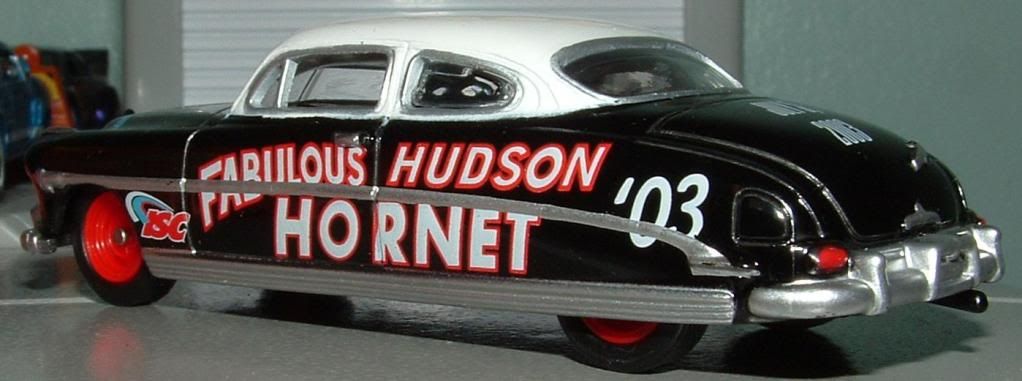
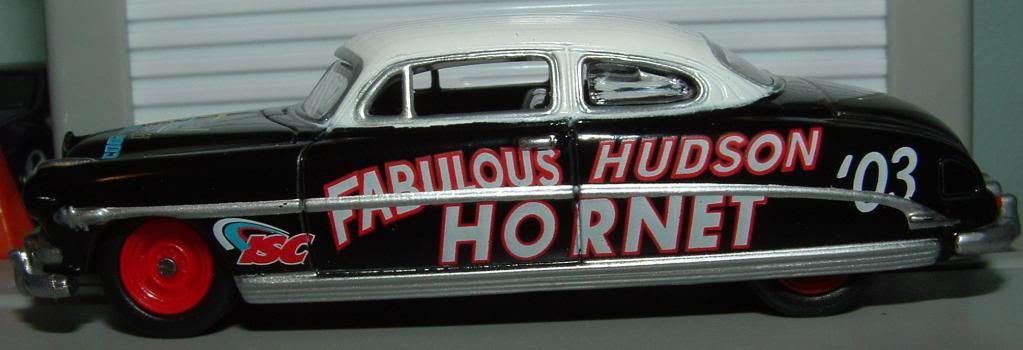
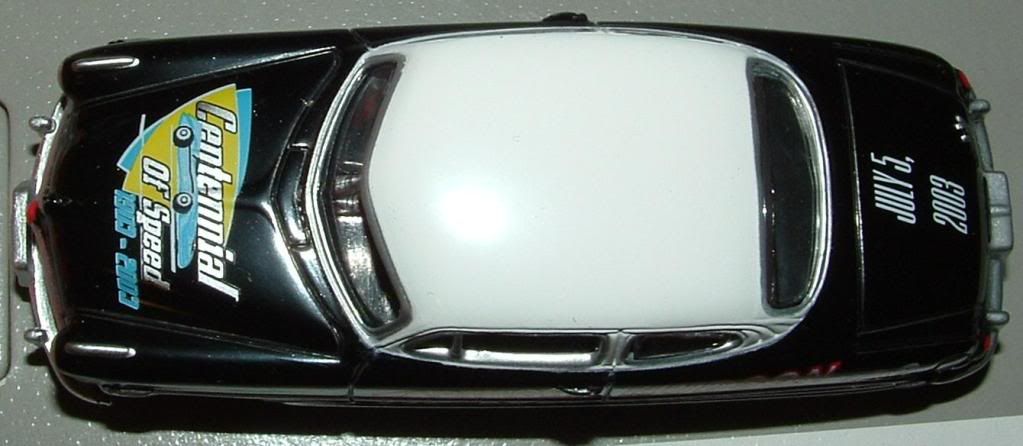
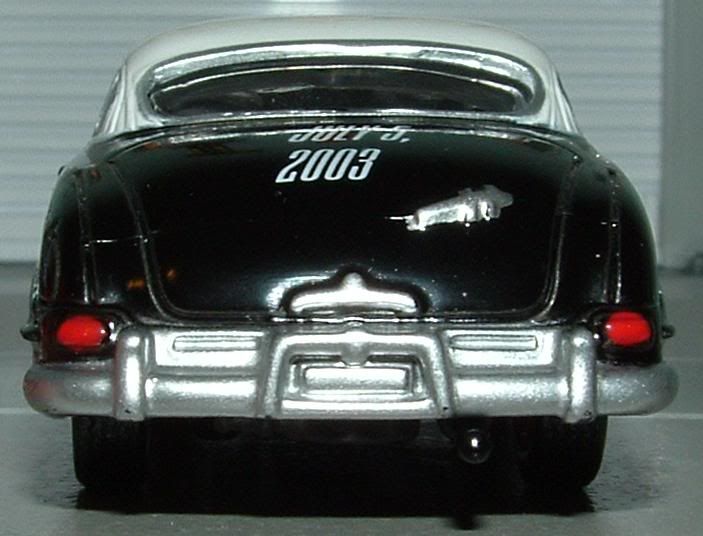
Today's car of the day is Team Caliber's 1951 Hudson Hornet.


The Hudson Hornet is an automobile that was produced by the Hudson Motor Car Company of Detroit, Michigan between 1951 and 1954. The Hornet was also built by American Motors Corporation (AMC) in Kenosha, Wisconsin and marketed under the Hudson brand between 1955 and 1957.

The first-generation Hudson Hornets featured a functional "step-down" design with dropped floorpan and a chassis with a lower center of gravity than contemporary vehicles that helped the car handle well – a bonus for racing. The Hornet's lower and sleeker look was accented by streamlined styling. The car's "unique, low slung appearance and silky handling earned Hudson an image that – for many buyers – eclipsed luxury marques like Cadillac's."

The second-generation Hudson Hornets became a restyled Nash that was badge engineered as a Hudson.


For more information and pictures of the real car please visit: Hudson Hornet


As my Grandpa had a Bali Blue '51 Hornet back in the 1950s, I've made collecting Hornets a subfocus in my collection, and until a few weeks ago this was the only one I was aware of in small scale that I was missing.  Thanks to an RAOK from Billy Kingsley (thanks Billy!) I now have this one!   Hindsight is always a pain, but one can't help to think that had the following chain of events happened, Hudson would still be with us to this day: Hudson and Nash convince Packard to merge with them instead of Studebaker (the original plan was to have Hudson and Nash merge and Studebaker and Packard merge, and then they would merge together, but this fell through).  Considering Studebaker's dire finacial condition in 1954, Packard's cash reserves would have had far more impact at AMC.  Nash (specifically Rambler) as a low-cost car competing with Chevy and Ford.  Packard would be the top end of the spectrum competing against Cadillac and Lincoln, and that would leave Hudson in the territory occupied by Mercury, Dodge, and Oldsmobile.  Considering AMC managed to make it until the late '80s with what little they had.... you never know.  But speculation is just that and we'll never know for sure.


The Hornet, introduced for the 1951 model year, was based on Hudson's "step-down" design that was first seen in the 1948 model year on the Commodore. The design merged body and frame into a single structure, with the floor pan recessed between the car's frame rails instead of sitting on top of the frame. Thus one "stepped down" into a Hudson. The step-down chassis's "lower center of gravity...was both functional and stylish. The car not only handled well, but treated its six passengers to a sumptuous ride. The low-slung look also had a sleekness about it that was accentuated by the nearly enclosed rear wheels."
Hudson Hornets were available as a two-door coupe, four-door sedan, a convertible and a hardtop coupe. The models were priced the same as Commodore Eight, which was priced from US$2,543 to $3,099.
All Hornets were powered by Hudson's high-compression straight-six "H-145" engine. An L-head (flathead or sidevalve) design, at 308 cu in (5.0 L) it was the "largest [displacement] six-cylinder engine in the world" at the time. It had a two-barrel carburetor and produced 145 hp (108 kW) at 3800 rpm and 275 lb·ft (373 N·m) of torque. The engine was capable of far more power in the hands of precision tuners, including Marshall Teague, who claimed he could get 112 miles per hour (180.2 km/h) from an AAA- or NASCAR-certified stock Hornet, as well as Hudson engineers who developed "severe usage" options (thinly disguised racing parts). The combination of the Hudson engine with overall road-ability of the Hornets, plus the fact these cars were over engineered and over built, made them unbeatable in competition on the dirt and the very few paved tracks of the 1950s. The newly introduced "Twin H-Power" was available in November 1951 as a Dealer installed option at the cost of $85.60. An electric clock was standard.

Hudson Hornet 1951 model year production totaled 43,656 units.

Friday, October 14, 2011

Car Of The Day: October 14, 2011


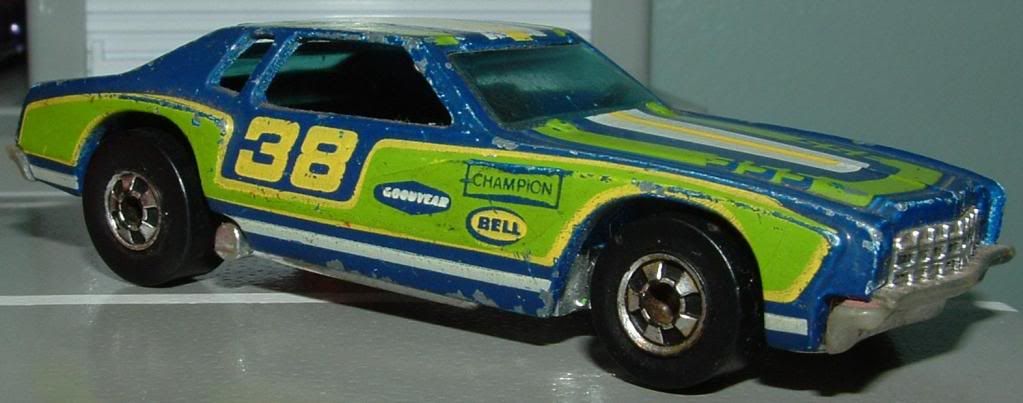
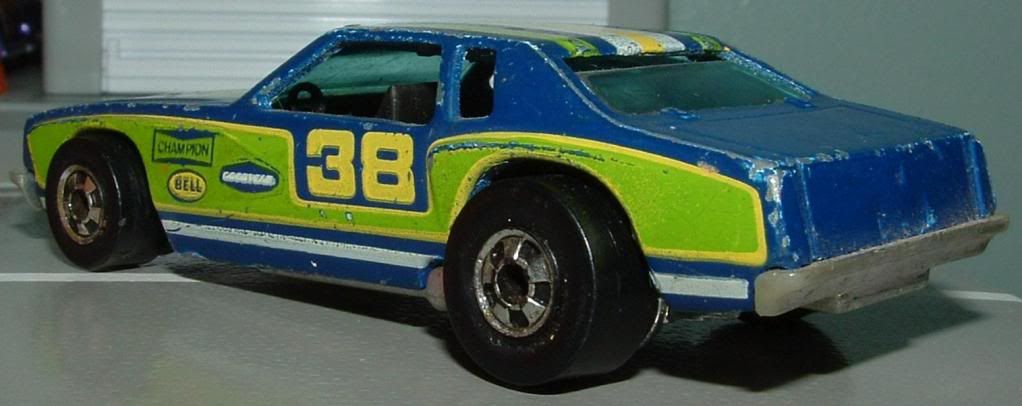
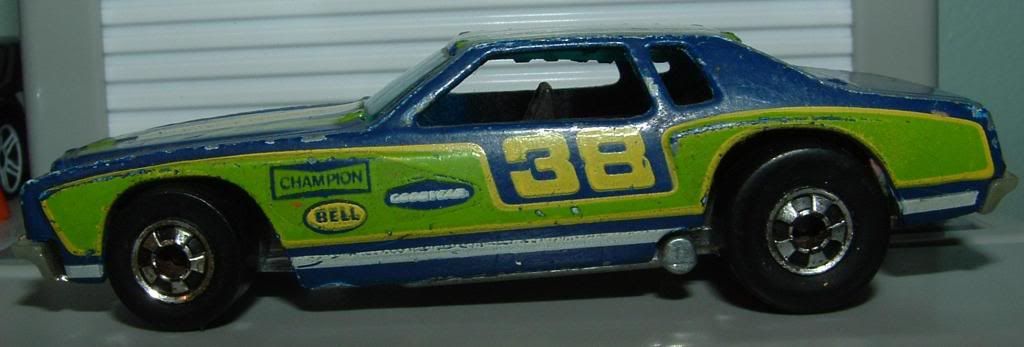
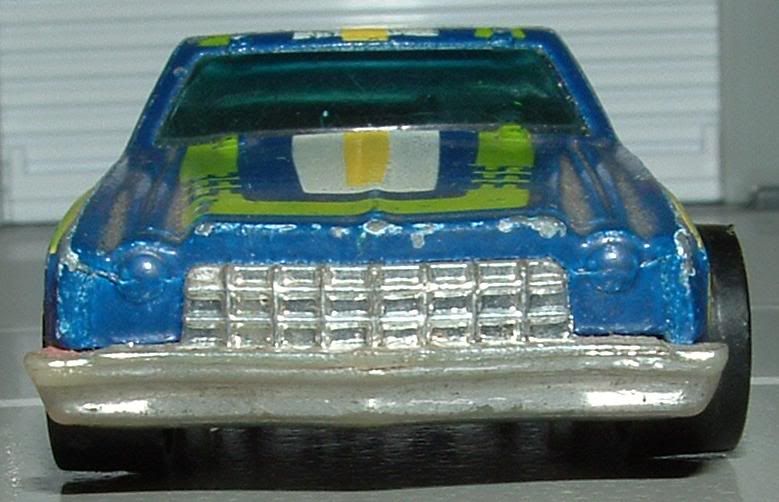
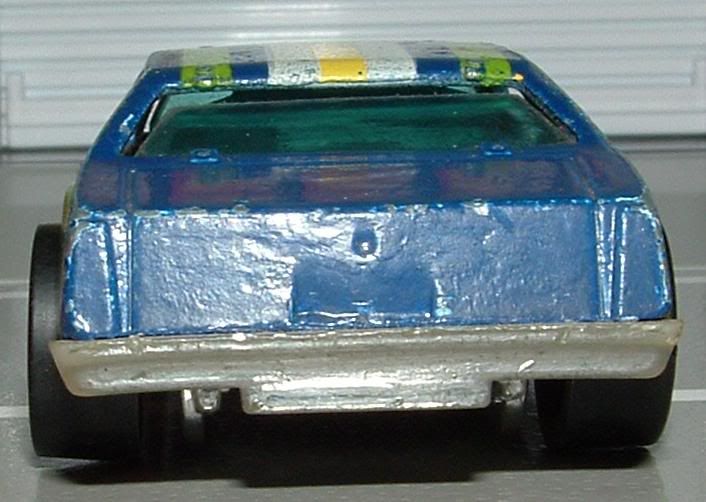
Today's car of the day is Hot Wheels' 1974 Chevrolet Monte Carlo.


The Chevrolet Monte Carlo is an American-made two-door coupe introduced for model year 1970, and manufactured over five generations through model year 2007. It was marketed as a personal-luxury coupe through most of its history, with the last model version being classified as a full-sized coupe. When it was discontinued in 2007, it had outlived many competitors that were either discontinued many years earlier or changed in concept to either a four-door sedan or small sport coupe.

The Monte Carlo endured five design generations. The first three (1970–72, 1973–77, 1978–80 and 1981–88) were of a rear-wheel-drive, V8-powered (V6 available beginning in 1978) coupe style, utilizing separate body-on-frame construction. The later rear-wheel-drive generations bucked the trend of unit-body construction, along with smaller engines, that became more prevalent in the early 1980s as automakers downsized their vehicle lines to meet increasing stringent fuel-economy regulations in the aftermath of two energy crises that led to gasoline shortages and skyrocketing pump prices in 1973-74 and 1979-80. Despite those trends, the Monte Carlo remained a popular seller and even regained the SS version (initially offered for 1970-71 with 454 cubic-inch V8) from mid-1983 to 1988 with a high-performance 305 cubic inch V8.
Following a several year hiatus following the discontinuation of the rear-drive Monte Carlo after 1988, the nameplate was revived for 1995 on a front-drive, V6-powered coupe based on the Chevrolet Lumina sedan. It was succeeded by the fifth and final-generation Monte Carlo in 2000 that was built along-side of the Chevrolet Impala, which succeeded the Lumina as Chevy's mid-sized sedan. The Monte Carlo SS was revived from 2000 to 2007, initially powered by 3.8-liter V6 (supercharged in 2004-2005), which was replaced by a 5.3-liter V8 for 2006-2007.


For more information and pictures of the real car please visit: Chevrolet Monte Carlo


I have no idea why this is such an expensive piece to obtain.  This one was marked $20 but I talked him down to $15 and still feel like I overpaid.  But this is about a $50 car mint.  Considering it shares a base, interior and winshield with the Torino Tornado and is a far from accurate Monte Carlo I don't see the popularity.  But I love this particular paint scheme and it's been among my most wanted models for years.  And now its finally mine- I just wish it was in better shape.


A redesigned Monte Carlo was introduced alongside other GM intermediates. Like other GM mid-size cars, the 1973 Monte Carlo was no longer a hardtop, but a pillared coupe with rear side opera windows and frameless door glass. Prominent styling features included dual headlights flanking an egg-crate grille with a Monte Carlo emblem in front and vertical taillights above the bumper. The front bumper was a large federally mandated 5 mph (8.0 km/h) bumper that was among the required 1973 federal safety standards for all passenger cars sold in the U.S. with the 5 mph (8.0 km/h) requirement extended to rear bumpers on 1974 models. Also new was a double-shell roof for improved noise reduction and rollover protection along with the flush-mounted pull-up exterior door handles first introduced on the 1970½ Camaro and 1971 full-sized Chevrolets and Vegas.

The separate body-on-frame construction carried over for 1973, as was the basic all-coil suspension.
For improved ride and handling, the 1973 Monte Carlo featured a number of innovations (for a large American car) such as standard radial-ply tires, Pliacell shock absorbers, high-caster steering, and front and rear anti-roll bars (previously offered only with the SS package). The standard Monte Carlo with manual transmission, retained "traditional" steering and bias-ply tires, but the radial-tuned system was included when the automatic transmission was ordered, earning the Monte Carlo S label.

A new model for 1973 was the Monte Carlo Landau, which was basically an "S" with a rear quarter Landau vinyl roof, Turbine II wheels and driver and passenger-side sport mirrors.

The interior of the 1973 Monte Carlo featured an all-new, wraparound cockpit-style instrument panel, similar to that found in some contemporary Pontiacs, Oldsmobiles and Buicks, in which gauges and various instruments were centered within easy reach of the driver. The simulated burl elm trim was retained. A split bench seat was standard, but "Strato Bucket" seats of a new design were optional, along with a floor console featuring an equally new shifter with knob and button similar to Pontiac's Rally Sports Shifter replacing the Buick-like horseshoe shifter of previous years, and storage compartment. The bucket seats were of a one-piece high-back design with built-in headrests, and could swivel some 90 degrees to permit the driver and front passenger easier entry and exit. Cloth and vinyl trims were offered with both the bench and bucket seats.

The standard engine was a 145 (net) hp (108 kW) 350 CID (5.7 L) Turbo-Fire V8. Optional engines included a 175 (net) hp (30 kW) 350 CID V8 with a four-barrel carburetor and a four-barrel carbureted 454 CID Turbo-Jet V8 rated at 245 (net) hp (183 kW).

The 1973 Monte Carlo was named Motor Trend's "Car of the Year", due to its new styling and emphasis on Euro-style ride and handling. The 1973 Monte Carlo set a new sales record for Chevrolet, with nearly 250,000 sold for the model year.

The success of the Monte Carlo and Pontiac's similar Grand Prix led to several new personal luxury cars from competitors, including subsequent Mercury Cougar, the Ford Torino Elite, the Chrysler Cordoba and restyled Dodge Charger, and even high-line versions of the AMC Matador, which got a swoopy new coupe design for 1974.

The 1974 Monte Carlo received only minor detail changes from its 1973 predecessor, most notably a revised grille in the front and taller and slimmer vertical taillights in the rear, along with a relocated license plate and larger 5 mph (8.0 km/h) rear bumper.

The base Monte Carlo with manual transmission, standard suspension and bias-ply tires was discontinued, leaving only the "S" and "Landau" models equipped with radial-ply tires and upgraded suspensions along with standard power steering and front disc brakes.

A three-speed manual transmission was listed as standard equipment on 1974 "S" and "Landau" models equipped with the standard 350 CID V8, and an automatic transmission was a required option with the larger 400 and 454 CID V8s. However, a number of sources indicate that Chevrolet built virtually all 1974 Monte Carlos with the Turbo Hydra-Matic transmission.

The standard 350 CID Turbo-Fire V8 was again rated at 145 hp (108 kW) with two-barrel carburetor in 49 states. For Californians, the standard engine was a 350 Turbo-Fire V8 with a four-barrel carburetor rated at 160 hp (120 kW) that was not offered in the other 49 states. Reappearing on the Monte's option list for the first time since 1970 was a 400 CID Turbo-Fire small block V8 rated at 150 hp (110 kW) with a two-barrel carburetor (not offered in California) or 180 hp (134 kW) with a four-barrel carburetor. The top engine was again the 454 CID Turbo-Jet big block V8 rated at 235 hp (183 kW).

Despite the Arab Oil Embargo of late 1973 and early 1974 that greatly cut into sales of standard and intermediate-sized cars in favor of smaller compacts and imported subcompacts, the Monte Carlo went the other way on the sales charts by setting a new sales record this year of over 300,000 units despite the long lines at gas stations and record-high gasoline prices. The Monte Carlo continued to lead in intermediate personal luxury car sales with the Grand Prix placing second and the arrival of new competitors this year, including an upsized Mercury Cougar, Ford Torino Elite and AMC's Matador coupe. Chrysler would introduce its entries in this field for 1975 including the Chrysler Cordoba and redesigned Dodge Charger.