Showing posts with label Toyota. Show all posts

Thursday, October 11, 2012

Car of the Day:October 11, 2012

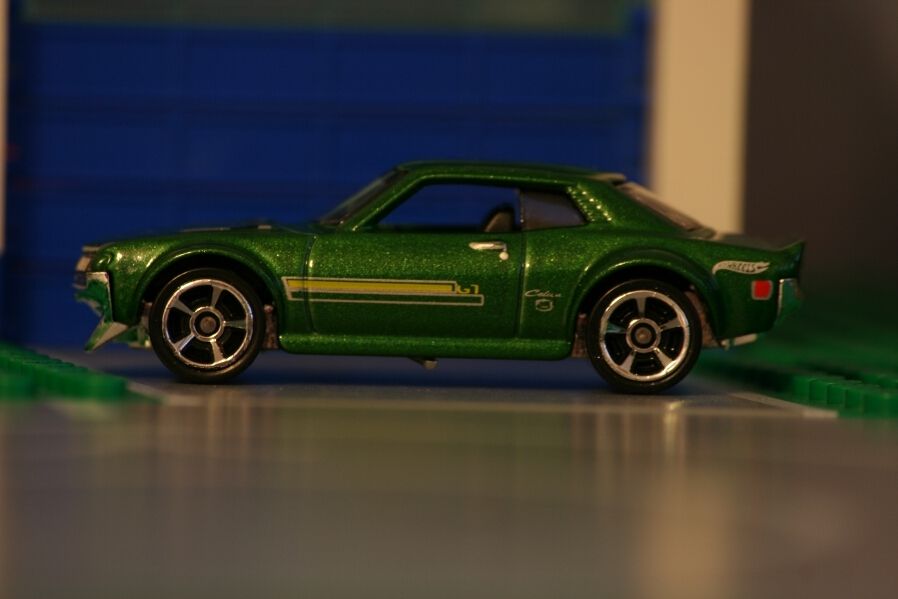
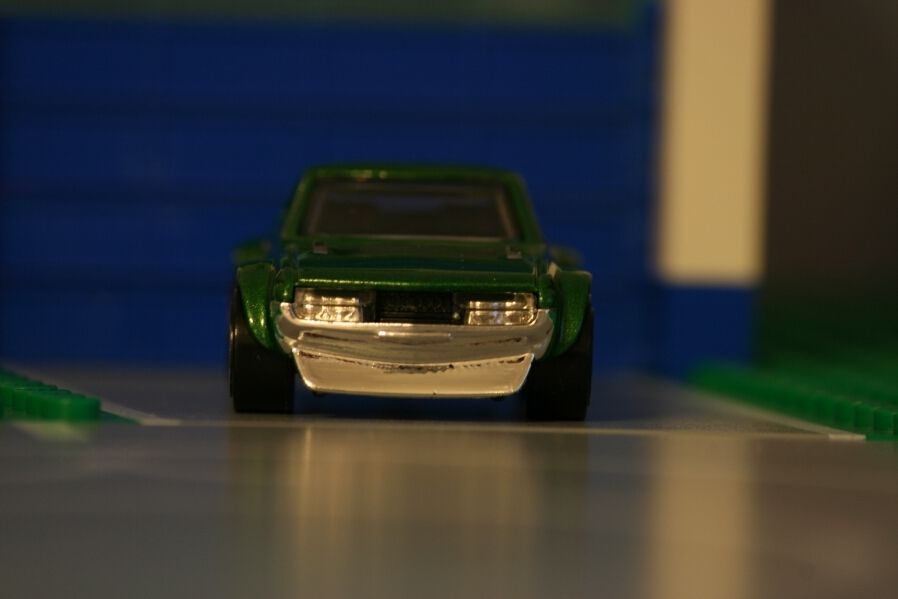
Today's Car of the Day is from Jedmimario's collection and is the Hot Wheels' 1970 Toyota Celica GT.
Wikipeida.com Displayed at the October 1970 Tokyo Motor Show[3] and marketed in December of the same year, the Celica was a personal car that emphasized styling and driving enjoyment. Japanese models were ET, LT, ST, GT, and GTV (which was introduced in 1972, the V standing for Victory). The platform was shared with the Toyota Carina, a vehicle exclusive to Toyota Store Japanese dealerships. For export markets, the Celica was offered in three different levels of trim; LT, ST and GT.
For more information about the real car check out http://en.wikipedia.org/wiki/Toyota_Celica
This is the latest from what is probably my favorite theme in the current Hot Wheels line: 70-80s Japanese sports cars. This one, similar to this others, is done up in period racing modifications with exaggerated fender flares and a low front spoiler. Distinctly, though, it retains factory trim and decals. A great little model with jeweled lights. The proportions aren't quite perfect and the wheels on the large size, but the casting gets the job and has loads of charm.

Thursday, October 4, 2012

Car Of The Day: October 4, 2012


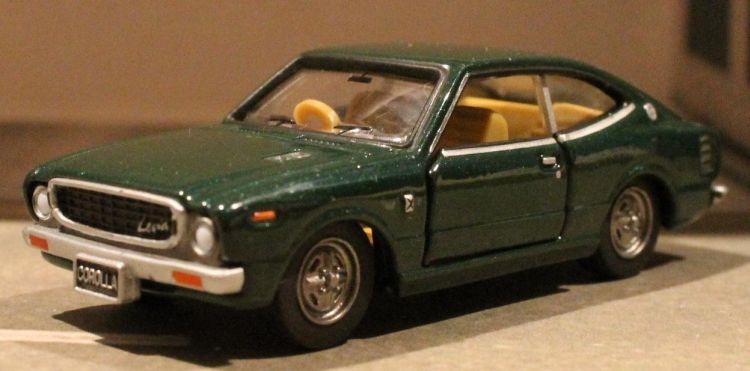
Today's car of the day is Tomica Limited's 1974 Toyota Corolla Levin.


The Toyota Corolla is one of a line of subcompact and compact cars manufactured by the Japanese automaker Toyota, which has become very popular throughout the world since the nameplate was first introduced in 1966. In 1997, the Corolla became the best selling nameplate in the world, surpassing the Volkswagen Beetle. Over 39 million Corollas have been sold as of 2012. The series has undergone several major redesigns.

The name Corolla is part of Toyota's naming tradition of using the name Crown for primary models: the Corona, for example, gets its name from the Latin for crown; Corolla is Latin for small crown; and Camry is an Anglicized pronunciation of the Japanese for crown, kanmuri. The Corolla has always been exclusive in Japan to Toyota Corolla Store locations, and manufactured in Japan with a twin, called the Toyota Sprinter, sold at a specific Japanese Toyota dealership called Toyota Auto Store, then renamed Toyota Vista Store in 1980.

Corollas are manufactured in Japan and in Brazil (Indaiatuba, São Paulo), Canada (Cambridge, Ontario), China (Tianjin), India (Bangalore), Indonesia, Malaysia, Pakistan, Philippines, South Africa (Durban), Taiwan, Thailand, Turkey and Venezuela. Production has previously been made in Australia (Victoria) and the United Kingdom (Derbyshire). Production in the United States (at NUMMI in Fremont, California) ended in March 2010.

The Corolla's chassis designation code is "E", as described in Toyota's chassis and engine codes.

Early models were mostly rear-wheel drive, later models were mostly front-wheel drive and some models were four-wheel drive. Its traditional competitor almost from the very beginning has been the Nissan Sunny also introduced the same year as the Corolla in Japan.


For more information and pictures of the real car please visit: Toyota Corolla Levin


Another Hershey show find, I couldn't leave this one behind.


The Corolla E30 was the third generation of cars sold by Toyota under the Corolla nameplate. It was built from August 1974 to July 1981 and marked Toyota's greatest growth in the United States in the wake of the fuel crisis. In addition to its sister model, the Sprinter, there was a redesigned-body version built by Toyota affiliate Daihatsu, called the Daihatsu Charmant. While there were certain fourth-generation models with a longer model life, this generation, when considered as a whole, was the longest-lived one, possibly due to the worldwide recession in the 1970s. A large range of cars were built using this chassis, including Corollas, Sprinters, Daihatsu, and the sporty Levin and Trueno models with the DOHC motor, with a fuel injection upgrade added to Japanese Levin models in January 1977.

The 3K engine was used in certain markets and later the 4K, while most Japanese and American models had the bigger 2T engine. A "Toyoglide" 2/3-speed automatic transmission was added as well as a four-speed and five-speed manual transmission, driving to the rear wheels. A three-door "liftback" (E50) and sports coupé (E51) was added in 1976. The E40 and E60 series were assigned to the Sprinter variants.
Even though the E30 and E50 series were replaced by the E70 series in August 1979 in most markets, the original E30 series and the facelifted E50 series both continued production until July 1981.


Road & Track was critical of the 1975 Corolla, calling it "large and heavy" and "expensive" compared to the Honda Civic and Datsun B210. They also criticized the "relatively crude rear suspension", lack of interior space, and poor fuel economy when compared to the VW Rabbit. The base model cost US$2,711 in 1975, but only the $2989 "deluxe" model had features comparable to the contemporary pack.

Emissions became a problem further into the 1970s especially with the 3K engine, which became popular because of its low fuel consumption. Its replacement, the 4K engine, came with emissions equipment but only produced 60 hp (45 kW), despite a greater 1290 cc displacement.

The E30 series 2T-C engines outmatched rival Datsun B210's engine output.
Saturday, June 30, 2012

Car Of The Day: June 30, 2012


Today's car of the day comes from juantoo3's collection and is Playart's 1971 Toyota Celica.


The Toyota Celica name has been applied to a series of coupes made by the Japanese company Toyota. The name is ultimately derived from the Latin word coelica meaning "heavenly" or "celestial".

Throughout its life span the Celica has been powered by various four-cylinder engines. The most significant change occurred in August 1985, when the car's drive layout was changed from rear wheel drive to front wheel drive. During the first three generations, American market Celicas were powered by various versions of Toyota's R series engines. The four-wheel drive turbocharged model (designated All-trac in the United States or GT-Four elsewhere) was produced from 1986 to 1999. Variable Valve Timing came in late 1997 Japanese models, and became standard in all models from 2000 on. Through seven generations, the model has gone through many revisions and design forks, including the Toyota Celica Supra (later known as the Toyota Supra). The Celica was available as notchback and liftback coupes, as well as a convertible.


For more information and pictures of the real car please visit: Toyota Celica


The first generation Celica was released to the Japanese market intended to be a more affordable alternative to Toyota's sportscar, the 2000GT. The car's platform was shared with the Toyota Carina yet sold at a different dealership sales channel called Toyota Corolla Store. The Carina was sold at Toyota Store locations. The Celica was also positioned above the Corolla Levin, also sold at Toyota Corolla Store (the Corolla Levin was not a hardtop, the Celica was).

Displayed at the October 1970 Tokyo Motor Show and marketed in December of the same year, the Celica was a personal car that emphasized styling and driving enjoyment. Japanese models were ET, LT, ST, GT, and GTV (which was introduced in 1972, the V standing for Victory).
For export markets, the Celica was offered in three different levels of trim; LT, ST and GT.
At its introduction the Celica was only available as a pillarless hardtop notchback coupe. The SV-1 liftback was shown as a concept car at the 1971 Tokyo Motor Show. With slight modifications, this was introduced in Japan in April 1973 as the 2-litre RA25 and 1.600 L TA27 liftbacks. It was then exported to Europe in RHD form as the 1.6-litre liftback. After the October 1975 facelift, it was available in both RHD and LHD forms in other markets. The RV-1 wagon was also shown at the 1971 Tokyo Motor Show but it did not reach production.

The Japanese GT models had various differences from the ET, LT and ST including the hood flutes, power windows, air conditioning, and specific GT trim, but shared a few things with the ST - a full-length center console and oil pressure/ammeter gauges while the LT had warning lights for these functions.
There was also the GTV version, which differed from the GT with a slightly cut-down interior, and did not come standard with things like power windows, but they were optional. The GTV has firmer suspension.
The first generation Celicas can be further broken down into two distinctive models. The first of these was the original with slant nose (trapezoid-like shape front corner light). This is for Coupe model only, TA22, RA20, and RA21. These models were released from 1970 to 1975 and came equipped with the 2T, 2T-G 1.6-liter, or 18R 2.0-liter motor. They had a 95 inches (2,400 mm) wheelbase. The second series (98 in or 2,500 mm wheelbase) had a flat nose (square front corner light) and slightly longer wheelbase, and was known in Europe as the TA23. This facelift model appeared in Japan in 1974, but for export was the 1976 model year. The Japanese version had engines under 2.0 liters so as to conform to Japanese regulations concerning engine displacement size, thereby allowing buyers to avoid an additional tax for a larger engine.
In some markets, the lower-end LT was equipped with the single carbureted four-cylinder 2T engine displacing 1,600 cc, while the ST came with a twin downdraft-carburetor 2T-B engine. The 2T-G that powered the high-end GT model was a DOHC 1,600 cc engine equipped with twin Mikuni-Solex Carburetors.

The first Celica for North America, 1971 ST was powered by 1.9-liter 8R engine. The 1972-1974 models have 2.0-liter 18R-C engines. For 1975-77, the engine for the North American Celica is the 2.2-liter 20R. The Celica GT and LT models were introduced in the U.S. for the 1974 model year. The top-line GT included a 5-speed manual transmission, rocker panel GT stripes, and styled steel wheels with chrome trim rings. The LT was marketed as an economy model. Mid-1974 saw minor changes in the Celica's trim and badges and slightly different wheel arches. The A30 automatic transmission became an option on North American ST and LT models starting in the 1973 model year. For 1975, the 1974 body was used, but body-color plastic fascia and sturdier chrome and black rubber bumpers, replaced the chrome bumpers used in the earlier cars (in accordance with US Federal bumper laws). Unfortunately the early 8R and 18R series engines proved to be less than durable, with early failures common. The 1974 18R-C engine's durability was improved somewhat, but the 20R introduced for 1975 proved to be a better engine in most respects.

Saturday, June 16, 2012

Car Of The Day: June 16, 2012


Today's car of the day comes from craftymore's collection and is Maisto's 2005 Toyota Celica GTS.


The Toyota Celica name has been applied to a series of sports compact coupes made by the Japanese company Toyota. The name is ultimately derived from the Latin word coelica meaning "heavenly" or "celestial".
Throughout its life span the Celica has been powered by various four-cylinder engines. The most significant change occurred in August 1985, when the car's drive layout was changed from rear wheel drive to front wheel drive. During the first three generations, American market Celicas were powered by various versions of Toyota's R series engines. The four-wheel drive turbocharged model (designated All-trac in the United States or GT-Four elsewhere) was produced from 1986 to 1999. Variable Valve Timing came in late 1997 Japanese models, and became standard in all models from 2000 on. Through seven generations, the model has gone through many revisions and design forks, including the Toyota Celica Supra (later known as the Toyota Supra). The Celica was available as notchback and liftback coupes, as well as a convertible.


In late 1999, Toyota began production and sales of the seventh generation Celica. It closely resembled the XYR concept with the exception of the front bumper and rear spoiler. The 2000 model year Celica was an element of Toyota Project Genesis, an effort to bring younger buyers to the marque in the United States. Toyota took time to lighten the car and lower cost whenever possible. Power window and door lock controls were placed in the center console so only 1 set was necessary for both doors. Initial moonroofs were made of polymer plastic instead of the traditional glass.
In the US and Canada, two models were offered; the base model GT and the sportier GT-S. All models are in liftback only body shape. In the interest of light weight, optional sunroofs were polymer plastics instead of glass. In later models, the sunroofs were made of glass, probably for cost reasons. All models featured dual front airbags, daytime running lights (DRL) with auto-on parking and headlights, and 4 cup holders; two in the front and two in the rear. Rear seats were contoured for only 2 passengers and can split down 50/50 to increase cargo capacity. Two-speed front wipers had variable intermittent adjustment. The rear wiper had a single speed and fixed intermittent speed. Windshield and rear window washers were also standard. Options include ABS, rear spoiler, fog lights, HID low beam headlights, upgraded JBL stereo system, 6-disc CD changer, leather seat surfaces, side-impact airbags, floor mats, vehicle intrusion protection (VIP) alarms with door lock/unlock feature, cargo net, and hatchback cargo cover. The Celica had a center-mounted stack for the windows and locks to make it cheaper for young buyers.
The GT-S was powered by the 2ZZ-GE engine rated at 180 bhp (134 kW; 182 PS) at 7600 rpm and 133 lb·ft (180 N·m) torque at 6800 rpm. The engine featured Toyota’s VVTL-i (Variable Valve Timing and Lift control with intelligence). A second stage valve lift control for intake was added to the variable intake cam phase timing. This is similar to Honda’s VTEC but was more advanced because of the variable phase timing that Honda had not yet released (i-VTEC). Variants of this engine were offered in the Matrix XRS, Corolla XRS and the Lotus Elise (with a Lotus ECU which added 10 bhp). Buyers had the option of a 4-speed automatic or 6-speed manual transmissions. The base tire size was 205/55/15 but the optional size offered was 205/50/16. The tire upgrade was merely US$42 so most GT-S models had the optional wheels and tires. All GT-S models had 4-wheel disc brakes and metal pedals. Manual transmission shifters and all steering wheels were upgraded to leather. Hatchback cargo covers were standard along with fog lights for models without the “Action Package.”


Imagine for a moment if Ford discontinued their iconic car,  the Mustang.  It might send the entire brand in a downward spiral image wise.  I think in a highly simplified statement this occurred with Toyota after discontinuing the Celica upon the end of the 7th generation in 2006.  Instead of designing a new Celica, Toyota launched a new youth aimed brand called Scion and released the tC in 2005. In my view, Toyota never recovered image wise from this move.


Tuesday, March 13, 2012

Car Of The Day: March 13, 2012


Today's car of the day comes from Firehawk73's collection and is Johnny Lightning's 1967 Toyota 2000GT.


The Toyota 2000GT is a limited-production, front-engine, rear-wheel drive, two-seat, hardtop coupé grand tourer designed by Toyota in collaboration with Yamaha. First displayed to the public at the Tokyo Motor Show in 1965, the 2000GT was manufactured under contract by Yamaha between 1967 and 1970.

The 2000GT revolutionized the automotive world's view of Japan. The 2000GT demonstrated that Japanese auto manufacturers could produce a sports car to rival those of Europe, in contrast to Japan's image at the time as a producer of imitative and stodgily practical vehicles. Reviewing a pre-production 2000GT in 1967, Road & Track magazine summed up the car as "one of the most exciting and enjoyable cars we've driven", and compared it favorably to the Porsche 911. Today, the 2000GT is seen as the first seriously collectible Japanese car and the first "Japanese supercar". Examples of the 2000GT have sold at auction for as much as US$375,000.


For more information and pictures of the real car please visit: Toyota 2000GT


The 2000GT made its most famous screen appearance in the 1967 James Bond movie You Only Live Twice, most of which was filmed in Japan. Even though the car was never commercially available as a convertible, two were made specially for the film. However, they did not have roofs, just an upholstered hump at the rear of the cabin to simulate a folded top, and therefore were not really true convertibles. Prior to the decision to make fully roofless cars, building the car as a targa was tried, allegedly due to Sean Connery's height not allowing him to fit into the ultra-low coupé version. This retained the hatchback of the original car, but eliminated the rear side windows. However, when the Targa was completed, Connery's head stuck out of the top to such an extent that it was decided it looked too ridiculous and that roofless versions would have to be made if the car was to be featured in the film. The car was mainly driven by his girlfriend Aki (Akiko Wakabayashi) in the film.

Friday, March 9, 2012

Minivan Of The Day: March 9, 2012


Today's car of the day is Pioneer's 1995 Toyota Previa.


The Toyota Previa, also known as the Toyota Estima in Japan and the Toyota Tarago in Australia, is an MPV or multi-purpose vehicle (known as a minivan in North America) produced by Toyota Motor Corporation since 1990. The name "Previa" comes from the Italian for "preview," as Toyota saw the first Previa as a vehicle that would preview technologies used in future minivans. Along with the Toyota Sienna, Previa is the largest minivan in toyota's range, located above the Wish.


For more information and pictures of the real car please visit: Toyota Previa


The Previa is one of the few minivans that stands out in a crowd.  Along with the GM "Dustbuster" minivans it's hard to mistake a Previa for anything else.  Unfortunately traditional boxy minivans (mostly Chryslers) continued to outsell them so we ended up with the Sienna here in the USA.  Not the greatest replica out there, but there aren't exactly a lot of choices if you want this generation Previa in this scale.  The trailer hitch is gigantic and the graphics are loud (wouldn't a camo paint scheme be more appropriate- I mean how is this blending in unless you're hunting Care Bears or My Little Ponies?).  Which brings us to "Hunting Camp"...  They'd never get away with that these days!


The first generation, introduced in 1990, had only one sliding side door for the rear passengers. It featured a unique mid-engined platform, where the inline four cylinder gasoline-powered engine was installed almost flat (at a 75-degree angle), beneath the front seats. Installing the engine in this configuration allowed moderately easy access to the spark plugs, which were located underneath a panel on the upper left-side of the vehicle, after removing the front passenger seat, the carpet, and an access panel. All engine-driven accessories, such as the alternator, power steering pump, air conditioning compressor, and radiator fan, are accessible from the front hood, driven off the front of the engine by an accessory driveshaft, and is known as the Supplemental Accessory Drive System, or "SADS." This allows for even front/rear weight distribution, which benefits ride quality and handling. However, it also prevents the installation of a larger engine, while the cost could not be relayed by sharing the platform with other vehicles.

The first generation Previa was 4,750 mm (187.0 in) long and 1,803 mm (71.0 in) wide. In Japan, two smaller versions, the Toyota Estima Lucida and Toyota Estima Emina, were produced, which were approximately 110 mm (4.3 in) narrower and 70 mm (2.8 in) shorter than the standard model. The reason for the difference between the smaller Emina and Lucida models is the vehicle tax system in Japan, which is based on the product of length and width of the car. The smaller variants fall in to a lower tax band. The Estima Emina and Estima Lucida were also available with a 2.2 litre diesel engine (3C-T and 3C-TE).
The first generation Previa was available in both rear- and all-wheel drive versions (called All-Trac) and powered by a 135 hp (101 kW) JIS (99 kW) 4-cylinder 2.4-litre fuel injection engine. Available with a 4-speed automatic or 5-speed manual gearbox, this Previa also seated seven or eight people, with three seating configurations offered (North America only received the seven passenger configurations, however). All configurations have a driver and front passenger seat forward, and a three-seat bench seat at the rear that splits and folds flat against the sides of the cabin. The 8-seat configuration contains a 2/1 split swiveling bench seat in the middle row, while the 7-seat configurations contain either two independently swiveling captain's chairs (referred to as "Quad Seating"), in the middle row or a two seat bench offset towards the driver's side. The third row is also better upholstered in the 7-seat version. It was available with either 4-wheel disc brakes or traditional front disc/rear drum brake setup, with Anti-Lock Brakes (ABS) as an option.

In the United States, the Previa was sold from 1991 through 1997. It was imported from Japan to compete with Chrysler Corporation's successful Dodge Caravan minivan, and its twins Chrysler Town and Country and Plymouth Voyager. The Previa quickly became a common vehicle in the US, despite its relatively high price and poor fuel economy mainly due to the popularity of Japanese vehicles in the United States at a time when domestic vehicles were perceived to be of inferior quality. The mid-engine design proved to have a special weakness – the inability to increase engine size, which proved a significant problem as American drivers were used to having more power; the Dodge/Plymouth/Chrysler models were sold with available V6 engines. Starting in 1994, Toyota solved this problem by offering a Roots-type supercharger with air-to-air intercooler, providing 6psi of boost (these models were called the "S/C"), bringing the engine power up to a competitive 160 hp (120 kW). Initially, the S/C engine was only available as an option on the LE in 1994 and all models in 1995. For 1996, the normally aspirated engine was discontinued, and the S/C became the standard engine on all trim levels. The United States version of the Previa was discontinued after the 1997 model year, replaced by the more traditionally designed, front-wheel-drive, U.S.-designed and -built, Camry-based Sienna. A few Americans have obtained the newer Previa model (and first generation Japan-spec Estimas), but the U.S. DOT and EPA restrictions against "grey-market" import vehicles are very stringent.

Friday, January 27, 2012

SUV Of The Day: January 27, 2012


Today's car of the day is Pioneer's 1997 Toyota RAV4.


The Toyota RAV4 is a Crossover SUV from Toyota. It was the first compact crossover SUV, introduced in Japan and Europe in 1994 and beginning sales in North America in 1996. The vehicle was designed for consumers wanting a vehicle that had most of the benefits of SUVs, such as increased cargo room, higher visibility, and the option of full-time four-wheel drive, along with the maneuverability and better fuel economy of a smaller car. Its name stands for "Recreational Active Vehicle with 4-wheel drive", although not all RAV4s have four-wheel drive, which is optional in some countries. The early success of the RAV4 paved the way for other compact SUVs such as the Ford Escape and the Subaru Forester.
In most countries, the RAV4 is the only compact SUV from Toyota. In other markets, it is the crossover counterpart of the FJ Cruiser. Since the 2006 third generation model, Toyota has offered both short- and long-wheelbase versions of the RAV4. Short-wheelbase versions are retailed in Japan and Europe, with Australia and North America receiving the long-wheelbase versions. Toyota in Japan also sells the longer version as the Toyota Vanguard.


For more information and pictures of the real car please visit: Toyota RAV4


Not the greatest model, and the paint scheme is horrible, but the RAV4 is not seen in diecast frequently.


The RAV4 was originally based on the Corolla platform, and was offered in both two- and four-door versions. In the US, a 2.0 L straight-4 producing 89 kW (120 hp) was offered. Both front-wheel drive and all-wheel drive were available, and the RAV4 could be had with either a five-speed manual or four-speed automatic transmission. It was named the 1997 Automobile of the Year by Automobile Magazine. In 1998, the RAV4 was slightly restyled on the front and rear fascias, and a soft-top two-door was made available. Power was increased slightly to 95 kW (127 hp). In 1999, the two-door hardtop was dropped from the American lineup, leaving the 4-door and soft-top models. In Japan, the 2.0 L 3S-GE BEAMS engine with 132 kW (177 hp) was also available.

Friday, January 20, 2012

Car Of The Day: January 20, 2012


Today's car of the day is Konami's 1978 Toyota Starlet.


The Toyota Starlet is a small automobile manufactured by Toyota from 1973 to 1999, replacing the Publica, but retaining the Publica's "P" code and generation numbering. The Starlet was marketed as the Publica in some Toyota export markets.


For more information and pictures of the real car please visit: Toyota Starlet


This is one of the most prized cars in my entire collection.  Yes, this tiny little Japanese economy hatchback is special- this is what my Mom had when I was growing up.  Hers was a silver '81 (had a facelift) and it really was a great car.  I never in a million years expected anyone to do a Starlet in 1/64, so when I saw Konami was doing one it became an obsession to obtain one.  There are two colors but I only have this one (the green one is high on my want list, however!).  My hope is that eventually Tomica will get around to doing a Limited Vintage Neo of the '81 in silver, but I'm not holding my breath.  It doesn't hurt its prospects that due to being rear wheel drive it has been a fairly popular drift car over the years and that this is pretty much the definitve generation of the Starlet (not to mention the only generation to be sold in the USA).


The 60 series, introduced in 1978 was better known, being the first to be extensively sold outside Japan. It was offered with 993 (KP60 2K), 1,166 (KP62 3K) and 1,290 cc (KP61 4K) engines. Three- and five-door hatchbacks were offered in export markets, although a distinctive 5-door wagon variant was sold in Japan, Hong Kong and Germany. Trim levels were Standard, De Luxe (also known as DX in some markets), GL, XL, S, and SE.

In 1980 the Starlet was facelifted to include square headlights and a second facelift followed in 1983 to incorporate a slant nose front end, and lower hatch opening.

The KP61 was the only Starlet ever sold in the USA from 1981 to 1984, and the Toyota Corolla FX replaced it in 1985. The 1981–1982 models came with standard 5-speed manual transmission and tachometer. It is an equivalent to other markets' S model. The 1983–1984 models were additionally offered with Electronic Fuel Injection (EFI) with the 4K engine, but with 4-speed manual transmission, and similar to other markets' XLi model.

Sunday, January 8, 2012

Car Of The Day: January 8, 2012


Today's car of the day is Zylmex's 1985 Toyota MR2.


The Toyota MR2 is a two-seat, mid-engined, rear wheel drive sports car produced by Central Motors, a part of Toyota, from 1984 until July 2007 when production stopped in Japan. There are three different generations of the MR2: 1984–1989, with angular, origami-like lines, 1990–1999, which had styling that some compared to Ferrari sports cars, and 2000–2007, which somewhat resembled the Porsche Boxster. It was designed to be small, with an economical powerplant, but sporty in style and handling. Basic design elements, such as MacPherson strut front and rear suspensions and transverse-mounted inline-four engines, are common to all three generations of MR2, though each generation differs greatly from the next in particulars.


For more information and pictures of the real car please visit: Toyota MR2


This is a recent purchase from Pegers (thanks Dan!).  I have one of these from my childhood, and it's actually in really good shape and didn't need to be replaced.  However, the one I had as a child came as part of a belt, and there's a big piece of velcro glued to the bottom of the car.  I've never removed it and really don't plan to do so.  It's not often you can point to a car in your collection and say 'I got that one for Christmas...attached to a belt!'


The small and light MR2 was something no one had expected from Toyota, known for their economical and practical family cars. The two-seat MR2 was definitely not practical as a family car and nor was it intended to be, having been designed instead with style and sport as priorities. The moniker 'Mid-engined Runabout, 2 Seater' was more than a marketing tool - it was the fundamental design philosophy. The folded angular lines evoked origami paper sculpture. Other cars with a similar design concept including the Lancia Beta Montecarlo, Fiat X 1/9 and the exotic Lancia Stratos were all produced in the 70s and early 80s. The most important features of the MR2 were its light body (as low as 2,095 lb (950 kg) in Japan and 2,350 lb (1066 kg) in the US), superior handling and lightly powered, small-displacement engine. The car is often referred to as the AW11, referring to the chassis code of the most common 1.6-litre, A-engined versions.

Some rumors have persisted that the MR2 was designed by Lotus. This is a reference to the Lotus M90 (a.k.a. the X100) project, but this was scrapped after a single prototype was built. This used the same engine and gearbox as the MR2. At the time, Toyota, along with the Chapman family was a major share holder in Lotus, but General Motors later acquired majority control. However, the MR2's suspension and handling were designed by Toyota with the help of Lotus engineer Roger Becker. Toyota's cooperation with Lotus during the prototype phase can be seen in the AW11, and it owes much to Lotus's legendary sports cars of the 1960s and 1970s.

As a power plant, Toyota chose to use the naturally aspirated 4A-GE 1,587 cc straight-4 engine, a dual overhead-cam, four-valve-per-cylinder motor. This engine was also equipped with DENSO electronic port fuel injection and a variable intake geometry ("T-VIS"), giving the engine a maximum power output of 112 hp (84 kW) in the US, 128 hp (95 kW) in the UK, 116 or 124 PS (85 or 91 kW; 114 or 122 hp) in Europe (with or without catalytic converter), 118 hp (88 kW) in Australia and 130 PS (96 kW; 128 hp) in Japan. Japanese models were later downrated to 120 PS (88 kW; 118 hp). The engine had already been introduced earlier on the AE86 Corolla, gathering a lot of positive publicity. A five-speed manual transmission was standard and a four-speed automatic was optional. Road tests delivered 0-60 mph times in the mid- to high-8 second range, and 1/4 mile times in the mid- to high-16 second range, significantly faster than the four-cylinder Pontiac Fiero or Fiat X1/9. In the home market, the AW10 base model was offered, which used the more economical 1452 cc 3A-U engine rated at 61 kilowatts (82 hp), but it attracted few buyers.

In 1987 (1988 for the US market), Toyota introduced a supercharged engine for the MR2. Based on the same block and head, the 4A-GZE was equipped with a small Roots-type supercharger and a Denso intercooler. T-VIS was eliminated and the compression ratio was lowered to 8:1. It produced 145 horsepower (108 kW) and 140 foot-pounds (190 N·m) and accelerated the small car from 0 to 100 km/h (0 to 62 mph) in 6.5 to 7.0s. The supercharger was belt-driven but actuated by an electromagnetic clutch, so that it would not be driven except when needed, increasing fuel economy. Curb weight increased to as much as 2,494 pounds (1,131 kg) for supercharged models, due to the weight of the supercharger equipment and a new, stronger transmission. A fuel selector switch was also added in some markets, to allow the car to run on regular unleaded if required to. In addition to the new engine, the MR2 SC was also equipped with stiffer springs, and received special "tear-drop" aluminium wheels. The engine cover had two raised vents (only one of which was functional) that visually distinguished it from the normally aspirated models. It was also labeled "Supercharged" on the rear trunk and body mouldings behind both doors. This model was never offered in European or Australian markets, although some cars were privately imported.