A blog focusing on 1/64 diecast from such popular brands as Hot Wheels, Matchbox, Johnny Lightning, M2 Machines, GreenLight, Tomica, Yat Ming, Majorette, MotorMax, Siku, Corgi, Guisval, Playart, Ertl, Zylmex, Racing Champions, & many more. Swifty's Garage features a daily Car Of The Day and news updates from your favorite brands!
Showing posts with label Celica. Show all posts
Thursday, October 11, 2012
Car of the Day:October 11, 2012
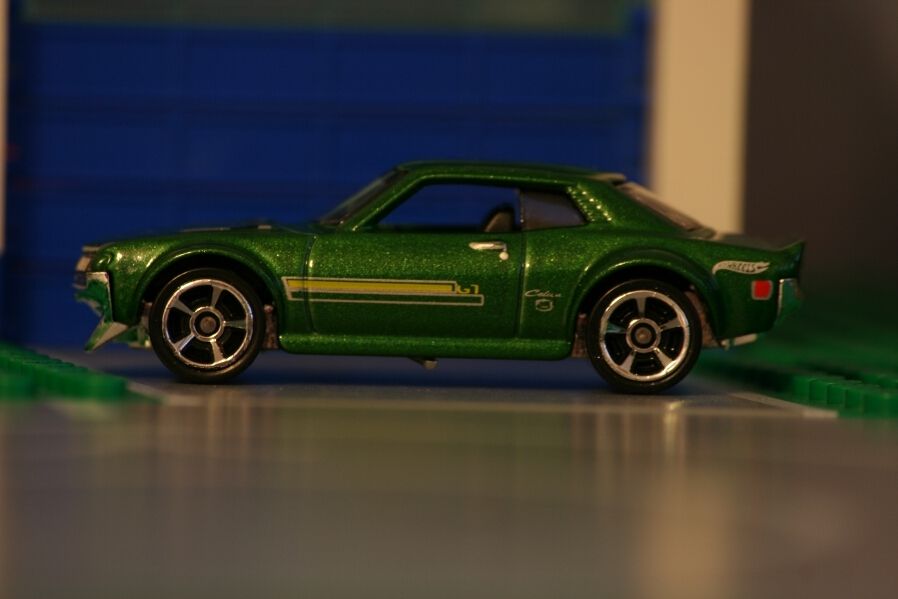
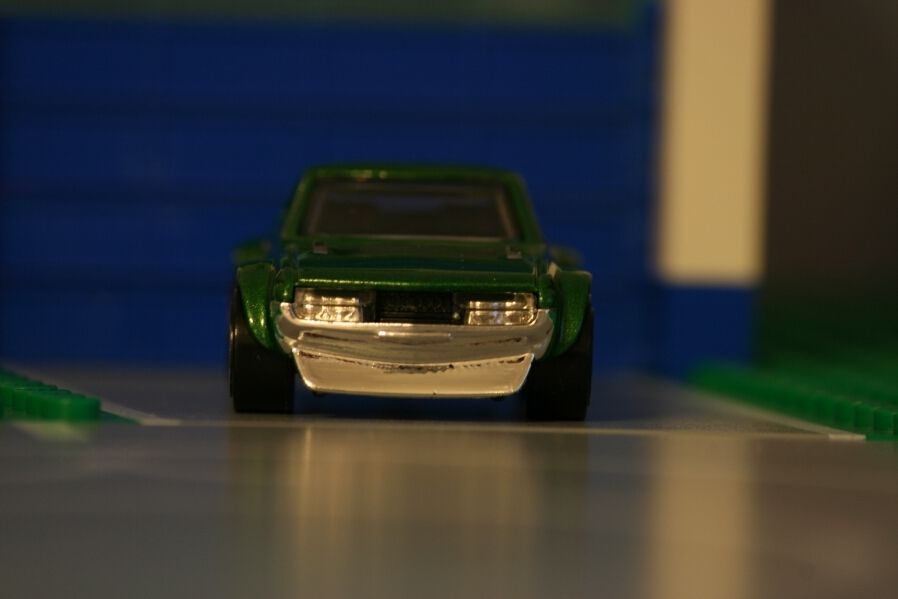
Today's Car of the Day is from Jedmimario's collection and is the Hot Wheels' 1970 Toyota Celica GT.
Wikipeida.com
Displayed at the October 1970 Tokyo Motor Show[3] and marketed in December of the same year, the Celica was a personal car that emphasized styling and driving enjoyment. Japanese models were ET, LT, ST, GT, and GTV (which was introduced in 1972, the V standing for Victory). The platform was shared with the Toyota Carina, a vehicle exclusive to Toyota Store Japanese dealerships.
For export markets, the Celica was offered in three different levels of trim; LT, ST and GT.
For more information about the real car check out http://en.wikipedia.org/wiki/Toyota_Celica
This is the latest from what is probably my favorite theme in the current Hot Wheels line: 70-80s Japanese sports cars. This one, similar to this others, is done up in period racing modifications with exaggerated fender flares and a low front spoiler. Distinctly, though, it retains factory trim and decals. A great little model with jeweled lights. The proportions aren't quite perfect and the wheels on the large size, but the casting gets the job and has loads of charm.
Saturday, June 30, 2012
Car Of The Day: June 30, 2012
Today's car of the day comes from juantoo3's collection and is Playart's 1971 Toyota Celica.
The Toyota Celica name has been applied to a series of coupes made by the Japanese company Toyota. The name is ultimately derived from the Latin word coelica meaning "heavenly" or "celestial".
Throughout its life span the Celica has been powered by various four-cylinder engines. The most significant change occurred in August 1985, when the car's drive layout was changed from rear wheel drive to front wheel drive. During the first three generations, American market Celicas were powered by various versions of Toyota's R series engines. The four-wheel drive turbocharged model (designated All-trac in the United States or GT-Four elsewhere) was produced from 1986 to 1999. Variable Valve Timing came in late 1997 Japanese models, and became standard in all models from 2000 on. Through seven generations, the model has gone through many revisions and design forks, including the Toyota Celica Supra (later known as the Toyota Supra). The Celica was available as notchback and liftback coupes, as well as a convertible.
For more information and pictures of the real car please visit: Toyota Celica
The first generation Celica was released to the Japanese market intended to be a more affordable alternative to Toyota's sportscar, the 2000GT. The car's platform was shared with the Toyota Carina yet sold at a different dealership sales channel called Toyota Corolla Store. The Carina was sold at Toyota Store locations. The Celica was also positioned above the Corolla Levin, also sold at Toyota Corolla Store (the Corolla Levin was not a hardtop, the Celica was).
Displayed at the October 1970 Tokyo Motor Show and marketed in December of the same year, the Celica was a personal car that emphasized styling and driving enjoyment. Japanese models were ET, LT, ST, GT, and GTV (which was introduced in 1972, the V standing for Victory).
For export markets, the Celica was offered in three different levels of trim; LT, ST and GT.
At its introduction the Celica was only available as a pillarless hardtop notchback coupe. The SV-1 liftback was shown as a concept car at the 1971 Tokyo Motor Show. With slight modifications, this was introduced in Japan in April 1973 as the 2-litre RA25 and 1.600 L TA27 liftbacks. It was then exported to Europe in RHD form as the 1.6-litre liftback. After the October 1975 facelift, it was available in both RHD and LHD forms in other markets. The RV-1 wagon was also shown at the 1971 Tokyo Motor Show but it did not reach production.
The Japanese GT models had various differences from the ET, LT and ST including the hood flutes, power windows, air conditioning, and specific GT trim, but shared a few things with the ST - a full-length center console and oil pressure/ammeter gauges while the LT had warning lights for these functions.
There was also the GTV version, which differed from the GT with a slightly cut-down interior, and did not come standard with things like power windows, but they were optional. The GTV has firmer suspension.
The first generation Celicas can be further broken down into two distinctive models. The first of these was the original with slant nose (trapezoid-like shape front corner light). This is for Coupe model only, TA22, RA20, and RA21. These models were released from 1970 to 1975 and came equipped with the 2T, 2T-G 1.6-liter, or 18R 2.0-liter motor. They had a 95 inches (2,400 mm) wheelbase. The second series (98 in or 2,500 mm wheelbase) had a flat nose (square front corner light) and slightly longer wheelbase, and was known in Europe as the TA23. This facelift model appeared in Japan in 1974, but for export was the 1976 model year. The Japanese version had engines under 2.0 liters so as to conform to Japanese regulations concerning engine displacement size, thereby allowing buyers to avoid an additional tax for a larger engine.
In some markets, the lower-end LT was equipped with the single carbureted four-cylinder 2T engine displacing 1,600 cc, while the ST came with a twin downdraft-carburetor 2T-B engine. The 2T-G that powered the high-end GT model was a DOHC 1,600 cc engine equipped with twin Mikuni-Solex Carburetors.
The first Celica for North America, 1971 ST was powered by 1.9-liter 8R engine. The 1972-1974 models have 2.0-liter 18R-C engines. For 1975-77, the engine for the North American Celica is the 2.2-liter 20R. The Celica GT and LT models were introduced in the U.S. for the 1974 model year. The top-line GT included a 5-speed manual transmission, rocker panel GT stripes, and styled steel wheels with chrome trim rings. The LT was marketed as an economy model. Mid-1974 saw minor changes in the Celica's trim and badges and slightly different wheel arches. The A30 automatic transmission became an option on North American ST and LT models starting in the 1973 model year. For 1975, the 1974 body was used, but body-color plastic fascia and sturdier chrome and black rubber bumpers, replaced the chrome bumpers used in the earlier cars (in accordance with US Federal bumper laws). Unfortunately the early 8R and 18R series engines proved to be less than durable, with early failures common. The 1974 18R-C engine's durability was improved somewhat, but the 20R introduced for 1975 proved to be a better engine in most respects.
Saturday, June 16, 2012
Car Of The Day: June 16, 2012
Today's car of the day comes from craftymore's collection and is Maisto's 2005 Toyota Celica GTS.
The Toyota Celica name has been applied to a series of sports compact coupes made by the Japanese company Toyota. The name is ultimately derived from the Latin word coelica meaning "heavenly" or "celestial".
Throughout its life span the Celica has been powered by various four-cylinder engines. The most significant change occurred in August 1985, when the car's drive layout was changed from rear wheel drive to front wheel drive. During the first three generations, American market Celicas were powered by various versions of Toyota's R series engines. The four-wheel drive turbocharged model (designated All-trac in the United States or GT-Four elsewhere) was produced from 1986 to 1999. Variable Valve Timing came in late 1997 Japanese models, and became standard in all models from 2000 on. Through seven generations, the model has gone through many revisions and design forks, including the Toyota Celica Supra (later known as the Toyota Supra). The Celica was available as notchback and liftback coupes, as well as a convertible.
In late 1999, Toyota began production and sales of the seventh generation Celica. It closely resembled the XYR concept with the exception of the front bumper and rear spoiler. The 2000 model year Celica was an element of Toyota Project Genesis, an effort to bring younger buyers to the marque in the United States. Toyota took time to lighten the car and lower cost whenever possible. Power window and door lock controls were placed in the center console so only 1 set was necessary for both doors. Initial moonroofs were made of polymer plastic instead of the traditional glass.
In the US and Canada, two models were offered; the base model GT and the sportier GT-S. All models are in liftback only body shape. In the interest of light weight, optional sunroofs were polymer plastics instead of glass. In later models, the sunroofs were made of glass, probably for cost reasons. All models featured dual front airbags, daytime running lights (DRL) with auto-on parking and headlights, and 4 cup holders; two in the front and two in the rear. Rear seats were contoured for only 2 passengers and can split down 50/50 to increase cargo capacity. Two-speed front wipers had variable intermittent adjustment. The rear wiper had a single speed and fixed intermittent speed. Windshield and rear window washers were also standard. Options include ABS, rear spoiler, fog lights, HID low beam headlights, upgraded JBL stereo system, 6-disc CD changer, leather seat surfaces, side-impact airbags, floor mats, vehicle intrusion protection (VIP) alarms with door lock/unlock feature, cargo net, and hatchback cargo cover. The Celica had a center-mounted stack for the windows and locks to make it cheaper for young buyers.
The GT-S was powered by the 2ZZ-GE engine rated at 180 bhp (134 kW; 182 PS) at 7600 rpm and 133 lb·ft (180 N·m) torque at 6800 rpm. The engine featured Toyota’s VVTL-i (Variable Valve Timing and Lift control with intelligence). A second stage valve lift control for intake was added to the variable intake cam phase timing. This is similar to Honda’s VTEC but was more advanced because of the variable phase timing that Honda had not yet released (i-VTEC). Variants of this engine were offered in the Matrix XRS, Corolla XRS and the Lotus Elise (with a Lotus ECU which added 10 bhp). Buyers had the option of a 4-speed automatic or 6-speed manual transmissions. The base tire size was 205/55/15 but the optional size offered was 205/50/16. The tire upgrade was merely US$42 so most GT-S models had the optional wheels and tires. All GT-S models had 4-wheel disc brakes and metal pedals. Manual transmission shifters and all steering wheels were upgraded to leather. Hatchback cargo covers were standard along with fog lights for models without the “Action Package.”
Imagine for a moment if Ford discontinued their iconic car, the Mustang. It might send the entire brand in a downward spiral image wise. I think in a highly simplified statement this occurred with Toyota after discontinuing the Celica upon the end of the 7th generation in 2006. Instead of designing a new Celica, Toyota launched a new youth aimed brand called Scion and released the tC in 2005. In my view, Toyota never recovered image wise from this move.
Monday, December 26, 2011
Car Of The Day: December 26, 2011
Today's car of the day is Jada's 2001 Toyota Celica.
The Toyota Celica name has been applied to a series of coupes made by the Japanese company Toyota. The name is ultimately derived from the Latin word coelica meaning "heavenly" or "celestial".
Throughout its life span the Celica has been powered by various four-cylinder engines. The most significant change occurred in August 1985, when the car's drive layout was changed from rear wheel drive to front wheel drive. During the first three generations, American market Celicas were powered by various versions of Toyota's R series engines. The four-wheel drive turbocharged model (designated All-trac in the United States or GT-Four elsewhere) was produced from 1986 to 1999. Variable Valve Timing came in late 1997 Japanese models, and became standard in all models from 2000 on. Through seven generations, the model has gone through many revisions and design forks, including the Toyota Celica Supra (later known as the Toyota Supra). The Celica was available as notchback and liftback coupes, as well as a convertible.
For more information and pictures of the real car please visit: Toyota Celica
My love of Toyota Celicas and Supras is well-known. This generation is one of my favorites as the styling reminds me of the 1982-85 models. The previous generation Celica was too ugly for my tastes but this one fixed it nicely. And then Toyota went and killed it off and replaced it with the stupid Scion tC. This one arrived as a Christmas RAOK from James. Thanks!
In late 1999, Toyota began production and sales of the seventh generation Celica. It closely resembled the XYR concept with the exception of the front bumper and rear spoiler. The 2000 model year Celica was an element of Toyota Project Genesis, an effort to bring younger buyers to the marque in the United States. Toyota took time to lighten the car and lower cost whenever possible. Power window and door lock controls were placed in the center console so only 1 set was necessary for both doors. Initial moonroofs were made of polymer plastic instead of the traditional glass.
The Celica came in two different models. The ZZT230 was powered by a relatively economical 1.8 L 4-cylinder 140 hp (104 kW) 1ZZ-FE engine and the ZZT231 powered by a higher-performance 1.8 L 4-cylinder 190 hp (142 kW) (in Europe and Japan) 2ZZ-GE version, co-developed with Yamaha, the latter featuring a two-step variable valve lift control in conjunction with its variable valve timing. In 2004, CNNMoney.com rated the Celica as one of the best cars to purchase for gas mileage.
Exporting of the Celica ceased in July 2005. However until mid-May, customers could still order one, although it was advised they took action before that time ended. Outside of Japan, the Celica received a small restyling with new bumpers and headlamps, continuing its sales.
The last Celica was rolled off production line on April 21, 2006. In its last year, the Celica was only officially sold in Japan.
In the US and Canada, two models were offered; the base model GT and the sportier GT-S. All models are in liftback only body shape. In the interest of light weight, optional sunroofs were polymer plastics instead of glass. In later models, the sunroofs were made of glass, probably for cost reasons. All models featured dual front airbags, daytime running lights (DRL) with auto-on parking and headlights, and 4 cup holders; two in the front and two in the rear. Rear seats were contoured for only 2 passengers and can split down 50/50 to increase cargo capacity. Two-speed front wipers had variable intermittent adjustment. The rear wiper had a single speed and fixed intermittent speed. Windshield and rear window washers were also standard. Options include ABS, rear spoiler, fog lights, HID low beam headlights, upgraded JBL stereo system, 6-disc CD changer, leather seat surfaces, side-impact airbags, floor mats, vehicle intrusion protection (VIP) alarms with door lock/unlock feature, cargo net, and hatchback cargo cover. The Celica had a center-mounted stack for the windows and locks to make it cheaper for young buyers.
The GT was powered by the 1ZZ-FE rated at 140 bhp (104 kW; 142 PS) at 6400 rpm and 125 lb·ft (169 N·m) of torque at 4200 rpm. It uses Toyota’s VVT-i (Variable Valve Timing with intelligence) system which modulated the intake cam phase angle to increase torque and horsepower throughout the rev range. This is a similar engine used on the Matrix, Corolla, and MR2 Spyder. Buyers had the option of between a 4-speed automatic or 5-speed manual transmissions. The vehicles were shod with 195/60/15 tires with front disc brakes and rear drum brakes.
The GT-S was powered by the 2ZZ-GE engine rated at 180 bhp (134 kW; 182 PS) at 7600 rpm and 133 lb·ft (180 N·m) torque at 6800 rpm. The engine featured Toyota’s VVTL-i (Variable Valve Timing and Lift control with intelligence). A second stage valve lift control for intake was added to the variable intake cam phase timing. This is similar to Honda’s VTEC but was more advanced because of the variable phase timing that Honda had not yet released (i-VTEC). Variants of this engine were offered in the Matrix XRS, Corolla XRS and the Lotus Elise (with a Lotus ECU which added 10 bhp). Buyers had the option of a 4-speed automatic or 6-speed manual transmissions. The base tire size was 205/55/15 but the optional size offered was 205/50/16. The tire upgrade was merely US$42 so most GT-S models had the optional wheels and tires. All GT-S models had 4-wheel disc brakes and metal pedals. Manual transmission shifters and all steering wheels were upgraded to leather. Hatchback cargo covers were standard along with fog lights for models without the “Action Package.”
TRD USA offered performance upgrades such as lowering springs, dampers, anti-sway bars, brake disc pads, air filters, exhaust, short-shift kits (manual transmissions), and body kits. The exhaust offered an increase of 14 hp (10 kW), albeit mostly at higher RPM’s. A supercharger was also offered for the 1ZZ-FE engine however Toyota never marketed it directly for the Celica GT due to being too large to fit under the hood, The supercharger was available as an option for 2003-2004 Corolla and Matrix models. The most popular among buyers were the “Action Package” which offered a more pronounced front spoiler, rocker panels, a rear wing, and lower rear fascia extension. The revised front faring interfered with the mounting location for the standard factory fog lights, requiring them to be adjusted or removed when this option was added.
On the 2000, 2001, 2003 and 2004 GT-S models, the rev limiter is set to around 8200-8300 rpm (seems to differ vehicle-to-vehicle) while the 2002 and 2005 have it set to 7800 (left-hand drive markets only). This lower limiter on the 2002 and 2005 models reduces the available performance as the 2ZZ is primarily a high-revving engine, and it is more difficult for the driver to land in the 'lift' (aggressive cam) rev range on an upshift. This only affects the 6-speed manual transmission as the gearing is spaced to where shifting up at approximately 8,250 RPMs in any gear other than first gear will result in about 6,200 RPM after the shift, which is where "lift", or the aggressive cam, engages. This allows models without the limited RPM range to remain within the car's power band throughout the gears. First gear is excluded because the gearing ratio is much lower than 2nd gear. For 2003, minor updates were made to the car. The interior was mildly restyled, power antennae replaced the fixed one, the front and rear fascias were redone. In 2004, all models were fitted with a cabin air filter.
In July 2004, Toyota announced the Celica (as well as the MR2) would be discontinued in the United States at the end of the 2005 model year due to lack of sales. Celica sales hit 52,406 units in 2000, but dropped sharply to 14,856 in 2003. Just 8,710 Celicas were sold in 2004, and only 3,113 were sold in 2005. The sports coupe market, in general, was rapidly shrinking. The Subaru XT6, Nissan 240SX, Honda Prelude and Mazda RX-7 were already gone and the Acura RSX was soon to follow. In 2005, the Scion project released a spiritual successor for the North American market - the Scion tC.
Japanese models continued to carry SS-I and SS-II trim levels. The SS-I is powered by 1ZZ-FE engine, SS-II came with 2ZZ-GE engine. The SS-II also can be ordered with Super Strut Package with super strut suspension, rear strut bar, 16-inch alloys, metal pedals, and colored rocker panels. The SS-II has climate control AC with digital display. Options included the choice of the Elegant Sports Version with front lip spoiler and headlight covers, or the Mechanical Sports Version with full body kits. The JDM Celica was updated with minor changes in August 2002.
Toyota also released a limited-production version of the 7th generation called the TRD Sports M. This version was rated at 200 hp (149 kW) and featured a reinforced unibody and available TRD engine and suspension components. The Sports M was only sold in Japan.
Saturday, April 23, 2011
Car Of The Day: April 23, 2011
The Toyota Supra is a sports car/grand tourer that was produced by Toyota Motor Company from 1979 to 2002. The styling of the Toyota Supra was derived from the Toyota Celica, but it was both longer and wider. Starting in mid-1986, the Supra (in its third generation, Mark III) became its own model and was no longer based on the Celica. In turn, Toyota also stopped using the prefix Celica and began just calling the car Supra. Due to the similarity and past of the Celica's name, it is frequently mistaken for the Toyota Supra, and vice versa.
The Supra also traces much of its roots back to the Toyota 2000GT with the main instance being its engine. The first three generations were offered with a direct descendant to the Toyota Crown's and 2000GT's M engine. All four generations of Supra produced have an inline 6-cylinder engine. Interior aspects were also similar, as was the chassis code "A".
Along with this name and car Toyota also included its own logo for the Supra. It is derived from the original Celica logo, being blue instead of orange. This logo was used until January 1986, when the Mark III Supra was introduced. The new logo was similar in size, with orange writing on a red background, but without the dragon design. That logo, in turn, was on Supras until 1991 when Toyota switched to its current oval company logo. (the dragon logo was a Celica logo regardless of what color it was. It appeared on the first two generations of the Supra because they were officially Toyota Celicas. The dragon logo was used for the Celica line until it too was discontinued.)
In 1998, Toyota ceased sales of the Supra in the United States and in 2002 Toyota officially stopped production of the Supra in Japan.
As an iconic sports car, the Supra has appeared in numerous video games, movies, music videos and TV shows. Some of the most notable appearances include the Gran Turismo, Forza Motorsport, Need for Speed, and Midnight Club series of video games and the 2001 film, The Fast and the Furious.
For more information and pictures of the real car please visit: Toyota Supra
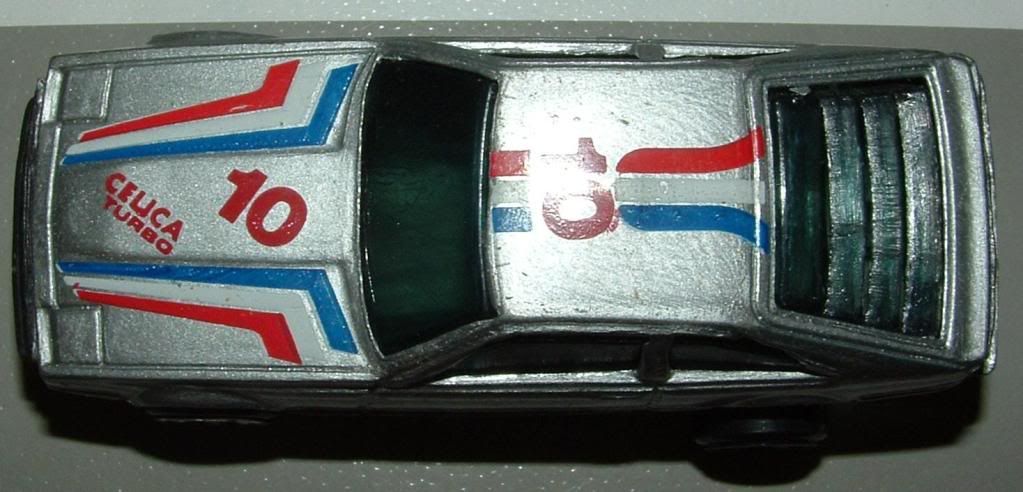
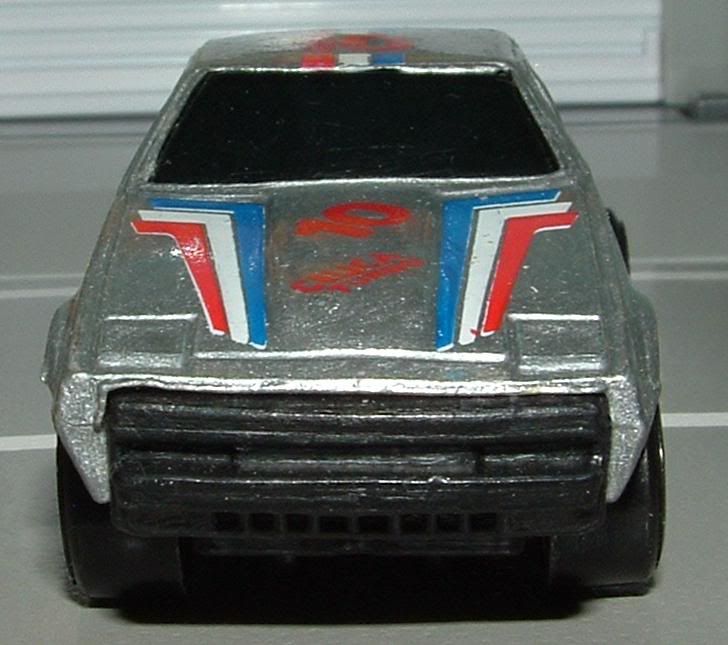
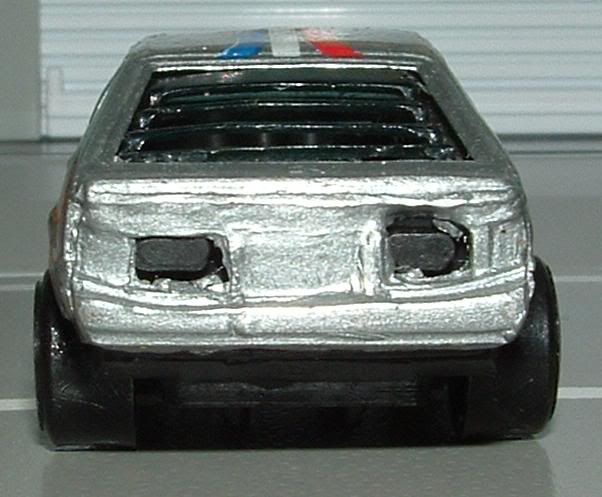
A recent acquisition from old442dude (thanks Eric!) this little Supra joined my collection at this past weekend's Keystone CARnival. Ignore the "turbo" on the hood as this generation Supra was not available with a turbo from the factory (though there were turbo kits available aftermarket). Turbo was a big deal in the '80s and diecast manufacturers from Summer to Hot Whhels quickly slapped "turbo" tampos on their models.
In 1981, Toyota completely redesigned the Celica Supra as well as the entire Celica lineup. In Japan, they were known as Celica XX, but everywhere else the Celica Supra name was used. Still being based around the Celica platform, there were several key differences, most notably the design of the front end and fully retractable pop-up headlights. Other differences would be the inline-6 still present in the Supra instead of the inline-4 as well as an increase in length and wheel base to conform with the overall larger engine. Toyota's continued market competition with Nissan is shown by the Supra's use of a rear hatch sun shade to avoid the louvres popularly associated with the Z car. Due to an increase in the Supra's width, it was no longer regarded as a "compact" under Japanese dimension regulations.
Sunday, November 28, 2010
Super Celica To Wing Car: Toyota Supras In Small Scale
In 1979 Toyota added an inline six cylinder to the Celica and named it the Celica Supra (or Celica XX in Japan). The Supra went through four generations before being discontinued in 2002.
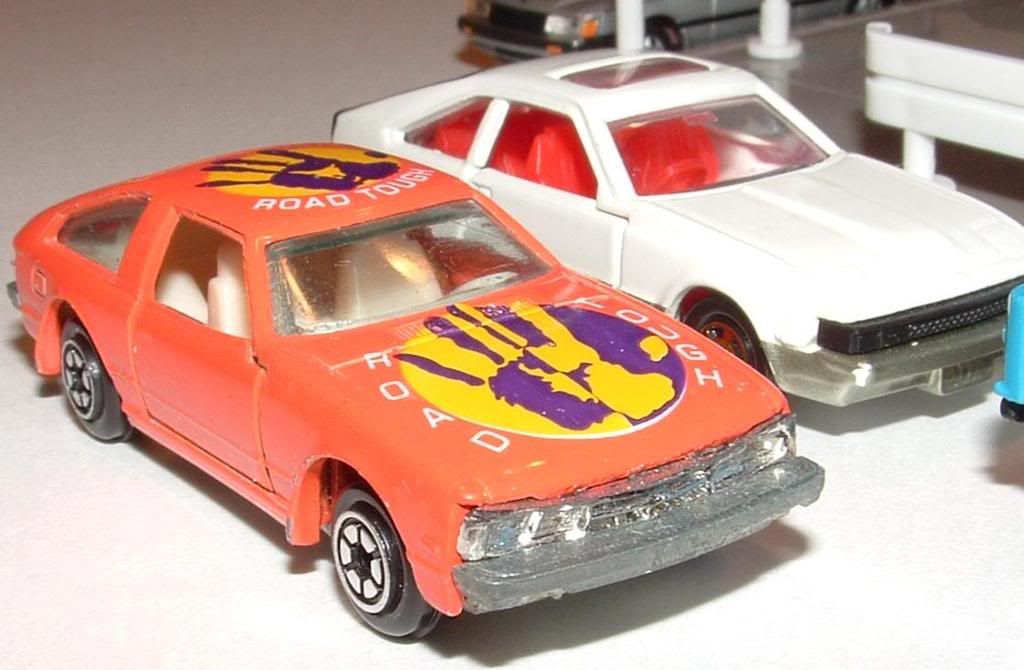
The first generation was from 1979-1981 and visually the cars were very similar to the Celica. The car was lengthened about 5 inches to accommodate the larger engine and there were a few other minor differences to tell them apart. This generation Supra was offered by Matchbox (as an XX) and Yat Ming. Tomica added a “Supra” sticker to their existing Celica casting, but this did not a Supra make.
Yat Ming MK I (in orange) & Tomica MK II (in white)
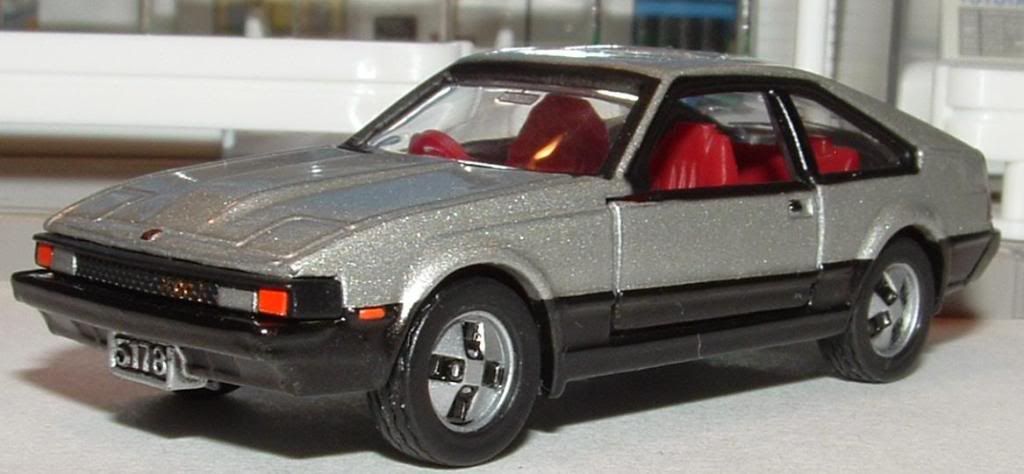
The second generation Celica Supra debuted in 1981 as a 1982 model. The Japanese models were still known as the Celica XX, but the car remained the Celica Supra in the rest of the world. The second generation Supra was differentiated from the Celica much more than the original car. In addition to having the front stretched to accommodate the larger engine, the cars share no body panels in front of the doors. The Supra had fully retracting headlights, a power bulge hood, and different (larger) taillights. This generation of Supra was very popular in small scale with models from Hot Wheels, Matchbox, Tomica, Welly, Yat Ming, Zylmex, Summer, and others. The Matchbox model featured an opening hatchback, while the Zylmex, Tomica, and Welly all had opening doors. The Welly is a copy of the Tomica, with added details including a switch from right hand drive to left hand drive.
Tomica Limited MK II XX
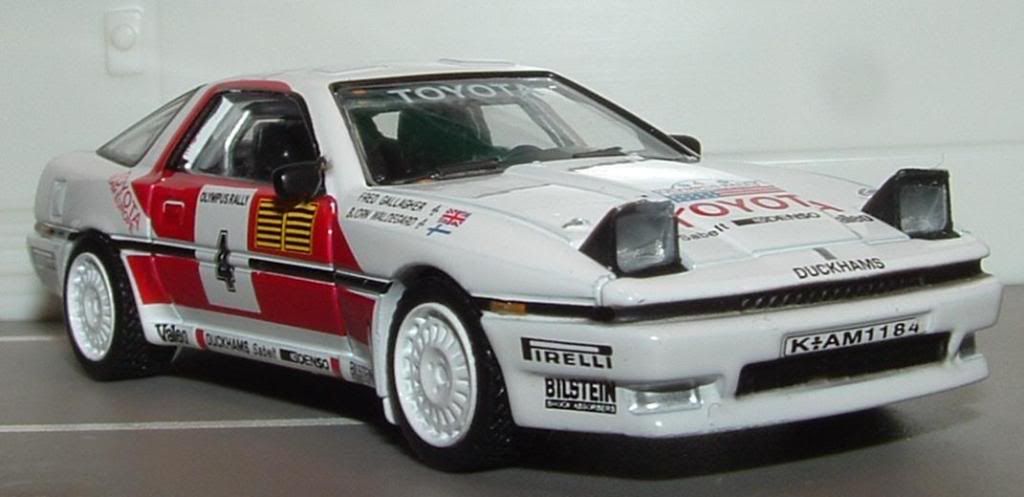
While the Celica was completely redesigned for 1986, and switched to front wheel drive, the Supra remained rear wheel drive, continuing on as the Celica Supra through mid year, when the third generation Supra was released. The MK III dropped the Celica moniker and retained rear wheel drive. While this was the best selling Supra generation, surprisingly, there are very few replicas in small scale. Tomica mocked up a prototype but it never entered production. Bluebox released an ’87 Supra with a cast over rear window, and in the early 2000s Summer released a highly stylized (and unlicensed) MK III also. The definitive MK III is CM’s rally car, however, a nice casting of a civilian MK III is a glaring omission in 1/64 scale. This would make a great candidate for a Tomica Limited Vintage Neo.
CM’s MK III rally
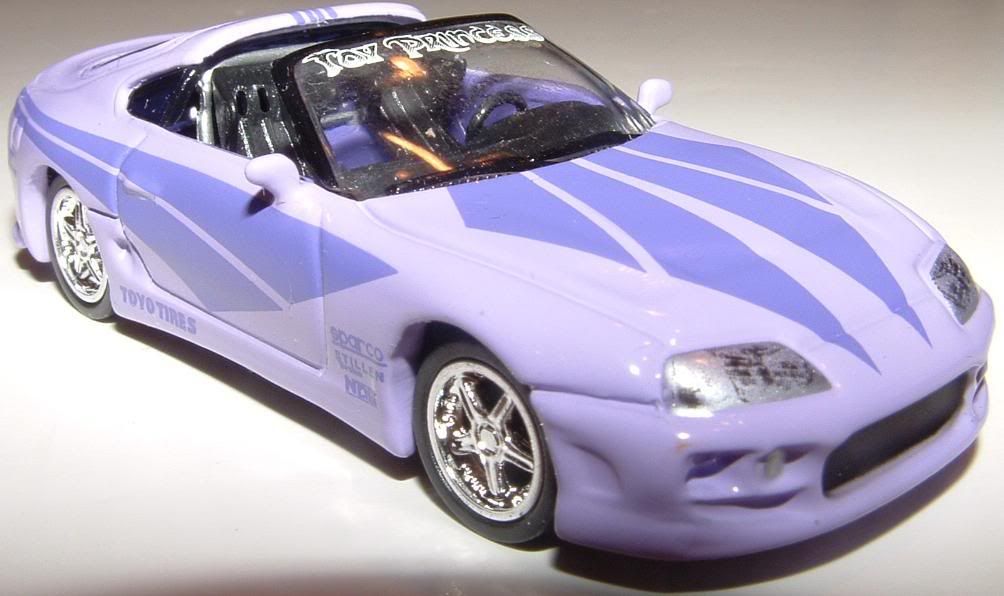
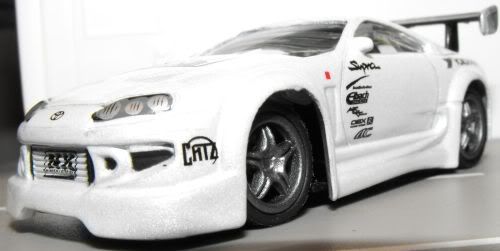
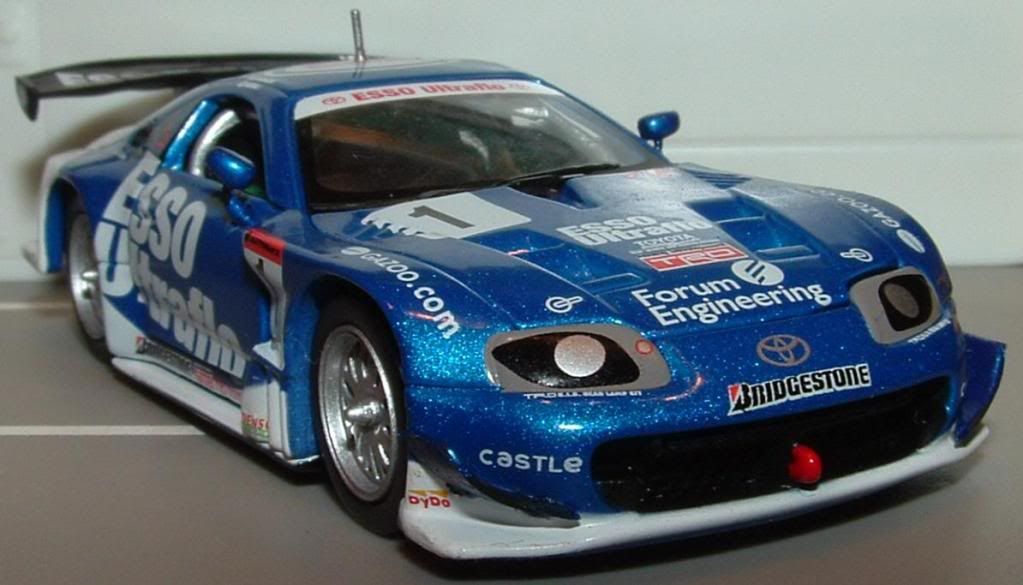
In 1993 the final generation of Supra debuted. The MK IV is usually considered the best of the breed by Supra enthusiasts, and is the first (and often only) Supra that comes to mind when someone hears the words. Pop-up headlights were gone, twin turbos were added, and a spoiler reminiscent of the Dodge Charger Daytona & Plymouth Roadrunner Superbird was standard (at least on the turbo models). The MK IV was replicated by Matchbox and Tomica when the car debuted, and a number of other manufacturers after it starred in “The Fast & The Furious”, among them Hot Wheels (the unlicensed “Super Tsunami”), Racing Champions, Jada, and Muscle Machines. Johnny Lightning was supposed to revive the Racing Champions casting but they eventually canceled the line of “Fast And Furious” cars they were planning to release when the latest movie came out.
Racing Champions MK IV
Muscle Machines MK IV
Muscle Machines MK IV JGTC
Matchbox MK IV
The first generation was from 1979-1981 and visually the cars were very similar to the Celica. The car was lengthened about 5 inches to accommodate the larger engine and there were a few other minor differences to tell them apart. This generation Supra was offered by Matchbox (as an XX) and Yat Ming. Tomica added a “Supra” sticker to their existing Celica casting, but this did not a Supra make.
Yat Ming MK I (in orange) & Tomica MK II (in white)
The second generation Celica Supra debuted in 1981 as a 1982 model. The Japanese models were still known as the Celica XX, but the car remained the Celica Supra in the rest of the world. The second generation Supra was differentiated from the Celica much more than the original car. In addition to having the front stretched to accommodate the larger engine, the cars share no body panels in front of the doors. The Supra had fully retracting headlights, a power bulge hood, and different (larger) taillights. This generation of Supra was very popular in small scale with models from Hot Wheels, Matchbox, Tomica, Welly, Yat Ming, Zylmex, Summer, and others. The Matchbox model featured an opening hatchback, while the Zylmex, Tomica, and Welly all had opening doors. The Welly is a copy of the Tomica, with added details including a switch from right hand drive to left hand drive.
Tomica Limited MK II XX
While the Celica was completely redesigned for 1986, and switched to front wheel drive, the Supra remained rear wheel drive, continuing on as the Celica Supra through mid year, when the third generation Supra was released. The MK III dropped the Celica moniker and retained rear wheel drive. While this was the best selling Supra generation, surprisingly, there are very few replicas in small scale. Tomica mocked up a prototype but it never entered production. Bluebox released an ’87 Supra with a cast over rear window, and in the early 2000s Summer released a highly stylized (and unlicensed) MK III also. The definitive MK III is CM’s rally car, however, a nice casting of a civilian MK III is a glaring omission in 1/64 scale. This would make a great candidate for a Tomica Limited Vintage Neo.
CM’s MK III rally
In 1993 the final generation of Supra debuted. The MK IV is usually considered the best of the breed by Supra enthusiasts, and is the first (and often only) Supra that comes to mind when someone hears the words. Pop-up headlights were gone, twin turbos were added, and a spoiler reminiscent of the Dodge Charger Daytona & Plymouth Roadrunner Superbird was standard (at least on the turbo models). The MK IV was replicated by Matchbox and Tomica when the car debuted, and a number of other manufacturers after it starred in “The Fast & The Furious”, among them Hot Wheels (the unlicensed “Super Tsunami”), Racing Champions, Jada, and Muscle Machines. Johnny Lightning was supposed to revive the Racing Champions casting but they eventually canceled the line of “Fast And Furious” cars they were planning to release when the latest movie came out.
Racing Champions MK IV
Muscle Machines MK IV
Muscle Machines MK IV JGTC
Matchbox MK IV
Subscribe to:
Posts (Atom)