Showing posts with label Cadillac. Show all posts

Saturday, August 11, 2012

Car Of The Day: August 11, 2012


Today's car of the day comes from craftymore's collection and is Yat Ming's 1976 Cadillac Fleetwood Brougham.


The Fleetwood Metal Body Company began business in Fleetwood, Pennsylvania on April 1, 1909 and continued as an independent automobile body builder until acquired in 1925 by the Fisher Body Company, a division of General Motors. The company continued in Fleetwood until 1931 at which time General Motors moved the entire operation to Detroit.

Long before acquisition by Fisher Body Company, the Fleetwood Metal Body Company had established its reputation as a builder of fine wood and aluminum auto bodies. Its built-to-order product was sought after by many notable people in the U.S. and abroad, some of whom were royalty from India and Japan, presidents of Poland and the United States, and well-known American movie idols. One specimen, built for silent screen star Rudolph Valentino, was recently on sale for $1,600,000.00.

"Unique" was the magic word that attracted the wealthy. One could purchase a chassis with wheels and motor from the best builders abroad, Isotta Fraschini, Bentley, Mercedes, Rolls-Royce or Fiat. American makers were Duesenberg, Packard, Cadillac, Pierce-Arrow or Stutz. There were also Reading makers of the S.G.V., the Chadwick and Daniels. The purchased chassis with engine and wheels was shipped to Fleetwood while the purchaser met with one of the company’s designers, usually in New York, to put onto a drawing the customer’s ideas of what the finished design should be. Once accepted, the plans were sent to Fleetwood where the body would be created, mounted on the chassis and finished in the colors, upholstery, and appointments chosen by the new owner. The car was “unique” to the likes of the proud possessor.
Eventually, under Fisher’s directives, the company also made production models with the celebrated Fleetwood name. General Motors most notable Cadillac model was the “Fleetwood” until it was recently discontinued.

The Fleetwood name was used on the top of the Cadillac line since 1927. In 1946, Cadillac created a special version of the Series 60 Special called the "Series 60 Special Fleetwood". The Fleetwood name was then used to designate the top of the line trim of the Series 70 and Sixty Special models through 1976.
In 1972, Cadillac refocused the Fleetwood name. The Fleetwood Limousine carried on from the Fleetwood Seventy-Five, while the Fleetwood Brougham took over where the Sixty Special was positioned.


The beginning of the end of the largest of all GM production cars was realized with the introduction of the 1971 B/C/D body cars. Cadillac remained exclusive to the D body for the Deville and Fleetwood with a wheelbase stretching to a lengthy 130 inches (3,300 mm). Engines grew to cubic inches not seen since the end of these massive cars, displacing 472 (7.7L) and finally 500 (8.2L) cubic inches. Unfortunately hp and torque levels plummeted with ever increasing EPA restrictions on tailpipe emissions and grams per mile emissions requirements, forcing gear ratios to taller and taller ratios, dropping to as low as 2.41:1.
1971 also saw the consolidation of the GM full size car lines to a new common frame/suspension design, shared by the Chevrolet Caprice/Impala/Bel Air, Buick LeSebre/Electra, Oldsmobile 88/98, Pontiac Catalina/Bonneville, and the Cadillac Sedan Deville/Coupe Deville and Fleetwood. While the other GM divisions used a front-steer setup (steering linkage in front of the engine crossmember), all Cadillac RWDs retained the 1961-vintage front suspension (rear steering linkage, eccentric cams in the steering knuckle in lieu of shims, strut rods attached to the framerails for caster adjustment). Rear suspsensions were now driven by the Pontiac designed 8 7/8" (8.875") ring gear 10 bolt salisubury live axle.


A new trailer towing package was added for the 1971-1976 model run allowing larger than ever trailers to be towed by Cadillac owners. Coupled with heavy duty cooling, 3.23 gearing, high output 80 amp large frame alternator and Heavy Duty THM400 transmission, the long wheelbase was ideal to pull trailers weighing up to 7,000 lb (3,200 kg).


If you needed a 5,000 pound car with a 133" truck like wheelbase and four doors, the '76 Caddy Fleetwood was your ride to destiny. This was the longest and biggest mainstream production car that was ever sold by Cadillac as 1977 would introduce the down sized full size models from GM across the Chevrolet, Buick, Oldsmobile, Pontiac and Cadillac brands.

Tuesday, May 8, 2012

Car Of The Day: May 8, 2012


Today's car of the day comes from Derby Driver 60's collection and is Matchbox's 2010 Cadillac CTS.


At the 2008 Pebble Beach Concours d'Elegance, Cadillac presented the 2010 CTS Sport Wagon. The wagon became available in late 2009. The car is the first non-hearse Cadillac station wagon to be sold in the U.S. market.

The CTS Sport Wagon is available in either rear-wheel-drive or all-wheel-drive layouts, and is powered by either a 3.0-liter DOHC V6 engine, or a 3.6-liter V6 with variable valve timing. The 3.0-liter engine produces 270 horsepower and the 3.6-liter produces 304. The wagon is available with only a six-speed automatic. (except the CTS-V wagon, which is available with a manual transmission).
The car is made for primarily the European market, where in some countries, wagons are preferred to sedans.


For more information and pictures of the real car please visit: Cadillac CTS

Sunday, February 19, 2012

Car Of The Day: February 19, 2012


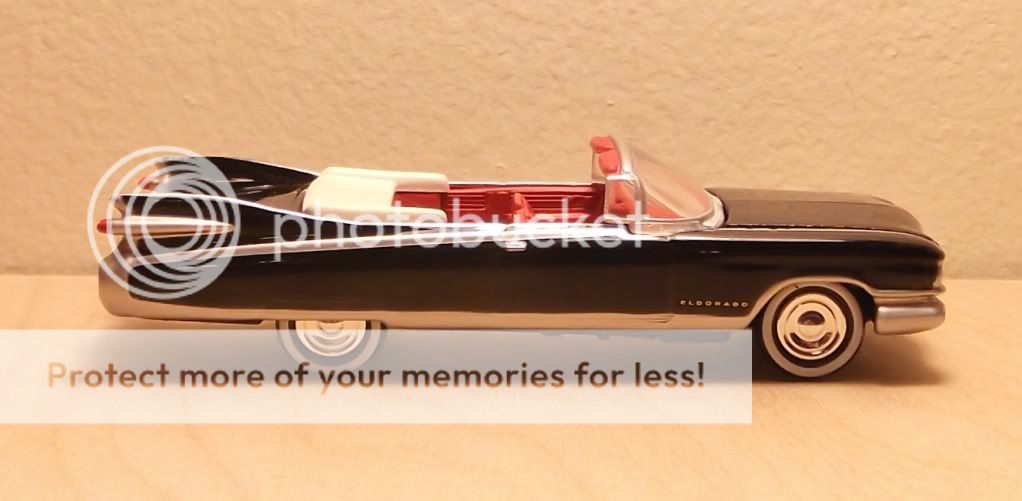
Today's car of the day comes from Firehawk73's collection and is Johnny Lightning's 1959 Cadillac Eldorado.


The Eldorado model was part of the Cadillac line from 1953 to 2002. The Cadillac Eldorado was the longest running American personal luxury car as it was the only one sold after the 1999 model year. Its main competitors included the Lincoln Mark Series and the lower-priced Buick Riviera.
Although cars bearing the name varied considerably in body style and mechanical layout during this long period, the Eldorado models were always near the top of the Cadillac line. Nevertheless, and except for the Eldorado Brougham models of 1957–1960, the most expensive models were always the opulent, long wheel-based Series 75 sedans and limousines, not the Eldorado.


For more information and pictures of the real car please visit: Cadillac Eldorado


A different Eldorado Brougham was sold for 1959 and 1960. These cars were not quite so extravagantly styled but were very unusual pieces in themselves. Priced at $13,075, they cost $1 more, each, than their older siblings. The design was 100% Cadillac but the company contracted out the assembly to Pininfarina of Italy, with whom the division has had a long-running relationship, and these Eldorados were essentially hand-built in Italy. Discreet, narrow taillights integrated into modest tailfins, and a squared-off rear roof line caused the Italian-built Brougham to contrast sharply to the rounded roof lines, and especially the new "rocketship" taillights and flamboyant fins of the standard 1959 Cadillacs, which are a feature only of that year. The Brougham's styling cues would prove to indicate where standard Cadillac styling would head from 1960 through the early-mid 1960s. The Brougham build-quality was not nearly to the standard of the Detroit hand-built 1957–1958 models, and thus the 1959–1960 Broughams did not sell as well as their forebears. However, collector interest and values for these cars remain high. The Eldorado Brougham was moved to its own unique Series 6900 for its remaining two years.

Both the Eldorado Biarritz and Eldorado Seville were their own separate Series 6400 for 1959 and 1960. The last Eldorado Seville was built in 1960.

Saturday, January 21, 2012

Car Of The Day: January 21, 2012


Today's car of the day is Yat Ming's 1980 Cadillac Seville Elegante.


The Cadillac Seville is a luxury-type car that was manufactured by the Cadillac division of American automaker General Motors from 1975 to 2004, as a smaller-sized top-of-the-line Cadillac. The name of "Cadillac's first small car" was selected over a revival of LaSalle and the GM design staff's preference, LaScala, primarily because, notes GM Marketing Director Gordon Horsburgh, "It had no negatives."


For more information and pictures of the real car please visit: Cadillac Seville


Another childhood survivor, this one shows a little more wear and tear than the Chevy stock car featured a few days ago.  The rear suspension is sagging and the paint is chipped, but very likely due to this model (and the Hot Wheels) this remains my favorite Cadillac model of all time.  Nothing else on the road looked like this- even the imitators from Lincoln and Chrysler toned down the bustleback on their respective Continental and Imperial.  Gorgeous design, but one has to think that trunk space suffered, which may explain why this styling trend did not continue.


For the 1980 model year, Cadillac moved the Seville to the 114 in (2,900 mm) wheelbase K-body, based on the front-wheel drive E-body Eldorado, Buick Riviera and Oldsmobile Toronado. Returning to some of the original concepts floated for the 1975 edition (the March 2008 issue of Collectible Automobile featured an early concept of what evolved into the downsized 1977 Cadillac DeVilles and Fleetwoods — one of the concepts which was withdrawn looks similar to the second-generation Seville), The rear styling was intended to invoke the look of Daimlers of a past era (though British Leyland were building cars with this feature even then). In the U.S., The bustle-back styling was imitated by the 1982–1987 Lincoln Continental sedan, and the 1981–1983 Chrysler Imperial coupe.

The new model, one of the last vehicles designed by GM's Bill Mitchell, featured front-wheel drive and independent rear suspension. The Seville initiated features that would become more traditional in later years. In 1981, "memory seats" — a feature not seen on a Cadillac since the Eldorado Broughams of the late 50's — became available again. This option allowed two memorized positions to be recalled at the touch of a button. Also for 1981 was a digital instrument cluster. The "Cadillac Trip Computer" was a precursor to this option in 1979. For the '81-'85 Seville and Eldorado, it was considerably less expensive, at US$200 in '81, and did not contain the many features of Trip Computer, but rather, just a digital speedometer and fuel gauge. "Puncture-sealing" tires were also new for '81. In 1982, Seville offered heated outside rear-view mirrors with the rear defogger option. Inside, a "Symphony Sound" stereo tape system was available. For 1983, a new "Delco/Bose" stereo cassette system was offered at US$895. It featured a brushed gold-look front panel and bulbous lower interior door speaker assemblies giving almost an aftermarket installation look to the system. This was also the last year for the availability of an 8-track stereo system for Seville. On the outside, Seville was available with a "Full Cabriolet Roof" treatment option, which gave Seville the dashing look of a four-door convertible. Cadillac may have provided this due to the popularity of a similar option, available since 1979, on the Lincoln Continental automobiles and Cadillac's own "Phaeton" series of De Ville models in 1978 and 1979.

In hip hop culture, this generation of Sevilles were known as "slantbacks." Sales were respectable at first, but disastrous experimentation with diesel engines (an Oldsmobile sourced 5.7 V8, plagued with head gasket problems) and the ill-fated 1981 V8-6-4 variable displacement engine (1980s technology could not make it work reliably), along with poor quality control and lackluster performance from engines severely detuned to meet more stringent CAFE standards, began to erode the Seville's standing in the marketplace. A new but underpowered 4.1 liter V8 was fitted to post-1981 models. It was prone to the block becoming porous and coolant mixing with the oil, resulting in catastrophic engine failure. Some later cars were also fitted with the 4.1 liter Buick-derived V6, which was a reliable enough engine, but was not designed for fitment to "full size" cars, and performance was rather lacking.

Sunday, December 25, 2011

Car Of The Day: December 25, 2011


Today's car of the day is Hot Wheels' 2003 Cadillac Sixteen.


The Cadillac Sixteen was a prototype of a stylish and high performance automobile first presented by Cadillac in 2003.

The vehicle was equipped with a 32-valve V16 concept engine displacing 13.6 liters (~830 cu. in) and was mated to a four-speed, electronically controlled, automatic transmission driving the rear wheels. The engine featured fuel-saving Active Fuel Management technology, much improved from its notorious ancestor, debuting in 2004 on some 2005 GM models. On the Sixteen, it would seamlessly shut down twelve cylinders in light driving, eight during strenuous driving, and only awaken the entire engine under full acceleration. With this type of system, the engine was capable of 20 mpg Imperial under normal conditions. The engine was said to produce 1,000 horsepower (750 kW) using no form of forced induction. The car itself weighs about 2,270 kilograms (5,000 lb).


For more information and pictures of the real car please visit: Cadillac Sixteen


This is 2011's custom Christmas RAOK from Ivantt (thanks Ivan!).  I've liked this concept car since it came out, and I have most of the regular releases of this one.  I don't know which is more a sign of what was wrong with the "old GM" (and by some accounts, is still wrong with the current GM also): the fact that they designed this car that would be almost impossible to produce profitably; or the fact that they didn't put it into production because this is exactly the kind of car that has been missing in the USA since the 1950s (it could be argued back to the 1930s).  The last American-made ultra luxury car I can think of was the Continental MK II.  Before that we have to go back to the Depression and the three P's (Packard, Pierce-Arrow, and Peerless).  Packard cheapened themselves to be more mainstream to survive the Depression (it worked) while the other two were gone before World War II started.  If Cadillac wants to seriously threaten the German luxury brands, they need to build something like this.  Sure, they need to keep building the cars they're making too, as those will sell much better and remain the company's bread& butter, but something like this acts as a halo model generating traffic into showrooms and perception of the brand as a whole.  They need to get people to start thinking "Sixteen" and less "Cimarron".


The car was conceptually related to the Cadillac V-16 of the 1930s. The actual design of the car was a combination of Cadillac's current "Art and Science" design theme and 1967 Cadillac Eldorado cues. Additional original design elements were provided by an in-house design competition led by GM Vice President Robert Lutz. The Sixteen has the Cadillac logo carved out of solid crystal on the steering wheel and a Bulgari clock on the dashboard.

Although the Sixteen fell short (narrowly, by some accounts) of production approval, its legacy is alive in Cadillac's future product planning. The subsequent generation of Cadillac products, particularly the revised CTS, have incorporated elements of the Sixteen's design. A scaled-down version of the car, referred to as the ULS (Ultra Luxury Sedan) or XLS, with a standard V8 and an optional V12, has been rumored for production since 2005, but was shelved in favor of the Cadillac XTS.

Sunday, August 14, 2011

Car Of The Day: August 14, 2011


Today's car of the day is Hot Wheels' 1980 Cadillac Seville.


The Cadillac Seville is a luxury-type car that was manufactured by the Cadillac division of American automaker General Motors as a limited production specialty model in the 1950s and 1960s. It was usually second in the Cadillac lineup after the top-of-the-line Eldorado. The Eldorado line was more focused on technology than the sales-leader Deville. The Seville was the two-door hardtop body style of the Eldorado line, while the Eldorado Biarritz was the convertible.

Reintroduced as a regular production vehicle from 1975 to 2004, the Seville was a smaller-sized top-of-the-line Cadillac.

The name of "Cadillac's first small car" was selected over a revival of LaSalle and the GM design staff's preference, LaScala, primarily because, notes GM Marketing Director Gordon Horsburgh, "It had no negatives."


For more information and pictures of the real car please visit: Cadillac Seville


Here's one of my childhood survivors- this one came out in okay condition.  Looks like it could use a bath as the close-ups show more dirt than the naked eye does.


For the 1980 model year, Cadillac moved the Seville to the 114 in (2,900 mm) wheelbase K-body, based on the front-wheel drive E-body Eldorado, Buick Riviera and Oldsmobile Toronado. Returning to some of the original concepts floated for the 1975 edition (the March 2008 issue of Collectible Automobile featured an early concept of what evolved into the downsized 1977 Cadillac DeVilles and Fleetwoods — one of the concepts which was withdrawn looks similar to the second-generation Seville), The rear styling was intended to invoke the look of Daimlers of a past era (though British Leyland were building cars with this feature even then). In the U.S., The bustle-back styling was imitated by the 1982–1987 Lincoln Continental sedan, and the 1981–1983 Chrysler Imperial coupe.

The new model, one of the last vehicles designed by GM's Bill Mitchell, featured front-wheel drive and independent rear suspension. The Seville initiated features that would become more traditional in later years. In 1981, "memory seats" — a feature not seen on a Cadillac since the Eldorado Broughams of the late 50's — became available again. This option allowed two memorized positions to be recalled at the touch of a button. Also for 1981 was a digital instrument cluster. The "Cadillac Trip Computer" was a precursor to this option in 1979. For the '81-'85 Seville and Eldorado, it was considerably less expensive, at US$200 in '81, and did not contain the many features of Trip Computer, but rather, just a digital speedometer and fuel gauge. "Puncture-sealing" tires were also new for '81. In 1982, Seville offered heated outside rear-view mirrors with the rear defogger option. Inside, a "Symphony Sound" stereo tape system was available. For 1983, a new "Delco/Bose" stereo cassette system was offered at US$895. It featured a brushed gold-look front panel and bulbous lower interior door speaker assemblies giving almost an aftermarket installation look to the system. This was also the last year for the availability of an 8-track stereo system for Seville. On the outside, Seville was available with a "Full Cabriolet Roof" treatment option, which gave Seville the dashing look of a four-door convertible. Cadillac may have provided this due to the popularity of a similar option, available since 1979, on the Lincoln Continental automobiles and Cadillac's own "Phaeton" series of De Ville models in 1978 and 1979.

In hip hop culture, this generation of Sevilles were known as "slantbacks." Sales were respectable at first, but disastrous experimentations with diesel engines (an Oldsmobile sourced 5.7 V8, plagued with head gasket problems) and the ill-fated 1981 V8-6-4 variable displacement engine (1980s technology could not make it work reliably), along with poor quality control and lacklustre performance from engines severely detuned to meet more stringent CAFE standards, began to erode the Seville's standing in the marketplace. A new but underpowered 4.1 litre V8 was fitted to post-1981 models. It was prone to the block becoming porous and coolant mixing with the oil, resulting in catastrophic engine failure. Some later cars were also fitted with the 4.1 litre Buick-derived V6, which was a reliable enough engine, but was not designed for fitment to "full size" cars, and performance was rather lacking.