Friday, April 8, 2011

Car of the Day:April 9, 2010


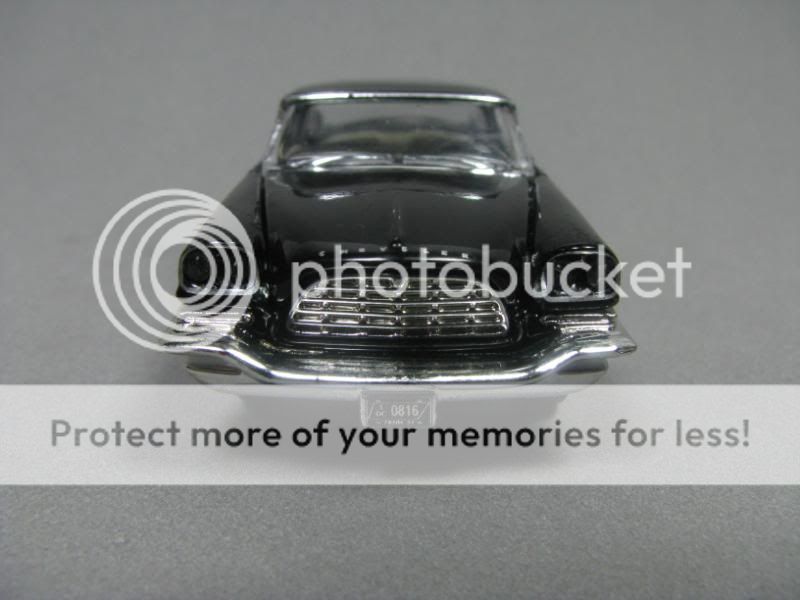
Today's car is the ERTL 1957 Chrysler 300C.


The Chrysler 300 "letter series" were high-performance luxury cars built in very limited numbers by the Chrysler Corporation in the U.S. from 1955-1965. Each year's model used a new letter of the alphabet as a suffix (skipping "i"), reaching 300L by 1965, after which the model was dropped.

The 300 "letter series" cars were among the vehicles that focused on performance built by domestic U.S. manufacturers after World War II, and thus can be considered one of the muscle car's ancestors, though much more expensive and exclusive.


The 1957 300C is generally considered the classic year of the 300 "letter series". New styling was brought in, with a yawning wide front grille and fins; the Hemi engine was upgraded to 392 cu in (6.4 L) with 375 hp (280 kW), or as a very limited edition 390 hp (290 kW) version (18 built). A convertible model was available for the first time. The car had a number of red, white and blue '300C' medallions on the sides, hood, trunk and interior. 1,767 coupes and 484 convertibles were built.


The Chrysler 300 could be argued as the quintessential American car of the 1950s. With graceful and elegant styling as well as 380 horsepower V-8, it's the car that defined America. With so few built, they are collectors cars today that when fully restored bring six figure values.

Bought this ERTL model from Quicksilver recently. An extremely nice replica which features chrome accents, jewled headlights and multiple opening parts. Add in the detailed underside with scale leaf springs and exhaust piping and we've got a winner

Car of the Day:April 8, 2011


The Yatming '57 Chevy Corvette is the car for today


The 1957 Corvette included a larger V-8 and, as a mid-year addition to the options list, a four-speed manual gearbox that had long been demanded by enthusiasts. The Corvette's appearance didn't change -- not that it needed to -- except that the bodyside "coves" could now be finished in a contrasting color as a $19.40 option.

The 283-cid V-8 has become one of Chevy's most revered engines -- the definitive small-block enshrined by a generation of car enthusiasts and all the collectors who followed. It was essentially the existing 265 engine that had been bored out 1/8-inch (to 3.875 in.; stroke remained a short 3.00 in.). In Chevrolet passenger cars, the 283 delivered 185 bhp in base form, but the standard Corvette version with a four-barrel carburetor developed 220 bhp at 4800 rpm. Dual four-barrels took it to 245 and 270 bhp, and GM's newly developed "Ramjet" fuel injection system yielded 250 or 283 bhp. The last was the magic "one-horsepower-per-cubic-inch" threshold, and Chevy ads blared the news. (It wasn't a first, though; Chrysler had actually exceeded that goal the previous year with its 355-bhp 354-cid hemi V-8 in the 300B.)

Fuel injection was a foreign concept -- literally -- to Detroit automakers in the 1950s. Chevrolet turned to the technology as a way of gleaning added performance out of its two-year-old V-8 while its competitors were preparing all-new eight-cylinder powerplants of their own. The engineers borrowed a page from the European automakers' performance books and settled on obtaining more horsepower via a more precise fuel metering system than a carburetor allowed, namely fuel injection. Model year 1957 was closing fast, so a development team was formed -- and hustled.

In a relatively short period of time, the engineers put together a fuel injection system that appeared to be relatively inexpensive to manufacture and promised significant power gains. Yet initial dyno-testing showed the "fuelie" to be no more powerful than a standard dual-carburetor V-8. So it was back to the lab for more research.


Ultimately Chevrolet and GM's Rochester carburetor division came up with a workable system that not only increased top-end output but spread power over a wider rpm range. Reliability problems surfaced quickly, which together with the option's high price tag -- $500 -- rendered fuel injection a scarce commodity. Installations ran to only 240 in a total '57 production run of 6,339 Corvettes. Ramjet fuel injection was subsequently dropped from Chevy's other passenger car lines after 1958, though it remained as a Corvette option through 1965.

Despite its problems, fuel injection provided the necessary performance ability. "Fantastico!" began one ad that pictured a Corvette being unloaded from a freighter, a half-covered Ferrari just visible in the background. "Even in Turin, no one has fuel injection!" Ironically in view of the hubbub about "1 h.p. per cu. in.," the top fuelie actually delivered closer to 290 bhp -- more than the advertised 283. This was attained on 10.5:1 compression, shared with the dual-carb 270-bhp engine. The milder 250-bhp fuelie ran a lighter 9.5:1 squeeze, same as that of the 245-bhp twin-carb unit. Some historians think that in its zeal to promote Ramjet, Chevrolet deliberately underrated power on the dual-carb engines.

The 283-cid/283-bhp motor was sold as a $484.20 option; it carried the EL order code and should not be confused with the EN racing version, which, at $726.30, was sold as a package complete with column-mounted tachometer and a cold-air induction system. Chevy warned potential buyers that the EN option was not for the street and actually refused to include heaters on cars equipped with the racing package.

In the long run, the four-speed manual gearbox option was probably more significant than fuel injection for the Corvette's overall performance aura. Priced at only $188.30, Regular Production Option (RPO) 685 was essentially the existing three-speed Borg-Warner transmission with the reverse gear moved into the tailshaft housing to make room for a fourth forward speed. Ratios were again closely spaced: 2.20:1 (1st), 1.66 (2nd), 1.31 (3rd), and 1.00 (4th). "Positraction," Chevy's new limited-slip differential, was a separate option available with four different final-drive ratios to help get the most out of the new engines and gearbox in each particular driving or competition situation.
For the 1957 Corvette -- answering the previous generations' complaints about handling and braking deficiencies -- Chevrolet also issued RPO 684. This was a $780.10 "heavy-duty racing suspension" package comprising heavy-duty springs, a thicker front anti-sway bar, Positraction, larger-piston shock absorbers with firmer valveing, a faster steering ratio that reduced turns lock-to-lock from 3.7 to 2.9, and ceramic-metallic brake linings with finned ventilated drums. Add the 283-bhp fuelie V-8, and you had a car that was ready to go racing right off the showroom floor.

In almost any form, the '57 Corvette delivered certifiably staggering performance. Motor Trend clocked a 250-bhp fuelie at just 7.2 seconds in the 0-60-mph sprint. The 283-bhp version was even more formidable, with Road & Track running the same test in a four-speed with the short 4.11:1 final drive in just 5.7 seconds; it breezed through the quarter-mile in 14.3 seconds at better than 90 mph and sailed on to a maximum of 132 mph. Motor Trend took a version with the 283-bhp engine, dual exhausts, special cam, and solid lifters all the way up to 134 mph.


Check out http://auto.howstuffworks.com/1957-corvette.htm to learn more on the '57 Vette.


There are two versions of this casting. One version offers the headlights and grill casted while the version shown offered plastic lights and grill. Purchased this all metal Yat from a member on another board. Working suspension, opening doors and a metal base, yeah it rocks!


Thursday, April 7, 2011

Car Of The Day: April 7, 2011


Today's car of the day is Yat Ming's 1977 Jaguar XJS.  Just barely squeaking this one in today.  Sorry about that!


The Jaguar XJ-S (later the Jaguar XJS) is a luxury grand tourer produced by the British manufacturer Jaguar from 1975 to 1996. The XJ-S replaced the legendary E-Type (or XK-E) in September 1975, and was based on the XJ saloon. It had been developed as the XK-F, though it was very different in character from its predecessor. Although it never had quite the same sporting image, the XJ-S was a competent grand tourer, and more aerodynamic than the E-Type. The last XJS was produced on 4 April 1996, by when 115,413 had been produced during a 21-year production life. The model was replaced by the XK8.


For more information and pictures of the real car please visit: Jaguar XJS


Casting 1041 (hence the #41 racing number) is the closed door version of the XJS.  The color fade was a Yat Ming specialty during the late '80s & early '90s.


The first XJ-S appeared in 1975 as a 1976 model. Power came from the Jaguar V-12 petrol engine with a choice of a manual or automatic transmission, but the manual was soon dropped. V-12 automobiles were unusual at the time, with notable others coming from Italian luxury sports car makers Lamborghini and Ferrari. The specifications of the XJ-S compared well with both Italian cars; it was able to accelerate to 60 mph (97 km/h) in 7.8 seconds and reach 142 mph (229 km/h). The first series of XJ-S cars had a Borg-Warner Model 12 transmission with a cast iron case and a bolt-on bell-housing. In 1979 GM Turbo-Hydromatic 400 transmissions were fitted. The TH400 transmission was an all aluminium alloy case with an integrated non-detachable bell-housing.

Jaguar's timing was not good; the car was launched in the wake of a fuel crisis, and the market for a 5.3 litre V12 grand tourer was very small. The styling was also the subject of criticism, including the buttresses behind the windows. German authorities feared these would restrict rearward vision, and refused to give the model (along with a similarly adorned contemporary Lancia model) type approval: it was for a time necessary instead for German XJS buyers to obtain type approval for each individual car when registering it. Such fears were ill founded, since in reality the rear visibility was very reasonable, with only the frontmost top edges of the buttresses being visible, when looking rearward.

Jaguar did seize promotional opportunities with the television series The New Avengers and Return of the Saint. The New Avengers featured Mike Gambit (Gareth Hunt) who drove an XJ-S. Return of the Saint saw Simon Templar (played by Ian Ogilvy) driving an early XJ-S with the number plate "ST 1". Miniature versions were made by Corgi and proved popular. A decade and a half before, Jaguar had turned down the producers of the earlier Saint series when approached about the E-type; the producers had instead used a Volvo P1800.

Wednesday, April 6, 2011

Car Of The Day: April 6, 2011


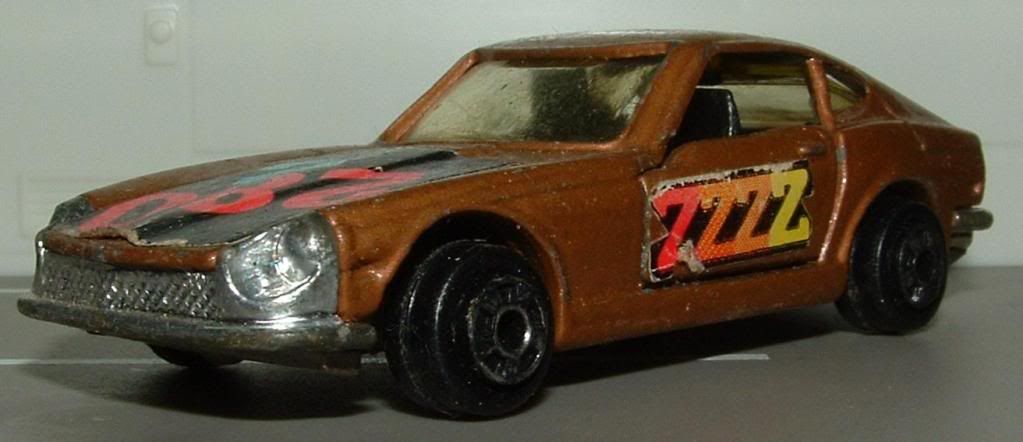
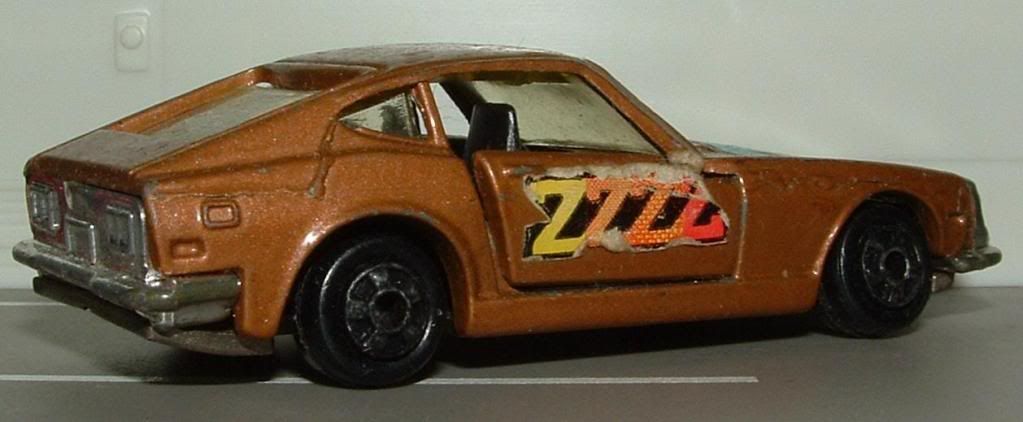
Today's car of the day is Zylmex's 1977 Datsun 280Z.


The Nissan S30 (sold in Japan as the Nissan Fairlady Z and in other markets as the Datsun 240Z, then later as the 260Z and 280Z) was the first generation of Z GT 2 seat coupe, and later (beginning in the 1974 model year) also 2+2 hatchbacks produced by Nissan Motors, Ltd. of Japan from 1970 to 1978. It was designed by a team led by Mr. Yoshihiko Matsuo, the head of Nissan's Sports Car Styling Studio. HLS30 was the designation of the left-hand drive model and HS30 for the right-hand drive model.


For more information and pictures of the real car please visit: Datsun 280Z


The Z-Car is among the most prolific models in small scale.  So here's a Z by Zee!  The 260Z and 280Z seem to be ignored in favor of the earlier 240Z and later 280ZX.


In a further effort to keep the S30 models sporting in the face of increasingly stringent U.S. emission and safety requirements, Nissan Motors released the Datsun 280Z model for the U.S. market in the 1975 model year. Both the 2 seat coupe and 2/2 (2+2) hatchback models remained available throughout the 1975-78 model year run of the 280Z.

For the 280Z, engine size was again increased, this time to 2.8 L, by enlarging the bore of the L26 engine to create the L28, and a reliable Bosch L-Jetronic fuel injection system was added.

1975 and 1976 models continued to be fitted with the Federally required 5mph crash test bumpers that were introduced for the mid-1974 model year of the 260z. These bumpers were smooth surfaced, and blended into smooth black rubber extensions as they met the body of the car. 1977 and 1978 models received bumpers with recessed channels added to the faces of the bumpers themselves, that blended into corrugated or accordion style black rubber extension trim. Also new for the 1977 model year, 280Zs no longer received the full size spare tire, and instead had a "space saver" spare and a larger fuel tank. This resulted in a raised rear deck area made of fiberboard, reducing cargo space. In 1977-78 an optional 5-speed manual transmission was available along side the 4-speed manual, and the 3-speed automatic options, which included a "5-speed" emblem on the left bottom edge of the rear hatch. 1977 also saw an update from the charcoal painted hubcap style (with a chrome Z floating in the amber center emblems) to a hubcap that resembled an alloy wheel, bearing a center cap with a chrome Z floating in a black circle.

In 1977 and 1978 respectively, Datsun offered two special edition models. The "Zap" edition was offered in 1977 as a "Special Decor Package". Zap cars were finished in Sunshine Yellow paint, and sported black stripes down the center and sides, with yellow, red, and orange chevrons at the front ends of the stripes. An estimated 1,000 "Zap Z" cars were offered in 1977. The "Zap Z" model was also used as the pace car in the 1977 Long Beach Gran Prix. The Black Pearl edition (produced in 1978) came with Black Pearlescent paint and a "Special Appearance Package" (SAP), which consisted of dual racing mirrors, rear window louvers, and a unique red and silver stripe. It is estimated that between 750-1,500 of these cars were produced.
The S30 series Z car was replaced in 1979 by the S130 Nissan Fairlady 280ZX / Datsun 280ZX.

Tuesday, April 5, 2011

Car Of The Day: April 5, 2011


Today's car of the day is Matchbox's 1971 Pontiac Firebird Formula.

(Normally there would be more images here, but this blog is NOT cooperating.  Check the forum for more images: http://swiftysgarage.net/topic/6775345/1/ ).  First the blog tells me that the images hosted on Photobucket and showing in the forum are invalid and then it will only let me upload one picture.  This is why I remain unimpressed with the blog format and much prefer message boards.  I also prefer the audience participation seen on forums.)

The Pontiac Firebird was built by the Pontiac division of General Motors between 1967 and 2002. The Firebird was introduced the same year as the automaker's platform-sharing model, the Chevrolet Camaro. This coincided with the release of the 1967 Mercury Cougar, which shared its platform with another pony car, the Ford Mustang.

The vehicles were powered by various four-cylinder, six-cylinder, and V8 engines of different GM divisions. While primarily Pontiac-powered until 1977, Firebirds were built with several different engines from nearly every GM division until 1982 when GM began to discontinue engines it felt were unneeded and either spread successful designs from individual divisions among all divisions or use new engines of corporate architecture.

(Picture three should be here.)

For more information and pictures of the real car please visit: Pontiac Firebird

(Picture four should be here.)

The real tragedy is that Matchbox's distribution has gotten so horrible right at the same time their model range and castings are among the best they've ever been.  Kiddie Kar, a local (and online) diecast dealer that specializes in Matchbox hasn't even gotten this in yet!  This one came from birds&goats (thanks Dave!) as an RAOK in today's mail.  As soon as I liberated it I knew this was a great casting, and as always the real test is when I see the pictures as the car gets magnified and the flaws are exposed for the world to see.  I'm happy to say there are no flaws- this Matchbox is the whole package.  Kudos to Mattel for this one and I hope to see it in a higher detailed series (whatever replaces Lesney Editions next year).

(Picture five should be here.  Can you tell I'm annoyed yet?)

The second generation debut for the 1970 model year was delayed until February 26, 1970, because of tooling and engineering problems; thus, its popular designation as a 1970½ model, while leftover 1969s were listed in early Pontiac literature without a model-year identification.

Replacing the "Coke bottle" styling was a more "swoopy" body style, with the top of the rear window line going almost straight down to the lip of the trunk lid—a look that was to epitomize F-body styling for the longest period during the Firebird's lifetime. The new design was initially characterized with a large C-pillar, until 1975 when the rear window was enlarged.

There were two Ram Air 400 cu in (6.6 L) engines for 1970: the 335 hp (250 kW) Ram Air III (366 hp (273 kW) in GTO) and the 345 hp (257 kW) Ram Air IV (370 hp (280 kW) in GTO) that were carried over from 1969. The difference between the GTO and Firebird engines was the secondary carburetor linkage which prevented the rear barrels from opening. Bending the linkage to allow full carburator operation resulted in identical engines.

A distinctive, slant-nose facelift occurred in 1977, redone somewhat in 1979. From 1977 to 1981, the Firebird used four square headlamps, while the Camaro continued to retain the two round headlights that had previously been shared by both Second Generation designs. Curb weights rose dramatically in the 1973 model year due to the implementation of 5 mph (8.0 km/h) telescoping bumpers and various other crash and safety related structural enhancements; SD455 Trans Ams weighed in at 3,850 lb (1,750 kg).

The 455 engine available in the second generation Firebird Trans Am was arguably the last high-performance engine of the original muscle car generation. The 455 cu in (7.5 L) engine first made its appearance in 1971 as the 455-HO. In 1973 and 1974, a special version of the 455, called the SD-455, was offered. The SD-455 consisted of a strengthened cylinder block that included 4-bolt main bearings and added material in various locations for improved strength. Original plans called for a forged crankshaft, although actual production SD455s received nodular iron crankshafts with minor enhancements. Forged rods and forged aluminum pistons were specified, as were unique high flow cylinder heads. A 1967 GTO Ram Air camshaft with 301/313 degrees of advertised duration, 0.407 inch net valve lift, and 76 degrees of valve overlap was specified for actual production engines in lieu of the significantly more aggressive Ram Air IV style cam that had originally been planned for the engine (initially rated at 310 hp (230 kW) with that cam), but proved incapable of meeting the tightening emissions standards of the era. This cam, combined with a low compression ratio of 8.4 (advertised) and 7.9:1 actual resulted in 290 SAE net horsepower. Production test cars yielded 1/4 mile times in the 14.5 second/98 MPH range in showroom tune - results consistent for a car with a curb weight of 3,850 pounds and the rated 290 SAE net horsepower figure some sources suggest was "under-rated," High Performance Pontiac magazine dyno-tested an SD and gave it 371 SAE net rating. During a 1972 strike, the Firebird (and the sister F-body Camaro) were nearly dropped. Pontiac offered the 455 for a few more years, but tightening restrictions on vehicle emissions guaranteed its demise. Thus, the 1976 Trans Am was the last of the "Big Cube Birds," with only 7,100 units produced with the 455 engine.
The 1974 models featured a redesigned "shovel-nose" front end and new wide "slotted" taillights. In 1974, Pontiac offered two base engines for the Firebird: a 100 hp (75 kW) 250 cu in (4.1 L) inline-6 and a 155 hp (116 kW) 350 cu in (5.7 L) V8. Available were 175 hp (130 kW) to 225 hp (168 kW) 400 cu in (6.6 L) V8 engines, as well as the 455 cu in (7.5 L) produced 215 hp (160 kW) or 250 hp (190 kW), while the SD-455 produced 290 hp (220 kW). The 400, 455, and SD-455 engines were offered in the Trans Am and Formula models during 1974.

The 1975 models featured a new wraparound rear window with a revised roofline. The Super Duty engines, Muncie 4-speed, and TurboHydramatic were no longer available in 1975. The 400 and 455 engines were optional above the base six and V8 in the 1975 and 1976 models.

In 1976, Pontiac celebrated their 50th Anniversary, and a special edition of the Trans Am was released. Painted in black with gold accents, this was the first anniversary Trans Am package and the first production Black and Gold special edition. In 1977, Pontiac offered the T/A 6.6 Litre 400 (RPO W72) rated at 200 hp (150 kW), as opposed to the regular 6.6 Litre 400 (RPO L78) rated at 180 hp (130 kW). In addition, California and high altitude cars received the Olds 403 engine, which offered a slightly higher compression ratio and a more usable torque band than the Pontiac engines of 1977. The 1977 Trans-Am Special Edition became famous after being featured in Smokey and the Bandit. Later on the 1980 Turbo model was used for Smokey and the Bandit II.

Beginning in 1978, Pontiac engineers reversed years of declining power by raising the compression ratio in the Pontiac 400 through the installation of different cylinder heads with smaller combustion chambers (1977 pontiac 400 engines also had the 350 heads bolted to the 400 blocks, these heads were known as the 6x-4 heads)(taken from the Pontiac 350). This increased power by 10% for a total of 220 during the 1978-79 model years. The 400/403 options remained available until 1979, when the 400 CID engines were only available in the 4-speed transmission Trans Ams and Formulas (the engines had actually been stockpiled from 1978, when PMD had cut production of the engine). 1979 marked the 10th Anniversary of the Trans Am, and a special anniversary package was made available: silver paint with a silver leather interior. The 10th Anniversary cars also featured a special Firebird hood decal, which extended off of the hood and onto the front fenders. In 1979 Pontiac sold 116,535 Trans Ams which still holds the record to this day. In 1980, due to ever-increasing emissions restrictions, Pontiac dropped all of its large displacement engines.

1980 therefore saw the biggest engine changes for the Trans Am. The 301, offered in 1979 as a credit option, was now the standard engine. Options included a turbocharged 301 or the Chevrolet 305 small block.

In the final year of the Second Generation Firebirds (1981), Trans Am still used the same engines as it had in the previous model year, with the only change being the addition of a new electronic carburetion system.

(Picture six should be here)

Monday, April 4, 2011

Car Of The Day: April 4, 2011


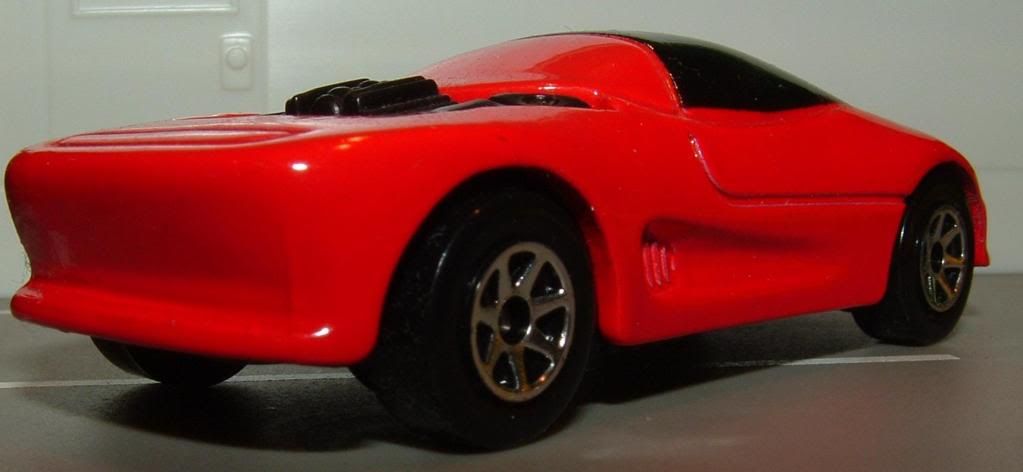
Today's car of the day is Hot Wheels' 1985 Buick Wildcat concept car.


Buick has used the name Wildcat for five concept vehicles, three in the early 1950s, one in 1985 and another in 1997. The 1953 Wildcat I, 1954 Wildcat II and 1955 Wildcat III were all designed under the guidance of Harley Earl. The I and II still exist today.

The 1985 Wildcat was a radical mid-engined, all-wheel-drive sports car with an exposed high-performance, double-overhead cam V6. The chassis was built of carbon-fiber and vinyl-ester resin and the body featured a 'lift-up' canopy for entry/exit. This futuristic vehicle is still owned by Buick today, and is still operational.
In 1997, Buick made a Riviera Wildcat concept car. This car had carbon fiber instead of woodgrain trim inside and black chrome outside and its engine was modified.


For more information and pictures of the real car please visit: Buick Wildcat


The Wildcat name has been used off and on by Buick over the decades.  The original Wildcat was a '50s dream car, followed by a full-size model from 1962-1970.  Then this concept car came out in 1985 and was later featured in the movie "Demolition Man" hence the reason why this one was cast by Hot Wheels.


So an obscure concept car gets dusted off for a movie and Hot Wheels tools up a replica of the car as a tie-in to the movie.  It later entered the Mainline (the car shown here) in the same color it was in the "Demolition Man" series.  It's basically one big lump of metal with the exception of the engine- the canopy is painted on, there is no glass insert or interior.


Sunday, April 3, 2011

Car Of The Day: April 3, 2011


Today's car of the day is Matchbox's 1994 Mitsubishi 3000GT.


The Mitsubishi GTO is a sports car built by Japanese automaker Mitsubishi Motors between 1990 and 2001. In most export markets it was rebadged as a Mitsubishi 3000GT. It was also sold by Chrysler in North America as a Dodge Stealth captive import from the 1991 to 1996 model years with only minor detail/appearance differences. It took its name from the Galant GTO, a two-door hardtop coupé sold by the company in the early 1970s, which got its name from the Ferrari GTO, which means Gran Turismo Omologata.


For more information and pictures of the real car please visit: Mitsubishi 3000GT


How can a car so perfectly illustrate what was right at Tyco and what was so very wrong at Tyco at the same time?  What was right- this is a great little casting.  Lots of detail, especially in the rear fascia.  But then they spoil this model with hideous tampos, lousy wheels, and a neon green interior.  We almost got its badge-engineered twin (the Dodge Stealth) at the same time but Chrysler denied the license because the casting was ill-proportioned.


Second generation models are identified by a revised front bumper to accommodate projector beam headlights and small, round projector fog lights. The caps on the hood were replaced with integrated blisters, and the side air vents and rear bumpers were modified. The interior was redesigned with dual air bags, a new audio system, and revised air conditioning refrigerant. The engines in all models received a slight boost in torque from 307 lb·ft (416 N·m) to 315 lb·ft (427 N·m). To complement this, the VR-4 now included a six-speed Getrag manual transmission. Bigger wheel/tire combinations were provided beginning in 1995. The base and SL model received 16" wheels in silver or chrome with 225/55 tires, while the VR4 now had 18" chrome wheels with 245/40 tires (the Spyder had the standard 17" with higher profile tires from 1994 to handle the additional 400 lb (180 kg)).

As the price of the cars increased, many of the "gadgets" on the car were discontinued. The tunable exhaust was phased out after model year 1994, the ECS disappeared after the 1995 model year, and the active aerodynamics disappeared after 1996. Finally, Chrysler ceased sales of the Dodge Stealth captive import, and for the remainder of its life only Mitsubishi-badged versions were available.

In 1995 and 1996, special edition retractable hardtop convertible models of the 3000GT SL and VR-4 were sold in the USA. Customized by ASC in California, these cars had retractable hardtops which could be opened or closed at the touch of a button. It was the first of its kind in America since the 1957–59 Ford Skyliner, and although it was abandoned after two years because of slow sales (1618 units), it presaged a market which would eventually mature the following year with the Mercedes SLK.

Saturday, April 2, 2011

Truck Of The Day: April 2, 2011


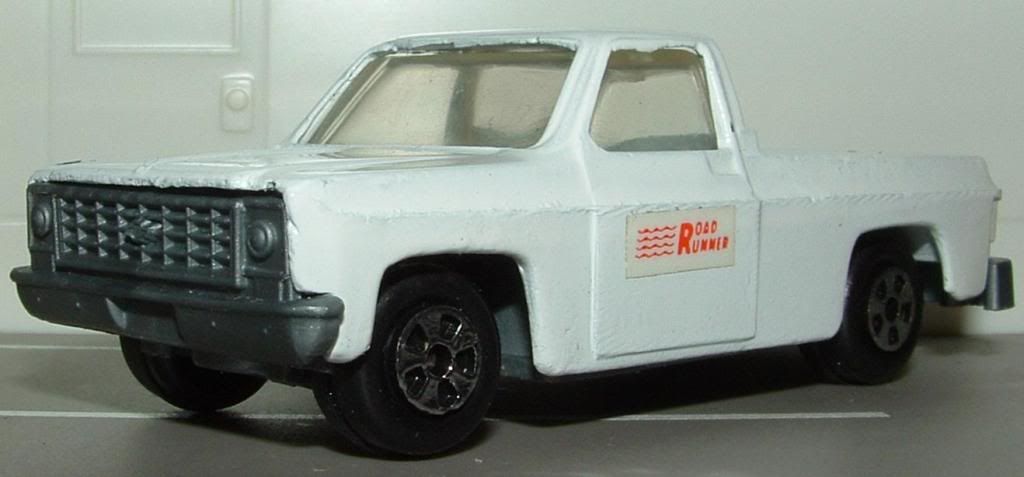
Today's car of the day is Ertl's 1978 Chevrolet C/K Series Fleetside.


The C/K is the name for Chevrolet and GMC's full-size pickup truck line from 1960 until 1999 in the United States, from 1965 to 1999 Canada, from 1964 through 2001 in Brazil, and from 1975 to 1982 in Chile. The first Chevrolet pickup truck appeared in 1924, though in-house designs did not appear until 1930. "C" denoted two-wheel drive while "K" denoted four-wheel drive. The C/K light-duty pickup truck was replaced with the Chevrolet Silverado and GMC Sierra in 1999 in the US and Canada, and 2001 in Brazil; the Chevrolet Silverado HD and GMC Sierra HD heavy-duty pickup trucks followed in 2001.


For more information and pictures of the real car please visit: Chevrolet C/K Series


This is a crude model, even by Ertl's standards, but it still has it's charm.


An all-new clean sheet redesign of General Motor’s (GM) Chevrolet and GMC brand C/K-Series pickups débuted in 1972 for the 1973 model year. Development of the new third generation trucks began in 1968, four years prior to production in 1972, with vehicle components undergoing simulated testing on computers, before the first prototype pickups were even built for real world testing. The redesign was revolutionary in appearance at the time, particularly the cab, departing from typical American pickup truck designs of the era. As a result, the third generation quickly became known as the "rounded-line" generation; although some people refer to them as "square bodys", given that the trucks appear square-like by more modern standards.

GM's design engineers fashioned the "rounded-line" exterior in an effort to improve aerodynamics and fuel efficiency, using wind tunnel technology to help them sculpt the body. Third generation design traits include "double-wall" construction, sleek sculpted body work, flared secondary beltline and a aerodynamic cab which featured rounded doors cutting high into the roof and steeply raked windshield featuring an available hidden radio antenna embedded into the glass.

There were two types of pickup boxes to choice from. The first type, called "Fleetside" by Chevrolet and "Wideside" by GMC, was a "double-wall" constructed full width pickup box and featured a flared secondary beltline to complement the cab in addition to new wraparound tail lamps. Both steel and wood floors were available. The second type, called "Stepside" by Chevrolet and "Fenderside" by GMC, was a narrow width pickup box featuring steps and exposed fenders with standalone tail lamps. Initially, only wood floors were available.

The wheelbase length was extended to 117.5 in (2985 mm) for the short wheelbase pickups, and 131.5 in (3340 mm) for the long wheelbase pickups. A new dual rear wheel option called "Big Dooley" was introduced on 1-ton pickups, along with a new Crew Cab option on the 164.5 in (4178 mm) wheelbase. Crew Cabs were available in two versions: a "3+3" which seated up to six occupants and "bonus cab" which deleted the rear seat and added rear lockable storage in its place. The fuel tank was moved from the cab to the outside of the frame, and a dual tank option was available which brought fuel capacity to 40 US gallons.
The rounded-line generation ultimately ran for a lengthy 15 model years (1973–1987) with the exception of 1-ton and Blazer, Jimmy, and Suburban versions, which continued up until the 1991 model year.

Friday, April 1, 2011

Car Of The Day: April 1, 2011


Today's car of the day is Racing Champions' 1957 Ford Ranchero.


The Ford Ranchero was a coupe utility produced between 1957 and 1979. Unlike a pickup truck, the Ranchero was adapted from a station wagon platform that integrated the cab and cargo bed into the body. A total of 508,355 units were produced during the model's production run. It was adapted from full-size, compact and intermediate automobiles by the Ford Motor Company for the North American market. Variations based on the original 1960 US Falcon for home markets in Argentina and South Africa were produced through the late 1980s. It sold well enough to spawn a competitor from General Motors in 1959, the Chevrolet El Camino.


For more information and pictures of the real car please visit: Ford Ranchero


Here's a beautiful Racing Champions casting that is begging to be released into the JL lineup.


Introduced in December 1956, three months after the traditional September model year start-up, the Ranchero was based on the standard and new-for-1957 full-size Ford platform, specifically the short wheelbase Custom sedan, two-door Ranch Wagon station wagon and utilitarian Courier sedan delivery. Essentially a Courier with an open, reinforced bed, its own unique rear window and integrated cab and cargo box, the Ranchero was initially offered in two trim levels and, throughout the model run, was built on the corresponding automobile assembly line but sold as a truck through Ford's truck division. There was an extremely basic standard model, marketed to traditional pickup truck buyers such as farmers, and the Custom which picked up most of the options and accessories available on the Fairlane line, including stainless steel bodyside mouldings and two-tone paint. Upscale models were badged both as a Fairlane and Ranchero, with a stylized representation of a longhorn as the symbol for the model located on the tailgate. Indeed, print advertising of the time played on the theme of the American Southwest that the Spanish model name and longhorn symbol were meant to evoke, showing artistic representations of the vehicle being used in ranching and outdoor activities, proclaiming it as "More Than A Car! More Than A Truck!" The Ranchero was a hit with both the automotive press and the buying public, filling an untapped market niche for vehicles with the utility of a light pickup with the ease of operation and riding characteristics of a car. In fact, the Ranchero had a marginally higher cargo capacity by about fifty pounds/23 kg than the half-ton F-Series pickup. Both standard and Custom could be ordered with any engine available for Ford cars, all the way up to the 352 cu in (5.8 L) "Thunderbird Special." In Canada, the Ranchero was also available in the Meteor line-up.

The 1958 version would remain largely unchanged under the skin save for the new front sheet metal and its new four-headlamp arrangement.

The 1959 model was built with the same 118"/300 cm wheelbase as the sedan as were all 1959 Fords, giving the Ranchero the advantage over its predecessors of a longer bed. However, this would be the last time that the vehicle would grow either in size or trim for several years to come. The Custom Ranchero was the only model marketed in 1959.


Rancheros are reasonably collectible, though they are nowadays often overlooked in favor of the later-arriving Chevrolet El Camino, which stayed in production eight more years. Miniatures, apart from hand-cast resin kits from cottage-industry makers are rare. Several Revell offerings of the 1957 model in both 1/32 and 1/25 scale have been offered over the years as has a kit of the 1961 Ranchero by AMT/Ertl. A well-detailed promotional model of the 1959 intended for distribution by dealers was offered both with and without interior trim, windows and friction drive by AMT/Ertl's predecessor, SMP; resin castings of this model's body are offered by the aforementioned cottage industries as well. There are no Matchbox versions, but Johnny Lightning makes a 1964 model, Hot Wheels an adult collectible '57, Racing Champions made a 1/64 scale 1957 Ranchero and AMT/Ertl currently produces a diecast '57 which doubles as a bank. AMT was responsible for other early dealer promotional models as well, including those of the aforementioned El Camino. Tonka produced a resin toy version of the 1968-69 model in roughly 1/24 scale as part of an auto transporter set; the front end of that toy arguably resembles the 1969 model more closely. A 1970 Ranchero was featured in the music video for Brooks and Dunn's Hillbilly Deluxe.

The idea of a car-based pickup remains an attractive one, and is an illustration of how favorable treatment for light trucks over cars by United States regulations skews the marketplace. There are many Ranchero and El Camino owners, indeed, who stopped buying new vehicles when those models were discontinued. Aftermarket conversions of the Fairmont Futura and Mercury Zephyr Z7 sport coupes to a Ranchero-like "Durango" pickup were sold in select Ford dealers in the early- to mid-1980s. Recently there has been more interest in producing such vehicles again, including those like the Subaru Baja, essentially an Outback station wagon with a stubby pickup bed instead of an enclosed cargo area. The Baja, like the Ranchero, is titled in most American states and Canadian provinces as a commercial vehicle. The current market has tended to lean towards compact and midsized crew-cab four-door pickups such as the Ford Explorer Sport Trac and Chevrolet Colorado.

In Australia, Ford continues to produce a car based "pickup", the FG Falcon Ute.