Wednesday, March 23, 2011

Car Of The Day: March 23, 2011


Today's car of the day is Corgi's 1967 Citroën Dyane.


The Citroën Dyane is an economy car/supermini produced by the French automaker Citroën from 1967 to 1983. It was based on the Citroën 2CV, and 1,444,583 Dyanes were produced. The Dyane spawned a panel van version called the Acadiane.


For more information and pictures of the real car please visit: Dyane Citroën


Not as well-known as the 2CV, the Dyane was nonetheless made by both Corgi and Majorette.  The Majorette is the nicer of the two models, but the Corgi has an opening hatch and captures the lines of the car well.


The Dyane was a development of the Citroën 2CV, and was intended as an answer to the increasingly popular Renault 4, which after its introduction in 1961 had affected 2CV sales. The Renault 4 incorporated many ideas copied from the Citroën Traction Avant, but on a smaller scale. Like the Renault 4, the Dyane was designed from the outset as a hatchback with some other styling differences, such as conventional round headlamps set into the front fender with a squared chrome trim ring – as opposed to the old-fashioned separate units found on the 2CV – and stainless steel wheel embellishments as standard. It is often believed that the Dyane was intended to replace the 2CV, but it was aimed slightly higher in the Citroën range – between the 2CV and the Ami – and attracted a different clientele seeking the versatility offered by the Dyane's hatchback. From the mid 1950s until the 1970 Citroën GS, Citroën had no car in the mid size market segment and needed to make the most of the capable Citroën 2CV chassis

Tuesday, March 22, 2011

Car Of The Day: March 22, 2011


Today's car of the day is Matchbox Premiere's 1996 Ferrari F50.


The Ferrari F50 is a mid-engined range-topping sports car made by Ferrari. The F50 was introduced in 1995 to celebrate the company's 50th anniversary. The car is a two door, two seat convertible with a removable hardtop. It has a 4.7 L naturally-aspirated 60-valve V12 engine that was developed from the 3.5 L V12 used in the 1992 Ferrari F92A Formula One car.

Only 349 cars were made, one fewer than Ferrari estimated they could sell. This was, in the words of Ferrari spokesman Antonio Ghini, because "Ferraris are something cultural, a monument. They must be hard to find, so we will produce one less car than the market." The last F50 was produced in Maranello, Italy in July 1997.

The F50's engine predated the car: It was used in the Ferrari 333 SP for the American IMSA series in 1994 allowing it to become eligible for the stock engine WSC category.


For more information and pictures of the real car please visit: Ferrari F50


I always did love the Matchbox Premieres.  This one could use better headlight tampos (we've come a long way in the last fifteen years) but overall is a very nice example of the Premiere line.


Following the motorsport theme, Ferrari developed the F50 GT, a prototype based on the F50 that was built to compete in GT1-class racing. The car had a fixed roof, large rear spoiler, new front spoiler and many other adjustments. The 4.7 litre V12 engine was tuned to generate around 750 bhp (559 kW). In testing in 1996 the car proved to be quicker even than the 333SP, but this went unnoticed as Ferrari cancelled the F50 GT project, instead focusing on Formula One. Ferrari sold off the three complete chassis that were built - the test car 001, 002 and 003. Chassis 002 and 003 had bodies fitted before being sold. The remaining three tubs were apparently destroyed.

Monday, March 21, 2011

Monster Car Of The Day: March 21, 2011


Today's car of the day is Hot Wheels' 1975 Chevrolet Corvette 4x4.


The Chevrolet Corvette (C3) is a sports car produced by the Chevrolet division of General Motors for the 1968 through 1982 model years. Corvette chief Zora Arkus-Duntov wanted a striking new Corvette; although engines and chassis components were mostly carried over from the previous generation, its body and interior were new. "Though initially flawed, the 1968 like the 1958, would improve and mature into a car precisely right for its time." The so-called Shark was produced during one of the most troubled periods in America: civil unrest, burgeoning federal guidelines, fuel economy and pollution regulations, oil embargoes, rising fuel and insurance costs, runaway inflation, and a lingering recession. Through it all the third generation Corvette continued to set new sales records with an all-time high of 53,807 produced for the 1979 model year.


For more information and pictures of the real car please visit: Chevrolet Corvette


I love this model.  I know the vast majority of folks do not like this particular casting, but I was thrilled to see it return as I have fond memories of both the yellow and purple flamed 4x4 Vettes Hot Wheels did in the 1980s.  My only complaint is the brown tires.  I know they're meant to invoke mud, but the rest of the car (including the rims!) is sparkling clean so it doesn't make sense.


The 1975 model was advertised as "a more efficient Corvette," as service intervals were extended and electronic ignition and the federally mandated catalytic converter were introduced with "unleaded fuel only" warnings on the fuel gauge and filler door. Dual exhaust pipes were routed to a single converter, then split again leading to dual mufflers and tailpipes. Starting this year, tachometers were electronically driven. The Corvette began to be influenced by the metric system as speedometers now displayed small subfaces indicating kilometers-per-hour. 75's featured revised inner bumper systems with molded front and rear simulated bumper guards. The urethane rear bumper, now in its second year, reappeared as a one-piece seamless unit. This was the final year for Astro Ventilation. Power bottomed out this year — the base engine produced only 165 hp (123 kW) and the only remaining optional motor, the L-82, dropped an astonishing 45 hp (34 kW), managing to deliver 205 hp (153 kW). With no larger engine available, L-82 hood emblems began to appear on cars so equipped. Unchanged was the standard rear axle ratio for the base engine, which remained at 3.08 with automatic and 3.36 with manual transmission. This was the last convertible for the 1968-82 third-generation and only 12% of the cars were ordered as such. As in previous years, a folding top came standard with roadsters and a body color or vinyl covered hardtop was optional at additional cost. Anticipating further federal safety restrictions, Chevrolet believed it would be Corvette's last soft-top model ever but the convertible returned in 1986.

Car and Driver recorded a respectable 7.7 second 0-60 time in a 1975 base engine-automatic, making the Corvette still one of the fastest cars available at the time. C&D said: "The Corvette feels highly competent with power-everything to help you guide the long body around..."


The C3 fifteen year run shows an extreme contrast. The list price for the Corvette in 1968 was $4,663. By 1982 due mostly to inflation, the base price had increased to $18,290. In 1968 there were six engines, two small-block V8s and four big-block V8s. By 1982 there was only one small block V8 engine available. In '68 there were five transmissions, including four manual choices. By '82 there was one, a four-speed automatic. Although refined, emission standards and fuel economy concerns had changed America's only sports car.

Sunday, March 20, 2011

SUV Of The Day: March 20, 2011


Today's car of the day is Realtoy's 1994 Mercedes-Benz G-Class.


The Mercedes-Benz G-Class or G-Wagen, short for Geländewagen (or cross-country vehicle), is a four-wheel drive vehicle / sport utility vehicle (SUV) produced by German automaker Mercedes-Benz. Designed to be a durable, reliable, and rugged off-roader, the G-wagen is characterized by its boxy styling and body-on-frame construction. It utilizes three fully locking differentials, one of the few vehicles to have such a feature.

Mercedes-Benz secured military contracts for the vehicle in the late 1970s and offered a civilian version in 1979. A major reason to start development was the need of the German Army for a light military vehicle. Without any joint test the cheaper Volkswagen Iltis were chosen, but since 1990 it is replaced by the G-Class "Wolf" and LAPV Enok. After a design change to a civilian cross-country vehicle in co-operation with the Austrian car manufacturer Steyr-Daimler-Puch, production of the G-Class began in 1979 with the 460 Series models. The G-Class has been sold under the Puch name in certain markets, and the Peugeot P4 is a variant made under license, with a Peugeot engine and different parts.

Despite the introduction of an intended replacement, the unibody crossover SUV Mercedes-Benz GL-Class in 2006, the G-Class is still produced and is expected to continue in production until 2015.


For more information and pictures of the real car please visit: Mercedes-BenzG-Class


Realtoys are often overlooked as 'generics' these days, but the same thoughts applied to Playarts, Yat Mings, and Zylmexes thirty years ago and look where they are now.


The G-Wagen was developed by Steyr-Daimler-Puch and first offered for sale in 1979 and redesigned in 1990/1991. A new version was expected for 2007, but the new GL-Class will not replace the G-Wagen, and it will continue to be hand-built in Graz, Austria at an annual production of 4,000 to 6,000 units. In February 2009, Magna Steyr, an operating unit of Magna International, announced that it signed an agreement with Daimler AG to extend the production of the Mercedes-Benz G-Class at Magna Steyr in Graz, Austria until 2015. Besides the production, the further development of the G-Class by Mercedes-Benz is also located in Graz since 1992.

Saturday, March 19, 2011

Ambulance Of The Day: March 19, 2011


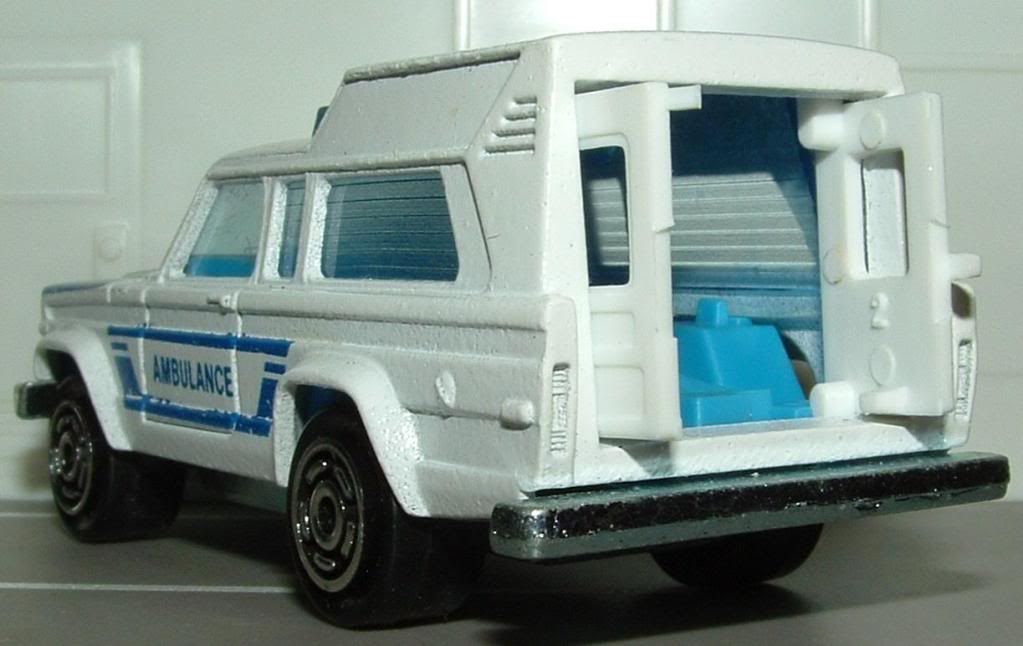
Today's car of the day is Majorette's 1979 Jeep Cherokee Ambulance.


The SJ series Jeep Cherokee was a full-size SUV produced from 1974 through 1983 by the Jeep division of the American Motors Corporation (AMC). It was similar to the Wagoneer that was originally designed by Brooks Stevens in 1963.


For more information and pictures of the real car please visit: Jeep Cherokee


Not many Cherokees/Wagoneers were pressed into ambulance duty, though a quick Google search reveals at least two different ones.  Neither of which looks like this one (which resembles a Cadilla based ambulance) whereas the ones I've found pictures of are box ambulances.


The Cherokee was a redesigned reintroduction of a two door body style, with a single fixed rear side window with an optional flip-out section. Previously, a two door version had been available in the Jeep Wagoneer line (1963–67), although this had the same pillar and window configuration as the four-door Wagoneer.

Based on the Wagoneer, the Cherokee was marketed as the "sporty" two-door variant of Jeep's station wagon. The term "Sport Utility" appears for the first time in the 1974 Cherokee sales brochure. A four-door was not added to the lineup until 1977. Other than the base model, the trim levels of the Cherokee included the S (Sport), Chief, Golden Eagle, Limited, Classic, Sport, Pioneer, and Laredo.


Engine choices consisted of AMC I6 or V8 powerplants. When it was equipped with the powerful 401 cu in (6.6 L) AMC V8 engine, it would out-run just about any other 4x4 in its class, and, with 3.07:1 highway gearing, could reach speeds in excess of 100-mile-per-hour (161 km/h) (early models had 120 mph speedometers). A range of AMC engines were offered: the 258 cu in (4.2 L) inline six-cylinder, a 360 cu in (5.9 L) V8 with two-barrel carburetor, a four-barrel 360, or the 401 cu in (6.6 L) V8. The durable 401 had a forged crankshaft and forged connecting rods, as well as the high nickel content block of the other AMC V8s. The 401 was discontinued at the end of 1978. After acquiring AMC in 1987, Chrysler kept the 360 V8 in production until 1991 for the Jeep Grand Wagoneer.


A T-18/T-18a four speed manual gearbox was standard for all years, while through 1979 the General Motors' Turbo-Hydramatic TH400, more commonly fitted to 3/4- and 1-ton trucks rather than SUVs, was optional. For comparison, the Chevy Blazer used the TH350 automatic. After 1979, the TH400 was replaced by the Chrysler's TorqueFlite 727.

A gear-driven Dana 20 transfer case with 2.03:1 low range was standard with the manual gearbox (which had a much lower first gear of about 6.3:1), while the TH400 automatics received the permanent four-wheel drive QuadraTrac system. The chain-driven, aluminum QuadraTrac was quite advanced at the time. It included a vacuum operated center differential lock. The transfer case was offset, allowing it to sit just above the frame to avoid obstacles, and the chain itself is larger than nearly any other. A test by the Four-Wheel Drive Book found that the Cherokee was the only vehicle unable to be dynoed because the transfer case would not allow the rear wheels to spin, unlike the other full-time four-wheel drive vehicles being tested. In the off-road test, the same held true. This transfer case was also employed successfully in Baja races, for example by Roger Mears in the Baja 1000. A 2.57:1 low range was optional on QuadraTrac.

In 1975, the Cherokee Chief package was introduced. Aside from trim changes, this model received larger fenders and wider axles, allowing larger tires to be fitted to further improve off-road ability. Four-door models were not available with "wide-track" axles.

Dana 44 model axles were used both in the front and the rear at least through 1979. Brake hardware was mostly General Motors equipment, with disc brakes up front (optional on earlier models) and drum brakes in the rear.

All Cherokees had semi-elliptical leaf springs in the front and rear.

Friday, March 18, 2011

Car Of The Day: March 18, 2011


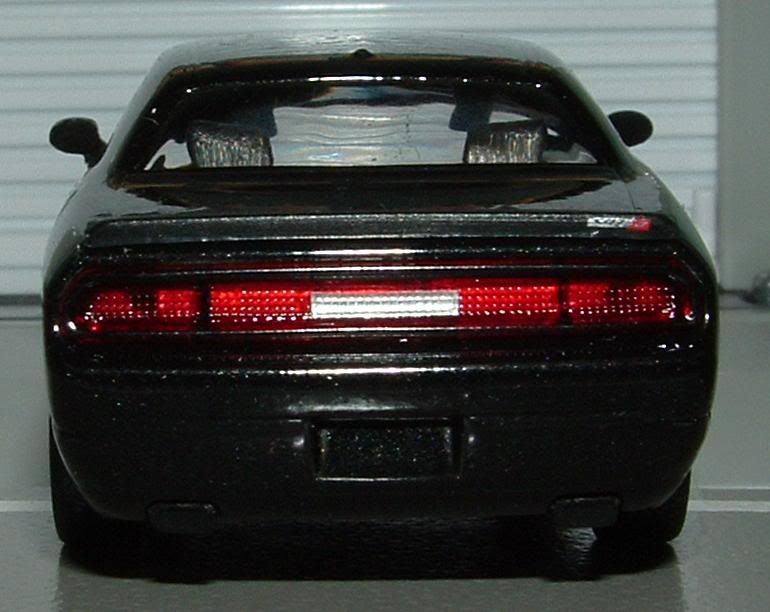
Today's car of the day is Kyosho's 2010 Dodge Challenger.


The Dodge Challenger is the name of three different generations of automobiles marketed by the Dodge division of Chrysler.

The first generation was a pony car built from 1970 to 1974, using the Chrysler E platform and sharing major components with the Plymouth Barracuda. The second generation, from 1978 to 1983, was a badge engineered Mitsubishi Galant Lambda. The third, and current generation, was introduced in 2008 as a rival to the evolved fifth generation Ford Mustang and the reintroduced fifth generation Chevrolet Camaro.


For more information and pictures of the real car please visit: Dodge Challenger


Quite possibly the nicest casting of the new Challenger out there.  Not surprisingly, this car has already had replicas from Hot Wheels, GreenLight, Johnny Lightning, Matchbox, and others.


Production of the limited edition 2008 SRT/8s ended in July 2008, and production of the expanded 2009 line-up started in early August of the same year. The expanded offering was the same as had been unveiled earlier that spring at the 2008 New York Auto Show. Chrysler debuted the full Dodge Challenger line for 2009, with four different trims - SE, R/T, SRT8, and the SXT in Canada only. In addition to the SRT8, which remained unchanged except for the optional 6 speed manual, the line-up included the previously mentioned SE and SXT which offered the 250 HP 3.5-Liter V6. The R/T hosted a 5.7 Hemi sporting 370 hp (276 kW) and 398 lb·ft (540 N·m) of torque when coupled with the 5 speed automatic, and 375 hp (280 kW) with 404 lb·ft (548 N·m) when matched with the same Tremec 6-speed manual transmission as the SRT8.

For 2010, the vehicle cost $515 to $1,010 more than in 2009. The color, HEMI Orange, was initially dropped for the 2010 model year, then re-released later in the model year. Two new color schemes became available for the 2010 model year; Plum Crazy and Detonator Yellow. A third new color, Furious Fuchsia was announced in February 2010. But unlike previous special editions, the Furious Fuchsia version will have significant changes to the interior with white leather instead of the usual black seats. Chrysler also made a late-year addition to the 2010 model year with the limited edition Mopar '10 Challenger R/T. These cars, limited to only 500 examples, were metallic gray in color with three accent colors of stripes to choose from. In addition, these cars were available with black R/T Classic-style rims along with a Hurst aftermarket pistol grip shifter, custom badging, Mopar cold air intake for a 10 horsepower increase, and Katzkin-sourced aftermarket interior.

For the 2011 model, Dodge will outfit the base model Challenger with the new Pentastar V6 engine, which boasts a significant increase in power, now up to 305 bhp (227 kW; 309 PS) and 268 lb·ft (363 N·m). The new engine will also be more efficient than the outdated version, featuring cylinder deactivation and dual variable valve timing. The bottom grille will also be flipped upside down, different from the 2008-10. Chrysler engineers cited airflow as a main reason for the change. For the new SRT8's, the chin spoiler was also reengineered and enlarged to create more downforce. It will resemble the '70 Challenger R/T. Later in the production year, a refreshed SRT8 will enter production, with the new 392-cubic-inch (6.4L) HEMI V8. The new engine will feature Variable Camshaft Timing, as well as the Multiple Displacement System featured on the 5.7L (345 c.i.d.) HEMI V8. The 392 has officially been rated at 470 horsepower (350 kW) and 470 lb·ft (640 N·m) of torque. Dodge engineers said they sacrificed peak horsepower ratings for low-end torque, stating a 90 horsepower (67 kW) increase over the outgoing 6.1-L (370 c.i.d.) Hemi V8 at 2900 rpm. Thanks to the revised engine, Chrysler engineers cited a quarter mile (~400 m) time of 12.4 seconds at 110 mph (180 km/h) - bettering the outgoing 6.1-Liter Hemi by 0.8 seconds, although that figure has varied wildly between automotive magazines. Car and Driver tested the 392 at 12.9 seconds at 114 mph (183 km/h) while Motor Trend's tester clocked in at 13.0 seconds at 111.3 mph (179.1 km/h) and Edmunds' number was far closer to Chrysler's claimed numbers at 12.6 seconds at 112.1 mph (180.4 km/h). Nevertheless, the new engine shows significant improvements over the 2008-2010 cars in trap speed and quarter mile times.

Thursday, March 17, 2011

Car Of The Day: March 17, 2011


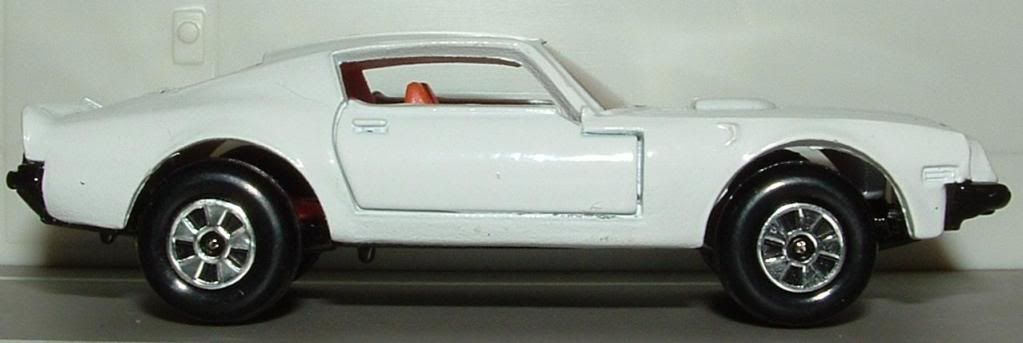
Today's car of the day is Ertl's 1974 Pontiac Firebird Trans Am.


The Pontiac Firebird was built by the Pontiac division of General Motors between 1967 and 2002. The Firebird was introduced the same year as the automaker's platform-sharing model, the Chevrolet Camaro. This coincided with the release of the 1967 Mercury Cougar, which shared its platform with another pony car, the Ford Mustang.

The vehicles were powered by various four-cylinder, six-cylinder, and V8 engines of different GM divisions. While primarily Pontiac-powered until 1977, Firebirds were built with several different engines from nearly every GM division until 1982 when GM began to discontinue engines it felt were unneeded and either spread successful designs from individual divisions among all divisions or use new engines of corporate architecture.


For more information and pictures of the real car please visit: Pontiac Firebird


The 1974-1976 F-Bodies are the forgotten models in the diecast world.  This Ertl and a Matchbox from the same vintage are the only two Firebirds, and Ertl did a highly modified dirt track Camaro (with a newer '77-81 front clip, but pre-wraparound rear window) while Hasbro has a '76 Camaro out currently to represent the beater Bumblebee from the first Transformers live action move.  The real cars are regarded as among the low-points in their respective models' histories and as such that explains the lack of small-scale examples.  GreenLight was supposed to do a '76 Trans Am but instead is releasing yet another '77-'81 Bird instead.


The second generation debut for the 1970 model year was delayed until February 26, 1970, because of tooling and engineering problems; thus, its popular designation as a 1970½ model, while leftover 1969s were listed in early Pontiac literature without a model-year identification.

Trims
Firebird
Firebird Esprit
Firebird Formula
Firebird Trans-Am
Firebird Skybird
Firebird Redbird
Firebird Yellowbird
Special versions
Special Edition (popular 'Bandit')
Gold Special Edition
Macho Trans-Am (made by one of the Pontiac dealers)
1976 50th (Pontiac) Anniversary Edition
1979 10th (Trans Am) Anniversary Edition
1980 Pace Car Indy 500 Edition (turbo Trans Am)
1981 NASCAR Edition (turbo Trans Am)


Replacing the "Coke bottle" styling was a more "swoopy" body style, with the top of the rear window line going almost straight down to the lip of the trunk lid—a look that was to epitomize F-body styling for the longest period during the Firebird's lifetime. The new design was initially characterized with a large C-pillar, until 1975 when the rear window was enlarged.

There were two Ram Air 400 cu in (6.6 L) engines for 1970: the 335 hp (250 kW) Ram Air III (366 hp (273 kW) in GTO) and the 345 hp (257 kW) Ram Air IV (370 hp (280 kW) in GTO) that were carried over from 1969. The difference between the GTO and Firebird engines was the secondary carburetor linkage which prevented the rear barrels from opening. Bending the linkage to allow full carburator operation resulted in identical engines.

A distinctive, slant-nose facelift occurred in 1977, redone somewhat in 1979. From 1977 to 1981, the Firebird used four square headlamps, while the Camaro continued to retain the two round headlights that had previously been shared by both Second Generation designs. Curb weights rose dramatically in the 1973 model year due to the implementation of 5 mph (8.0 km/h) telescoping bumpers and various other crash and safety related structural enhancements; SD455 Trans Ams weighed in at 3,850 lb (1,750 kg).
The 455 engine available in the second generation Firebird Trans Am was arguably the last high-performance engine of the original muscle car generation. The 455 cu in (7.5 L) engine first made its appearance in 1971 as the 455-HO. In 1973 and 1974, a special version of the 455, called the SD-455, was offered. The SD-455 consisted of a strengthened cylinder block that included 4-bolt main bearings and added material in various locations for improved strength. Original plans called for a forged crankshaft, although actual production SD455s received nodular iron crankshafts with minor enhancements. Forged rods and forged aluminum pistons were specified, as were unique high flow cylinder heads. A 1967 GTO Ram Air camshaft with 301/313 degrees of advertised duration, 0.407 inch net valve lift, and 76 degrees of valve overlap was specified for actual production engines in lieu of the significantly more aggressive Ram Air IV style cam that had originally been planned for the engine (initially rated at 310 hp (230 kW) with that cam), but proved incapable of meeting the tightening emissions standards of the era. This cam, combined with a low compression ratio of 8.4 (advertised) and 7.9:1 actual resulted in 290 SAE net horsepower. Production test cars yielded 1/4 mile times in the 14.5 second/98 MPH range in showroom tune - results consistent for a car with a curb weight of 3,850 pounds and the rated 290 SAE net horsepower figure some sources suggest was "under-rated," High Performance Pontiac magazine dyno-tested an SD and gave it 371 SAE net rating. During a 1972 strike, the Firebird (and the sister F-body Camaro) were nearly dropped. Pontiac offered the 455 for a few more years, but tightening restrictions on vehicle emissions guaranteed its demise. Thus, the 1976 Trans Am was the last of the "Big Cube Birds," with only 7,100 units produced with the 455 engine.
The 1974 models featured a redesigned "shovel-nose" front end and new wide "slotted" taillights. In 1974, Pontiac offered two base engines for the Firebird: a 100 hp (75 kW) 250 cu in (4.1 L) inline-6 and a 155 hp (116 kW) 350 cu in (5.7 L) V8. Available were 175 hp (130 kW) to 225 hp (168 kW) 400 cu in (6.6 L) V8 engines, as well as the 455 cu in (7.5 L) produced 215 hp (160 kW) or 250 hp (190 kW), while the SD-455 produced 290 hp (220 kW). The 400, 455, and SD-455 engines were offered in the Trans Am and Formula models during 1974.

The 1975 models featured a new wraparound rear window with a revised roofline. The Super Duty engines, Muncie 4-speed, and TurboHydramatic were no longer available in 1975. The 400 and 455 engines were optional above the base six and V8 in the 1975 and 1976 models.

In 1976, Pontiac celebrated their 50th Anniversary, and a special edition of the Trans Am was released. Painted in black with gold accents, this was the first anniversary Trans Am package and the first production Black and Gold special edition. In 1977, Pontiac offered the T/A 6.6 Litre 400 (RPO W72) rated at 200 hp (150 kW), as opposed to the regular 6.6 Litre 400 (RPO L78) rated at 180 hp (130 kW). In addition, California and high altitude cars received the Olds 403 engine, which offered a slightly higher compression ratio and a more usable torque band than the Pontiac engines of 1977. The 1977 Trans-Am Special Edition became famous after being featured in Smokey and the Bandit. Later on the 1980 Turbo model was used for Smokey and the Bandit II.

Beginning in 1978, Pontiac engineers reversed years of declining power by raising the compression ratio in the Pontiac 400 through the installation of different cylinder heads with smaller combustion chambers (1977 pontiac 400 engines also had the 350 heads bolted to the 400 blocks, these heads were known as the 6x-4 heads)(taken from the Pontiac 350). This increased power by 10% for a total of 220 during the 1978-79 model years. The 400/403 options remained available until 1979, when the 400 CID engines were only available in the 4-speed transmission Trans Ams and Formulas (the engines had actually been stockpiled from 1978, when PMD had cut production of the engine). 1979 marked the 10th Anniversary of the Trans Am, and a special anniversary package was made available: silver paint with a silver leather interior. The 10th Anniversary cars also featured a special Firebird hood decal, which extended off of the hood and onto the front fenders. In 1979 Pontiac sold 116,535 Trans Ams which still holds the record to this day. In 1980, due to ever-increasing emissions restrictions, Pontiac dropped all of its large displacement engines.

1980 therefore saw the biggest engine changes for the Trans Am. The 301, offered in 1979 as a credit option, was now the standard engine. Options included a turbocharged 301 or the Chevrolet 305 small block.

In the final year of the Second Generation Firebirds (1981), Trans Am still used the same engines as it had in the previous model year, with the only change being the addition of a new electronic carburetion system.

Wednesday, March 16, 2011

Car Of The Day: March 16, 2011


Today's car of the day is Matchbox's 2008 Caterham R500.


The Caterham Seven (or Caterham 7) is a sports bike-sized sports car produced by Caterham Cars in the United Kingdom. It is based on the Lotus Seven, a lightweight sports car sold in kit and pre-built form by Lotus Cars, from the late 1950s to the early 1970s. After Lotus ended production of the Lotus Seven, in 1972, Caterham bought the rights to the design, and today make both kits and fully assembled cars. 2007 marked the 50th year of production of the Lotus/Caterham 7.

The Caterham Seven is a small, lightweight, two-seater sports car renowned for its performance and handling. Various other manufacturers offer a sports car in a similar basic configuration, but Caterham owns various legal rights to the Lotus Seven design and name. The company has taken legal action in the past in order to protect those rights. In South Africa, it lost its case against Birkin (a competitor) on the basis that it never obtained the rights from Lotus that it claimed it had. The modern Seven is based on the Series 3 Lotus Seven, though Caterham have developed it to the point that no part is the same as on the original Lotus.


For more information and pictures of the real car please visit: Caterham R500


We can thank "Top Gear" for this one making it to the Matchbox line.  Personally, I've been a huge fan of the real car since playing a game by the name of "Test Drive 5" for the PlayStation back in the late 1990s.  The Caterham was an unlockable car and I wasn't too enthusiastic about it.  There Mustangs and a Charger Daytona, so of course my attention was diverted there.  But then I took this one out for a spin.  Acceleration in spades.  Handled like a dream.  I could outrun everything, even if the car was limited by a low top speed compared to some of the other cars.  The ability to accelerate and weave through traffic were much better benefits than high top speed in this particular game as the racing was done on the streets.  Won me over right away so I was thrilled to finally have a Caterham in my collection!


The Superlight is available in both S3 and SV chassis sizes. The list of standard equipment reflects the Superlight's bias to track work; Wide-track front suspension, 6 speed gearbox, Carbon fibre dashboard and front wings, GRP aeroscreen and seats, racing harness, removable steering wheel. Quoted weight for the Superlight is about 50 kg (110 lb) less than the Roadsport, due in part to the lack of a spare wheel and carrier. Engine options again are something of a temporary mix of incoming Ford Sigma (150 bhp) and outgoing Rover k-series (160 bhp) for the R300. Both the R400 and R500 use the 2 litre variant of Ford Cosworth Duratec engine, in different states of tune. The R400 is quoted at 210 bhp (160 kW), the R500 at 263 bhp (196 kW). With the recent launch of the R500 (April 2008), Caterham made available the options of a sequential gearbox and launch control. Quoted performance for the R500 is 0-60 in 2.88 seconds and a top speed of 150 mph (240 km/h).

At the beginning of December 2008, the R500 was featured on the popular BBC television show Top Gear, putting in a timed lap of the Top Gear circuit of 1 minute 17.9 seconds. This is, to date, the eighth fastest official lap timed by the show, faster than, amongst others, the Bugatti Veyron. This feat was considered even more impressive due to the coldness of the conditions which made it difficult for the test driver (The Stig) to get heat into the tyres. Shortly afterwards, on the 14th December show, Top Gear made the R500 its '2008 Car of the Year'.