Sunday, May 22, 2011

Car Of The Day: May 22, 2011


Today's car of the day is Matchbox's 1974 Pontiac Firebird.


The second generation debut for the 1970 model year was delayed until February 26, 1970, because of tooling and engineering problems; thus, its popular designation as a 1970½ model, while leftover 1969s were listed in early Pontiac literature without a model-year identification.


For more information and pictures of the real car please visit: Pontiac Firebird


Here's the original Matchbox Firebird, the one the current model is in homage to.  As you can see this is not a very accurate casting, but it is one of only two 1974 Firebirds in small scale (the other, better looking example is Ertl's).  This is a recent purchase from MatchboxDave at the Keystone CARnival.  And the story as to why I like this car so much amused him, and may amuse all of you as well.  When I was in kindergarten, a group of boys had this car, and were always burying it in various places in the playground, with the intention of sending it all the way to China.  I watched them like hawks, because I wanted that car.  Well, one day they successfully lost the car.  I moved in to try and find it myself but also to no luck.  So somewhere in Kinnelon, New Jersey there's one of these awaiting fossilization.


The 455 engine available in the second generation Firebird Trans Am was arguably the last high-performance engine of the original muscle car generation. The 455 cu in (7.5 L) engine first made its appearance in 1971 as the 455-HO. In 1973 and 1974, a special version of the 455, called the SD-455, was offered. The SD-455 consisted of a strengthened cylinder block that included 4-bolt main bearings and added material in various locations for improved strength. Original plans called for a forged crankshaft, although actual production SD455s received nodular iron crankshafts with minor enhancements. Forged rods and forged aluminum pistons were specified, as were unique high flow cylinder heads. A 1967 GTO Ram Air camshaft with 301/313 degrees of advertised duration, 0.407 inch net valve lift, and 76 degrees of valve overlap was specified for actual production engines in lieu of the significantly more aggressive Ram Air IV style cam that had originally been planned for the engine (initially rated at 310 hp (230 kW) with that cam), but proved incapable of meeting the tightening emissions standards of the era. This cam, combined with a low compression ratio of 8.4 (advertised) and 7.9:1 actual resulted in 290 SAE net horsepower. Production test cars yielded 1/4 mile times in the 14.5 second/98 MPH range in showroom tune - results consistent for a car with a curb weight of 3,850 pounds and the rated 290 SAE net horsepower figure some sources suggest was "under-rated," High Performance Pontiac magazine dyno-tested an SD and gave it 371 SAE net rating. During a 1972 strike, the Firebird (and the sister F-body Camaro) were nearly dropped. Pontiac offered the 455 for a few more years, but tightening restrictions on vehicle emissions guaranteed its demise. Thus, the 1976 Trans Am was the last of the "Big Cube Birds," with only 7,100 units produced with the 455 engine.
The 1974 models featured a redesigned "shovel-nose" front end and new wide "slotted" taillights. In 1974, Pontiac offered two base engines for the Firebird: a 100 hp (75 kW) 250 cu in (4.1 L) inline-6 and a 155 hp (116 kW) 350 cu in (5.7 L) V8. Available were 175 hp (130 kW) to 225 hp (168 kW) 400 cu in (6.6 L) V8 engines, as well as the 455 cu in (7.5 L) produced 215 hp (160 kW) or 250 hp (190 kW), while the SD-455 produced 290 hp (220 kW). The 400, 455, and SD-455 engines were offered in the Trans Am and Formula models during 1974.

Saturday, May 21, 2011

Truck Of The Day: May 21, 2011


Today's car of the day is Hartoy's 1980 GMC K15 Sierra Grande.


The C/K is the name for Chevrolet and GMC's full-size pickup truck line from 1960 until 1999 in the United States, from 1965 to 1999 Canada, from 1964 through 2001 in Brazil, and from 1975 to 1982 in Chile. The first Chevrolet pickup truck appeared in 1924, though in-house designs did not appear until 1930. "C" denoted two-wheel drive while "K" denoted four-wheel drive. The C/K light-duty pickup truck was replaced with the Chevrolet Silverado and GMC Sierra in 1999 in the US and Canada, and 2001 in Brazil; the Chevrolet Silverado HD and GMC Sierra HD heavy-duty pickup trucks followed in 2001.
For the first Chevrolet C Series, made from 1911 to 1913, see Chevrolet Series C Classic Six, (the first Chevy).


For more information and pictures of the real car please visit: GMC Sierra Grande


The Chevrolet/G<C pickups of the late '70s and early '80s were quite popular in 1/64 with examples from Hot Wheels (Bywayman), Hartoy, Kidco/Universal, Yat Ming, and more.


An all-new clean sheet redesign of General Motor’s (GM) Chevrolet and GMC brand C/K-Series pickups débuted in 1972 for the 1973 model year. Development of the new third generation trucks began in 1968, four years prior to production in 1972, with vehicle components undergoing simulated testing on computers, before the first prototype pickups were even built for real world testing. The redesign was revolutionary in appearance at the time, particularly the cab, departing from typical American pickup truck designs of the era. As a result, the third generation quickly became known as the "rounded-line" generation; although some people refer to them as "square bodys", given that the trucks appear square-like by more modern standards.

GM's design engineers fashioned the "rounded-line" exterior in an effort to improve aerodynamics and fuel efficiency, using wind tunnel technology to help them sculpt the body. Third generation design traits include "double-wall" construction, sleek sculpted body work, flared secondary beltline and a aerodynamic cab which featured rounded doors cutting high into the roof and steeply raked windshield featuring an available hidden radio antenna embedded into the glass.

There were two types of pickup boxes to choice from. The first type, called "Fleetside" by Chevrolet and "Wideside" by GMC, was a "double-wall" constructed full width pickup box and featured a flared secondary beltline to complement the cab in addition to new wraparound tail lamps. Both steel and wood floors were available. The second type, called "Stepside" by Chevrolet and "Fenderside" by GMC, was a narrow width pickup box featuring steps and exposed fenders with standalone tail lamps. Initially, only wood floors were available.

The wheelbase length was extended to 117.5 in (2985 mm) for the short wheelbase pickups, and 131.5 in (3340 mm) for the long wheelbase pickups. A new dual rear wheel option called "Big Dooley" was introduced on 1-ton pickups, along with a new Crew Cab option on the 164.5 in (4,178 mm) wheelbase. Crew Cabs were available in two versions: a "3+3" which seated up to six occupants and "bonus cab" which deleted the rear seat and added rear lockable storage in its place. The fuel tank was moved from the cab to the outside of the frame, and a dual tank option was available which brought fuel capacity to 40 US gallons.
The rounded-line generation ultimately ran for a lengthy 15 model years (1973–1987) with the exception of 1-ton and Blazer, Jimmy, and Suburban versions, which continued up until the 1991 model year.[/quote]
[url=http://i78.photobucket.com/albums/j120/swiftysgarage/2011COTD/0521cotd6.jpg][img]http://i78.photobucket.com/albums/j120/swiftysgarage/2011COTD/Resized/0521cotd6.jpg[/img][/url]
[quote=Wikipedia]For 1975, the 185 hp 400 cu in (6.6 L) small-block V8 was added to the line and there was a realignment of Chevy trim levels, along with new grilles and clear/white instead of orange front turn signals. Base models gained a passenger-side woodgrain dash accent and a new plaid upholstery pattern (which would change slightly each year until 1978).

A new gauge to show voltage replaced the ammeter in 1976, and the engine size decals were removed from the grille during this model year.

For 1977, there was another round of new grilles, revised inner door panels that left less metal exposed, a four-wheel drive, full one-ton chassis was added to the lineup, and a Dana 60 was used for the front axle, as well as an electric oil pressure gauge replacing the mechanical unit. Trucks with an optional trim level, but without an additional wheel upgrade, received flatter stainless steel hubcaps, still with painted accents.
The addition of the 125 hp 350 cu in (5.7 L) Oldsmobile diesel V8 began in 1978. All models got new, flatter dash trim panels, black on the lower two trims and aluminum-look on the fancier two. Base models received the flatter stainless hubcaps, and Stepsides got new squared-off taillights with built-in backup lights and side markers, while the rear fenders were smoothed out where the old side markers were.
The 1979 models got a new grille surround that incorporated the turn signals; inside there was a new full-width "houndstooth" seat trim on base models and a (rare) fifth interior color option on the higher series called "oyster" by Chevrolet and "Mystic" by GMC (mostly white with a gray dash, carpeting and cloth).
Some 1980 models had a new grille, others did not; high-trim Chevys had both a new surround that incorporated near-flush square headlights and revised turn signals with a new, squarer grille pattern, while a GMC base model was entirely carryover, base Chevys had the new center section in the 1979 surround while GMCs with uplevel trims or the separate RPO V22 option had the new square-light surround with the main grille introduced in 1977. Blue interiors were a darker shade than before, and cloth-upholstered deluxe models had a new seat fabric.

Friday, May 20, 2011

Car Of The Day: May 20, 2011


Today's car of the day is Yat Ming's 2001 Mini Cooper.


Mini (styled as MINI) is a British automotive marque owned by BMW which specialises in small cars.

Mini originated as a specific vehicle, a small car originally known as the Morris Mini-Minor and the Austin Seven, launched by the British Motor Corporation in 1959, and developed into a brand encompassing a range of small cars, including the Clubman, Traveller and Moke. The original two-door Mini continued in production until 2000. Development of a successor began in 1995 and the new generation car was launched in 2001. The Mini range has since expanded from the core two-door Hardtop/Hatch to include the Clubman (estate), Convertible and Countryman (crossover).

The Mini brand originally belonged to British Motor Corporation, which in 1966 became part of British Motor Holdings. British Motor Holdings merged with Leyland Motors in 1968 to form British Leyland. In the 1980s British Leyland was broken-up and in 1988 Rover Group, including Mini, was acquired by British Aerospace. In 1994 Rover Group was acquired by BMW. In 2000 Rover Group was broken-up by BMW, with BMW retaining the Mini brand.

The Mini Hatch/Hardtop, Clubman and Convertible are assembled at Plant Oxford in Cowley, United Kingdom, and the Countryman is assembled by Magna Steyr in Austria.


For more information and pictures of the real car please visit: Mini Cooper


Yat Ming's take on the new MINI is a fairly nice effort.  With as many new MINIs as there are in scale, this one is right in the middle of the pack.


The Mini Hatch (US: Hardtop) was designed by Frank Stephenson, and drew inspiration from the original Mini. The name of the new car's brand, MINI, was all-capitalised to distinguish it from its predecessor. Development of the car was conducted between 1995 and 2001 by Rover Group in Gaydon, United Kingdom and BMW AG in Munich, Germany. During this development phase, there was continual contention between the two design groups, especially concerning the positioning of the car; Rover wanted a straight economy car, whilst BMW supported a small, sporting car. Ultimately, BMW prevailed, and in 1999, they assumed control over the entire project following the departure of BMW's CEO, Bernd Pischetsrieder. When BMW divested itself of Rover in 2000, BMW elected to retain the Mini project, and to move the planned production site of the car from Rover's Longbridge plant, to BMW's Oxford plant in Cowley, Oxford, United Kingdom. The team of designers working on the 2001 Mini had finished the full-sized clay mock-up of the Mini in plenty of time for a presentation to the board of directors. However, the chief designer, Frank Stephenson, realised that the model did not have an exhaust pipe. His short-term solution was to pick up an empty beer can, punch a hole in it, strip off the paint and push it into the clay at the back of the car, which took just a few minutes. The overall design for the mock-up was so good that the board members told him not to change a thing, resulting in the distinctive exhaust tip seen in production cars.
The vehicles produced during the 2001 to 2006 model years included four hatchback models (UK and some international markets: Hatch, US: Hardtop, other markets just plain Mini): the standard "Mini One", the diesel-engined "Mini One/D", the sportier "Mini Cooper" and the supercharged "Mini Cooper S"; in 2005, a convertible roof option was added to the Mk I line-up. In November 2006, BMW released a facelift version of the Mini Hardtop as a 2007 model-year vehicle.

The first new generation Mini was introduced in 2001. In many European markets, the Mini One was powered by a 1.4 litre I4 version of the Tritec engine but all other petrol powered Minis used the 1.6 litre I4 version. Since 2005, a soft-top convertible option has been available across the entire range.

There are numerous styling and badging differences between the models, perhaps the most obvious being that the Cooper S has a distinctive scoop cut into the bonnet. The Cooper S also has twin exhausts which exit under the centre of the rear valance. The (non-S) Cooper has more chrome parts than the Mini One and has a single exhaust. The Mini One D has no visible exhaust pipes at all.

In some markets, such as Australia and the U.S., only the Mini Cooper and Cooper S are offered because the Mini One's engine was considered inadequate to deliver sufficient power to run an air conditioner — a necessary feature in those markets. Almost fifty percent of all Minis sold in Australia and about seventy percent of those sold in the U.S. are the more-powerful Cooper S model. Other models of note, sold in varying markets around the world, are the Mini Seven, Mini Park Lane, Mini Check Mate, and Mini Monte Carlo.

The names Cooper and Cooper S echo the names used for the sportier version of the classic Mini, which in turn come from the involvement of John Cooper and the Cooper Car Company. The Cooper heritage is further emphasised with the John Cooper Works (JCW) range of tuning options that are available with the Mini. John Cooper also created a one-off racing model of the Mini Cooper S named the Mini Cooper S Works. This car features many extras which help to improve performance, such as a racing exhaust and air filter as well as uprated suspension. The car also has one-of-a-kind 17-inch (430 mm) racing wheels.

Thursday, May 19, 2011

Car Of The Day: May 19, 2011


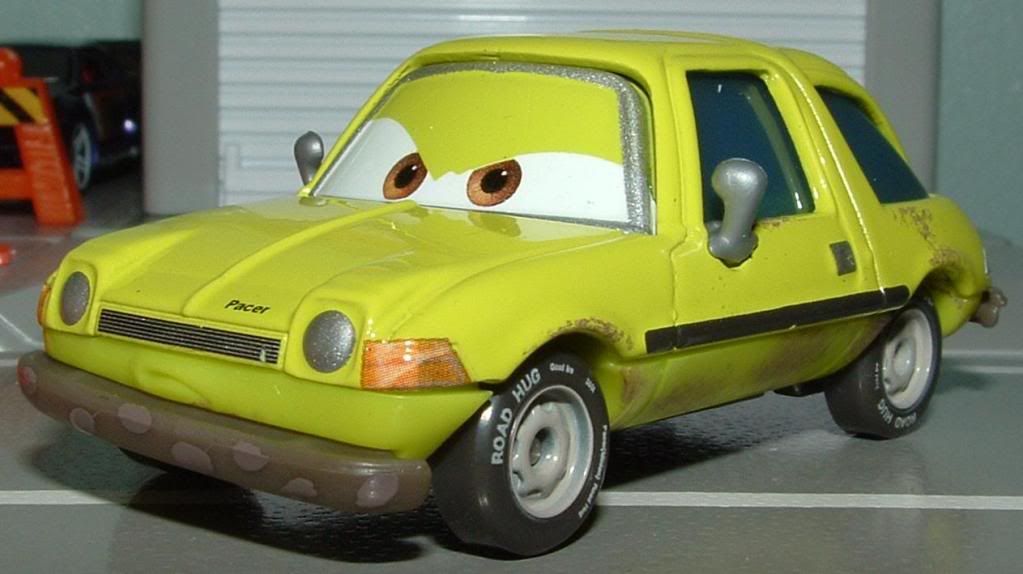
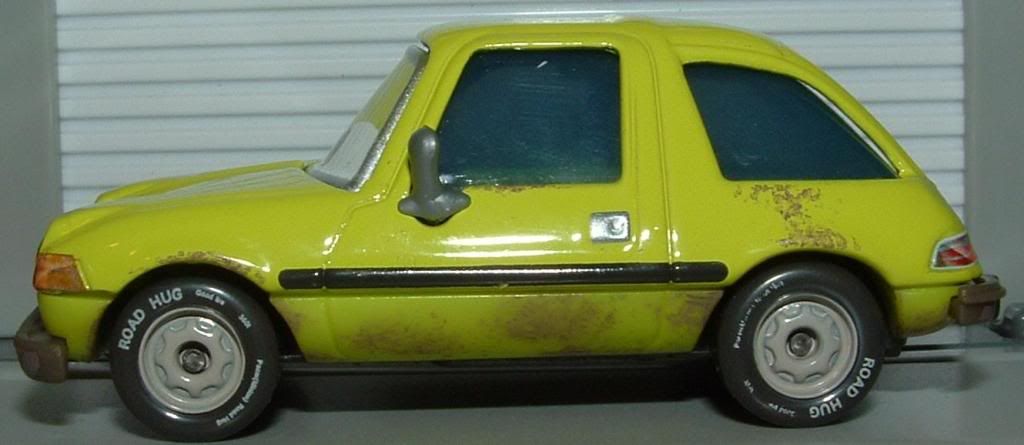
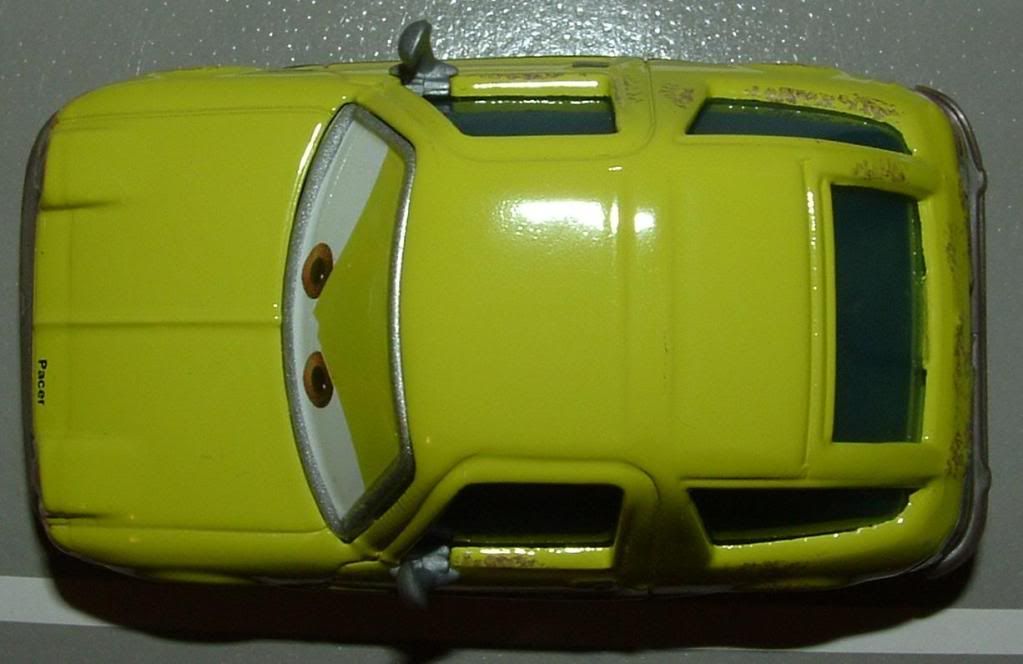
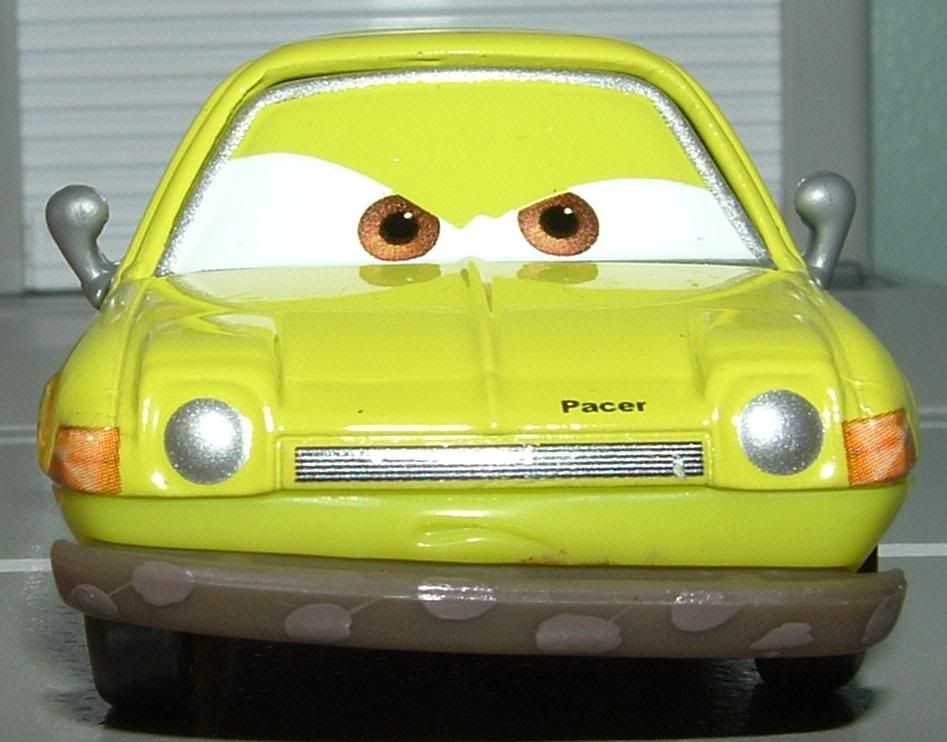
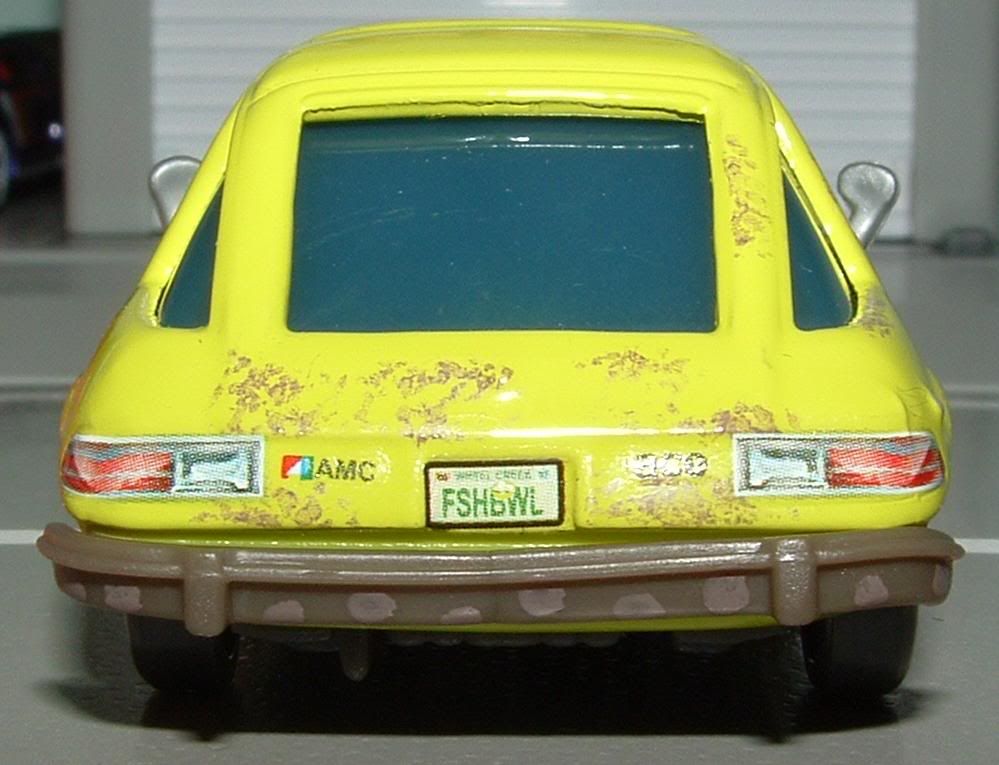
Today's car of the day is Mattel's Disney Pixar "Cars 2" 1975 AMC Pacer (Acer).


The AMC Pacer is a two-door compact automobile produced in the United States by the American Motors Corporation between 1975 and 1980. Its initial design idea was started in 1971. The car's unusual rounded shape with massive glass area greatly contrasted with the three-box architecture with "square, boxy designs" incorporating upright grilles and slab-sides of the era. The Pacer was described as "the seventies answer to George Jetson's mode of transportation" at a time when "Detroit was still rolling out boat-sized gas guzzlers." The large amount of glass led Car and Driver to dub it "The Flying Fishbowl". The Pacer's "jellybean" body style is a readily recognized icon of the 1970s.


For more information and pictures of the real car please visit: AMC Pacer


I was excited to stumble across some of the characters from the latest Pixar movie tonight.  I don't think I will be getting all of the cars for this movie, but I will be chasing after the ones that appeal to me.  And you all know me and AMC- so this one was a no brainer!  I do find it annoying that the AMCs serve as the enemies for this movie and are called lemons.  The '70s were a bad period for cars in general and American cars in particular, but the AMC offerings were better than their domestic competitiors (Pinto...KABOOM and Vega....rust anyone?).  But neither of those is distinctive-looking, something the AMC duo has in spades, so hence we end up with them as the villains.  I must admit that this round of "Cars" characters has resulted in some very realistic replicas!  The Gremlin and Pacer both in particular, but the vintage Topolino also counts.


AMC's chief stylist Richard A. Teague began work on the Pacer in 1971, anticipating an increase in demand for smaller vehicles through the decade.

Car and Driver magazine noted that "AMC said it was the first car designed from the inside out. Four passengers were positioned with reasonable clearances and then the rest of the car was built around them as compactly as possible."

Designed to appear futuristic, the shape was highly rounded with a huge glass area, and was very unusual for its time. Road & Track magazine described it as "fresh, bold and functional-looking".

Development was under Product Group Vice President Gerald C. Meyers, whose goal was to develop a car that was truly unique: "...everything that we do must distinguish itself as being importantly different than what can be expected from the competition..."

A number of futuristic ideas were explored by AMC. However, the automaker lacked adequate resources to build components from scratch and needed to use outside suppliers or adapt its existing parts and use its production facilities. Unique for a comparatively small car, the Pacer was as wide as a full-size American car of the era. Contrary to myth, it was not widened six inches (152.4 mm) to make room for the rear-wheel drive configuration. The editor of Road & Track asserted that front-wheel drive, as well as a transverse mid-engined configuration, were among "various mechanical layouts...tossed around by the idea people at AMC", adding that "it's unlikely they ever had much hope of being able to produce anything other than their traditional front engine and rear drive, using components already in production."

The introductory 1975 AMC advertising and literature proclaimed it as "the first wide small car". The width was dictated partly by marketing strategy—U.S. drivers were accustomed to large vehicles, and the Pacer's occupants had the impression of being in a larger car—and partly by the fact that AMC's assembly lines were already set up for full-size cars.

Also unique at the time, the passenger door was four inches (101 mm) longer than the driver's. This made passenger loading easier, particularly from the rear seats; and they would also tend to use the safer curb side in countries that drive on the right. Ford used this design element in the 1990s Ford Windstar minivan.
Teague's low-drag design, which predated the fuel crisis and the flood of small foreign imports into the American market, was highly innovative. Its drag coefficient of 0.43 was remarkably low for that time. Teague even eliminated rain gutters, smoothly blending the tops of the doors into the roof—an aerodynamic detail that, although criticized at the time for allowing rain onto the front seat, has become the norm in today's designs.

The Pacer was also among the first production cars in the U.S. to feature rack-and-pinion steering. The body was designed with the aim that structural lines protected it from hit damages, AMC engineers claimed that they succeeded in more than 50% of the car surface.

In the mid-1970s the U.S. government mandated major safety improvements for the 1980 model year, to include 50-mile-per-hour (80 km/h) front-end crash testing, 25-mile-per-hour (40 km/h) side crash testing and 30-mile-per-hour (48 km/h) rollover testing, as well as installation of bumpers to resist 5-mile-per-hour (8 km/h) impact at the front and 10-mile-per-hour (16 km/h) at the rear. The Pacer was designed to these specifications, and also had laminated safety glass in the windshield.

General Motors, Ford, and Chrysler persuaded the government that it was not financially viable to modify existing production cars to comply with the new regulations, and that instead each company would be put to the enormous expense of producing new, safety-compliant vehicles. Accordingly the government requirements were reduced, which led to the deletion of several safety features from the production Pacer—for example the roll bar over the passenger compartment, and the bump in the roof that accommodated it. The Pacer's remaining safety features were not strongly advertised, and seldom influenced a potential customer's purchasing decision. The car's extra weight—due in part to the safety equipment and the abundance of heavy glass—hurt fuel economy: production models tested by the United States Environmental Protection Agency (EPA) gave 16 miles per US gallon (15 L/100 km; 19 mpg-imp) in the city, but 26 miles per US gallon (9.0 L/100 km; 31 mpg-imp) or better on the highway (depending on driving habits and transmission), thanks to aerodynamic efficiency.

Originally the car was designed for a Wankel rotary engine. In 1973, AMC signed a licensing agreement with Curtiss-Wright to build Wankels for cars and Jeep-type vehicles. (The agreement also permitted Curtiss-Wright to sell rotaries elsewhere.) Later, AMC decided instead to purchase the engines from General Motors (GM), who were developing them for use in their own cars. However, GM canceled development in 1974 for reasons that included durability issues, the fuel crisis, tooling costs (for the engines and also for a new product line designed around the rotary's ultra-compact dimensions) and the upcoming (late 1970s) U.S. emissions legislation. It was also thought that the high-revving Wankel would not suit Americans accustomed to low revs and high torque.

General Motors's change of plans left the Pacer without an engine. American Motors took a calculated risk and introduced the new model. The company's over commitment to the project resulted in entrapment with so much money and effort in the car's design. Engineers hastily reconfigured it to accept their existing straight-six engine. This involved a complete redesign of drivetrain and firewall to keep the longer engine within the body dimensions designed for the Wankel, but allowed the Pacer to share many mechanical components with other AMC models.

The "outside of the box" thinking incorporated by AMC in the Pacer as the first "wide, small car" attempted to capture a revolutionary change in marketplace. However, a radical departure from what was accepted by consumers as "good styling" was a risky strategy. Only the largest firms can stick with a radical element until it "grows", and the automaker’s dominance in the marketplace may eventually establish it as a standard feature. However, the styling research axiom no longer applied by the late 1970s that if a car with some controversial styling was liked by at least half of the potential market segment; then chances were good that this feature was a differential advantage for the manufacturer. The AMC Pacer incorporated many controversial styling and design innovations led to its market failure after five model years. American Motors created the Pacer by identifying emerging trends and design technologies, but it faced a small window of opportunity since a product that comes out either too early or too late can fail even if the opportunity was there initially. A further complication was the purchasing dynamics and the Pacer's design was focused on maximizing the internal sense of space, while the market focused on external dimensions. Many of the attributes the Pacer incorporated became the goal of all manufacturers in the two decades that followed.
With an uncommonly wide and short body for a small car, the Pacer’s design is still considered controversial while its powerplants did not contribute to fuel economy. Nevertheless, “the foresight by Teague and AMC was correct” with approaches to meet the evolving U.S. government regulations covering automobiles (such as the Highway Safety Act of 1970 and the new National Highway Traffic Safety Administration).

Wednesday, May 18, 2011

Car Of The Day: May 18, 2011


Today's car of the day is Hasbro Transformer's 1981 Porsche 924 (Cliffjumper).


The Porsche 924 is an automobile produced by Porsche AG of Germany from 1976 to 1988. A two-door, 2+2 coupé, the 924 replaced the 914 as the company's entry-level model, and was the model that finally retired the 912. It was the first Porsche model powered by a water-cooled, front-mounted engine to make production easier, although the similarly-configured 928 was designed before the 924 these changes sped up production. The front-engine, rear wheel drive arrangement was normal for most other manufacturers, but it was unusual for Porsche having previously only used mid- or rear-mounted engines of a boxer configuration, all of which had been air-cooled. It was the first Porsche to be offered with a fully-automatic transmission.

The first official appearance of the 924 took place in November 1975 (as a press launch rather than a motorshow appearance) at the harbour at La Grande Motte, Camargue in the south of France. The model was a success and not only helped to take Porsche out of financial ruin, but created the revenue stream needed to continue building and developing the 911. The 924 was replaced by the 944 in 1983 in the U.S. market, but continued to be produced until 1985 for other markets.

For the 1986 to 1988 model years the car acquired the powerplant from the 944 model and became the Porsche 924S.


For more information and pictures of the real car please visit: Porsche 924 & Cliffjumper


Cliffjumper was among the main cast of characters in the original "Transformers" cartoon.  His transformation is simple and his car mode is.....as accurate as a Penny Racer.  For years I thought he transformed into a 3rd generation Trans Am, so that should say it all right there.


One of the retroactively-called 'Pre-Transformer' toys, the Cliffjumper mold was originally designed and released in 1983 in Japan by Takara as part of the Micro Change subset of their Microman line. The toy was designated simply `1981 'Porsche 924' (MC-01). Its "stubby" vehicle mode proportions were designed to resemble Takara's Choro-Q toyline (Penny Racers in the US). Following Hasbro's licencing of Takara toys for sale in the US, 'Cliffjumper' was released with the first wave of Transformers in 1984. A second side effect of the use of Takara overstock was that of a similar MicroChange mold (MC-02 Mazda Familia 1500 XG in yellow) being placed on Cliffjumper packaging. This toy was sometimes also found on Bumblebee cards, leading to fans referring to the character as Bumblejumper (BUMBLEbee + cliffJUMPER). The name was later officially shortened by Transformer fiction to simply Bumper. Cliffjumper was later remolded into the Series 3 mini-bot Hubcap.

Tuesday, May 17, 2011

SUV Of The Day: May 17, 2011


Today's car of the day is Majorette's 1984 Ford Bronco II.


The Ford Bronco II was a compact SUV sold between 1984 and 1990. It was commissioned as a smaller complement to the full-size Bronco as well as to offer a Ford alternative to the Chevrolet S-10 Blazer, Jeep Cherokee (XJ), and Toyota 4Runner. The Bronco II was Ford's first compact SUV since the original Bronco sold from 1966 to 1977. It is mechanically and (except in detail) structurally identical to the Ford Ranger. It had a 94-inch (2,388 mm) wheelbase and was enclosed in the rear. Unlike the Bronco, the Bronco II offered four wheel drive as an option (all full-sized Broncos were four wheel drive) and did not have a removable roof.


For more information and pictures of the real car please visit: Ford Bronco II


This was a recent purchase from pjedsel (thanks John!) and just arrived in the mail yesterday.  I dind't have an example of this casting in my collection, and this paint scheme was too nice to ignore.


The first Bronco II was developed in parallel with the Ranger from 1984 to 1988. The restyling of the Bronco II and Ranger started in 1989, but ended for the Bronco II with the end of production in February 1990, replaced by the larger Explorer. The restyling is marked not only by difference in physical appearance, but also improved structural support. 1990 models produced after November 1989 with four-wheel drive came equipped with the Dana 35 front axle, as opposed to the Dana 28 front axle used in earlier production.

The Explorer started where the Bronco II left off with a similar Ranger-based platform, sharing essentially the same front end, but with Ford's new 4.0 L OHV Cologne 155 hp (116 kW) V6 and a four-door model with a two-door Sport option. The Explorer kept to the Ranger based tradition until 1995 when it was overhauled with a major exterior restyling, and chassis modifications to allow the addition of Ford's 302 cu in (4.9 L) V8, and that was the end of the line for any reminisce of the Bronco II.

Ford would not market another compact SUV until the release of the Escape in 2001.


Majorette and Matchbox were the only two diecast companies to model the Bronco II, and both did it up as a 4x4 with monster truck tires, which were all the rage back in the 1980s as Bigfoot and USA-1 launched their campaign to crush every car in America.  Matchbox got the lines of the truck more accurate than Majorette, but Majorette gets kudos for the opening hatch, bouncy suspension, and also the detail they put into the front fascia.


Monday, May 16, 2011

Car Of The Day: May 16, 2011


Today's car of the day is Matchbox's 1993 Toyota Supra.


The Toyota Supra is a sports car/grand tourer that was produced by Toyota Motor Company from 1979 to 2002. The styling of the Toyota Supra was derived from the Toyota Celica, but it was both longer and wider. Starting in mid-1986, the Supra (in its third generation, Mark III) became its own model and was no longer based on the Celica. In turn, Toyota also stopped using the prefix Celica and began just calling the car Supra. Due to the similarity and past of the Celica's name, it is frequently mistaken for the Toyota Supra, and vice versa.

The Supra also traces much of its roots back to the Toyota 2000GT with the main instance being its engine. The first three generations were offered with a direct descendant to the Toyota Crown's and 2000GT's M engine. All four generations of Supra produced have an inline 6-cylinder engine. Interior aspects were also similar, as was the chassis code "A".

Along with this name and car Toyota also included its own logo for the Supra. It is derived from the original Celica logo, being blue instead of orange. This logo was used until January 1986, when the Mark III Supra was introduced. The new logo was similar in size, with orange writing on a red background, but without the dragon design. That logo, in turn, was on Supras until 1991 when Toyota switched to its current oval company logo. (the dragon logo was a Celica logo regardless of what color it was. It appeared on the first two generations of the Supra because they were officially Toyota Celicas. The dragon logo was used for the Celica line until it too was discontinued.)

In 1998, Toyota ceased sales of the Supra in the United States and in 2002 Toyota officially stopped production of the Supra in Japan.

As an iconic sports car, the Supra has appeared in numerous video games, movies, music videos and TV shows. Some of the most notable appearances include the Gran Turismo, Forza Motorsport, Need for Speed, and Midnight Club series of video games and the 2001 film, The Fast and the Furious.


For more information and pictures of the real car please visit: Toyota Supra


The long-awaited Swifty's Garage promo car is upon us at last!  For those following on the message board, you'll know this process started two years ago.  For those following us on the blog, this is probably a surprise.  The run is limited to fifty examples and pricing and ordering information will follow in a seperate thread as there are still a few details that need to be worked out.


With the new model of Supra, Toyota took a big leap in the direction of a more serious high performance car. Again using subframe, suspension and drivetrain assemblies from the Z30 Soarer (Lexus SC300/400), test model pre-production started in December 1992 with 20 models, and official mass production began in April 1993. The new Supra was completely redesigned, with rounded body styling and featured two new engines: a naturally aspirated Toyota 2JZ-GE producing 220 hp (164 kW; 223 PS) at 5800 rpm and 210 ft·lb (280 N·m) at 4800 rpm of torque and a twin turbocharged Toyota 2JZ-GTE making 276 hp (206 kW; 280 PS) and 318 ft·lb (431 N·m) of torque for the Japanese version. For the export model (America/Europe) Toyota upgraded the Supra turbo's engine (smaller, steel wheeled turbochargers, bigger fuel injectors, etc.). This increased the power output to 320 hp (239 kW; 324 PS) at 5600 rpm and 315 ft·lb (427 N·m) at 4000 rpm. The turbocharged variant could achieve 0–60 mph in as low as 4.9 seconds (0-62: 5.2 sec.) and 1/4 mile (402 m) in 13.3 seconds at 109 mph (175 km/h). The turbo version was tested to reach over 285 km/h (177 mph) all-stock, but the cars are restricted to just 180 km/h (112 mph) in Japan and 250 km/h (155 mph) elsewhere. European versions also had an air intake on the bonnet. Drag coefficient is .31 for the naturally aspirated models and .32 for the turbo models and N/A's with the rear spoiler.

The Mark IV Supra's twin turbos operated in sequential mode as opposed to parallel mode. Initially all of the exhaust is routed to the first turbine for reduced lag. This resulted in boost and enhanced torque as early as 1800 rpm, where it already had 300 lb-ft of torque. Approaching 3500 rpm, some of the exhaust is routed to the second turbine for a "pre-boost" mode, although none of the compressor output is used by the engine at this point. Approaching 4000 rpm, the second turbo's output is used to augment the first turbo's output. As opposed to the parallel mode, the sequential turbos provides quicker low RPM response and increased high RPM boost. (The Mazda RX-7 Twin Turbo also uses a sequential turbo setup, while the Nissan Skyline GT-R, 300ZX Twin Turbo and the Mitsubishi VR4 used a parallel setup.) This high RPM boost was also aided with technology originally present in the 7M-GE's in the form of the Acoustic Control Induction System (ACIS) which is a way of managing the air compression pulses within the intake piping as to increase power.
For this generation, the Supra received a new 6-speed Getrag/Toyota V160 gearbox on the turbo models while the naturally aspirated models made do with a 5-speed manual W58, revised from the previous version. Each model was offered with a 4-speed automatic with manual shifting mode. Turbo models were equipped with larger brakes and tires than naturally aspirated models. All vehicles were equipped with 5-spoke aluminium alloy wheels and a space saver spare tire on a steel wheel to save weight and space. Additionally, there are other differences such as the differential, headlight assemblies, throttle body, oil cooler.

Toyota took measures to reduce the weight of the current model compared to the previous model. Aluminium was used for the hood, targa top (if so equipped), front crossmember, oil and transmission pans, and the suspension upper A-arms. Other measures included hollow carpet fibers, magnesium-alloy steering wheel, plastic gas tank and lid, gas injected rear spoiler, and a single pipe exhaust. Despite having more features such as dual airbags, traction control, larger brakes, wheels, tires, and an additional turbo, the car was at least 200 lb (91 kg) lighter than its predecessor. The base model with a manual transmission had a curb weight of 3,210 lb (1,460 kg). The Sport Roof added 40 lb (18 kg) while the automatic transmission added 55 lb (25 kg). It had a 51:49 (front:rear) weight distribution. The turbo model came in as 3,417 lb (1,550 kg) with the manual and the automatic added another 10 lb (4.5 kg). Weight distribution was 53% front/47% rear. Among other two-seat Japanese sports cars of the era, the Supra was heavier than the spartan Mazda RX-7 and aluminium-bodied Acura NSX but weighs less than the Nissan 300ZX Turbo and the Mitsubishi 3000GT VR4.

For the 1996 model year in the U.S., the turbo model was only available with the automatic transmission due to OBD-II certification requirements. The targa roof was also made standard on all turbo models. For 1997, the manual transmission returned for the optional engine along with a redesign of the tail lights, headlights, front fascia, chromed wheels, and other minor changes such as the radio and steering wheel designs. All 1997 models included badges that said "Limited Edition 15th Anniversary". All turbo models came standard with the rear spoiler. Only minor updating was done for 1998. Along with a 3-spoke steering wheel, the radio was redesigned once again. The naturally aspirated engine was enhanced with VVT-i which raised the output by 5 hp (4 kW; 5 PS) and 10 ft·lbf (14 N·m) of torque. In Japan, the turbo engines were installed with VVT-i. The SZ-R model was also updated with the introduction of a six-speed Getrag V161 transmission, the same used for the twin-turbo RZ models.

The stock Mark IV Supra chassis has also proven an effective platform for roadracing, with several top 20 and top 10 One Lap Of America finishes in the SSGT1 class. Despite its curb weight, in 1994 the Mark IV managed a remarkable skidpad rating of 0.95 lateral g's (200 ft) or 0.98 lateral g's. (300 ft) The Mark IV Supra also featured a four-sensor four-channel track tuned ABS system with yaw control whereby each caliper is sensored and the brakes are controlled individually according to the speed, angle, and pitch of the approaching corner. This unique Formula One-inspired braking system allowed the Supra Turbo to record a 70 mph (113 km/h) -0 braking distance of 149 ft (45 m), the best braking performance of any production car tested in 1997 by Car and Driver magazine. This record was finally broken in 2004 by a Porsche Carrera GT, which does it in 101 ft (31 m).

Sales to Canada ceased in 1996, and to the US in 1998. The Turbo was not available in 1998 in CARB states. Production continued in Japan until August 2002, ceasing due to restrictive emission standards.


This model was produced by ColorComp and comes from their limited supplies of blanks that they still have left from when they did promos for Matchbox.  This car was never offered in this color in the Matchbox range, and the most common variant is a white with flames version.

Sunday, May 15, 2011

Car Of The Day: May 15, 2011


Today's car of the day is Hot Wheels' 2009 Honda S2000.


The Honda S2000 was a roadster manufactured by the Japanese automaker Honda Motor Company. It was launched in April 1999 and was created to celebrate the company's 50th anniversary. The car was first shown as a concept at the Tokyo Motor Show in 1995, following which it was launched in world markets in 1999. The S2000 is named for its engine displacement of 2 L, carrying on in the tradition of the S500, S600, and S800 roadsters of the 1960s. Several revisions were made throughout the car's lifetime, including changes to the engine, gearbox, suspension and interior and exterior. Officially two variants exist: the initial launch model was given the chassis code AP1, while the AP2 designation was given to vehicles produced from mid-2003 onwards. Though cosmetically similar, the AP2 incorporated significant changes to the drivetrain and suspension. Production of the S2000 ceased in June 2009.


For more information and pictures of the real car please visit: Honda S2000


With sales numbers like these, it's no wonder such a wonderful little roadster was scrapped.  The Miata apparently kicked it's rear bumper in the marketplace.  The Hot Wheels is a nicely done example of this car.


In the United States, the largest market for the S2000 worldwide, the suggested retail price of the base 2009 Honda S2000 was $34,995. The CR trim's base price was $36,995 with a $1,000 option to add air-conditioning and stereo.

In the United Kingdom, the 2009 model was offered in two trims, Roadster and GT. The GT trim featured a removable hard-top and an outside temperature gauge. On-the-road prices of these trims were £27,300 and £27,850, respectively.

After several years of steady production, sales of the roadster began falling dramatically starting in 2006, and the trend accelerated during the 2008 U.S. recession. In 2008, only 2,538 units were sold in the U.S. - a 74% decline from the 2002 sales peak. In November of that year, for the first time since its launch, fewer than 100 new S2000s were sold nationwide during a calendar month.