A blog focusing on 1/64 diecast from such popular brands as Hot Wheels, Matchbox, Johnny Lightning, M2 Machines, GreenLight, Tomica, Yat Ming, Majorette, MotorMax, Siku, Corgi, Guisval, Playart, Ertl, Zylmex, Racing Champions, & many more. Swifty's Garage features a daily Car Of The Day and news updates from your favorite brands!
Friday, December 23, 2011
Car Of The Day: December 23, 2011
Today's car of the day is Hot Wheels' 2005 Ford Shelby GR-1.
The Ford Shelby GR-1 was a 2.2 million dollar concept car that was created by the Ford Motor Company. It was first introduced at the 2005 North American International Auto Show. The GR-1 was created with the inspiration from the Shelby brand. It was inspired by and bears resemblance to the Shelby Daytona.
For more information and pictures of the real car please visit: Ford Shelby GR-1
A nice concept model from Hot Wheels. Pity Ford didn't put this into production as a replacement for the Ford GT
Much of the GR-1 chassis and running gear is based on the Ford Shelby Cobra Concept, which was presented one year earlier at the 2004 North American International Auto Show. As with the Ford Shelby Cobra Concept, GR-1 project was led by Manfred Rumpel and developed by Ford's Advanced Product Creation group.
The GR-1 uses a 6.4L all-aluminum V10 engine and also has certain components from the Ford GT. The GR-1 is rated up to 605 hp (451 kW) and up to 501 lb·ft (679 N·m) of torque. It uses a 6-speed manual transmission.
Thursday, December 22, 2011
Car Of The Day: December 22, 2011
Today's car of the day is Johnny Lightning's 1984 Oldsmobile Hurst/Olds.
Following the success of Hurst components in Oldsmobile's 442 models, Oldsmobile, in collaboration with Hurst Performance of Warminster, Pennsylvania, produced special-edition performance versions of the 442 or Cutlass Supreme, the Hurst/Olds.
For more information and pictures of the real car please visit: Oldsmobile Hurst/Olds
Hurst/Olds- two words that scream performance to this very day. Sadly, there will never be another new one as Oldsmobile is long gone.
After the Cutlass line was split between the front-wheel drive A-body Cutlass Ciera and the rear-wheel drive G-body Cutlass Supreme in 1982, GM again offered a limited-edition Hurst/Olds - it was the 15th anniversary of the first Hurst/Olds introduced in 1968. The Hurst Lightning Rod floor shifter was introduced in the '83 H/O. For its 15th Anniversary Edition, the '83 H/O came only in black with silver rocker panels. Chrome 15" wheels fitted Goodyear GT tires, and a power bulge hood and rear spoiler gave the car a purposeful look. A modified version of Oldsmobile's 307 CID V8 was installed, along with 3.73 gears and Hurst's radical Lightning Rods shifter. Dual exhausts with rumbling mufflers meant there was no mistaking the H/O for a garden variety Cutlass. A new style "Hurst/Olds" emblem was introduced, and red and silver stripes separated the black and silver paint. Demand for the car was very strong. Originally, 2500 units were scheduled to be produced, but Olds had to up that number to 3001 because of high demand. That may have been a factor in bringing the H/O back for '84. The paint scheme was reversed, with silver being the main body color, and black on the rocker panels. In most respects, the '84 was mechanically identical to the '83. The '84 did get a stronger 8.5" rear end. 3500 units were produced in 1984.
A fully loaded 1984 H/O model tipped the cash register at $19,500 (base price ~$11k).
The Johnny Lightning Projects In Progess series has always been a favorite of mine. I love total beaters as much as I like pristine condition cars.
Wednesday, December 21, 2011
Car Of The Day: December 21, 2011
Today's car of the day is Maisto's 1955 Chevrolet Nomad.
The Chevrolet Nomad was a station wagon model made off and on from 1955 to 1972, and a Chevy Van trim package in the late 1970s and early 1980s, produced by the Chevrolet Division of General Motors. The Nomad is best remembered in its two-door 1955–57 form, and was considered a halo model during its three-year production as a two-door station wagon.
For more information and pictures of the real car please visit: Chevrolet Nomad
This one is begging for the Stangfreak treatment. Racing slicks and a blower (or hoodscoop) to match the flamed paint scheme and the rollcage inside.
The two-door Nomad differed from other station wagons of the era by having unique styling more reminiscent of a hardtop sedan than that of a standard station wagon. Chevrolet shared this body with its sister Pontiac, which marketed their version as the Pontiac Safari.
The Nomad's unique design had its roots in a General Motors Motorama show car of the same name that was based on the Corvette. The Concept was introduced at the GM Motorama in 1954 as one of Head Stylist, Harley Earl's "dream cars".
GM approved production of the vehicle if the design could be transferred to its standard model, because top GM brass felt that they could sell more models if it were attached to the popular Bel Air model.
1955 Chevrolets received all-new styling. Advertised as "The Hot One," the boxy new Chevy was crisp, clean, and thoroughly modern-looking. Nomads, like Bel Airs, came loaded with interior carpet, chrome spears on front fenders, chrome window moldings, and full wheel covers. For 1955 Chevrolets gained a V8 engine option. The new 265 cubic inches (4,343 cc) cubic-inch V8 featured a modern, overhead valve high compression, short stroke design that was so good that it remained in production in various forms, for many decades. The base V8 had a two-barrel carburetor and was rated at 162 horsepower (121 kW), and the "Power Pack" option featured a four-barrel carburetor and other upgrades yielding 180 brake horsepower (130 kW). Later in the year, a "Super Power Pack" option added high-compression and a further 15 brake horsepower (11 kW). It had room for six passengers.
Tuesday, December 20, 2011
Car Of The Day: December 20, 2011
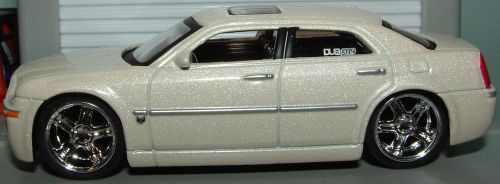
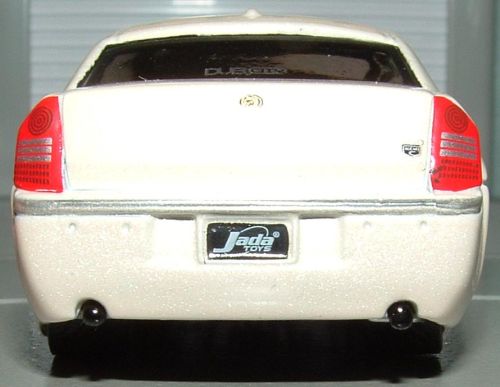
Today's car of the day is Jada's 2005 Chrysler 300C.
The Chrysler 300 is a full-size upscale car first shown at the 2003 New York Auto Show as a concept car. Sales in the U.S. began in the spring of 2004 as an early 2005 model year car. Designed by Ralph Gilles, the new 300 was built as a high-end sedan while the SRT-8 model was designed to be the high-performance version. The Chrysler 300 is also marketed in Australia, as the first full-size Chrysler vehicle sold there since the Valiant was discontinued in 1981. The car will be sold in Europe as the Lancia Thema beginning in October 2011. However, it will remain branded as the Chrysler 300 in the UK and Ireland only.
For more information and pictures of the real car please visit: Chrysler 300
This is what Jada does best. They should really stick to doing cars like this- a lot of rap stars and basketball players would be proud to drive this ride with the custom touches Jada has applied. They don't really float my boat all that much, but I do appreciate the tame paint scheme and since cars like this exist in the real world, they exist in my collection too.
The top-line 300C version uses a 5.7 L (345 cu in) Hemi V8. Using the Multidisplacement System (MDS), this engine can run on four cylinders when less power is needed in order to reduce total fuel consumption. The United States Environmental Protection Agency has rated the 300C as getting 15 miles per US gallon (16 L/100 km; 18 mpg-imp) city, 23 miles per US gallon (10 L/100 km; 28 mpg-imp) highway. When all eight cylinders are needed, the 300C can make 340 hp (250 kW) and 390 ft·lbf (530 N·m) torque. It uses a five-speed automatic transmission and comes standard with 18-inch chrome-clad alloy wheels, Chrysler's MyGIG Infotainment System in 2008 and SIRIUS Satellite Radio and Backseat Television in 2008. The HEMI engine includes a pushrod induction tube, located on the side of the engine-block. This tube makes the 300C more fuel efficient and quicker, because of the air being "pulled and pushed" into the engine's induction area. The engine uses the HEMI, or double rocker configuration, with a cam-in-block, overhead valve (OHV) pushrod design. There are two spark plugs per cylinder to assure complete fuel/air mixture burn and decrease emissions.
Monday, December 19, 2011
Car Of The Day: December 19, 2011
Today's car of the day is Matchbox's 2001 Smart Fortwo.
The Smart Fortwo is a rear-engined two-seater city car manufactured by Smart GmbH, introduced at the 1998 Paris Motor Show as the Smart City Coupé, and currently in its second generation. The name refers to its seat capacity.
In 2008, Smart debuted an all-electric concept, the Fortwo ed.
For more information and pictures of the real car please visit: Smart Fortwo
I know two people who own Smart cars. But despite that, they're an extremely rare sight on the roads around here and I've never seen either of the two I know about in person.
The Smart car allows back-in parking in otherwise parallel parking zones; its length of 250 cm (98.4 in) equals the width of a truck or a regular parking slot, allowing two or three Smarts to park in a standard space reserved for a single car. However, this type of parking has been banned in Munich, Germany, amongst other places. Such parking in parallel-designated spaces is illegal in most U.S.A jurisdictions.
Sunday, December 18, 2011
Car Of The Day: December 18, 2011
Today's car of the day is Revell's 1997 Pontiac Grand Prix.
The Pontiac Grand Prix is an automobile that was produced by the Pontiac division of General Motors. First introduced as part of Pontiac's full-size model offering for the 1962 model year, the Grand Prix name was also applied to cars in the personal luxury car market segment and the mid-size offering, slotting below the large Bonneville in the company's lineup.
For more information and pictures of the real car please visit: Pontiac Grand Prix
This is one of the cars that survived my basement flooding. As hard as it is to believe, this was mint in package back in September. I know, me keeping a car confined to packaging for fourteen years is unheard of! But for some reason this one never got DLMed when new and ended up in my basement, forgotten. It managed to fall from its hiding place after the flood abated and I found it laying in a damp patch on the floor. I immediately DLMed it and got rid of the wet packaging. However, as I'm looking at these pictures I can't help but wonder if that's mold over the #18 on the passenger side of the car. Bobby Labonte is from Texas and this car was run at the first race in Texas since he had been driving in the Winston (now
In 1997, the W-bodies received a major redesign. The first 1997 Grand Prix was built on August 12, 1996. Promoted for its "wide track" appearance and racy styling, the second generation W-body Grand Prix sold well. There were 2 trim levels available in 1997; the SE, GT (GT available in coupe and sedan body styles). The Grand Prix came as a base SE sedan or a sportier GT coupe and sedan, as well as with a high-performance GTP package—available for GT models in either body style. Coupes and sedans shared similar styling, except for rear doors and quarter panels. The GTP was an option package under the GT trim level and later became its own trim level. The base engine on the SE was the only engine carried over from the previous generation, the 3.1 liter V6. The GT had a 3.8 liter V6 (3800 Series II) which was an option on the SE. The 3800 Series II was on the Ward's 10 Best Engines list for 1995 through 1997. The GTP added an Eaton M90 supercharger (also used in the 1996-2003 Bonneville) to the 3.8 liter, boosting power from 195 hp (145 kW) to 240 hp (179 kW). GTP trim level featured a "performance shift" button on the shifter that raised the transmission shift points. Also standard was a tire-pressure monitor. The 6-passenger seating configuration with a front bench seat and column-mounted gear shift in the Grand Prix and its sister cars the Buick Regal and Oldsmobile Intrigue (formerly Cutlass Supreme) was discontinued.
Saturday, December 17, 2011
Car Of The Day: December 17, 2011
Today's car of the day is Poliguri's 1983 Fiat Uno.
The Fiat Uno is a supermini car produced by the Italian manufacturer Fiat. The Uno was launched in 1983 and built in its homeland until 1995, with production still taking place in other countries.
For more information and pictures of the real car please visit: Fiat Uno
It's been quite some time since we've had something really unique for Car Of The Day. So today I present a forgotten boxy hatchback by an obscure Portugese diecast firm that's been defunct for over two decades.
The Uno was launched in January 1983 to replace the ageing Fiat 127. Designed by Giorgetto Giugiaro's ItalDesign company, its tall, square body utilising a Kamm tail achieved a low drag coefficient of 0.34 won it much praise for airy interior space and fuel economy. It incorporated many packaging lessons learnt from Giugiaro's 1978 Lancia Megagamma concept car (the first modern people carrier / MPV / mini-van) but miniaturised. Its tall car / high seating packaging is imitated by every small car today. It reversed the trend for lower and lower built cars. It showed that not just low sleek cars could be aerodynamic, but small, roomy, boxy well packaged cars could be too. In 1984 it was voted European Car of the Year.
Initially, the Uno was offered with the 0.9 litre (903 cc) OHV, 1.1 litre (1116 cc), and 1.3 litre (1301 cc) 138-series SOHC petrol engines and transmissions carried over from the 127. The 1.3 (1300 cc) diesel (not for the UK market) engine was launched a couple of months later. The Uno's badging was not by the commonly used measurement of engine size but by metric horsepower: 45, 55, 60, 75 or 90. The Uno was available as either a 3 or 5-door hatchback. It also featured ergonomic "pod" switchgear clusters each side of the main instrument binnacle, (that could be operated without removing the driver's hands from the steering wheel), although indicators remained on a stalk; an unusual arrangement similar to that used by Citroen.
The Uno had MacPherson strut independent front suspension and twist-beam rear suspension with telescopic dampers and coil springs.
From 1985, the 1.0 litre (999 cc) SOHC Fully Integrated Robotised Engine (FIRE) powerplant was offered. This was a lighter engine, built with fewer parts, and gave improved performance and economy. Also in 1985, the hot hatch version - Uno Turbo - was launched, with an IHI turbocharged Ritmo/Strada-derived 1.3 146-series engine, initially offering 105 PS (77 kW). It was priced to compete with the Peugeot 205 GTI. The Turbo variant offered phenomenal performance for a supermini-sized car and was capable of reaching 210 km/h (130 mph).
In 1987, a 1.7 litre diesel engined version - the 60DS -was launched.
Also in 1987, the Uno Selecta continuously variable transmission (CVT) automatic was launched. The CVT transmission was a co-development with Dutch Van Doorne and Ford, (Fiat owned 24% stake of Van Doorne at that time). The Selecta transmission should be avoided according to honestjohn.co.uk, which claims it can cause expensive repairs.
The car is still sold in Brazil in three versions: Mille Economy, Uno Furgão and Fiorino Furgão.
In the second half of the 1980s and the first half of the 1990s, the Uno had a sedan, a pick-up and a wagon version, called Prêmio, Fiorino Pick-Up and Elba, respectively.
The Brazilian Uno featured an independent, transverse leaf spring suspension at the rear, based on the tried and tested Brazilian Fiat 147 (similar to the Italian Fiat 127). The design of the hood was also unique, since the Brazilian Uno kept the spare tire located in the engine bay, like the old Fiat 147, and saving extra space for the luggage in the trunk.
The Fiat Uno family, in Brazil, had a turbocharged 1.4-litre four inline sports version in the middle 1990s. This car was sold as a normal production vehicle with 1801 units produced.
From the end of the 1990s to the middle 2000s, the car was sold as the Fiat Mille, as a budget entry-level model, and received its most recent facelift for the 2004 model year. The 2005 Brazilian range has received a Flex Fuel system, enabling the car to use ethanol or gasoline as fuel, both pure or in any proportion mixture; also, there is a version fitted for unpaved roads called Mille Way, which includes a more resilient suspension, larger wheels and side cladding. From April 1988 until 2006, up to 2,000,000 Fiat Unos were made in Brazil.
The year 2010 reserved a surprise for Uno fans: Brazilian Fiat started the production of a new Uno - actually, a Brazilian version of the European Fiat Panda, with two options of body (2 and 4 doors) and two kinds of Flex Fuel engine (1.0 and 1.4). But this new Uno is going to live together with the old one until 2014, when Brazilian's market will finally demand mandatory air bags in every new vehicle, and the 1980s design of the first Uno does not allow the installation of air bags.
Friday, December 16, 2011
Car Of The Day: December 16, 2011
Today's car of the day is Hot Wheels' 1970 Oldsmobile 442.
The Oldsmobile 442 (pronounced four-four-two) was a muscle car produced by the Oldsmobile division of General Motors. It was introduced as an option package for F-85 and Cutlass models sold in the United States beginning with the 1964 model year. It became a model in its own right from 1968 to 1971, then reverted to an option through the mid-1970s. Oldsmobile revived the name in the 1980s on the rear-wheel drive Cutlass Supreme and early 1990s as an option package for the new front-wheel drive Cutlass.
For more information and pictures of the real car please visit: Oldsmobile 442
A remake of the original Olds 442 casting from the Redline era, this one features an opening hood. The original Hot Wheels 442 also did police & fire chief duty and this remake is no slouch when it comes to protecting & serving.
1970 was the pinnacle of performance from Oldsmobile. In order to keep up in the horsepower arms-race, General Motors dropped the cap on engine size in 1970, and Oldsmobile responded by making the Olds 455 V8 the standard 442 engine. Magazine ads using an offbeat mad scientist trumpeted "Dr. Olds introduces as large a V-8 as ever bolted into a special-performance production automobile!" Output was 365 hp (272 kW) and 500 lb·ft (680 N·m), with a 370 hp (276 kW) variant available with the W30 option. A common practice of the era was to under-rate engine horsepower, and the big 455s were reported to actually dyno in excess of 400 hp (300 kW). The revised body style and increased performance resulted in the 442 being awarded pace car duties at the Indianapolis 500 race in 1970. Motor Trend praised the 442, stating that "it's probably the most identifiable super car in the GM house".
Those seeking to experience the ultimate in performance from Lansing could order a "W-Machine" version of the 442, dubbed the W-30 package. The 442 W-30 added a fiberglass hood (option W25) with functional air scoops and low-restriction air cleaner, aluminum intake manifold, special camshaft, cylinder heads, distributor, and carburetor. Two W-30 equipped 442 Vista Cruisers were produced by special order.
Motor Trend tested a 442 W-30 with a 4-speed manual transmission and 3.91:1 rear gears, clocking a quarter mile time of 14.2 seconds @ 102 mph (164 km/h). However, Motor Trend noted that Oldsmobile engineers had earlier posted a best of 13.7 seconds on the same test car with a fresh tune.
New options for the 1970 442 included GM's Variable-ratio power steering (option N47), a console-mounted Hurst Dual/Gate shifter for use with the Turbo Hydra-matic transmission, and aluminum differential housing and cover (option W27). All Oldsmobile V8s received new Positive Valve Rotators for 1970s to increase engine valve life.
1970 Model Year Spotting Tips: Vertical bars in silver grille, rectangular parking lights in front bumper, vertical tail lights.
A 1970 Oldsmobile 442 was featured in the chase scene of the movie Demolition Man starring Sylvester Stallone.
Subscribe to:
Posts (Atom)