Showing posts with label Action. Show all posts

Thursday, July 19, 2012

Car Of The Day: July 19, 2012


Today's car of the day is Action's 1985 Chevrolet Camaro ASA (American Speed Association) stock car as driven by Darrell Waltrip.


Darrell Lee Waltrip (born February 5, 1947) is a 3-time NASCAR Cup Series champion (1981, 1982, 1985), 3-time runner-up (1979, 1983, 1986), winner of the 1989 Daytona 500 and 5-time winner of the prestigious Coca-Cola 600 (formerly the World 600), (1978, 1979, 1985, 1988, 1989, a record for any driver, all time). He posted a modern series record of 22 top five finishes in 1983, and 21 top five finishes in both 1981, and 1986. Waltrip is the winner of 84 Cup Series races, including seven consecutive wins at Bristol Motor Speedway, (a record for any driver, all-time), placing him second to Jeff Gordon for the most wins in the modern era of NASCAR, and tied with Bobby Allison for fourth on the all-time list. He is winner of 59 Cup Series pole positions (second all-time), including 35 on short tracks, and 8 on road courses (both all-time highs in the series). He has 271 top-five finishes, 390 top-ten finishes, and competed in 809 Cup Series races spanning 29 years (1972–2000).

In addition to NASCAR's top racing series, he has won 13 NASCAR Busch Grand National Series races, 7 American Speed Association (ASA) races, 3 IROC races, 2 Automobile Racing Club of America (ARCA) races, 2 NASCAR All-American Challenge Series events, 2 All Pro Racing Association races, a USAC race, and has competed in the 24 Hours of Daytona, a 24-hour sports car endurance race. Waltrip also holds the all-time track record with 67 wins at the Music City Motorplex, formerly Fairgrounds Speedway, in Nashville, Tennessee, counting NASCAR, USAC, ASA, and local track races.

Waltrip also became the first NASCAR driver to win $10 million (February 18, 1990). He is a 2-time winner of NASCAR's Most Popular Driver Award, (1989, 1990), was "American Driver of the Year", (1979, 1981, 1982), and was "NASCAR's Driver of the Decade", (1980s). In addition, he was the "National Motorsports Press Association Driver of the Year", (1977, 1981, 1982), the "Auto Racing Digest Driver of the Year", (1981, 1982) and the first "Tennessee Professional Athlete of the Year", (1979). He is a 2003 Motorsports Hall of Fame of America inductee and a 2005 International Motorsports Hall of Fame inductee, and was announced in July, 2009, as one of the initial 25 nominees for the inaugural NASCAR Hall of Fame induction class of 2010. Waltrip was named one of NASCAR's 50 Greatest Drivers (1998), and was awarded the Bill France "Award of Excellence", in 2000. On July 1, 2010, Waltrip was again nominated for the 2011 induction class of the NASCAR Hall of Fame. On July 14, 2011, it was announced that Waltrip, in only his third year of eligibility, will be inducted as one of the five members of the class of 2012, one of only nine top series Nascar drivers to be inducted to the NASCAR Hall of Fame thus far.

Waltrip currently owns Honda, Volvo and Subaru auto dealerships in Franklin, Tennessee, and is a lead television analyst and race commentator with Fox Broadcasting Company and Speed TV, a columnist at Foxsports.com and an author. He is the older brother of NASCAR driver and MWR team owner Michael Waltrip. He is married, has two daughters, and resides in Franklin, Tennessee.


For more information and pictures of the real car please visit: Darrell Waltrip & Chevrolet Camaro


I have been unable to determine what year Darrell raced this car.  Probably sometime between 1982-85 would be my guess but with the forum down I have no way of getting ahold of Ward (69Stang) or Billy Kingsley, both of whom would know the answer.


The third-generation Chevrolet Camaro was introduced for the 1982 model year. It continued to use General Motors's F-body platform and would produce a "20th Anniversary Commemorative Edition" for 1987 and "25th Anniversary Heritage Edition" for 1992. These were also the first Camaros with factory fuel injection, four-speed automatic transmissions, five-speed manual transmissions, four-cylinder engines, 16-inch wheels, and hatchback bodies. The third-generation Camaro continued through the 1992 model year.

Saturday, April 21, 2012

Race Car Of The Day: April 21, 2012


Today's car of the day comes from Firehawk73's collection and is Action's 1975 Chevrolet Monza funny car.


The Chevrolet Monza is a subcompact, four-passenger automobile produced by the Chevrolet division of General Motors for the 1975–1980 model years. The Monza is based on the Chevrolet Vega, sharing its wheelbase, width and 140 CID (2300 cc) inline-4 engine. The 1975 Monza 2+2 was designed to accommodate the GM-Wankel rotary engine, but due to mediocre fuel economy and emissions compliance issues the engine was cancelled, and a fuel-efficient 4.3 liter V8 engine option was substituted.

The Monza 2+2 and Monza Towne Coupe competed with the Ford Mustang II and other sporty coupes.  H-body variants Buick Skyhawk and Oldsmobile Starfire were produced using the Monza 2+2 body with grill and trim variations and Buick's 3.8 liter V6 engine. The Pontiac Sunbird variant was introduced the following model year, eventually offered in both Monza body styles. The Monza nameplate originated in mid-1960 for the sporty version of the Chevrolet Corvair.


For more information and pictures of the real car please visit: Chevrolet Monza


The Monza 2+2, Chevy's sporty successor to the Vega debuted as the single-model 2+2 hatchback. The Monza is 4 inches (100 mm) longer and weighs 180 pounds more than the Vega from which it is derived.  John DeLorean nicknamed it the Italian Vega citing styling with a strong resemblance to the Ferrari 365 GTC/4.

The 1975 Monza was initially slated to introduce the GM Wankel rotary engine which is licensed from NSU. Notable rotary issues included mediocre fuel economy compounded at a time of comparatively high fuel prices following the Arab oil boycotts of 1973 and 1974, and GM canceled the engine. Thus the 1975 Chevrolet Monza was launched carrying conventional piston engines instead.

The 1975 Monza 2+2 wore its newly approved rectangular headlights and a slot-style grille in a slanted nose made of resilient urethane. The side window louvers are functional, part of the flow-through ventilation system. The Monza 2+2's two-door hatchback body style was shared with the Oldsmobile Starfire and Buick Skyhawk. The standard Monza engine was the Vega aluminum-block 140 CID (2.3 liter) inline-4 engine with a single barrel carburetor generating 78 horsepower (58 kW) at 4200 rpm. Optional was the 2-barrel carburetor version that generates 87 horsepower (65 kW) at 4400 rpm. Chevrolet's new 4.3 liter (262 cid) V-8 engine was optional. The smallest V8 ever offered by Chevrolet, it features a Rochester 2-barrel carburetor and generates 110 horsepower (82 kW) at 3600 rpm. For 1975 only, Monzas sold in California and high altitude areas met the stricter emissions requirnment by substituting a version of the 5.7 liter (350 cid) V8 engine with a 2-barrel carburetor tuned to just 125 hp (93 kW). The Monza 2+2 and its Buick and Oldsmobile variants feature GM's first use of a torque arm rear suspension, also adopted for the 1975 Cosworth Vega introduced mid-1975, and later, all 1976-77 Vegas and Pontiac Astres. The basic design was also incorporated into GM's third and fourth generation F-bodies, Chevrolet Camaro and Pontiac Firebird.

In April 1975, the Monza Towne Coupe was introduced - a notchback body-style with a conventional trunk featuring different sheetmetal than the 2+2 hatchback, although sharing its windshield, front fenders, and doors. It features single round headlamps, instead of the dual rectangular headlamps on the 2+2. The Towne Coupe was offered in response to the sales success of the Ford Mustang II notchback coupe and its luxury version, the Mustang II Ghia. The Towne Coupe is 1.5 inches (38 mm) shorter and 135 pounds (61 kg) lighter than the 2+2 and has slightly more rear head room. A lower priced "S" version of the 2+2 Hatchback was introduced mid-year. It featured as standard the Vega 1-barrel engine with a 3-speed manual transmission. The sport suspension, full console, sport steering wheel, day/night and wheel opening moldings were deleted on the "S". The Chevrolet Monza 2+2 won Motor Trend magazine's "Car of the Year" award for 1975.

Wednesday, January 11, 2012

Race Car Of The Day: January 11, 2012


Today's car of the day is Action's 1980 Ford Thunderbird NASCAR stock car (as driven by Neil Bonnett).


1980 saw a new downsized Thunderbird that was an upmarket derivative of the Ford Fairmont sedan with nicer trim. The 1980 Thunderbird was a unibody car, weighing 800 lb (363 kg) less than the 1979 model, and was 17 in. (432 mm) shorter. It was based on the Fox platform, and the lighter weight resulted in better gas mileage.

These cars were not well received by the general public, and sales dropped off dramatically after 1980. The squarish upright lines favored by Ford design vice-president Eugene Bordinat, similar to the popular 1977-79 models, didn't translate well to the smaller platform.

The base engine was a 4.2 L (255 cu in V8), or an optional 140 hp (104 kW) 5.0 L (302 cu in) Windsor V8. A 3.3 L (201 cu in) I6 was offered as a delete option in late built 1980 models and became the standard powerplant in 1981. The 3.8 L (232 cu in) V6 was made available as an option in 1982, and the 4.9 L (302 cu in) Windsor 5.0 V8 was dropped.

The 1980 and 1982 Thunderbirds offered vacuum operated hidden headlamps. Digital instrumentation was also available, along with a variety of trim packages. The 1980 Thunderbird was also among the first cars with a keyless entry keypad available. Recaro bucket seats were optional, and power windows were available.

In 1980, Thunderbird was offered as a "Silver Anniversary Edition" model commemorating the 25th anniversary of the car. The external color scheme was called "Anniversary Glow Silver" and the interior was a silver/gray velour with optional leather available. The standard list of features was very comprehensive including the 302 V-8 as standard, as well as a host of luxury trim and convenience options above what the "Town Landau" model offered. Standard features included a garage door opener and a unique landau roof treatment with unique trim and exterior model designation badging.


For more information and pictures of the real car please visit: Ford Thunderbird & Neil Bonnett


This is a recent purchase from 69Stang (thanks Ward!).  I'm one of the few people that likes this generation Thunderbird.  I prefer the '77-'79 'Birds but the '80-'82s are nice too.


Lawrence Neil Bonnett (July 30, 1946 - February 11, 1994) was a NASCAR driver who compiled 18 victories and 20 poles over his 18-year career. The Alabama native currently ranks 35th in all-time NASCAR Cup victories. He appeared in the 1983 film Stroker Ace and the 1990 film Days of Thunder. He was a color commentator in the years up until his death.

Neil Bonnett began his NASCAR career as a protégé of 1983 Winston Cup champion Bobby Allison, working on the team's cars. He later became part of the famous "Alabama Gang" that included himself, Red Farmer and the Allison family: father Bobby, brother Donnie and, later, son Davey. He began driving in NASCAR in 1974 and earned his first victory in 1977 at the Capital City 400 in Richmond, Virginia driving for Harry Hyde/Jim Stacy Racing. He had another victory in 1977 at the Los Angeles Times 500, which would be the last Dodge win in NASCAR until 2001. Many in racing circles thought 1978 would be his year to dominate, but troubles with his cars (the new for 78 Dodge Magnum) and financial problems between Hyde and Stacy caused his cars to fail and to drop out of many races. In 1979 he hooked up with the Wood Brothers Racing Team and got his career back on track with three victories. He later won back-to-back World 600s (NASCAR's longest race, now the Coca-Cola 600) and back-to-back Busch Clash (now Bud Shootout) victories in 1983 and '84, including his first in which he did not win a single pole from the previous season, but was selected as a wild card entry.

In 1984, Bonnett joined Junior Johnson's team, becoming a teammate to Darrell Waltrip. In 1985, Bonnett had one of his best seasons, finishing fourth in the points standings while Waltrip went on to win his third championship.

Bonnett participated in International Race of Champions (IROC) during three seasons (1979, 1980, and 1984), and finished second twice.

On April 1, 1990, Neil Bonnett suffered a life-threatening crash during the TranSouth 500 at Darlington, South Carolina when his car hit the water barrels in front of pit road drivers-side first. Left with amnesia and dizziness, Bonnett retired from racing and turned to television, becoming a race color commentator for TNN, CBS Sports, and TBS Sports, and hosting the TV show Winners for TNN.

However, Bonnett still desired to continue racing. In 1992, he began testing cars for good friends Dale Earnhardt and car owner Richard Childress. Cleared to race again in 1993 and upon Earnhardt's suggestion, Childress gave Bonnett a ride for the 1993 DieHard 500 at Talladega Superspeedway which was numbered 31 and sponsored by Mom and Pop's, one of Earnhardt's associate sponsors. But Bonnett's comeback race was marred by a crash in which his car spun, became airborne, and crashed into the spectator fence. Bonnett was uninjured and called the rest of the race from the CBS broadcast booth after being cleared at the infield care center. He would also start the final race of the 1993 season in Atlanta, but he dropped out after just three laps. The reason the team gave for removing the car from the race was a blown engine, however Bonnett was teamed with points leader Dale Earnhardt, and the car was retired to assist Earnhardt in winning the season's championship. Earnhardt needed to maximize his finishing position, and by Bonnett quitting the race he was assured of those three championship points. That would be Bonnett's final cup start of his career.

Friday, November 25, 2011

Funny Car Of The Day: November 25, 2011


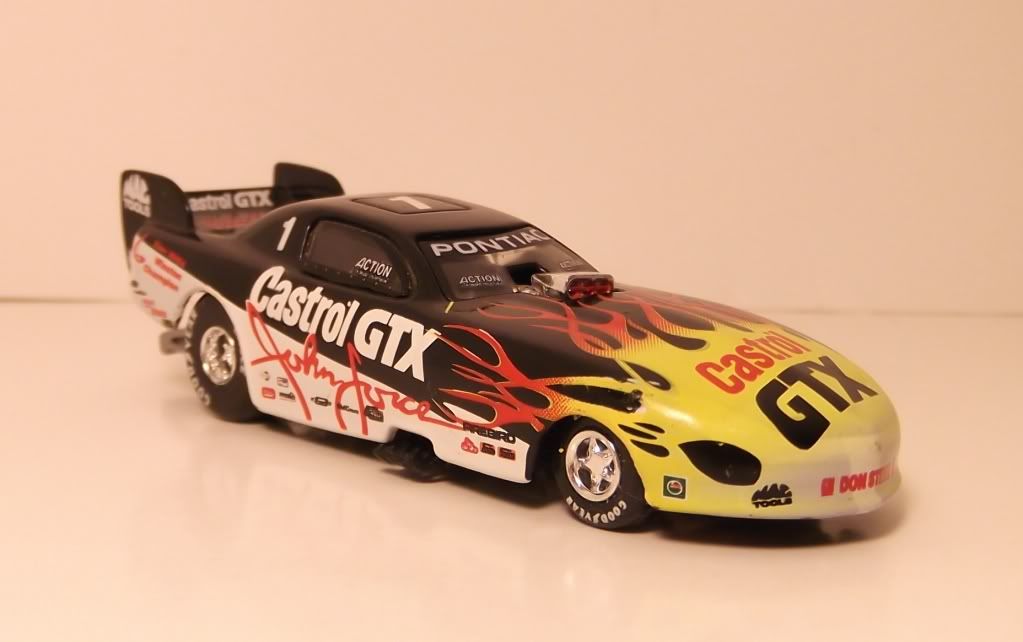
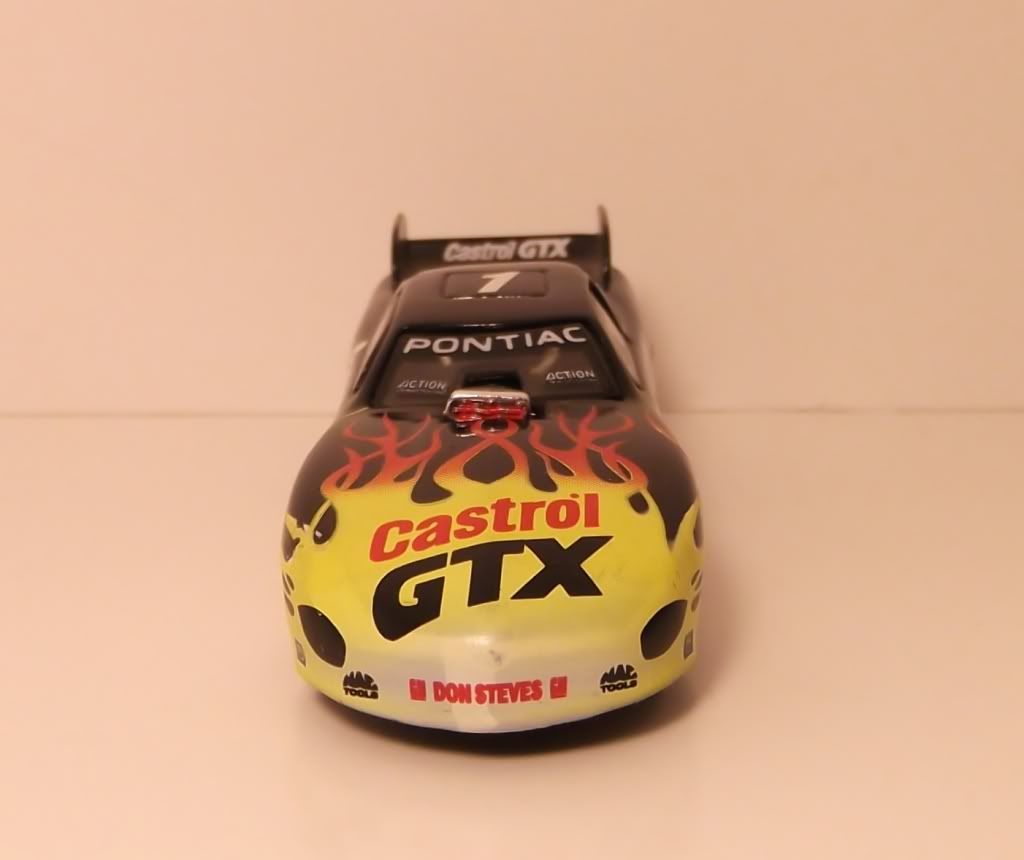
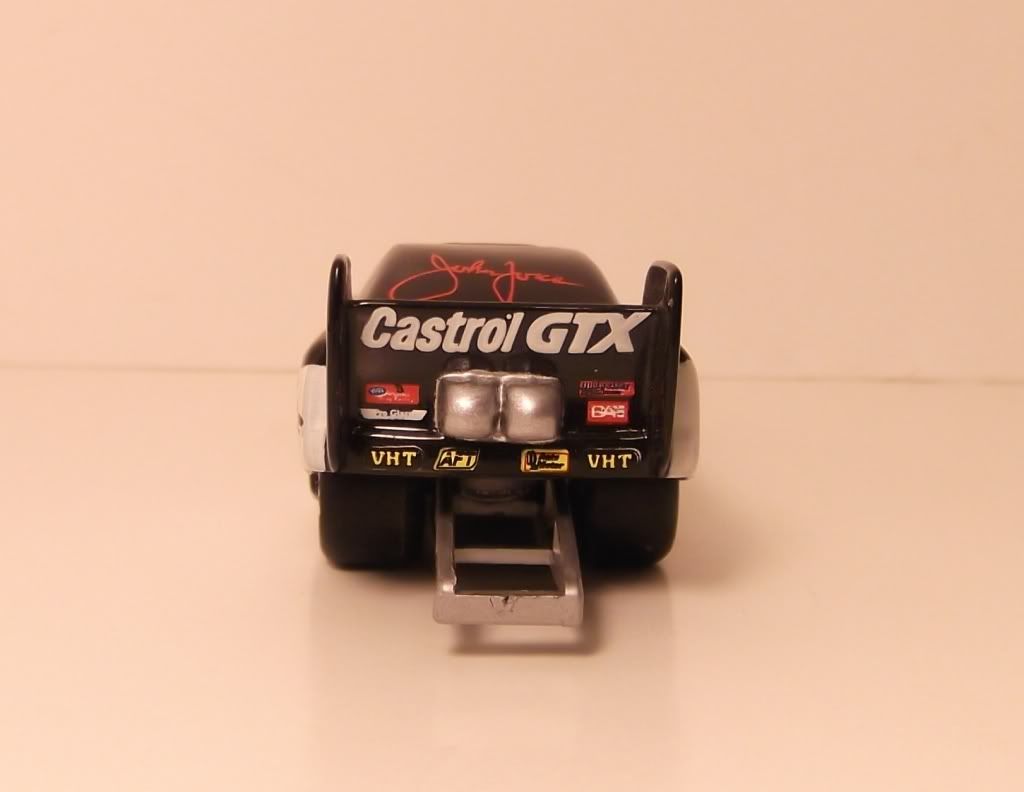
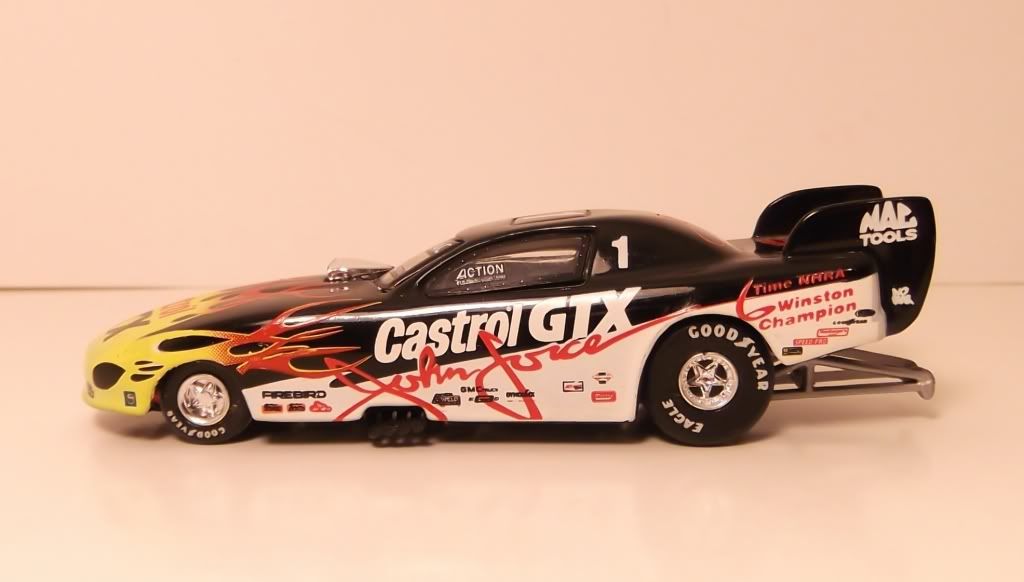
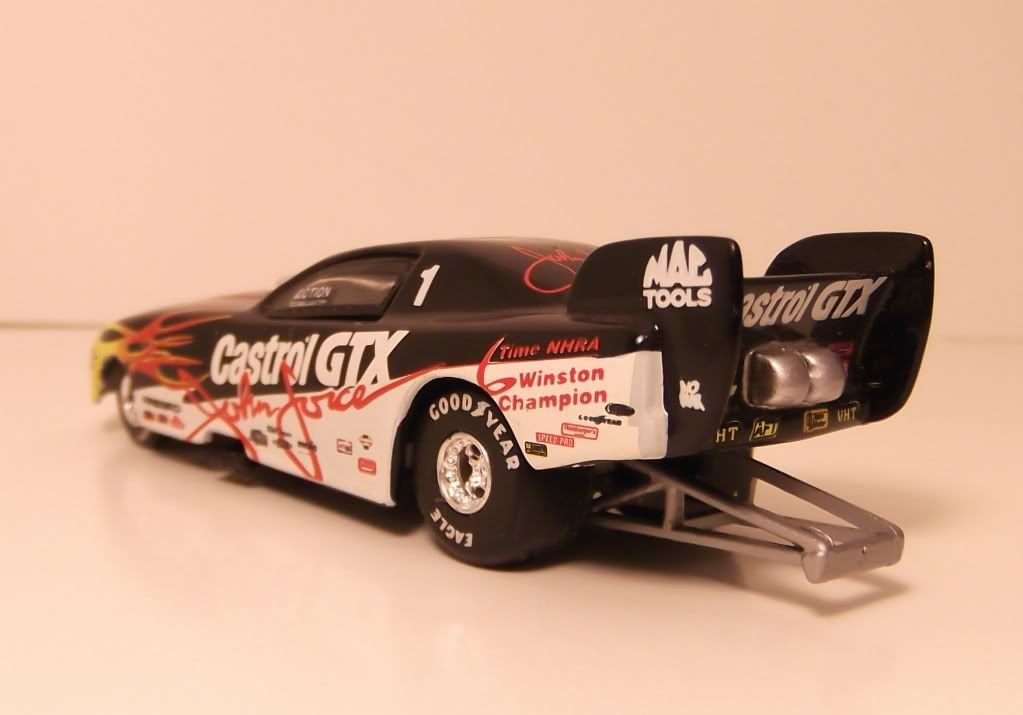
Today's car of the day comes from Firehawk73's collection and is Action's 19960 Pontiac Firebird funny car.


The fourth-generation F-body continued the aerodynamic formula initiated by the previous generation, but saw declining sales. As before, the Camaro kept the exposed headlights and the Firebird its pop-up units, with some minor changes. The overall styling of the Firebird more strongly reflected the "Banshee IV" concept car than the 1991 "face lift" received by the Third Generation model.


For more information and pictures of the real car please visit: Pontiac Firebird


We're celebrating Thanksgiving week with A Flock Of Seagulls Firebirds.  I can see you standing outside, see your shadow on the wall by a street lamp.  I've got a manual instructing my brain.  I turn around, cover eyes, I see you.  While the odds are still good that I run out of A Flock Of Seagulls songs to reference before Paul runs out of Firebirds... Yeah, anyone still buying that?  With one day left I don't think that's a concern now.


Firebirds were used in the Trans-Am series in the 1960s and 1970s. When the Pontiac Trans Am came out, there was controversy over the model's inability to compete in the Trans-Am because the smallest available engine was too large for use in the series at 400 cubic inches (6.6 liters). The name also caused controversy because it was used without permission from the SCCA, who threatened suit. GM settled the dispute by paying US$5 to the SCCA for every car sold. When the Trans-Am was last seen, model year 2002 Firebirds were in use. Firebirds were used in the IROC Series until it folded after the 2006 season.

During the 1995, 1996, and 1997 NHRA seasons, 14-time Funny Car champion John Force used a Firebird body to replace the obsolete Oldsmobile Cutlass and Chevrolet Lumina body he had used since 1988. He used it for three seasons, winning the championship in all three years. The Firebird body also replaced the Oldsmobile Cutlass in the Pro Stock class in 1995, forcing drivers Warren Johnson, Jerry Eckman, and Mark Pawuk to replace their body styles for the 1996 year, none of them would win with the first year of the Firebird body, but Pro Stock driver Jim Yates, a second year driver, using the Firebird body, would.