Showing posts with label GreenLight. Show all posts

Wednesday, October 24, 2012

SUV Of The Day: October 24, 2012


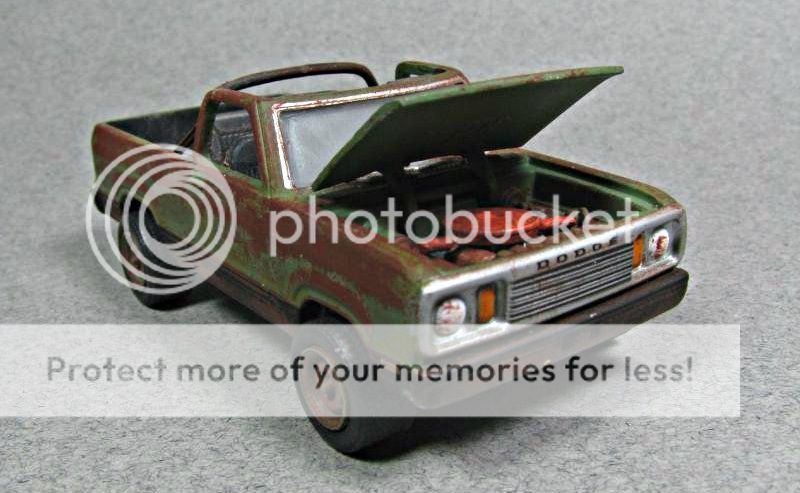
The SUV for today is Greenlight's 1977 Dodge Ramcharger (StupidSquirrel's custom).



The Dodge Ramcharger is a large sport utility vehicle built by Dodge from 1974 to 1993 (and 1999 to 2001 in Mexico), and based on a shortened-wheelbase version of the Dodge D Series/Ram pickup truck chassis. A Plymouth version, named the Trailduster and offered from 1974 to 1981, was Plymouth's only SUV.




The Ramcharger was primarily produced as a full-time four wheel drive vehicle, although a two wheel drive version was available starting in 1975. During development, it was known as the "Rhino".[1] 1974 through 1980 models have a removable hard top, although dealer-installed soft tops were available. The first year model differs from the others in that its door pillars are attached to the removable roof.
Like many vehicles, the Ramcharger was used in rallying, although its use was very limited. It did have some success, as demonstrated by achieving first place at Sno*Drift in 1975. In 1978 and 1979 the 360 CID's horsepower was bumped up to 195 horsepower (145 kW). 1978 was the last year for the 440 CID, which by then only put out 215 horsepower (160 kW).

The vehicle was usually powered by a Chrysler LA engine, the most common being the 318 cu in (5.2 L) V8. Optional was the 360 cu in (5.9 L) V8 and even big-block B series 400 cu in (6.6 L) V8 and RB 440 cu in (7.2 L) V8 were offered in the early years. Initially a normally aspirated carburetor, in 1988 the 318 gained throttle-body fuel injection with the 360 following in 1989. Power output for the TBI 318 was 230 horsepower (170 kW) and 280 lb (130 kg)-ft of torque. The TBI 360 had 240 hp (180 kW) and 283 to 295 lb·ft (400 N·m). In 1992 the multiport fuel injected Magnum 318 was the standard engine while the LA 360 with TBI was still offered. In 1993 the Magnum 360 replaced the LA engine version.

Many manual transmissions were offered throughout the years, starting with the A-230 three-speed and ending with the A-535 five-speed in 1992. The NP435 "granny gear" 4 speed was the most common in 4WD models, as well as the close ratio version, the NP445. In 1988 the clutch was converted from a mechanical linkage to a hydraulic system. Automatic transmission models had the Chrysler Loadflite TF-727A or B until, in 1991, it was replaced with the A-500/A-518 four-speed.

A full-time four-wheel drive NP-203 transfer case was standard until 1980, when it was replaced with the part-time NP-208. This was supplanted by the NP-241 in 1988.

Axles were Dana 44 front and 9¼" rear. Full time 4WD models (1973–1979) were equipped with the full time version of the Dana 44 that had no provision for locking hubs and had a front wheel bearing design with a somewhat dubious reputation. In 1980 when the part time 4WD system was introduced, the front Dana 44 was equipped with a more conventional front wheel bearing design and automatic locking hubs. Late in the 1984 model year the Dana 44 was switched to a CAD (Center Axle Disconnect) version. The CAD Dana 44 was vacuum actuated by a switch on the transfer case and powered by engine vacuum. [/quote]
[img]http://i790.photobucket.com/albums/yy190/thederbyfan83/Car-of-the-Day/IMG_9051.jpg[/img]
What's more redneck than an old beater full size SUV splashing down a muddy forest trail? :redneck:   Purchased this from Ward/69Stang who had commissioned John/Stupidquirells to a series of custom small scale items. These were given the weathered and worn treatment which seems ideal to a camo colored 30+ year old Dodge.


Sunday, September 23, 2012

Car Of The Day: September 22, 2012 (Belated)


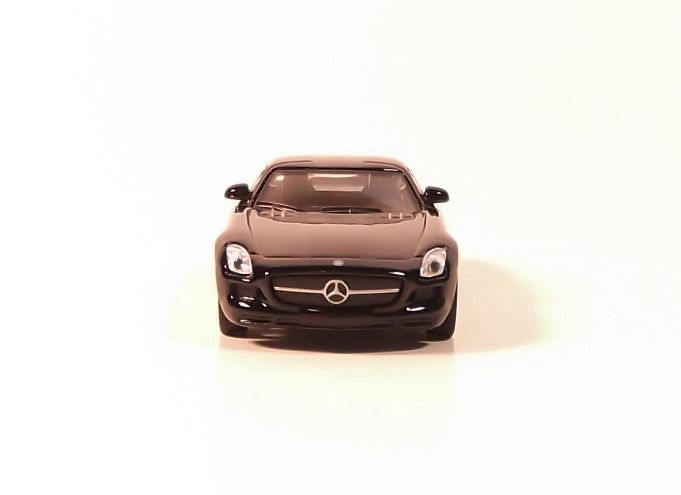
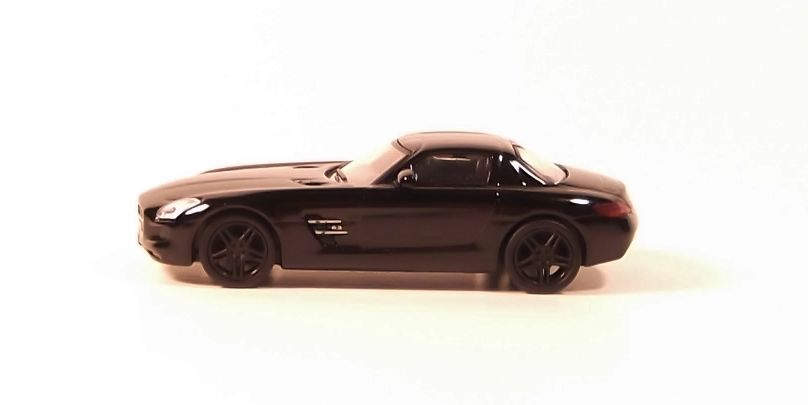
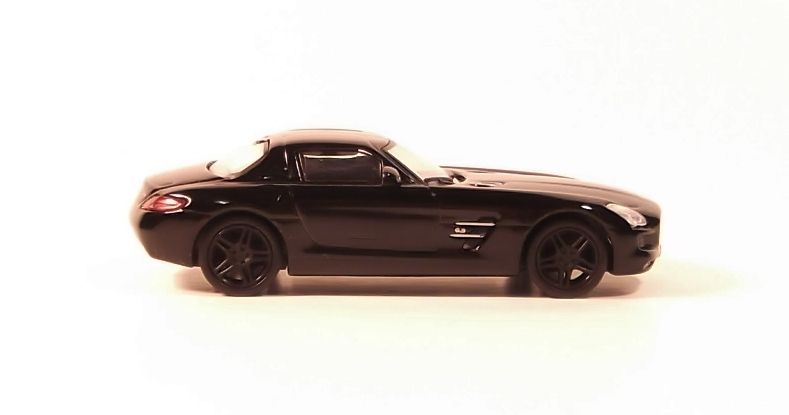
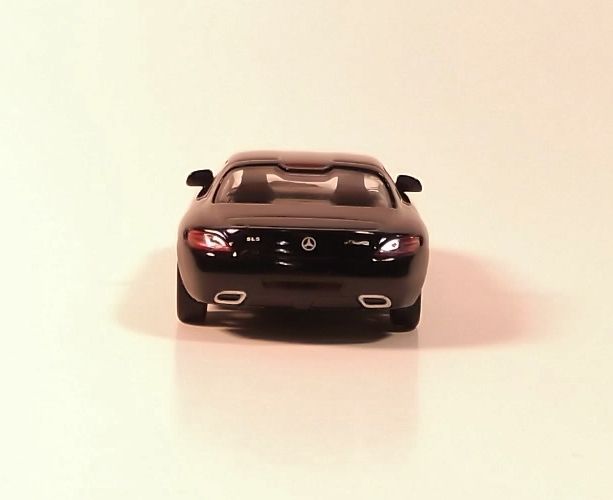
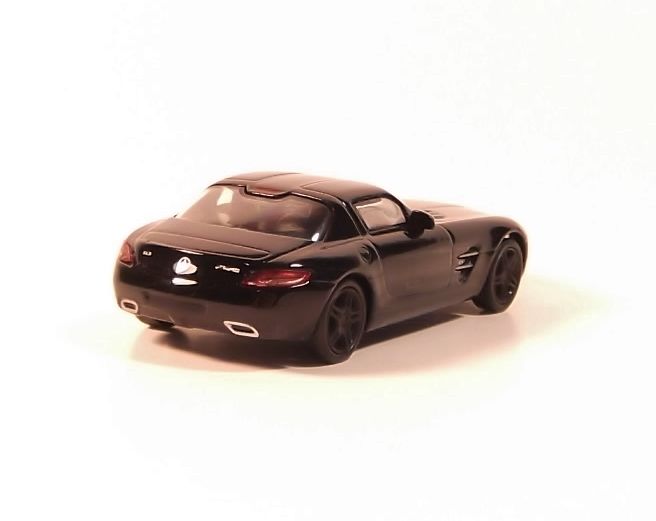
Todays car of the day is a GreenLight Motorworld  2010 Mercedes Benz SLS AMG


The Mercedes-Benz SLS AMG is a luxury grand tourer automobile developed by Mercedes-AMG to replace the Mercedes-Benz SLR McLaren. The car is the first Mercedes automobile designed in-house by AMG and is described by Mercedes-Benz as a spiritual successor to the Mercedes-Benz 300SL Gullwing.

The vehicle was unveiled at the 2009 IAA. Sales began in mid-2010 in Europe with MSRP of €177,310 (including taxes) and in the United States in mid-2011 for less than $200,000.


For more information and pictures of the real car please visit: Mercedes-Benz SLS AMG


The SLS AMG was designed to be a modern 300SL Gullwing revival by Mark Fetherston in 2007. The car has a long bonnet, the passenger compartment is close to the rear axle and the rear of the car is short. The SLS AMG was developed from late 2006 in tandem with the Dodge Viper, with mules using Viper body panels over an aluminum chassis developed by Dodge SRT. The SLS AMG has also adapted the feature of wing doors that will swing open upwards on gas struts, not in a mix of upwards and forward like the SLR. The doors must be closed manually as AMG engineers decided against auto-closing systems because the systems would have added 90 pounds (41 kg) to the car. In case of a roll-over, the doors can be fully detached to allow the occupants to leave the vehicle.

Although there is some overlapping in price and performance, the lighter SLS AMG is considered more of a sporty track-oriented car, compared to the Mercedes-Benz SL which is a more autobahn-focused grand tourer especially with its optional V12 engine. Compared to the SLS AMG Roadster, the SL is a hardtop convertible with technological and comfort amenities, and it also has available heated and cooled seats with a massage function.


The SLS AMG will be made in at least four different versions. The first to launch is the coupe with gullwing doors. In 2009 a Desert Gold version debuted at the Dubai International Auto Show, in mid-2010 a FIA-GT3 racing version. For 2011–2013 Mercedes will also be releasing a roadster (with conventional doors and a soft top), an electric powered E-Cell version (most likely to be a coupe), and there will be a Black Series version, which will see its weight being reduced by as much as 300 kg (661 lb).

Monday, June 4, 2012

Car Of The Day: June 4, 2012


Today's car of the day comes from Firehawk73's collection and is GreenLight's 1971 Pontiac GTO.


The Pontiac GTO is an automobile built by Pontiac Division of General Motors in the United States from 1964 to 1974, and by GM subsidiary Holden in Australia from 2004 to 2006. It is considered an innovative, and now classic muscle car of the 1960s and 1970s. From 1964 until midway through 1973 it was closely related to the Pontiac Tempest/LeMans and for the 1974 model year it was based on the Pontiac Ventura. The 21st century GTO is essentially a left-hand drive Holden Monaro, itself a coupe variant of the Holden Commodore.


For more information and pictures of the real car please visit: Pontiac GTO


The 1971 GTO had another modest facelift, this time with wire-mesh grilles, horizontal bumper bars on either side of the grille opening, more closely spaced headlamps, and a new hood with the dual scoops relocated to the leading edge, not far above the grille. Overall length grew slightly to 203.3 inches (516 cm).

A new corporate edict, aimed at preparing GM for no-lead gasoline, forced an across-the-board reduction in compression ratios. The Ram Air engines did not return for 1971. The standard GTO engine was still the 400 CID V8, but now with 8.2:1 compression. Power was rated at 300 hp (220 kW) SAE gross at 4,800 rpm and torque at 400 lb·ft (542 N·m) at 3,600 rpm. It had 255 hp (190 kW) SAE net at 4,400 rpm in the GTO and 250 hp (190 kW) SAE net at 4,400 rpm in the Firebird.

An engine option was the 455 CID V8 with four-barrel carburetor, 8.4 to 1 compression ratio and 325 hp (242 kW) at 4,400 rpm, which was only available with the Turbo Hydra-matic TH-400 transmission. It had 260 hp (190 kW) SAE net at 4,000 rpm in the GTO and 255 hp (190 kW) SAE net in the Firebird. This engine was not available with air induction.

The top GTO engine for 1971 was the new 455 HO with 8.4 compression, rated at 335 hp (250 kW) at 4,800 rpm and 480 lb·ft (651 N·m) at 3,600 rpm. It had 310 hp (230 kW) SAE net at 4,400 rpm in the GTO and 305 hp (227 kW) SAE net in the Firebird Trans Am or Formula 455 with air induction. The 1971 Pontiac brochure declared that this engine produced more NET horsepower than any other engine in its history. That would imply the 400 CID V8 Ram Air engines had less than 310 hp net. While rated at 335 hp gross, in order to suggest it had less power than it did, you could say it should have been rated at 375 hp gross to compare with other Pontiac engines. This engine had more NET horsepower than the 1970 455 CID V8 GTO, which was essentially the regular engine found in other Pontiacs with a GTO exhaust system, and was continued in 1971 as the second option above.

For 1971,the standard rear-end was an open 10 bolt. Posi-traction 10 bolt rear ends were available as an option on 400 CI engine equipped GTO's, while all 455 CI GTO's were available with a 12 bolt open or optional 12 bolt posi-traction rear-end.

Motor Trend tested a 1971 GTO with the 455, four-speed transmission, and 3.90 axle, and obtained a 0-60 mph time of 6.1 seconds and a quarter mile acceleration of 13.4 seconds at 102 mph (164 km/h).
The Judge returned for a final year, With the standard equipment being the Mountain Performance package was the 455 HO. Only 357 were sold before The Judge was discontinued in February 1971, including 17 convertibles today the rarest of all GTOs, aside from the 1969 Ram Air IV convertible. Only 10,532 GTOs were sold in 1971, 661 of which were non-Judge equipped convertibles.
David Pearson drove a 1971 GTO in the Winston Cup Series.

Friday, June 1, 2012

Car Of The Day: June 1, 2012


Today's car of the day comes from Firehawk73's collection and is GreenLight's 2006 Chevrolet Camaro concept.


The fifth-generation Chevrolet Camaro is a pony car produced by General Motors and marketed under the Chevrolet brand. It is the fifth distinct generation of the Camaro to be produced since its original introduction in 1967. Production of the new Camaro began on March 16, 2009 after several years on hiatus since the previous generation's production ended in 2002 and went on sale to the public in April 2009 for the 2010 model year.


For more information and pictures of the real car please visit: Chevrolet Camaro


On January 6, 2006, the first official word regarding a fifth generation Chevrolet Camaro from General Motors came at the 2006 North American International Auto Show, where the 2006 Camaro Concept was released. AutoWeek editors unanimously awarded the Camaro Concept "Best In Show." The concept is based on the new GM Zeta platform and was designed by South Korean-born Sangyup Lee. Road & Track offered an exclusive first look at the car which had photos as well as a short video on the day the concept was released.

The concept car features the following: 2-door, 4-passenger, rear-wheel drive coupe, while the body-styling is an homage to the first generation Camaro. The wheelbase is 110.5 in (281 cm), which is 9 in (23 cm) longer than the previous generation, but an overall length of just 186.2 in (473 cm), 7 in (18 cm) shorter. The Camaro Concept is powered by a 400 hp (298 kW) 6.0 L (366 cu in) LS2 V8 with Active Fuel Management and is equipped with the T-56 six-speed manual transmission. Other features include independent front and rear suspensions (all previous Camaros/Firebirds used a solid rear axle), four-wheel disc brakes with 14 in (36 cm) rotors and four-piston calipers, and 21 in (53 cm) front / 22 in (56 cm) rear wheels covered in huge 275/30R21 front / 305/30R22 rear tires.

Saturday, May 26, 2012

Car Of The Day: May 26, 2012


Today's car of the day comes from Firehawk73's collection and is GreenLight's 1971 Dodge Charger Super Bee.


The Dodge Super Bee was a limited-production muscle car from Dodge, produced from 1968-1971. The Super Bee model was resurrected for the 2007, 2008 and 2009 model Dodge Charger Super Bee.


For more information and pictures of the real car please visit: Dodge Super Bee


Since the 1971 Coronet was only available in sedan and station wagon versions, the Super Bee model was moved to the Charger platform. Since the Charger already had an R/T muscle car version, the Super Bee was slotted in as the low-priced entry in the line at US$3,271. 5,054 were produced which includes the 22 with the Hemi engine.

The moniker was discontinued until the 2007 Super Bee, which was a Charger SRT-8.
1971 was the first and only year that a small block engine (340 4-bbl) became available in the Super Bee.
Although the 440 Magnum (4-bbl) was not an available option on the Super Bee for 1971, 26 are known to have been built.

Friday, April 20, 2012

Car Of The Day: April 20, 2012


Today's car of the day comes from Firehawk73's collection and is GreenLight's 1971 Chevrolet Camaro.


The second-generation Chevrolet Camaro is a pony car by the Chevrolet division of General Motors produced for the 1970 through 1981 model years. It was introduced February 26, 1970 It was longer, lower, and wider than the first generation Camaro. A convertible body-type was no longer available. GM engineers have said the second generation is much more of "A Driver's Car" than its predecessor.


For more information and pictures of the real car please visit: Chevrolet Camaro


Dubbed "Super Hugger", the second-generation Camaro was developed without the rush of the first generation and benefited from a greater budget in light of the success of the first generation. Although it was an all-new car, the basic mechanical layout of the new Camaro was familiar, engineered much like its predecessor with a unibody structure utilizing a front subframe, A-arm and coil spring front suspension, and rear leaf springs. The chassis and suspension of the second generation were greatly refined in both performance and comfort; base models offered significant advances in sound-proofing, ride isolation, and road-holding. Extensive experience Chevrolet engineers had gained racing the first-generation led directly to advances in second-generation Camaro steering, braking, and balance. Although it began its run with a number of high-performance configurations, as the 1970s progressed, the Camaro grew less powerful, succumbing, like many production cars of the era, to the pressures of tightening emissions regulations and a fuel crisis. Major styling changes were made in 1974 and 1978; 1981 was the final model year for the second-generation Camaro.

Most of the engine and drivetrain components were carried over from 1969, with the exception of the 230 cu in (3.8 L) six-cylinder — the base engine was now the 250 cu in (4.1 L) six, rated at 155 hp (116 kW). The top performing motor was the 396 cu in (6.5 L) L78 rated at 375 hp (280 kW). Starting in 1970, the big block V8s (nominally 396 cu in (6.5 L)) actually displaced 402 cu in (6.6 L), yet Chevrolet chose to retain the 396 badging. Two 454 cu in (7.4 L) engines (the LS6 and LS7) were listed on early specification sheets and in some sales brochures but never made it into production. Besides the base model, buyers could select the Rally Sport option with a distinctive nose and bumper, a Super Sport package, and the Z-28 Special Performance Package (priced at US$572.95) featuring a new high-performance LT-1 360 hp (268 kW) 380 lb·ft (520 N·m) of torque 350 cu in (5.7 L) V8. The LT-1, an engine built from the ground up using premium parts and components, was a much better performer overall than the previous 302 cu in (4.9 L) V8s used in 1967-69 Z-28s; greater torque and less-radical cam, coupled with the 780 cfm Holley four-barrel, permitted the Z-28 to be available with the 3-speed Turbo Hydramatic 400 automatic transmission as an option to the four-speed manual for the first time.

The new body style featured a fastback roofline and ventless full-door glass with no rear side quarter windows. Doors were wider to permit easier access to the rear seat, and new pull-up handles replaced the old handles, for which the lower button had to be pushed in to lock the door. The roof was a new double-shell unit for improved rollover protection and noise reduction. The base model featured a separate bumper/grille design with parking lights under the bumper, while the Rally Sport option included a distinctive grille surrounded by a flexible Endura material along with round parking lights beside the headlights and bumperettes surrounding on both sides of the grille. The rear was highlighted by four round taillights similar to the Corvette. A convertible was not offered, making this the only Camaro generation not to offer one.
The '70½ was the first Camaro offered with a rear stabilizer bar. The four-wheel disc brake option (RPO JL8 of 1969) was dropped.

Inside, a new curved instrument panel featured several round dials for gauges and other switches directly in front of the driver while the lower section included the heating/air conditioning controls to the driver's left and radio, cigar lighter and ashtray in the center and glovebox door on the right. New Strato bucket seats, unique to 1970 models, featured squared-off seatbacks and adjustable headrests, and the rear seating consisted of two bucket cushions and a bench seat back due to the higher transmission tunnel. The optional center console, with standard Hurst shifter, was now integrated into the lower dashboard with small storage area or optional stereo tape player. The standard interior featured all-vinyl upholstery and a matte black dashboard finish, while an optional custom interior came with upgraded cloth or vinyl upholstery and woodgrain trim on dash and console.

The 1970 model was introduced in February 1970, halfway through the model year. This caused some people to refer to it as a "1970½." model; all were 1970 models. The 1970 model year vehicles are generally regarded as the most desirable of the early second-generation Camaros, since the performance of following years was reduced by the automobile emissions control systems of the period and later the addition of heavy federally mandated bumpers.

The 1971 Camaro received only minor appearance changes from its 1970 counterpart. Inside, new high-back Strato bucket seats with built-in headrests replaced the 1970-only low-back seats with adjustable headrests. The biggest changes came under the hood, due to a GM-corporate mandate all engines be designed to run on lower-octane regular-leaded, low-lead, or unleaded gasoline, necessitating reductions in compression ratios and horsepower ratings. The 250 ci 6, 307 ci V8 and two-barrel 350 V8 were virtually unchanged, as they were low-compression regular-fuel engines in 1970 and previous years, while the LT-1 350 V8 used in the Z/28 dropped from 360 to 330 horsepower (250 kW) due to compression ratio decline from 11.0:1 to 9.0:1, and the big 396/402 V8 dropped from 350 to 300 horsepower (220 kW) due to compression ratio drop from 10.25:1 to 8.5:1.

Production and sales dropped due to a 67-day corporate-wide strike at GM that coincided with the introduction of the 1971 models in late September 1970, along with a continued declining interest in the ponycar market fueled by skyrocketing insurance rates for high-performance cars. Rumors of the possible cancellation of the Camaro after 1972 began to surface and were nearly confirmed a year later when another worker's strike hit the assembly plant at Norwood, Ohio, which was the only plant building Camaros and Firebirds.

Friday, March 2, 2012

Car Of The Day: March 2, 2012


Today's car of the day comes from Firehawk73's collection and is GreenLight (High Speed)'s 1961 Jaguar E-Type.


The Jaguar E-Type (UK) or XK-E (US) is a British automobile, manufactured by Jaguar between 1961 and 1975. Its combination of good looks, high performance, and competitive pricing established the marque as an icon of 1960s motoring. More than 70,000 E-Types were sold during its lifespan.

In March 2008, the Jaguar E-Type ranked first in the Daily Telegraph's list of the "100 most beautiful cars" of all time. In 2004, Sports Car International magazine placed the E-Type at number one on their list of Top Sports Cars of the 1960s.


For more information and pictures of the real car please visit: Jaguar E-Type


The Series 1 was introduced, initially for export only, in March 1961. The domestic market launch came four months later in July 1961. The cars at this time used the triple SU carburetted 3.8 litre six-cylinder Jaguar XK6 engine from the XK150S. The first 300 cars built had flat floors and external hood (bonnet) latches. These cars are rare and more valuable. After that, the floors were dished to provide more leg room and the twin hood latches moved to inside the car. The 3.8-litre engine was increased to 4.2 litres in October 1964.

All E-Types featured independent coil spring rear suspension with torsion bar front ends, and four wheel disc brakes, in-board at the rear, all were power-assisted. Jaguar was one of the first vehicle manufacturers to equip cars with disc brakes as standard from the XK150 in 1958. The Series 1 can be recognised by glass-covered headlights (up to 1967), small "mouth" opening at the front, signal lights and tail-lights above bumpers and exhaust tips under the number plate in the rear.

3.8-litre cars have leather-upholstered bucket seats, an aluminium-trimmed centre instrument panel and console (changed to vinyl and leather in 1963), and a Moss four-speed gearbox that lacks synchromesh for first gear ("Moss box"). 4.2-litre cars have more comfortable seats, improved brakes and electrical systems, and an all-synchromesh four-speed gearbox. 4.2-litre cars also have a badge on the boot proclaiming "Jaguar 4.2 Litre E-Type" (3.8 cars have a simple "Jaguar" badge). Optional extras included chrome spoked wheels and a detachable hard top for the OTS.

A 2+2 version of the coupé was added in 1966. The 2+2 offered the option of an automatic transmission. The body is 9 in (229 mm) longer and the roof angles are different with a more vertical windscreen. (this is an incorrect assumption, the S1 OTS, coupe and 2+2 had identical rake windshields). The roadster remained a strict two-seater.

Less widely known, right at the end of Series 1 production and prior to the transitional "Series 1½" referred to below, a very small number of Series 1 cars were produced with open headlights. Production dates on these machines vary but in right hand drive form production has been verified as late as March 1968. The low number of these cars produced make them amongst the rarest of all production E Types.
Following the Series 1 there was a transitional series of cars built in 1967–1968, unofficially called "Series 1½", which are externally similar to Series 1 cars. Due to American pressure the new features were open headlights, different switches, and some de-tuning (with a downgrade of twin Zenith-Stromberg carbs from the original triple SU carbs) for US models. Some Series 1½ cars also have twin cooling fans and adjustable seat backs. Series 2 features were gradually introduced into the Series 1, creating the unofficial Series 1½ cars, but always with the Series 1 body style.

An open 3.8-litre car, actually the first such production car to be completed, was tested by the British magazine The Motor in 1961 and had a top speed of 149.1 mph (240.0 km/h) and could accelerate from 0 to 60 mph (0 to 97 km/h) in 7.1 seconds. A fuel consumption of 21.3 miles per imperial gallon (13.3 L/100 km; 17.7 mpg-US) was recorded. The test car cost £2,097 including taxes.

Wednesday, February 29, 2012

Car Of The Day: February 29, 2012


Today's car of the day is GreenLight's 2010 Ford Shelby GT500.


The Shelby Mustang is a high performance variant of the Ford Mustang which was built by Shelby American from 1965 through 1970. Following the introduction of the fifth generation Ford Mustang, the Shelby nameplate was revived in 2007 for new high performance versions of the Mustang.


For more information and pictures of the real car please visit: Shelby GT500


A recent RAOK from accobra64 via tsarlitto (thank you to you both!).


For the 2010 model year, the Shelby cobra Mustang GT500 was redesigned along with the base Ford Mustang. As with the 2007–09 GT500, the 2010 includes unique front and rear fascias, hood with functional vents and unique rear spoiler. The rear spoiler includes a functional Gurney flap. Along with new exterior colors, customers have the option of extending the exterior stripes onto the seats. Production was limited to 2000 units.

The 5.4 L engines's power output was increased to 540 horsepower (403 kW) and 510 lb·ft (690 N·m) of torque with the addition of a cold air intake similar to the 08/09 GT500KR and includes a knock sensor to protect the engine if lower octane fuel is used. The 2010 GT500's fuel efficiency increased by 2 miles per gallon.

SVT re-tuned the coupe's suspension and worked with Goodyear on 19" tires with new construction, compound and tread pattern. The coupe's 19" wheels are forged for a reduction in unsprung weight. The convertible retained the 18" wheels offered on the 2007–09 GT500.


Much like the 2011 V6 and GT Mustangs, the 2011 Shelby GT500 gets an engine update with an all-new 5.4 L aluminum engine which is 102 pounds lighter than the previous cast-iron engine and uses Ford-patented plasma-coating technology (Plasma transferred wire arc). The inventors of PTWA received the 2009 IPO National Inventor of the Year award. This technology was initially patented and developed by inventors from Flame-Spray. The technology was subsequently improved upon by Ford and Flamespray. With the engine updates, not only has performance improved to 550 horsepower and 510 ft.lb. of torque, but the GT500's gas mileage has improved to 15 MPG city and 23 MPG highway, which was enough to eliminate the U.S. Gas Guzzler Tax. The final production number of the 2011 Shelby GT500 by the end of the year was 5100 units.

Ford also improved upon the handling characteristics of the GT500. The overall stance of the car has been lowered by 11 millimeters in front and 8 millimeters at the rear. The car also features Ford's new Electric Power Assist Steering (EPAS) that improves torque build-up and road feel which delivers quicker and more precise steering, increased effort on the racetrack or winding roads, and reduced effort in low-speed parking maneuvers. The car also has Ford's AdvanceTrac stability control system, which features a sport mode when pressed twice consecutively.

External improvements include an optional SVT Performance Package, which includes Goodyear EagleF1 SuperCar G: 2 tires, all-new lightweight 19-inch forged-aluminum wheels in front and 20-inch forged-aluminum wheels at the rear, a 3.73 rear axle ratio, and performance tuned front and rear shocks along with stiffer springs. The package includes a unique rear spoiler Gurney Flap for improved handling, slightly revised front and rear fascias, a new pedal box for improved clutch use, slotted brake dust shields for improved brake cooling, standard HID (high-intensity discharge) headlamps, MyKey programmable vehicle key, integrated spotter mirrors, and fold-down rear headrests. Optional is a glass top roof, previously available, starting in 2009, with the Mustang GT. The total number of Sterling Gray colored GT500s in 2011 was 492.

The improvements in handling and performance gives the 2011 Shelby GT500 a skidpad rating of 1.0G, and a Virginia International Raceway lap time of 2:58:48, making it as fast as, and sometimes faster than, cars such as the M3, Audi R8 V10, Dodge Viper SRT-10 and Porsche GT3 around this racetrack.


Friday, February 3, 2012

Car Of The Day: February 3, 2012


Today's car of the day comes from Firehawk73's collection and is GreenLight's 1967 Dodge Coronet.


The Coronet was a full-size car from Dodge in the 1950s, initially the division's highest trim line but, starting in 1955, the lowest trim line. In the 1960s, the name was transferred to Dodge's mid-size entry.


For more information and pictures of the real car please visit: Dodge Coronet


After a brief absence, the Coronet name was attached to the former full-size models in 1965 to become Dodge's intermediate-sized car. The 1965 models were basically refreshed Dodge Polaras in the same B-body style offered in 1963 and 1964, riding on a 117 wheelbase. For 1965, Dodge sold slightly over 209,000 units, making the Coronet the most popular model sold by Dodge that year. Trim levels initially were base Coronet including a Deluxe version, Coronet 440 and Coronet 500. The base Coronet and Deluxe were available as two-door sedans, four-door sedans and station wagons. For 1965 only, Dodge also sold only 101 units of a modified wheelbase version of the base Coronet two-door sedan and 440 hardtop used for NHRA drag racing. The model known as A990 came with a racing version of the 426 Hemi engine. The car A990 was stripped of all features and included base bucket seats from Dodge's truck-van line of vehicles. The altered wheelbase eventually became commonly known as Funny Cars because of their stretched front clips. Front seat belts and padded dash were standard. The middle of the Coronet line-up was the 440 and was available as a two-door hardtop, convertible or station wagon. The 440 designation did not indicate engine displacement as commonly assumed. The nomenclature was a carryover theme from the 1963–64 Polara series. The top of the Coronet line-up was the Coronet 500 and was only available as a two-door hardtop or convertible in 1965. Slightly over 33,300 units were sold in 1965 and included as standard, a V8 engine (273 cubic inches), exterior trim and badging, bucket seats, padded dash and chrome floor console. Coronets were manufactured at Chrysler's Los Angeles assembly plant and at Lynch Road assembly plant in Detroit. Engines offered for 1965 included the base 225 Slant-Six, 273, 318 (Polyhead), 361 (the last year for this big block engine was 1966), 383 and 426 in multiple HP choices. Sales brochures list the 413 (its last year offered) as available, but no records exist of this engine commonly used in Imperials, being installed in Coronets for 1965. A tachometer was optional.
There would be no Coronet 500 wagon until 1968. Coronet received a redesign in 1966, and a facelift in 1967. Trim levels initially were base Coronet, Coronet 440 and Coronet 500. In 1966, the Coronet Deluxe was introduced, fitting between the base Coronet and the Coronet 440. The Coronet R/T was introduced in 1967. The Coronet R/T was available as a two-door hardtop or convertible.

When the 426ci Hemi was made available to the general public for the 1965 model year, it could be ordered in any Coronet model or trim level. No Hemi-powered Coronet wagons have been verified, but a few Coronet Deluxe four-door sedans are known to exist. A total of just 136 Coronet 500 Street Hemis were built for 1966. Beginning in 1967, Chrysler decided that the Hemi should only be available in their badged muscle cars: the Dodge Charger and Coronet R/T and the Plymouth Belvedere GTX. The top engine option for the rest of the Coronet line was supposed to be the 383 ci 4 bbl V8. Despite this, some Hemi-powered 1967 Coronet Deluxe two-door sedans were produced. There is also one Hemi-powered 1967 Coronet 440 two-door hardtop known, which is not among the 55 WO23 Super Stock cars produced for Dodge drag racers.