Showing posts with label Audi. Show all posts

Tuesday, June 19, 2012

SUV Of The Day: June 19, 2012


Today's car of the day comes from Dean-O-mite's collection and is Siku's 2008 Audi Q7.


The Audi Q7 is a full-size luxury crossover SUV unveiled in September 2005 at the Frankfurt Motor Show. Production of the Q7 began in autumn of 2005 in Bratislava, Slovakia. It is the first SUV offering from Audi and went on sale in North America for the 2007 model year. Later, Audi's second SUV, the Q5, was unveiled as a 2009 model. Audi has since unveiled a third SUV model, the Q3, going on sale in the 3rd quarter of 2011.

The Q7 utilizes a modified version of the Volkswagen Group PL71 platform. Previewed by the Audi Pikes Peak Quattro concept car, the Q7 is designed more for on-road use, and was not meant for serious off-road use where a transfer case is needed. Although it lacks a low-range transfer case, it has quattro permanent four wheel drive system with a central differential lock, and an adjustable-height air suspension which helps in off road situations.


For more information and pictures of the real car please visit: Audi Q7


This Siku is a pretty traditional (approx.) 1/55 scale. I am particularly fond of the separate headlight and tail light lenses, and the simulated rubber tires are also nice. The largest fault in my eyes, is the solid gray wheels - not so much because they are gray, but because they are gray even in between the spokes.
I narrowed this one down to a 2008 Q7 based on information from Wikipedia. Although the Q7 has been available for sale in Europe since 2005, and in North America and other markets since 2007, the 4.2 emblem without an accompanying TDI, is the key. The 4.2 gasoline engine was first available in 2008, per Wikipedia, and the 2009 Q7 received a styling facelift.


Despite its multiple airbags and safety electronics, such as Electronic Stability Programme (ESP), the Q7 scored only four stars out of five in the Euro NCAP crash test for adult occupant protection. According to Audi, this was caused by a design error, and has since been fixed in cars manufactured after the test which should allegedly lead to five stars. Official tests to prove this remains to be done as of March 2009.

However in the United States, the Q7 received five out of five stars from the National Highway Traffic Safety Administration (NHTSA) safety test for both front and side impacts. The Insurance Institute for Highway Safety awarded the Q7 its Top Safety Pick, with Good ratings in all 14 measured categories of the front and side impact test.


In early 2005, Nissan North America Inc. filed a lawsuit against Audi over the use of the letter "Q" as a model name.

Audi is using the "Q" for the designation of their quattro four-wheel drive system, used in production cars for over twenty-five years (Audi's quattro trademark is actually an umbrella term for several types of four wheel drive systems developed by Torsen, Haldex Traction AB, and Borg-Warner, the latter being used in the Q7). Nissan's Infiniti marque had been using Q as the name for sedans (the Q45) and SUVs (the QX4 and QX56) since 1989.

A settlement between Audi AG and Nissan was reached in late 2006. The agreement stipulates that Audi will only use the Q-prefix for two models, the Q5 and the Q7.

Monday, May 28, 2012

Car Of The Day: May 28, 2012


Today's car of the day comes from Firehawk73's collection and is Matchbox's 1981 Audi Quattro.


The Audi Quattro is a road and rally car, produced by the German automobile manufacturer Audi, now part of the Volkswagen Group. It was first shown at the 1980 Geneva Motor Show on 3 March.

The word quattro is derived from the Italian word for "four". The name has also been used by Audi to refer to the quattro four-wheel-drive system, or any four-wheel-drive version of an Audi model. To avoid confusion, the original Quattro model is also commonly referred to as the Ur-Quattro - the "Ur-" (German for "primordial", "original", or "first of its kind") is an augmentative prefix, in this case meaning "original", and is also applied to the first generation Audi S4 and Audi S6 models, as in "Ur-S4" and "Ur-S6".
The Audi Quattro was the first rally car to take advantage of the then-recently changed rules which allowed the use of four-wheel drive in competition racing. It won competition after competition for the next two years. To commemorate the success of the original vehicle, all subsequent Audis with their trademark quattro four-wheel-drive system were badged "quattro" with a lower case "q" and in a distinct typeface which has remained almost entirely unchanged since its inception. The original car with the upper case "Q" in the Quattro name is a collector's piece.

The Audi Quattro shared many parts and core body components with the Audi Coupé, which was a member of the Audi 80 (B2) model range. The Quattro was internally designated Typ 85, a production code it shared with the quattro versions of the Audi Coupé (B2) and Audi 80. Its characteristic flared wheelarches were styled by Martin Smith. The Audi Quattro also had independent rear suspension and independent front suspension.


For more information and pictures of the real car please visit: Audi Quattro


Audi released the original Quattro to European customers in late 1980, making it both the first car to feature Audi's quattro permanent four-wheel drive system (hence its name), and the first to mate four-wheel drive with a turbocharged engine.

The original engine was the 2,144 cc (131 cu in) (2.1 L), inline-5-cylinder 10 valve SOHC, with a turbocharger and intercooler. It produced 147 kW (200 PS; 197 bhp) and torque of 285 N·m (210 lbf·ft) at 3500 rpm; propelling the Quattro from 0 to 100 km/h (62 mph) in 7.1s, and reaching a top speed of over 220 km/h (137 mph).

The engine was eventually modified to a 2,226 cc (136 cu in) (2.2 L) inline-5 10 valve, still producing147 kW (200 PS; 197 bhp), but with peak torque lower in the rev-range. In 1989, it was then changed to a 2,226 cc (136 cu in) inline-5 20v (2.2 L 20v) DOHC setup producing 162 kW (220 PS; 217 bhp), now with a top speed of 230 km/h (143 mph).

Audi Quattros are often referred to among owners and enthusiasts by their engine codes, to differentiate between the earlier and later versions: the earliest 2144 cc 10v being the "WR" engine, the 2226 cc 10v being the "MB" engine, and the later 20v being the "RR" engine. Hence, Quattro models may be referred to as either the WR Quattro, MB Quattro, and RR or "20v" Quattro, respectively.

Quattro car production was 11,452 vehicles over the period 1980–1991, and through this 11 year production span, despite some touch-ups, there were no major changes in the visual design of the vehicle. For the 1983 model year, the dash was switched from an analogue instrument cluster, to a green digital liquid crystal display (LCD) electronic instrument cluster. This was later changed in 1988 to an orange LCD electronic instrument cluster. The interior was redesigned in 1984, and featured a whole new dash layout, new steering wheel design, and new centre console design, the switches around the instrument panel were also redesigned at this time. In 1985 the dash changed slightly with harder foam and lost a diagonal stripe, the dash switches were varied slightly and the diff lock pull knob gave way to a two-position turning knob with volt and oil temp digital readouts.

External styling received very little modification during its production run. Originally, the car had a flat fronted grille featuring four separate headlamp lenses, one for each of the low and high beam units. This was altered for the 1983 model year, and replaced with combined units featuring a single lens, but housing twin reflectors. This was changed again, for the 1985 model year, in what has become known as the 'facelift model' and included such alterations as a new sloping front grille, headlights, and trim and badging changes. Max speed was 124 mph. The RR 20v Quattro also featured a new three spoke steering wheel design, leather covering for door arm rests, gloveboxes, centre console and door pockets. There was also a full length leather-wrapped centre console running all the way to the rear seats. 20v was also the first Ur-Q to have "quattro" script interior with partial leather seats. The floor on the drivers side had a bulge due to dual catalytic exhaust setup. The different models may be distinguished by the emblems on their boot lids: the WR had a vinyl 'quattro' decal or a brushed aluminium effect plastic emblem, the MB had chrome plated 'audi', 'audi rings' and 'quattro' emblems, whilst the RR had only chrome plated 'audi rings'.

The rear suspension was altered early on with geometry changes and removal of the rear anti-roll bar to reduce a tendency for lift-off oversteer. For the 1984 facelift, the wheel size went from 6x15-inch with 205/60-15 tyres to 8x15-inch wheels with 215/50-15 tyres. At the same time the suspension was lowered 20 mm with slightly stiffer springs for improved handling. For 1987, the Torsen centre differential was used for the first time, replacing the manual centre differential lock.

Sales of the Quattro in North America began with the 1983 model year, which were constructed concurrently, and were of the same design as, the European 1982 models (they did not include the minor cosmetic changes of the European 1983 model) and continued through 1986. Total sales in the USA were 664. Canadian market received cars that were identical to the US cars with exception of the speedometer, which was metric like the early Euro cars. Official sales figures for Canada were 99, which included 61 in 1983, 17 in 1984, 18 in 1985 and 3 in 1986. Although it's believed that there might have been up to 6 cars bought in 1986.

US/Canadian cars were also equipped with larger impact bumpers with built-in shock absorbers, just like the rest of the 4000/Coupé models. None of the cars came with Anti-lock Braking System (ABS), however they were otherwise "loaded" with options, including air conditioning, and in 90% of the cars, leather upholstery. Most of the 1984 and 1985 Canadian models did not have sunroofs. The remainder of the electric, suspension and cosmetic updates took place at the same time as the European cars. Out of 99 cars imported to Canada 35 are still known to be on the road.

The initial 2.1L (2144cc, engine code "WX") engine for US/Canadian models included minor component and engine control unit (ECU) changes, including lowered turbocharger boost pressure, different camshaft, emission controls including catalytic converter, and lambda stoichiometric fuel control, which lowered power to 160 hp (119 kW; 162 PS). Otherwise, mechanical specifications were identical to the European spec cars. The WX engine was also used on Swiss and Japanese market cars. In fact Audi built 200 special edition cars in 1988 with WX engine and analogue instruments, the rest of the car was identical to the MB cars of that year.

Wednesday, May 9, 2012


Today's car of the day comes from Derby Driver 60's collection and is Matchbox's 2004 Audi RS 6.


The Audi RS 6 quattro, commonly referred to as the RS6, is the highest-performing version, and top-of-the-line specification of the Audi A6, positioned above the Audi S6. It is a mid-size sports-focused executive car, produced by the high-performance private subsidiary company quattro GmbH, for Audi AG, part of the Volkswagen Group.

Both versions of the RS6 have been produced as a five-door five-seat "Avant", Audi's name for an estate car–station wagon and a four-door five-seat saloon–sedan.


For more information and pictures of the real car please visit: Audi RS 6

Friday, November 11, 2011

Car Of The Day: November 11, 2011


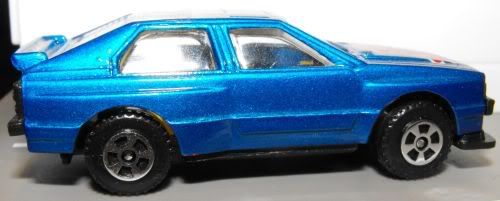
Today's car of the day is Wheeler's 1981 Audi Quattro.


The Audi Quattro is a road and rally car, produced by the German automobile manufacturer Audi, now part of the Volkswagen Group. It was first shown at the 1980 Geneva Motor Show on 3 March.

The word quattro is derived from the Italian word for "four". The name has also been used by Audi to refer to the quattro four-wheel drive system, or any four-wheel drive version of an Audi model. To avoid confusion, the original Quattro model is also commonly referred to as the Ur-Quattro - the "Ur-" (German for "primordial" or "ancestral") is an augmentative prefix, in this case meaning "original", and is also applied to the first generation Audi S4 and Audi S6 models, as in "Ur-S4" and "Ur-S6".

The Audi Quattro was the first rally car to take advantage of the then-recently changed rules which allowed the use of four-wheel drive in competition racing. It won competition after competition for the next two years. To commemorate the success of the original vehicle, all subsequent Audis with their trademark quattro four wheel drive system were badged "quattro" with a lower case "q". The original car with the upper case "Q" in the Quattro name is a collector's piece.

The Audi Quattro shared many components and the core of its body style with the Audi Coupé, which was a member of the Audi 80 (B2) model range. It was internally designated Typ 85, a type number it shared with the quattro versions of the Audi Coupé (B2) and Audi 80. Its characteristic flared wheelarches were styled by Martin Smith. The Audi Quattro also had independent rear suspension and independent front suspension.


For more information and pictures of the real car please visit: Audi Quattro


The Quattro, definitely one of the most collectible cars of the 1980s, was well covered in 1/64 with examples from Matchbox, Maisto (Matchbox copy), Yat Ming, Majorette, Wheeler (as seen here), and many more.


Audi released the original Quattro to European customers in late 1980, making it both the first car to feature Audi's quattro permanent four-wheel drive system (hence its name), and the first to mate four wheel drive with a turbocharged engine.

The original engine was the 2,144 cc (131 cu in) (2.1 L), inline-5 cylinder 10 valve SOHC, with a turbocharger and intercooler. It produced 147 kW (200 PS; 197 bhp) and torque of 285 N·m (210 ft·lbf) at 3500 rpm; propelling the Quattro from 0-100 km/h (62 mph) in 7.1s, and reaching a top speed of over 220 km/h (137 mph).

The engine was eventually modified to a 2,226 cc (136 cu in) (2.2 L) inline-5 10 valve, still producing147 kW (200 PS; 197 bhp), but with peak torque lower in the rev-range. In 1989, it was then changed to a 2,226 cc (136 cu in) inline-5 20v (2.2 L 20v) DOHC setup producing 162 kW (220 PS; 217 bhp), now with a top speed of 230 km/h (143 mph).

Audi Quattros are often referred to among owners and enthusiasts by their engine codes, to differentiate between the earlier and later versions: the earliest 2144 cc 10v being the "WR" engine, the 2226 cc 10v being the "MB" engine, and the later 20v being the "RR" engine. Hence, Quattro models may be referred to as either the WR Quattro, MB Quattro, and RR or "20v" Quattro, respectively.

Quattro car production was 11,452 vehicles over the period 1980–1991, and through this 11 year production span, there were no major changes in the visual design of the vehicle. For the 1983 model year, the dash was switched from an analogue instrument cluster, to a green digital liquid crystal display (LCD) electronic instrument cluster. This was later changed in 1988 to an orange LCD electronic instrument cluster. The interior was redesigned in 1984, and featured a whole new dash layout, new steering wheel design, and new centre console design, the switches around the instrument panel were also redesigned at this time. In 1985 the dash changed slightly with harder foam and lost a diagonal stripe, the dash switches were varied slightly and the diff lock pull knob gave way to a two-position turning knob with volt and oil temp digital readouts.

External styling received very little modification during its production run. Originally, the car had a flat fronted grille featuring four separate headlamp lenses, one for each of the low and high beam units. This was altered for the 1983 model year, and replaced with combined units featuring a single lens, but housing twin reflectors. This was changed again, for the 1985 model year, in what has become known as the 'facelift model' and included such alterations as a new sloping front grille, headlights, and trim and badging changes. Max speed was 124mph.ref> World Cars 1985. Herald Books. 1985. ISBN 0-910714-17-7. </ref> The RR 20v Quattro also featured a new three spoke steering wheel design, leather covering for door arm rests, gloveboxes, centre console and door pockets. There was also a full length leather wrapped centre console running all the way to the rear seats. 20v was also the first Ur-Q to have "quattro" script interior with partial leather seats. The floor on the drivers side had a bulge due to dual catalytic exhaust setup. The different models may be distinguished by the emblems on their boot lids: the WR had a vinyl 'quattro' decal or a brushed aluminium effect plastic emblem, the MB had chrome plated 'audi', 'audi rings' and 'quattro' emblems, whilst the RR had only chrome plated 'audi rings'.

The rear suspension was altered early on with geometry changes and removal of the rear anti-roll bar to reduce a tendency for lift-off oversteer. For the 1984 facelift, the wheel size went from 6x15" with 205/60-15 tyres to 8x15" wheels with 215/50-15 tyres. At the same time the suspension was lowered 20mm with slightly stiffer springs for improved handling. For 1987, the Torsen centre differential was used for the first time, replacing the manual centre differential lock.

Sales of the Quattro in North America began with the 1983 model year, which were constructed concurrently, and were of the same design as, the European 1982 models (they did not include the minor cosmetic changes of the European 1983 model) and continued through 1986. Total sales in the USA were 664. Canadian market received cars that were identical to the US cars with exception of the speedometer, which was metric like the early Euro cars. Official sales figures for Canada were 99, which included 61 in 1983, 17 in 1984, 18 in 1985 and 3 in 1986. Although it's believed that there might have been up to 6 cars bought in 1986.

US/Canadian cars were also equipped with larger impact bumpers with built in shock absorbers, just like the rest of the 4000/Coupé models. None of the cars came with Anti-lock Braking System (ABS), however they were otherwise "loaded" with options, including air conditioning, and in 90% of the cars, leather upholstery. Most of the 1984 and 1985 Canadian models did not have sunroofs. The remainder of the electric, suspension and cosmetic updates took place at the same time as the European cars. Out of 99 cars imported to Canada 35 are still known to be on the road.

The initial 2.1L (2144cc, engine code "WX") engine for US/Canadian models included minor cmponent and engine control unit (ECU) changes, including lowered turbocharger boost pressure, different camshaft, emission controls including catalytic converter, and lambda stoichiometric fuel control, which lowered power to 160 hp (119 kW; 162 PS). Otherwise, mechanical specifications were identical to the European spec cars. The WX engine was also used on Swiss and Japanese market cars. In fact Audi built 200 special edition cars in 1988 with WX engine and analogue instruments, the rest of the car was identical to the MB cars of that year.