A blog focusing on 1/64 diecast from such popular brands as Hot Wheels, Matchbox, Johnny Lightning, M2 Machines, GreenLight, Tomica, Yat Ming, Majorette, MotorMax, Siku, Corgi, Guisval, Playart, Ertl, Zylmex, Racing Champions, & many more. Swifty's Garage features a daily Car Of The Day and news updates from your favorite brands!
Showing posts with label Majorette. Show all posts
Tuesday, October 2, 2012
Car Of The Day: October 2, 2012
Today's car of the day is Majorette's 1978 Renault 5.
The Renault 5 (also called the R5) is a supermini produced by French automaker Renault in two generations between 1972 and 1996, and sold in the US as Le Car, from 1976 to 1983. Nearly 5.5 million were built.
For more information and pictures of the real car please visit: Renault 5
The Love LeCar! Wait, this isn't Herbie! I'm not exactly sure what Majorette was thinking in introducing a pink Renault covered in hearts. Are the Care Bears in need of a new ride? Cause if so, this is it.
The Renault 5 was first unveiled on 10 December 1971, being launched at the beginning of 1972.
The Renault 5 was styled by Michel Boué, who died before the car's release, the R5 featured a steeply sloping rear hatchback and front dashboard. Boué had wanted the tail-lights to go all the way up from the bumper into the C-pillar, in the fashion of the much later Fiat Punto and Volvo 850 Estate / Wagon, but the lights remained at a more conventional level. The 5 narrowly missed out on the 1973 European Car of the Year award, which was instead given to the Audi 80.
The R5 borrowed mechanicals from the Renault 4, using a longitudinally-mounted engine driving the front wheels with torsion bar suspension. OHV engines were borrowed from the Renault 4, Renault 8, and Renault 16, and ranged from 850 to 1,400 cc.
Early R5s used a dashboard-mounted gearshift (the gearbox is in front of the engine)—later replaced with a floor-mounted shifter. Door handles were formed by a cut-out in the door panel and B-pillar. The R5 was one of the first cars produced with plastic (polyester and glass fibre) bumpers that have become an industry standard.
The R5's engine was set well back in the engine bay, above and half behind the gear box, allowing the stowage of the spare wheel under the bonnet/hood, an arrangement that freed more space for passengers and luggage within the cabin. The passenger compartment "is remarkably spacious" in comparison to other modern, small European cars. The Renault 5 body's drag coefficient was only 0.37 (with most European cars going up to 0.45).
Other versions of the first generation included the four-door sedan version called the Renault 7 and built by FASA-Renault of Spain. A five-door R5 was added to the range in 1979. The Renault 5 achieved, like the original Mini, a cult status.
Saturday, July 21, 2012
Car Of The Day: July 21, 2012
Today's car of the day comes from juantoo3's collection and is Majorette's Simca 1308.
The Simca 1307 was the name under which Chrysler Europe launched its new large family car in July 1975.
A modern, front-wheel drive hatchback, it was one of the first such cars in that class, along with the Volkswagen Passat, and became the 1976 European Car of the Year. It had been in development since 1972.
The model was sold under a variety of names, including Simca 1308 and 1309 models (with larger engines), Chrysler Alpine (name used for the Irish, UK and New Zealand markets), Chrysler 150 (Spanish market), Talbot 1510 / Talbot Alpine / Talbot 150 (a facelifted version launched by PSA after its takeover of Chrysler Europe) and Talbot Solara (the saloon version).
More upmarket models were designated 1308 (1508 in some markets) and 1309. All of the models replaced the Simca 1301/1501 range in France, while on the British market it was sold alongside the ageing Hillman Hunter.
Styled by Roy Axe, the Simca 1307, along with the recently introduced Volkswagen Passat, was one of several full-size European family hatchback inspired by the Renault 16 that had defined the sector back in 1965. In the 1970s the most popular mid-size cars in Europe were still traditional sedans like Ford Taunus, Ford Cortina, Opel Ascona (Vauxhall Cavalier) and Peugeot 305. The car was originally manufactured in Poissy in France, in Ryton in the United Kingdom, from 1977 in Villaverde in Barreiros, subsidiary of Chrysler Europe in Spain, and assembled from CKD kits by Todd Motors (later Mitsubishi Motors NZ) in New Zealand between 1977 and about 1983. Between 1979 and 1985 the car was also built by Valmet Automotive in Uusikaupunki factory in Finland and assembled in Colombia as Dodge Alpine between 1978 and 1982 at the Chrysler Colmotores in Bogotá.
For more information and pictures of the real car please visit: Simca 1308
Opening hatch adds play value to a standard car seen all over Europe when it was new. Majorette was always very good at delivering standard road cars, usually with opening doors or hatchbacks.
In 1980 the car, which was now sold under the Talbot-brand, received a facelift. The new model was known as the Talbot 1510 (the Talbot Alpine name was used in the UK). A saloon version, called the Talbot Solara, was released that year, and produced alongside the hatchback version.
In New Zealand, Chrysler, Talbot, Alpine and 1510 badges were used on the car during its lifetime, though it was officially in price lists as an Alpine, following the UK convention. In 1982 the car was facelifted and renamed SX there.
French manufacturing of 1510, Alpine and Solara, along with the smaller Horizon, ended in 1985. In the United Kingdom the last cars were rebadged as the Rapier and Minx which were badged depending on trim level rather than body style. The names were sourced from the corporate ancestor of Chrysler Europe, the Rootes Group, having been used on the Sunbeam Rapier and Hillman Minx. Supply of these models was limited and in 1986 production ceased, with the Talbot marque being shelved soon afterwards on all passenger vehicles.
Due to corrosion problems similar to those of the Horizon few Alpines have survived in the UK; according to the June 2009 issue of Practical Classics, only 15 remain in the country.
The Simca 1307 was an inspiration for the design of Russian Moskvitch Aleko (1986–2001)
Tuesday, June 12, 2012
Truck Of The Day: June 12, 2012
Today's truck of the day comes from craftymore's collection and is Majorette's 1986 Chevy El Camino SS.
The Chevrolet El Camino is a coupe utility vehicle produced by the Chevrolet division of General Motors for the 1959–1960 model years in response to the success of its rival, Ford Ranchero. Production resumed for the 1964–1977 model years based on the Chevelle platform, and continued for the 1978–1987 model years based on the Malibu. Although based on corresponding Chevrolet car lines, the vehicle is classified and titled in North America as a truck.
The 1978 through 1987 El Caminos were produced in four trim levels: Classic, Black Knight(1978)/Royal Knight(1979–83), Conquista and Super Sport, and shared chassis components with the Chevrolet Malibu. Chevrolet 90° V6 and Buick V6 engines were used for the first time. The optional 305 cubic-inch small block V8 was rated at 150 or 165 horsepower (123 kW), and from 1982–1984, the Oldsmobile-sourced Diesel engine was also optional.
The 1982 (through the final 1987) El Camino sported a frontal appearance with a crosshatch grille flanked by quad rectangular headlights. New under the hood for 1982 was a 105-horsepower 5.7-liter (350-cubic-inch) Diesel V8, which was also offered in Chevy's full-size cars. Though mileage with the diesel was commendable, it was an expensive option and would eventually amass a dismal repair record. Gasoline-engine choices were unchanged, except Chevy's 229-cubic-inch (3.8-liter) V6 was now standard in California-bound cars, replacing Buick's 231-cubic-inch V6.
In 1983, the 4.4-liter V8 was gone, leaving the 5.0-liter version as the only optional gas V8. The standard engine was again Chevy's 3.8-liter V6 with 110 horsepower (82 kW), though California cars, once again, got a Buick V6 with similar specifications. Continuing on the options list was the 5.7-liter V8 Diesel with 105 hp (78 kW). The sister Malibu sedan and wagon were discontinued after the 1983 model year.
The 1984-87 El Camino SS was offered as a conversion (completed by Choo-Choo Customs Inc., of Chattanooga, Tennessee) to include the aerodynamic front end similar to the Monte Carlo SS, but did not receive the L69 engine package. For 1985, GM shifted El Camino production to Mexico, and the new 4.3 L was standard through 1987.
Received this one in a recent deal with Noirguru. Like many living in the US, new Majorettes are in slim supply. Kudos for the company sticking with a metal base, working suspension and opening doors.
Wednesday, May 23, 2012
Car Of The Day: May 23, 2012
Today's car of the day comes from Firehawk73's collection and is Majorette's 1999 BMW Z3 Coupe.
The BMW Z3 was the first modern mass-market roadster produced by BMW, as well as the first new BMW model assembled in the United States. The Z in Z3 originally stood for Zukunft (German for future). (The very first BMW assembled in the US was the E36/4, 318i that rolled off the Spartanburg Plant assembly line beginning in October 1994.) The Z3 was introduced as a 1996 model year vehicle, shortly after being featured in the James Bond movie, GoldenEye. At that time Karen Sortito created the BMW campaign for the film GoldenEye. Afterwards, while the film was number one at the box office, sales of the car spiked.
There were a few variants of the car before its production run ended in 2002, including a coupé version for 1999. It was manufactured and assembled in Greer, South Carolina. The Z3 was replaced by the BMW Z4 introduced in late 2002 at the Paris Auto Show.
For more information and pictures of the real car please visit: BMW Z3
The Z3 was designed by Joji Nagashima of the BMW design team and developed from the E36 platform of the 3 Series. The resulting platform is sometimes referred to as the E36/7 (roadster) or E36/8 (coupé). The rear semi-trailing arm suspension from the E30 was used rather than the more sophisticated multilink suspension from the E36. At first, only the 1.9 L M44B19 straight-4 engine was offered, but its 138 hp (103 kW) was not up to buyers' expectations. Interior appointments too were not up to the standard of other BMW models, and the plastic rear window looked poor compared to the glass unit found on the much less expensive Mazda MX5 (Miata).
In 1997 a more powerful 6-cylinder engine was added. The 2.8 L engine (M52B28), similar to the BMW M52 straight-6 in the 328i except with an all aluminum block and head, was especially desirable with its 189 hp (141 kW). The M Roadster appeared in 1998 with a 3.2 L S52B32 engine (North America) or more powerful 3.2 L S50B32 engine (International). In 1999, the 1.9 L 4-cylinder engine was replaced with a 2.5 L straight-6 M52TUB25, producing 170 hp (130 kW) in North America. Due to marketing, BMW wanted to differentiate the 2.8 L engine from the 2.5 L engine, so it was badged 2.3 just like the 3-Series 323i, which also has a 2.5 L engine. Outside of North America, the 1.9 L 4-cylinder was replaced with a 2.0 L straight-6 in 1999, with 148 hp (110 kW).
There have been V8 engines fitted into the Z3 by German tuning companies AC Schnitzer (4.4L in roadster version, no series production) and Hartge (5.0L in Coupé version, titled Hartge Z3 MQP V8).
All of the engines were replaced for 2000. The range consisted of the 2.2 L M54B22 (available outside North America), 2.5 L M54B25, 3.0 L M54B30, and (for the M Roadster) 3.2 L S54B32. All three of these straight-6 engines lasted through the end of the car's run in 2002. Also updated was the car's interior appointments, though the plastic window remained.
Monday, May 14, 2012
Truck Of The Day: May 14, 2012
Today's car of the day is Majorette's 1980 Jeep CJ-5.
The Willys CJ (later Jeep CJ) (or "Civilian Jeep") is a public version of the famous Willys Military Jeep from World War II.
The first CJ prototype (the Willys CJ-2) was introduced in 1944 by Willys, and the same basic vehicle stayed in production through seven variants and three corporate parents until 1986.
A variant of the CJ is still in production today under license. The last CJs, the CJ-7 and CJ-8, were replaced in 1987 by the Jeep Wrangler.
Also available were two-wheel-drive variants, known as DJs.
For more information and pictures of the real car please visit: Jeep CJ-5
A great model of the iconic Jeep from Majorette. Very few manufacturers have not done at least one Jeep at some point in their history.
The Willys CJ-5 (after 1964 Jeep CJ-5) was influenced by new corporate owner, Kaiser, and the Korean War M38A1 Jeep. It was intended to replace the CJ-3B, but that model continued in production. The CJ-5 repeated this pattern, continuing in production for three decades while three newer models appeared. "The CJ-5 has the distinct honor of being a vehicle that was hard to kill off... equaling the longest production run of note." A total of 603,303 CJ-5s were produced between 1954 and 1983.
From 1961 to 1965, optional for the CJ-5 and CJ-6 was the British-made Perkins 192 cu in (3.15 L) Diesel I4 with 62 gross horsepower (46 gross kW) at 3000 rpm and 143 gross torque at 1350 rpm.
In 1965, Kaiser bought the casting rights to the Buick 225 cu in (3.7 L) V6 Dauntless and the CJ-5 and CJ-6 got a new engine with 155 hp (116 kW) supplementing the four-cylinder Willys Hurricane engine. Power steering was a $81 option.
A similar but two-wheel drive model, the Jeep DJ, was based on the CJ.
Side-marker lights were added in 1969.
The company was sold to American Motors (AMC) in 1970, and the GM engine was retired after the 1971 model year. (GM's Buick division repurchased the engine tooling in the early 1970s which served as the powerplant in several GM vehicles.) The "Trac-Lok" limited-slip differential replaced the "Powr-Lok" in 1971.
American Motors began using their own engines in 1972. Replacing the Hurricane was the one-barrel 232 cu in (3.8 L) (except in California). Optional was a one-barrel 258 cu in (4.2 L) (standard in California). Both engines used the Carter YF carburetor. Also in 1972, AMC's 304 cu in (5.0 L) V8 engine became available in the same tune as a base V8 muscle car. To accommodate the new engines the fenders and hood were stretched 5 inches (127 mm) starting in 1972 and the wheelbase was stretched 3 inches (76 mm). Other drive train changes took place then as well, including the front axle becoming a full-floating Dana 30. In 1973, a new dash was used, with a single gauge in the center of the dash housing the speedometer, fuel and temp. gauges.
In 1976 the tub and frame were modified slightly from earlier versions. The frame went from an open channel to boxed in front of the rear axle, and the body tub became more rounded. The windshield frame and windshield angle were also changed, meaning that tops from 1955 to 1975 will not fit a 1976-1983 CJ-5 and vice-versa. The rear axle was also changed in 1976 from a Dana model 44 to an AMC-manufactured model 20 which had a larger-diameter ring gear but used a two-piece axleshaft/hub assembly instead of the stronger one-piece design used in the Dana.
For 1977, power disc brakes and the "Golden Eagle" package(which included a tachometer) were new options.
In 1979, the standard engine became the 258 cu in (4.2 L) I6 that now featured a Carter BBD two-barrel carburetor.
An AM/FM radio became optional in 1981.
From 1980 to 1983, the CJ-5 came standard with a "Hurricane"-branded version of the GM Iron Duke I4 with an SR4 close-ratio four-speed manual transmission. The 258 cu in (4.2 L) I6 remained available as an option, but the transmission was changed from the Tremec T-150 3-speed to a Tremec T-176 close-ratio four-speed. The Dana 30 front axle was retained, but the locking hubs were changed to ones using a five-bolt retaining pattern.
Saturday, April 28, 2012
Car Of The Day: April 28, 2012
Today's car of the day is Majorette's 1975 Ford Capri MK II.
Ford Capri was a name used by the Ford Motor Company for three different automobile models. The Ford Consul Capri coupé was produced by Ford of Britain between 1961 and 1964. The Ford Capri coupé was produced by Ford of Europe from 1969 to 1986. The Ford/Mercury Capri convertible was produced by the Ford Motor Company of Australia from 1989 to 1994.
The Capri name was also used by Ford's Lincoln-Mercury Division on six different models which did not bear the Ford name. The Lincoln Cosmopolitan Capri from 1950 to 1951; the Lincoln Capri from 1952 to 1959; the Mercury Comet Capri in 1966-1967; and three different generations of Mercury Capris from 1970 to 1994.
For more information and pictures of the real car please visit: Ford Capri
Another model acquired at this year's Keystone CARnival, I saw this Capri and it had to come home with me. I love this casting! The seperate vinyl roof makes this one a winner. What's visible in the pictures (but not to the naked eye) is the roof damage.
In February 1974, the Capri II was introduced. After 1.2 million cars sold, and with the 1973 oil crisis, Ford chose to make the new car more suited to everyday driving with a shorter bonnet, larger cabin and the adoption of a hatchback rear door. By the standards of the day, the Capri II was a very well evolved vehicle with very few reliability issues. For Germany the Capri now offered 1.3-litre (55 PS (40 kW)), 1.6-litre (72 PS (53 kW)) or 2.0-litre (88 PS (65 kW)) in-line four-cylinder engines, complemented by a 2.3-litre (108 PS (79 kW)) and the UK sourced 3.0-litre V6.
Although it was mechanically similar to the Mk I, the Capri II had a revised larger body and a more modern dashboard including a smaller steering wheel. The 2.0 L version of the Pinto engine was introduced in the European model and was placed below the 3.0L V6. The Capri still maintained the large square headlights, which became the easiest way to distinguish between a Mk II and a Mk III. Larger front disc brakes and a standard alternator finished the list of modifications.
Ford introduced the John Player Special limited edition, (known as the JPS) in March 1975. Available only in black or white, the JPS featured yards of gold pinstriping to mimic the Formula 1 livery, gold colored wheels, and a bespoke upgraded interior of beige cloth and carpet trimmed with black. In May 1976, and with sales decreasing, the intermediate 3.0 GT models disappeared to give way for the upscale 3.0 S and Ghia designations. In October 1976, production was limited to the Saarlouis factory only and the following year the Capri left the American market with only 513,500 models sold.
Sunday, March 25, 2012
Race Car Of The Day: March 25, 2012
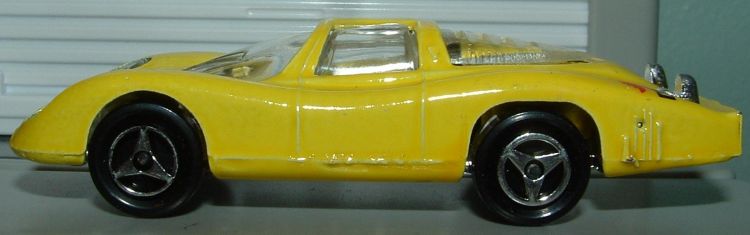
Today's car of the day is Majorette's 1967 Porsche 907.
The 907 was introduced at the 1967 24 Hours of Le Mans. As suggested by Ferdinand Piëch, the position of the driver was moved from the traditional left (as in German road cars) to the right as this gives advantages on the predominant clockwise race tracks.
With a new longtail body, the 907s reached 302 km/h (190 mph) on the straight even though they used the reliable 220 hp Porsche 910 2000cc 6-cyl rather than the more powerful 8-cyl. Also, vented brake disks were used as standard from now. The best Porsche 907 finished 5th, beaten only by Ford and Ferrari with their much bigger engines.
As the record-breaking performances of the 7.0L V8-powered Ford had triggered rumors about a future rule change, Porsche started to prepare themselves in summer of 1967. The 907 was equipped with the 270 hp 2200cc 8-cyl which was then modified for the rules of the new 3 litre prototype category that was announced in late 1967 to come in effect already in 1968. An engine with the full 3000cc would have to be developed first, though, to be introduced in the future Porsche 908.
For more information and pictures of the real car please visit: Porsche 907
I don't normally collect LeMans style racers but this one was in such nice shape and the price was right. And the cat sticker won me over.
From 1968, the big V8 and V12 prototypes of Ford and Ferrari were banned, and Porsche hoped to secure the World Sportscar Championship and maybe an overall win at Le Mans as the competition at Ford, Matra and Alfa Romeo was not prepared with suitable 3000cc prototypes yet, either. Ferrari even sat out the whole of 1968 as a protest against the rule change. Apart from the former 2000cc-class rivals Alfa Romeo T33/2 and Renault-powered Alpine, 5000cc sportscars were also permitted to enter if at least 50 of them had been built. This loophole was intended to fill the grid with cars dating mainly from 1965, like Ford GT40 and Lola T70.
Porsche was serious. Unlike during the rather modest earlier years, four cars were entered in the 1968 24 Hours of Daytona, supported by 20 mechanics and engineers. The pilots were fitted with cooling vests developed by NASA as the oil-cooler and the hot oil pipes caused heat in the closed cockpit.
After the #53 car of Gerhard Mitter had a big crash caused by tyre failure in the banking, his teammate Rolf Stommelen supported the #54 driven by Vic Elford/Jochen Neerpasch. When the #52 car of the longtime leaders Jo Siffert/Hans Herrmann dropped to second due to a technical problem, these two also drove on the #54 car in case theirs broke down. Due to this, five pilots won the race, and two of them scored also second. The #51 Jo Schlesser/Joe Buzzetta car completed the 1-2-3 side-by-side parade finish that the Ferrari prototypes had shown a year earlier at the banked finish line. The three Alfa Romeo T33/2's were even beaten by a Ford Mustang.
Thursday, March 1, 2012
Car Of The Day: March 1, 2012
Today's car of the day is Majorette's 2009 Renault Mégane Coupé.
The Renault Mégane is a small family car produced by the French automaker Renault since 1995. It is offered in 3- and 5-door hatchback, saloon, coupé, convertible and estate bodystyles. The Renault Scénic (launched 1996) is the first modern compact MPV to be built in Europe, and is based on the Mégane floorpan.
For more information and pictures of the real car please visit: Renault Mégane Coupé
Newer Majorettes are still absent from the USA which is a shame. Hopefully they return soon!
The third generation of Mégane was launched in late 2008 to keep the range competitive with newer rivals. It however lacks the distinctive hatchback acquired during its second generation.
In September 2008, both the Renault Mégane Berline 5-door hatchback & Mégane Coupé were presented officially. The two models feature quite a different design, the Coupé having a very aggressive and sporty design while the 5-door model is more conservative. In this generation, no automatic transmission is offered, replaced by a continuously variable transmission. The Coupé can be considered as a shooting brake due to its coupé-like design.
The phase I version of Megane II was well known for reliability issues, especially with the engine management system. Renault has now spent much more time and mileage testing the new model which is therefore expected to have improved reliability.
The electric version of the Mégane saloon that Renault is building will come with a lifetime warranty, and payment will follow the model established by the mobile-phone industry. After buying the car, owners will subscribe to a battery-replacement and charging plan based on their anticipated mileage. Recharging will be done at one of 500,000 spots that Project Better Place will build and maintain.
Sunday, January 22, 2012
Car Of The Day: January 22, 2012
Today's car of the day is Majorette's '75 Datsun 260Z.
The Nissan S30 (sold in Japan as the Nissan Fairlady Z and in other markets as the Datsun 240Z, then later as the 260Z and 280Z) was the first generation of Z GT two-seat coupe, and later (beginning in the 1974 model year) also 2+2 hatchbacks produced by Nissan Motors, Ltd. of Japan from 1969 to 1978. It was designed by a team led by Mr. Yoshihiko Matsuo, the head of Nissan's Sports Car Styling Studio. HLS30 was the designation of the left-hand drive model and HS30 for the right-hand drive model.
For more information and pictures of the real car please visit: Datsun 260Z
I actually saw one of these on Friday. I'm not 100% sure if the one I saw was a 260Z (only sold here for one year) or the 280Z (much more likely) but I do know it was a 2+2 model. I also know it was purple. Any Japanese car of this era is a rare sight to see on this coast- most of these cars rusted away many years ago here.
All variants had a 4-wheel independent suspension consisting of MacPherson struts in front (borrowed from the Nissan Laurel C30) and Chapman struts in back. Front disc brakes and rear drums were standard.
The 240Z and 260Z used twinturbo, variable venturi Hitachi one-barrel side-draft SU-like carburetors. The carburetors were changed beginning with model year 1973 to comply with emissions regulations, but the earlier carburetors were far superior for performance. Fuel injection (L-Jetronic electronic fuel injection, designed by Bosch) was added for the 280Z in 1975 for the US. This was primarily in order to cope with the difficulty faced in getting enough power using carburetors while still meeting US emissions regulations.
Due to its relatively low price compared to other foreign sports cars of the time (Jaguar, BMW, Porsche, etc.), it became popular in the United States and was a major success for the Nissan Motor Corporation, which at the time sold cars in North America under the name Datsun. The 240Z also broadened the image of Japanese car-makers beyond their econobox success.
Continuing through the 1975–1978 model years, other non-USA markets still received the 260Z coupe and the 260Z 2+2 hatchback — the two-door, four-seat model. The S30 240Z is essentially unrelated to the later 240SX, which is sold as the Silvia in Japan, although initial advertising for the 240SX mentioned the S30.
This model was sold in the United States for the 1974 model year only, but was available in other countries until 1978. The engine was enlarged over that of the 240Z with a longer stroke to 2.6 L. In the U.S., federal emissions regulations forced a reduction in ignition timing and compression ratio, resulting in a lower power output (140 hp) for the 260Z's despite the additional displacement, whereas in other countries the power output increased to 165 bhp (123 kW; 167 PS). A 3-speed automatic transmission was an option, and the 4-speed manual remained standard.
1974 brought for the first time to the S30 line a new 2/2 (2+2) seating option, which offered room for 4 passengers and an extra 11.9 in (302 mm) of wheelbase. These cars have a notably different roofline from the 2-seat coupes, incorporating larger opening quarter panel windows.
Some regard the 260Z as the least desirable of the S30 models, because of the reduced performance offered in comparison to the earlier 240Z, and also in comparison to the later 280Z with its fuel-injected 2.8-liter motor.
The 260Z claimed a few updates or improvements or over the 240Z. The climate controls were more sensibly laid out and easier to work, and those cars with air conditioning now had the A/C system integrated into the main climate control panel. There was also additional stiffness in the chassis due to a redesign of the chassis rails which were larger and extended further back than previous models. The 260Z debuted a redesigned dashboard and console, as well as new seat trim, and door panels for the interior. The rear tail lights were updated, moving the reverse lights from the main tail light housing to the back panel. Early 1974 U.S. 260Z models had bumpers that resembled those of the earlier 240Z, though increased slightly in size, pushed away from the body somewhat, and wearing black rubber bumper guards rather that the previous chrome bumper guards with rubber strips. These early cars still had the front turn signals located below the bumpers. Late 1974 U.S. 260Z models (often referred to as 1974.5 models) carried the heavier bumpers that would remain on the 1975-76 model years of the 280Z. These late cars had the front turn signals relocated to the outer edges of the front grill, above the bumper.
Subscribe to:
Posts (Atom)