Showing posts with label Impala. Show all posts

Friday, May 25, 2012

Car Of The Day: May 25, 2012


Today's car of the day comes from Firehawk73's collection and is Maisto's 1959 Chevrolet Impala.
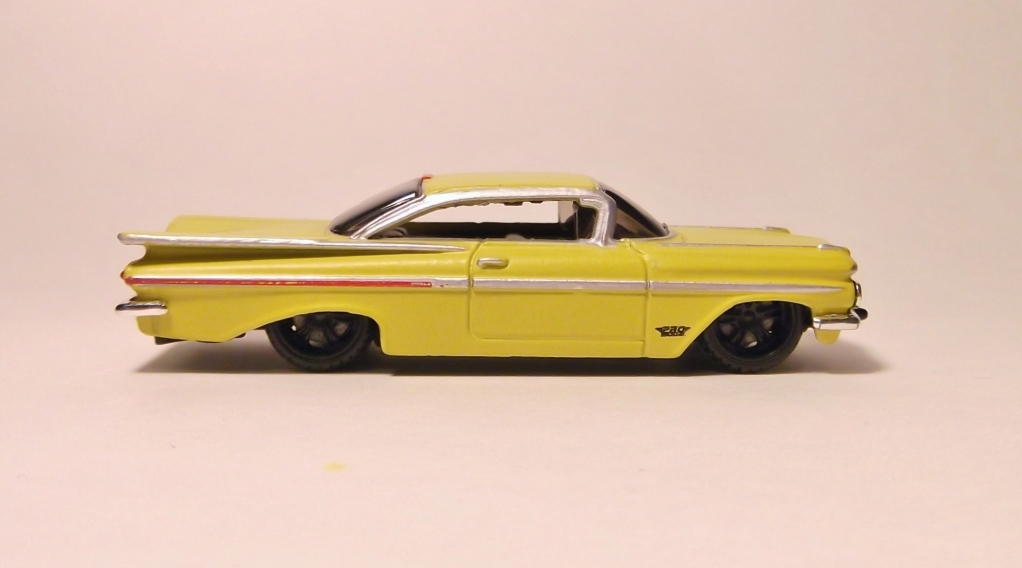


The Chevrolet Impala is a full-size automobile built by the Chevrolet division of General Motors introduced for the 1958 model year. Deriving its name from the southern African antelope, Chevrolet's most expensive passenger model through 1965 had become the best-selling automobile in the United States, competing against the Ford Galaxie 500 and the Plymouth Fury when full-size models dominated the market. The Impala was distinguished for many years by its symmetrical triple taillights. The Caprice was introduced as a top-line Impala Sport Sedan for the 1965 model year becoming a separate series positioned above the Impala in 1966, which itself remained above the Bel Air and Biscayne. The Impala continued as Chevrolet's most popular full-size model through the mid-1980s. Between 1994 and 1996, Impala was revived as a muscular 5.7-liter V8–powered version of the Caprice Classic sedan. In 2000, the Impala was re-introduced again as a mainstream front-wheel drive full-size sedan.
Ed Cole, Chevrolet's chief engineer in the late 1950s, defined the Impala as a "prestige car within the reach of the average American citizen."


For more information and pictures of the real car please visit: Chevrolet Impala


The 1959 Chevrolet Impala was radically reworked sharing bodyshells with lower-end Buicks and Oldsmobiles as well as with Pontiac, part of a GM economy move, Chevrolets rode a wheelbase 11/2 inches longer than before. Atop a new X-frame chassis, roofs sat three inches lower, and bodies measured more than two inches wider overall. The growing size contributed to increased curb weight, one more trend of the times. Its tailfins protruded outward rather than upward. Auto tester Tom McCahill, of Mechanix Illustrated, declared that a Chevy's decklid had "enough room to land a Piper Cub." Chevrolet eschewed the triple-taillight rear style this year with a very large, single controversial "teardrop" taillight at each side.
Impala was now a separate series, including a four-door hardtop and four-door sedan, as well as the two-door Sport Coupe and convertible. Sport Coupes featured a shortened roofline and wrap-over back window, promising a "virtually unlimited rear view" to complement the car's new compound-curve windshield. The hardtop Sport Sedan had a huge, pillar-free back window and "flying wing" roofline. Base V8 was the carryover 283 cu in (4,640 cc), at 185 hp (138 kW) horsepower. Performance fans could select 280 cu in outputs to 290 hp (220 kW) – or turn to the big-block 348 cu in (5,700 cc) V8 up to 315 hp (235 kW). With a V8, the Impala convertible listed at $2,967, but a six-cylinder version saved the customer $118. Impala interiors flaunted their top-of-the-line status, offering front and rear armrests, an electric clock, dual sliding sun visors, and crank-operated front ventipanes. A contoured instrument panel held deep-set gauges residing below hoods to prevent glare. A Flexomatic six-way power seat was a new option, as was "Speedminder" (a device which allowed the driver to set a needle at a specific speed; a buzzer would sound if he exceeded this pre-set speed).

Wednesday, December 7, 2011

Car Of The Day: December 7, 2011


Today's car of the day is MotorMax's 1971 Chevrolet Impala.


The fifth-generation Chevrolet Impala are full-size automobiles produced by the Chevrolet division of General Motors for the 1971 through 1976 model years and was one of GM's top-selling models throughout the 1970s. Models included a sport coupe using a semi-fastback roofline shared with other B-body GM cars, custom coupe with the formal roofline from the Caprice, four-door sedan, four-door hardtop sport sedan, and a convertible, - each of which rode on a new 121.5-inch wheelbase and measured 217 inches overall. Station wagons rode on a longer 125-inch wheelbase.


For more information and pictures of the real car please visit: Chevrolet Impala


It's pink.  It's got flamed dice tampos.  And it's a donk.  I like pink, I can live with the tampos, but I'll never understand donks...


The 1971 redesigned B-body would be the largest car ever offered by Chevrolet. All 1971 Chevrolet engines featured lower compression ratios to permit the use of regular leaded, low lead or unleaded gasoline of at least 91 Research octane per GM corporate mandate in anticipation of the catalytic converters planned for 1975 and later models which necessitated the use of unleaded fuel. A high-performance big block V8 was available in the form of the Turbo-Jet 454, which produced 365 hp in 1971, but power decreased as the years went along. The 1970s marked the impact of the 1973 energy crisis with gasoline prices doubling from 1973 through 1979 and industry car sales plummeted 20 percent between 1973 and 1974. For the first time in recent history, annual passenger car travel in the U.S. declined. The Impala's sales dropped to 176,376 units in 1975, the weakest since its introduction in 1958. An Econominder gauge package was offered for 1975 and 1976 models.

1971 models offered the same lineup as previous years including New standard features included power front disc brakes and inside hood release and a revised Astro Ventilation system that utilized air distribution grills in the trunklid. The new body featured a double panel roof for improved rollover protection and flush exterior door handles - both features previously introduced on the 1970½ Camaro.

Engine offerings included the base 145-horsepower, 250 cubic-inch Turbo Thrift six-cylinder (available only on the Impala four-door sedan as well as the lower-line Biscayne and Bel Air sedans) and 245-horsepower 350 cubic-inch Turbo Fire V-8 (standard on Impala Sport Sedan, Sport Coupe, Custom Coupe, convertible and Kingswood wagon, and optional on the sedan). Optional engines included the 255-horsepower 400 cubic-inch Turbo Fire V-8 (the standard Caprice and Kingswood Estate engine), 300-horsepower 400 cubic-inch Turbo Jet V8 and 365-horsepower 454 cubic-inch V-8. Early in the model year, all Impalas came standard with three-speed column shift manual transmissions and manual steering as standard equipment, with power steering and one of two automatic transmissions optional. During the first months of the model year, the three-speed Turbo-Hydramatic automatic transmission was optional with all engines while the two-speed Powerglide could be ordered with the 250 6 or 350 V-8s. At mid-year the Turbo-Hydramatic and variable-ratio power steering became standard equipment on all V-8 powered full-sized Chevrolets.

Station wagons featured a 'clamshell' design where the rear power-operated glass slid up into the roof as the tailgate (manually or with power assist), dropped below the load floor. The power tailgate, the first of its kind, ultimately supplanted the manual tailgate which required marked effort to lift from storage. This design was shared with other full-sized GM wagons from Pontiac, Oldsmobile and Buick. Subsequent generations reverted to the door-gate style for its full-size wagons. As expected, 1971 Impala production was well below 1970 totals due to the 67-day corporate wide strike at General Motors that began in September, 1970 after initial 1971-model production began and would not end until November. Impala production ended up at 427,000 units including 2,300 with six-cylinder engines and 425,400 with V8 with other series production totals including Caprice, 91,300; Biscayne, 37,600; Bel Air, 20,000; and station wagons (all series), 91,300.