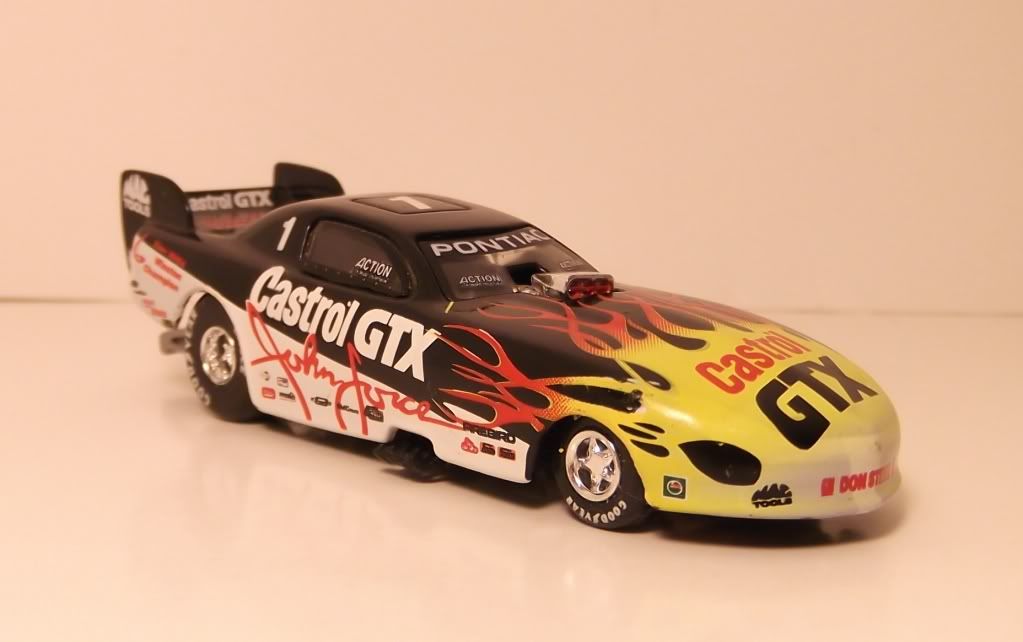
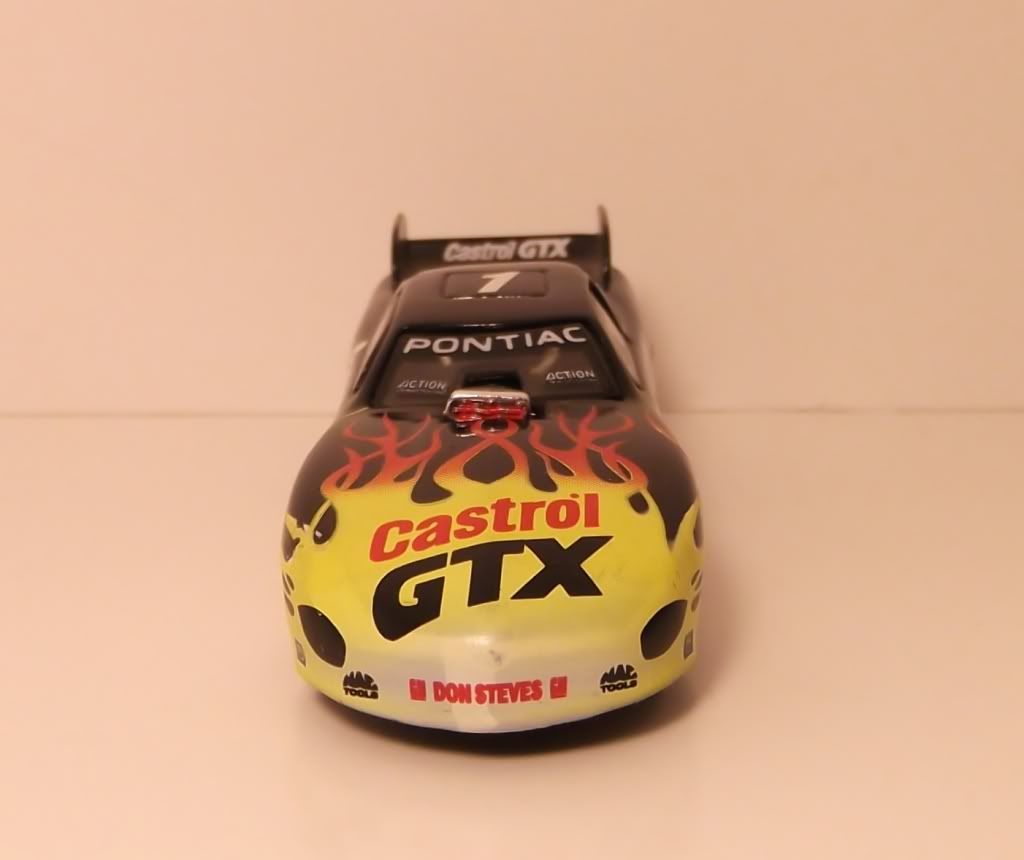
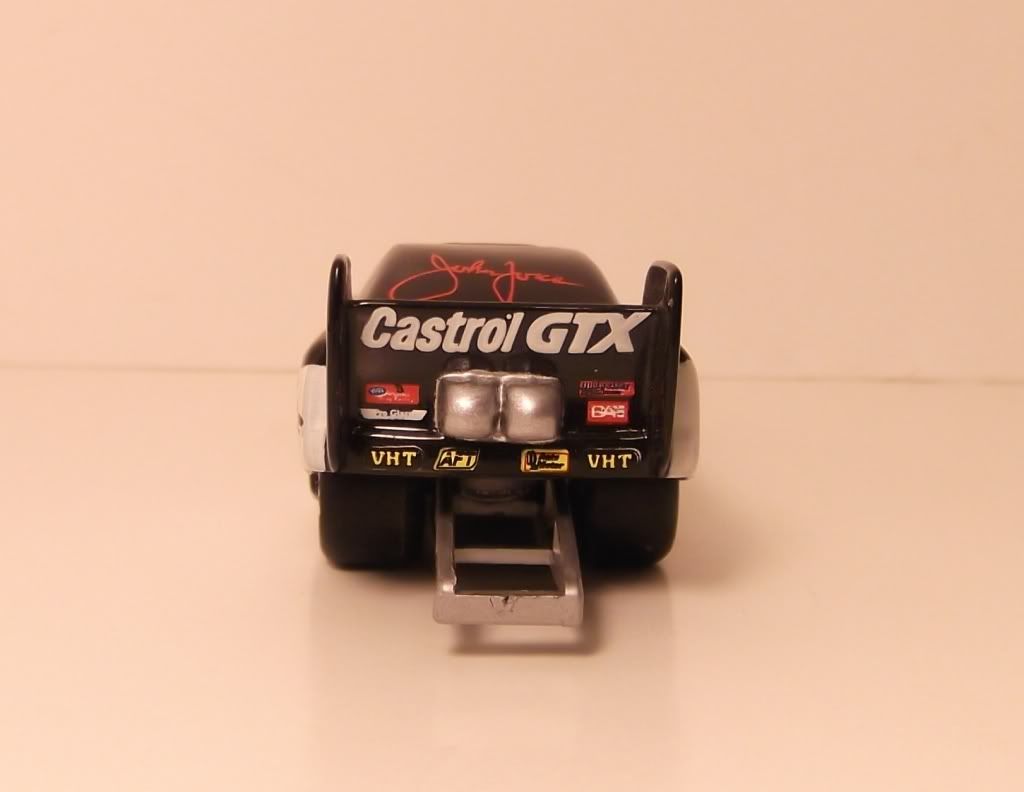
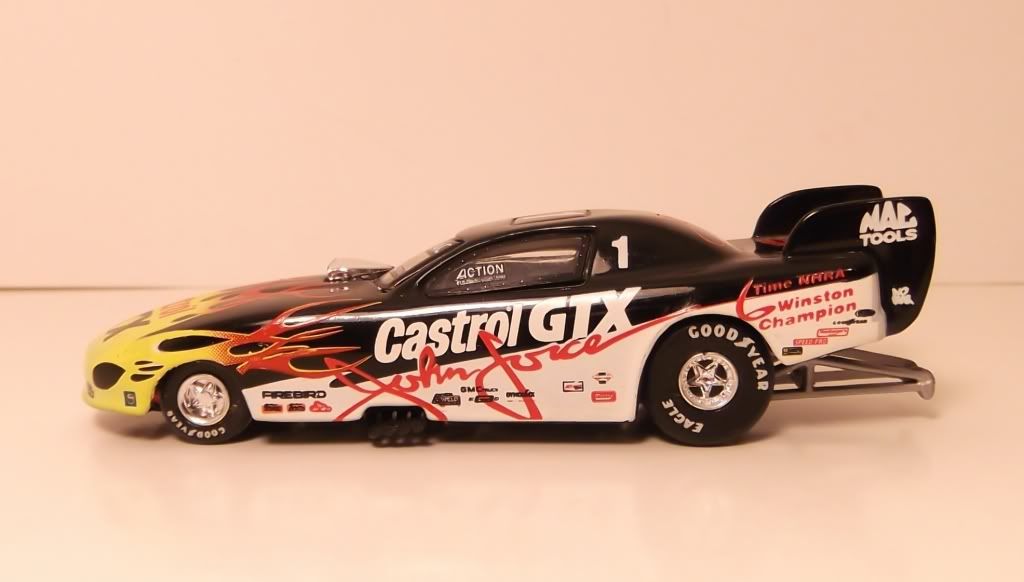
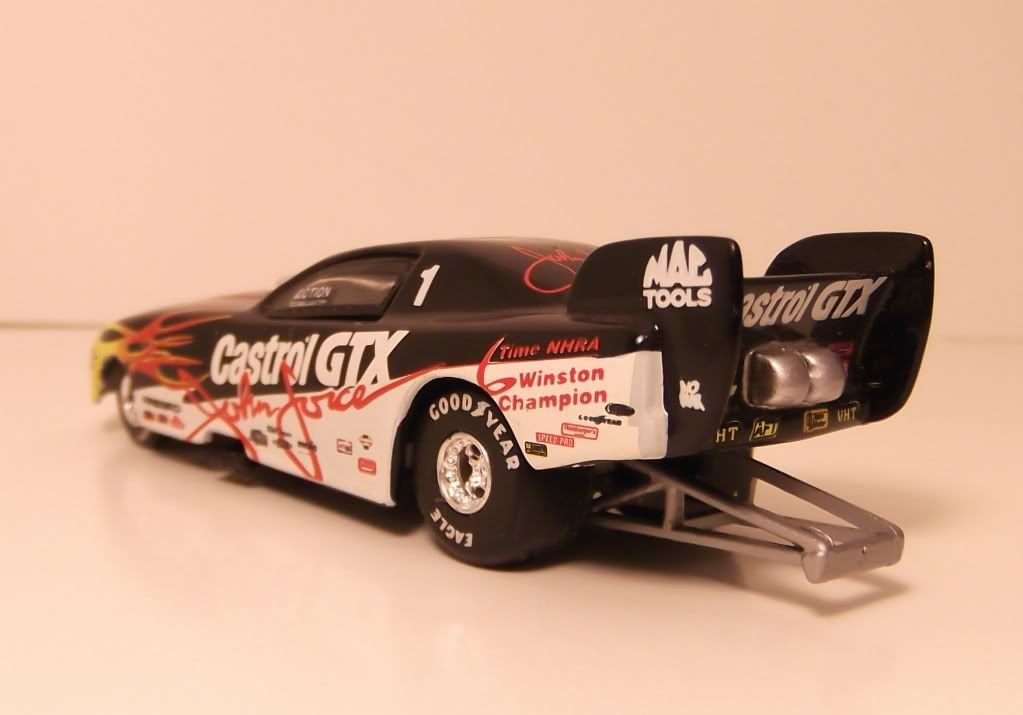
Today's car of the day comes from Firehawk73's collection and is Action's 1975 Chevrolet Monza funny car.

The Chevrolet Monza is a subcompact, four-passenger automobile produced by the Chevrolet division of General Motors for the 1975–1980 model years. The Monza is based on the Chevrolet Vega, sharing its wheelbase, width and 140 CID (2300 cc) inline-4 engine. The 1975 Monza 2+2 was designed to accommodate the GM-Wankel rotary engine, but due to mediocre fuel economy and emissions compliance issues the engine was cancelled, and a fuel-efficient 4.3 liter V8 engine option was substituted.
The Monza 2+2 and Monza Towne Coupe competed with the Ford Mustang II and other sporty coupes. H-body variants Buick Skyhawk and Oldsmobile Starfire were produced using the Monza 2+2 body with grill and trim variations and Buick's 3.8 liter V6 engine. The Pontiac Sunbird variant was introduced the following model year, eventually offered in both Monza body styles. The Monza nameplate originated in mid-1960 for the sporty version of the Chevrolet Corvair.

For more information and pictures of the real car please visit: Chevrolet Monza

The Monza 2+2, Chevy's sporty successor to the Vega debuted as the single-model 2+2 hatchback. The Monza is 4 inches (100 mm) longer and weighs 180 pounds more than the Vega from which it is derived. John DeLorean nicknamed it the Italian Vega citing styling with a strong resemblance to the Ferrari 365 GTC/4.
The 1975 Monza was initially slated to introduce the GM Wankel rotary engine which is licensed from NSU. Notable rotary issues included mediocre fuel economy compounded at a time of comparatively high fuel prices following the Arab oil boycotts of 1973 and 1974, and GM canceled the engine. Thus the 1975 Chevrolet Monza was launched carrying conventional piston engines instead.
The 1975 Monza 2+2 wore its newly approved rectangular headlights and a slot-style grille in a slanted nose made of resilient urethane. The side window louvers are functional, part of the flow-through ventilation system. The Monza 2+2's two-door hatchback body style was shared with the Oldsmobile Starfire and Buick Skyhawk. The standard Monza engine was the Vega aluminum-block 140 CID (2.3 liter) inline-4 engine with a single barrel carburetor generating 78 horsepower (58 kW) at 4200 rpm. Optional was the 2-barrel carburetor version that generates 87 horsepower (65 kW) at 4400 rpm. Chevrolet's new 4.3 liter (262 cid) V-8 engine was optional. The smallest V8 ever offered by Chevrolet, it features a Rochester 2-barrel carburetor and generates 110 horsepower (82 kW) at 3600 rpm. For 1975 only, Monzas sold in California and high altitude areas met the stricter emissions requirnment by substituting a version of the 5.7 liter (350 cid) V8 engine with a 2-barrel carburetor tuned to just 125 hp (93 kW). The Monza 2+2 and its Buick and Oldsmobile variants feature GM's first use of a torque arm rear suspension, also adopted for the 1975 Cosworth Vega introduced mid-1975, and later, all 1976-77 Vegas and Pontiac Astres. The basic design was also incorporated into GM's third and fourth generation F-bodies, Chevrolet Camaro and Pontiac Firebird.
In April 1975, the Monza Towne Coupe was introduced - a notchback body-style with a conventional trunk featuring different sheetmetal than the 2+2 hatchback, although sharing its windshield, front fenders, and doors. It features single round headlamps, instead of the dual rectangular headlamps on the 2+2. The Towne Coupe was offered in response to the sales success of the Ford Mustang II notchback coupe and its luxury version, the Mustang II Ghia. The Towne Coupe is 1.5 inches (38 mm) shorter and 135 pounds (61 kg) lighter than the 2+2 and has slightly more rear head room. A lower priced "S" version of the 2+2 Hatchback was introduced mid-year. It featured as standard the Vega 1-barrel engine with a 3-speed manual transmission. The sport suspension, full console, sport steering wheel, day/night and wheel opening moldings were deleted on the "S". The Chevrolet Monza 2+2 won Motor Trend magazine's "Car of the Year" award for 1975.