A blog focusing on 1/64 diecast from such popular brands as Hot Wheels, Matchbox, Johnny Lightning, M2 Machines, GreenLight, Tomica, Yat Ming, Majorette, MotorMax, Siku, Corgi, Guisval, Playart, Ertl, Zylmex, Racing Champions, & many more. Swifty's Garage features a daily Car Of The Day and news updates from your favorite brands!
Showing posts with label Bel Air. Show all posts
Monday, August 13, 2012
Car Of The Day: August 13, 2012
Today's car of the day comes from juantoo3's collection and is Hot Wheels' 1957 Chevrolet Bel Air.
The 1957 Chevrolet is an automobile which was introduced by the Chevrolet division of General Motors in September, 1956. It was available in three series models: the upscale Bel Air, the mid-range "two-ten", and the "one-fifty". A two-door station wagon, the Nomad was produced as a Bel Air model. An upscale trim option called the "Delray" was available for two-ten 2-door sedans. It is a popular and sought after classic car. These vehicles are often restored to their original condition and sometimes modified. The car's image has been frequently used in toys, graphics, music, movies and television. The '57 Chevy, as it is often known, is an auto icon.
For more information and pictures of the real car please visit: 1957 Chevrolet Bel Air
This one came in a recent box lot, and considering the tampos are what usually take the brunt of the damage in play, this one looks pretty decent. (My other one, which doesn't have the chips, does have noticeable wear on the tampos!) I'm a bit surprised by the plastic base, but that was not unheard of at this time among HW, even though this is a fairly early version of this casting. IIRC, Mattel stopped making cars in Hong Kong along about 1982, +/-. This casting originally came out in '77 I think it was, right at the end of the redline era, and for a time the first color red was made with blackwalls, so this is likely the first recolor (tampos are the same as the red one), and being made in HK would place this one in the early 80s. -Wes (juantoo3)
From a numbers standpoint, the '57 Chevy wasn't as popular as General Motors had hoped. Despite its popularity, rival Ford outsold Chevrolet for the 1957 model year for the first time since 1935. The main cause of the sales shift to Ford was the fact the '57 Chevy had tubeless tires, the first car to have them. This scared away sales to Ford as many people did not initially trust the new tubeless design. Also Ford's introduction of an all-new body styling that was longer, lower, and wider than the previous year's offerings helped Ford sales. However, the 1957 Ford — with the exception of the rare retractable hardtop model — is not nearly as prized by collectors today as the 1957 Chevrolet. Throughout the 1960s and 1970s, the '57 Chevy was a popular used car and highly prized "street machine" or hot rod in 1957 terms. It was the final year of the "shoebox" Chevrolet, as 1958 saw the introduction of a much larger and heavier "X" framed Chevrolet. The ideal size of the '57, combined with its relatively light weight compared to newer full-sized cars, made it a favorite among drag racers. The engine bay was big enough to fit GM's big-block engines, first introduced in 1958 and popularized in the 1960s by the Beach Boys in the song "409". The relatively simple mechanical attributes of the car made it easy to maintain, customize, and upgrade with components such as disc brakes and air conditioning.
The big block, however, was not what put the '57 on the map on the street scene; it was the introduction and the over-the-counter, low-priced availability of the small block, 365 horsepower 327 in 1962 that was the blockbuster that made both the '55 and '57 Chevy able to beat the Ford hotrods with their flathead V8s. This was a major turning point in American hot rodding: Chevrolet had claimed the street scene from Ford. The '57 Chevy also won 49 Grand National "cup" NASCAR races (the most of any car in NASCAR history), won the Southern 500 (in 1957, 1958, and 1959); becoming only car to do so.
The 57 also won 25 NASCAR convertible races, more than any car and won all three possible drivers championships. The 57's subsequently were used up in stock car racing at a very high rate. With the 283 engine placed from the factory behind the centerline of the front wheels made the '57 a superior handling car on the short tracks and the dirt tracks as well.
This mechanical advantage, coupled with a high reving reliable 283 earned the '57 the nickname "king of the short tracks". With the fuel injected 283, the 150 model two door sedan version, called the "black widow", was the first car that was outlawed (and quickly so) by NASCAR as it proved almost unbeatable on virtually all the NASCAR tracks in early 1957. After the "57 was grandfathered out from the now "cup" division in 1960 and relegated to the lower local track sportsman divisions they were the car to beat for years. Surprisingly enough, the '57 Chevy also won a disproportionate amount of demolition derbies as well: With the radiator set back from the grille, the car was difficult to disable. The additional advantage of having the last double lined trunk, coupled with a strong frame, made it a surprisingly common winner in the demolition derbies during the late 1960s and early 1970s. By the 1970s, the '57 Chevy became a collector car.
Companies such as Danchuk Manufacturing, Inc. and Classic Chevy International began selling reproduction and restoration parts. In the early 1990s, the value of meticulously restored '57 Chevy convertibles was as high as $100,000. Though those peaks gave way significantly after 1992, the '57 Chevy has held its value and now is poised to exceed the previous peak.
Restored, original examples are increasingly rare, and modern customizers and restorers are creating fast, powerful, ultra-modern hot rods that are winning the '57 Chevy a whole new generation of fans. Fiberglass and all-steel reproductions are making it possible for future generations to enjoy the '57 Chevy as original cars become harder to find.
Wednesday, July 25, 2012
Car Of The Day: July 25, 2012
Today's car of the day comes from craftymore's collection and is Road Champs' 1957 Chevrolet Bel Air.
The 1957 Chevrolet is an automobile which was introduced by the Chevrolet division of General Motors in September, 1956. It was available in three series models: the upscale Bel Air, the mid-range "two-ten", and the "one-fifty". A two-door station wagon, the Nomad was produced as a Bel Air model. An upscale trim option called the "Delray" was available for two-ten 2-door sedans. It is a popular and sought after classic car. These vehicles are often restored to their original condition and sometimes modified.
Initially, General Motors executives wanted an entirely new car for 1957, but production delays necessitated the 1955–56 design for one more year. Ed Cole, chief engineer for Chevrolet, dictated a series of changes that significantly increased the cost of the car. These changes included a new dashboard, sealed cowl, and the relocation of air ducts to the headlight pods, which resulted in the distinctive chrome headlight that helped make the '57 Chevy a classic. Fourteen-inch wheels replaced the fifteen-inch wheels from previous years to give the car a lower stance, and a wide grille was used to give the car a wider look from the front. The now famous '57 Chevy tailfins were designed to duplicate the wide look in the rear. Later in the year,Bel Air models were given gold trim: the grille, front fender chevrons, hood, and trunk script were all rendered in anodized gold. The 1957 Chevys did not have a oil pressure gauge or a voltmeter. The base engine was an inline 6-cylinder called the Blue Flame Six. The engine was smooth running and more fuel-efficient than the V-8. Carburetion came from a single one-barrel carburetor.
Off brand diecast from the 1980s is becoming more appealing to me on several levels. For starters, most were were all metal and featured some working features - suspension or doors. There was an apparent heaviness to the castings that rivaled that of Hot Wheels in the day. The other really unique feature on this Road Champs is the convertible top can be traded off for the rear bonnet. The conv top isn't great scale wise but it's a cool feature. -craftymore
Saturday, June 2, 2012
Car Of The Day: June 2, 2012
Today's car of the day comes from Firehawk73's collection and is Johnny Lightning's 1962 Chevrolet Bel Air.
The Chevrolet Bel Air is a full-size automobile that was produced by the Chevrolet division of General Motors for the 1950–1975 model years. Hardtops in the Chevrolet Deluxe Styleline model range were designated with the Bel Air name from 1950 to 1952, but it was not a distinct series of its own until the 1953 model year. Bel Air production continued in Canada for its home market only through the 1981 model year.
For more information and pictures of the real car please visit: Chevrolet Bel Air
For 1961, Chevrolet again had a totally new body, not just new sheetmetal. Its wheelbase remained 119 in (3,000 mm), but its length was now reduced slightly to 209.3 in (5,320 mm). All engines options of the previous year remained in effect with the standard engines being the 235.5 CID Six of 135 hp (101 kW) or the 283 CID V8 of 170 hp (130 kW). The V8 cost $110 more than the Six and weighed 5 lb (2.3 kg) less.
The Bel Air 2-door sedan used squared-off roof styling and large wrap-around rear window as opposed to the hardtop's swept-back design. The Bel Air 4-door Sport Hardtop still used a different roof line than did the 4-door sedan.
For 1962, all sheetmetal except the door panels was changed. Overall length was stretched slightly to 209.6 in (5,320 mm). The 4-door Sport Hardtop was no longer offered in the Bel Air series. Standard engines remained the same as the previous year. A new 327 cu in (5,360 cc) V8 of 250 or 300 hp (220 kW) was offered in addition to the giant (for the time) 409 cu in (6,700 cc) V8 of 380 hp (280 kW) or 409 hp (305 kW) with the dual four-barrel carburetor setup. All wagons this year were 4-door models and separate distinctions for wagons were dropped. Now all models were either Biscayne, Bel Air or Impala series. Full carpeting returned as standard equipment on all 1962 Bel Air models for the first time in several years.
Wednesday, April 18, 2012
Car Of The Day: April 18, 2012
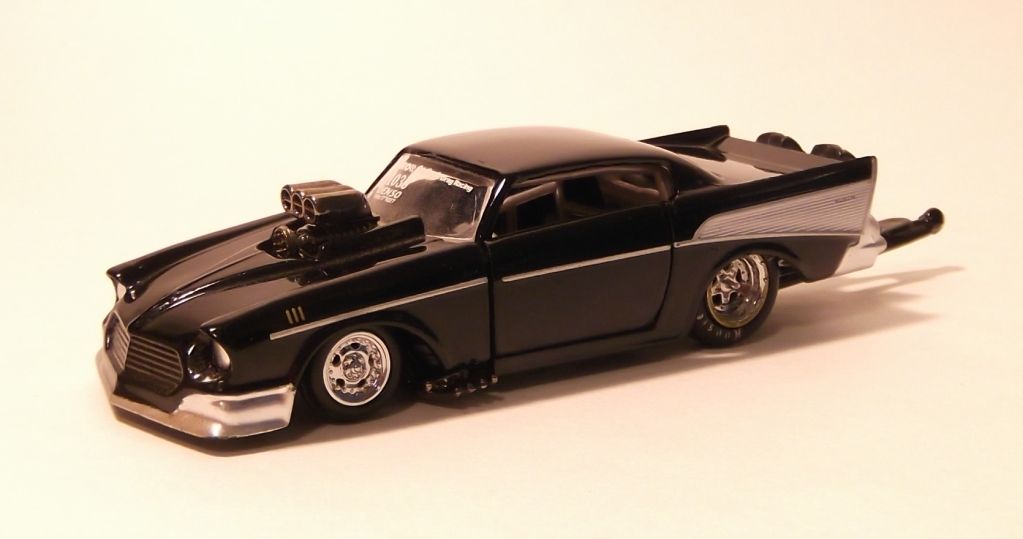
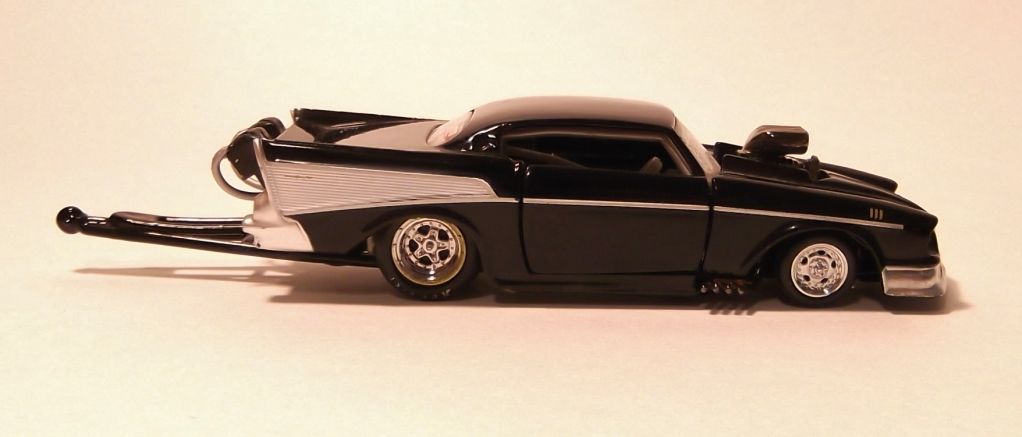
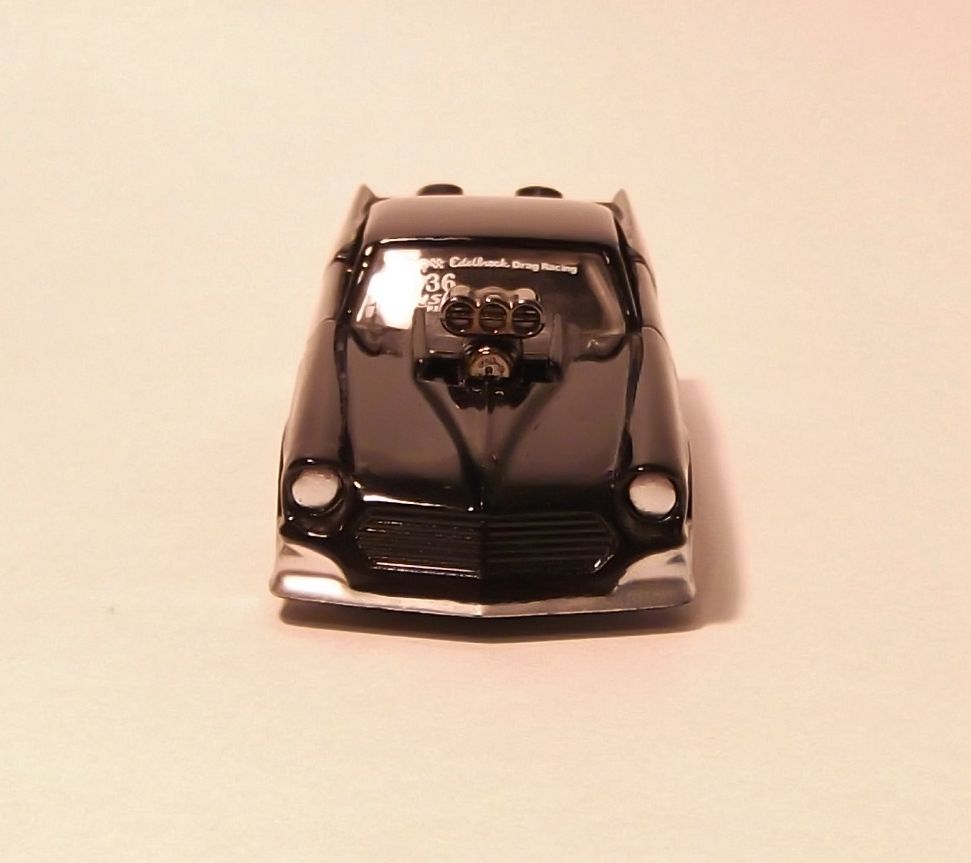
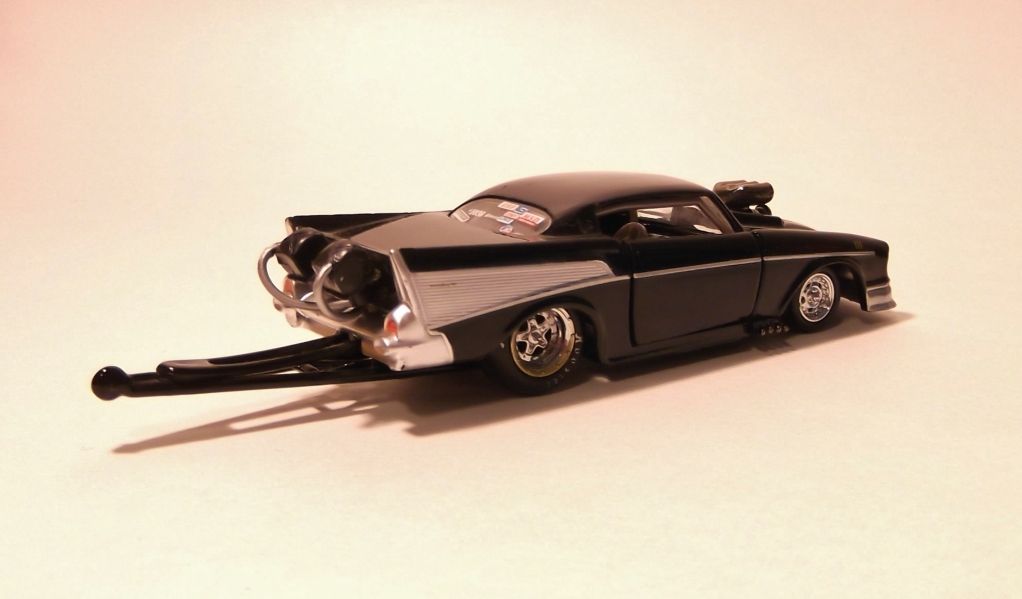
Today's car of the day comes from Firehawk73's collection and is Muscle Machines 1957 Chevy Bel Air Pro Stock.
The Chevrolet Bel Air is a full-size automobile that was produced by the Chevrolet division of General Motors for the 1950–1975 model years. Hardtops in the Chevrolet Deluxe Styleline model range were designated with the Bel Air name from 1950 to 1952, but it was not a distinct series of its own until the 1953 model year. Bel Air production continued in Canada for its home market only through the 1981 model year.
For more information and pictures of the real car please visit: Chevrolet Bel Air
For 1955, Chevrolet's full-size model received new styling that earned it the "Hot One" designation by enthusiasts. Unlike Ford and Plymouth, Chevrolet's styling was considered crisp and clean. Bel Airs came with features found on cars in the lower models ranges plus interior carpet, chrome headliner bands on hardtops, chrome spears on front fenders, stainless steel window moldings, and full wheel covers. Models were further distinguished by the Bel Air name script in gold lettering. For 1955 Chevrolets gained a V8 engine option. The new 265 cu in (4,340 cc) V8 featured a modern, overhead valve high compression, long stroke design that was so good that it remained in production in various forms, for many decades. The base V8 had a two-barrel carburetor and was rated at 162 hp (121 kW), and the "Power Pack" option featured a four-barrel carburetor and other upgrades yielding 180 bhp (130 kW). Later in the year, a "Super Power Pack" option added high-compression and a further 15 bhp (11 kW). "Idiot" lights replaced gauges for the generator and oil pressure. Motor Trend magazine gave the Bel Air top marks for handling. Front legroom was 43.1". Brakes were 11" drums.
The 1956 Bel Air received a face-lift with a more conventional full-width grille, pleasing those customers who didn't favor the Ferrari-inspired '55 front end. Distinctive two-tone bodyside treatments and graceful front and rear wheel openings completed the "speedline" restyling. Single housings incorporated the taillight, stoplight, and backup light, and the left one held the gas filler - an idea popularized on Cadillacs. Among the seven Bel Air models was a new Sport Sedan, a pillarless four-door hardtop that looked handsome with all the windows rolled down and allowed easy entry into the back seat. Production exceeded 103,000, compared to 128,000 two-door hardtops. Shapely two-door Nomad wagons topped the price chart at $2,608, but now carried the same interior and rear-wheel sheetmetal as other Bel Airs, lacking the original's unique trim. Only 7,886 were built. The least costly Bel Air, at $2,025, was the two-door sedan. Seatbelts, shoulder harnesses, and a padded dashboard were available, and full-size cars could even get the hot Corvette 225-horsepower engine. In 1956 sales material was an optional rain-sensing automatic top, which was first seen on the 1951 LaSabre concept car. However, it is believed that it was never installed on a car.
In 1957 engine displacement grew to 283 cu in (4,640 cc) with the "Super Turbo Fire V8" option producing 283 hp (211 kW) with the help of continuous (closed loop) mechanical fuel injection. These so-called "fuelie" cars are quite rare, since most Bel Airs were fitted with carburetion. The 1957 Bel Air is among the most recognizable American cars of all time; well-maintained examples, especially Sport Coupes and Convertibles are highly sought after by collectors and enthusiasts. They are roomy, fuel-efficient, with tastefully restrained, period use tail fins and chrome. A second automatic transmission, Turboglide, was optional. While the original two-speed Powerglide continued unchanged, Turboglide provided a continuously variable gear ratio which made "shifting" imperceptible. The shift quadrant on Turboglide cars followed a "P R N D Lr" pattern.
From 1955 to 1957, production of the two-door Nomad station wagon was assigned to the Bel Air series, although its body and trim were unique to that model. Prior to becoming a regular production model, the Nomad first appeared as a Corvette-based concept vehicle in 1954. Chevrolet has since unveiled two concept cars bearing the Nomad name, most recently in 1999. The 1955–1957 Chevrolets are commonly referred to as TriFives.
The 1955-1957s were made in right-hand drive and shipped from Oshawa, Canada, for local assembly in Australia (CKD), New Zealand (SKD) and South Africa. All three model years had a reversed version of the '55 LHD dashboard and did not get the LHD models' 1957 redesign.
Monday, March 12, 2012
Car Of The Day: March 12, 2012
Today's car of the day comes from Firehawk73's collection and is Hot Wheels' 1962 Chevrolet Bel Air.
The Chevrolet Bel Air is a full-size automobile that was produced by the Chevrolet division of General Motors for the 1950–1975 model years. Hardtops in the Chevrolet Deluxe Styleline model range were designated with the Bel Air name from 1950 to 1952, but it was not a distinct series of its own until the 1953 model year. Bel Air production continued in Canada for its home market only through the 1981 model year.
For more information and pictures of the real car please visit: Chevrolet Bel Air
For 1961, Chevrolet again had a totally new body, not just new sheetmetal. Its wheelbase remained 119 in (3,000 mm), but its length was now reduced slightly to 209.3 in (5,320 mm). All engines options of the previous year remained in effect with the standard engines being the 235.5 CID Six of 135 hp (101 kW) or the 283 CID V8 of 170 hp (130 kW). The V8 cost $110 more than the Six and weighed 5 lb (2.3 kg) less.
The Bel Air 2-door sedan used squared-off roof styling and large wrap-around rear window as opposed to the hardtop's swept-back design. The Bel Air 4-door Sport Hardtop still used a different roof line than did the 4-door sedan.
For 1962, all sheetmetal except the door panels was changed. Overall length was stretched slightly to 209.6 in (5,320 mm). The 4-door Sport Hardtop was no longer offered in the Bel Air series. Standard engines remained the same as the previous year. A new 327 cu in (5,360 cc) V8 of 250 or 300 hp (220 kW) was offered in addition to the giant (for the time) 409 cu in (6,700 cc) V8 of 380 hp (280 kW) or 409 hp (305 kW) with the dual four-barrel carburetor setup. All wagons this year were 4-door models and separate distinctions for wagons were dropped. Now all models were either Biscayne, Bel Air or Impala series. Full carpeting returned as standard equipment on all 1962 Bel Air models for the first time in several years.
Sunday, January 15, 2012
Car Of The Day: January 15, 2012
Today's car of the day is Hot Wheels' 1955 Chevrolet Bel Air.
The Chevrolet Bel Air is a full-size automobile that was produced by the Chevrolet division of General Motors for the 1950–1975 model years. Hardtops in the Chevrolet Deluxe Styleline model range were designated with the Bel Air name from 1950 to 1952, but it was not a distinct series of its own until the 1953 model year. Bel Air production continued in Canada for its home market only through the 1981 model year.
For more information and pictures of the real car please visit: Chevrolet Bel Air
A recent RAOK from Pegers (thanks Dan!). This was another long-lived casting in the Hot Wheels range until it met its demise in the Final Run series a decade ago. This particular example was a set car.
For 1955, Chevrolet's full-size model received new styling that earned it the "Hot One" designation by enthusiasts. Unlike Ford and Plymouth, Chevrolet's styling was considered crisp and clean. Bel Airs came with features found on cars in the lower models ranges plus interior carpet, chrome headliner bands on hardtops, chrome spears on front fenders, stainless steel window moldings, and full wheel covers. Models were further distinguished by the Bel Air name script in gold lettering. For 1955 Chevrolets gained a V8 engine option. The new 265 cu in (4,340 cc) V8 featured a modern, overhead valve high compression, long stroke design that was so good that it remained in production in various forms, for many decades. The base V8 had a two-barrel carburetor and was rated at 162 hp (121 kW), and the "Power Pack" option featured a four-barrel carburetor and other upgrades yielding 180 bhp (130 kW). Later in the year, a "Super Power Pack" option added high-compression and a further 15 bhp (11 kW). "Idiot" lights replaced gauges for the generator and oil pressure. Motor Trend magazine gave the Bel Air top marks for handling. Front legroom was 43.1".
Subscribe to:
Posts (Atom)