Showing posts with label MotorMax. Show all posts

Sunday, March 11, 2012

Car Of The Day: March 11, 2012


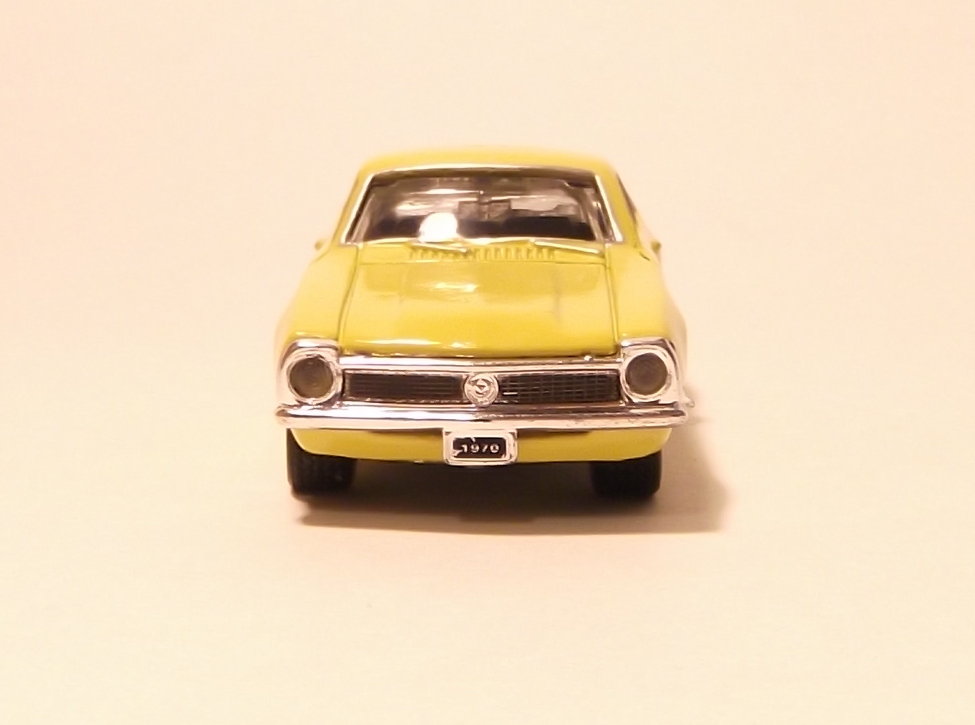
Today's car of the day comes from Firehawk73's collection and is MotorMax Fresh Cherries' 1970 Ford Maverick.


The Ford Maverick was a compact car manufactured from April 1969-1977 in the United States, Canada, Mexico and from 1973-1979 in Brazil — employing a rear wheel drive platform dating to the original 1960 Falcon. Originally marketed as a 2-door sedan at an initial price of USD$1,995, the Maverick was designed to be inexpensive to manufacture and maintain.

The name "maverick" was derived from the word for unbranded range animals, and the car's nameplate was stylized to resemble a longhorned cow head.


For more information and pictures of the real car please visit: Ford Maverick


The Maverick was originally conceived and marketed as a subcompact "import fighter", intended to do battle with the Volkswagen Beetle and newer Japanese rivals. The Falcon, Ford's compact offering since 1960, had seen its sales decimated by the introduction of the Mustang in 1964, and despite a redesign in 1966, was unable to meet forthcoming federal motor vehicle standards that would come into effect on January 1, 1970. Consequently, the Falcon was discontinued midway through the 1970 model year, and the Maverick repositioned as Ford's compact entry.

The Maverick's styling featured the long hood, fastback roof and short deck popularized by the Mustang, on a 103 in (2,600 mm) wheelbase — and featured simple and inexpensive to manufacture pop-out rear side windows rather than roll-down windows.

Nearly 579,000 Mavericks were produced in its first year. This rivaled the record-setting first year of Mustang sales (nearly 619,000), and easily outpaced the Mustang's sales of less than 200,000 in 1970.

Wednesday, December 7, 2011

Car Of The Day: December 7, 2011


Today's car of the day is MotorMax's 1971 Chevrolet Impala.


The fifth-generation Chevrolet Impala are full-size automobiles produced by the Chevrolet division of General Motors for the 1971 through 1976 model years and was one of GM's top-selling models throughout the 1970s. Models included a sport coupe using a semi-fastback roofline shared with other B-body GM cars, custom coupe with the formal roofline from the Caprice, four-door sedan, four-door hardtop sport sedan, and a convertible, - each of which rode on a new 121.5-inch wheelbase and measured 217 inches overall. Station wagons rode on a longer 125-inch wheelbase.


For more information and pictures of the real car please visit: Chevrolet Impala


It's pink.  It's got flamed dice tampos.  And it's a donk.  I like pink, I can live with the tampos, but I'll never understand donks...


The 1971 redesigned B-body would be the largest car ever offered by Chevrolet. All 1971 Chevrolet engines featured lower compression ratios to permit the use of regular leaded, low lead or unleaded gasoline of at least 91 Research octane per GM corporate mandate in anticipation of the catalytic converters planned for 1975 and later models which necessitated the use of unleaded fuel. A high-performance big block V8 was available in the form of the Turbo-Jet 454, which produced 365 hp in 1971, but power decreased as the years went along. The 1970s marked the impact of the 1973 energy crisis with gasoline prices doubling from 1973 through 1979 and industry car sales plummeted 20 percent between 1973 and 1974. For the first time in recent history, annual passenger car travel in the U.S. declined. The Impala's sales dropped to 176,376 units in 1975, the weakest since its introduction in 1958. An Econominder gauge package was offered for 1975 and 1976 models.

1971 models offered the same lineup as previous years including New standard features included power front disc brakes and inside hood release and a revised Astro Ventilation system that utilized air distribution grills in the trunklid. The new body featured a double panel roof for improved rollover protection and flush exterior door handles - both features previously introduced on the 1970½ Camaro.

Engine offerings included the base 145-horsepower, 250 cubic-inch Turbo Thrift six-cylinder (available only on the Impala four-door sedan as well as the lower-line Biscayne and Bel Air sedans) and 245-horsepower 350 cubic-inch Turbo Fire V-8 (standard on Impala Sport Sedan, Sport Coupe, Custom Coupe, convertible and Kingswood wagon, and optional on the sedan). Optional engines included the 255-horsepower 400 cubic-inch Turbo Fire V-8 (the standard Caprice and Kingswood Estate engine), 300-horsepower 400 cubic-inch Turbo Jet V8 and 365-horsepower 454 cubic-inch V-8. Early in the model year, all Impalas came standard with three-speed column shift manual transmissions and manual steering as standard equipment, with power steering and one of two automatic transmissions optional. During the first months of the model year, the three-speed Turbo-Hydramatic automatic transmission was optional with all engines while the two-speed Powerglide could be ordered with the 250 6 or 350 V-8s. At mid-year the Turbo-Hydramatic and variable-ratio power steering became standard equipment on all V-8 powered full-sized Chevrolets.

Station wagons featured a 'clamshell' design where the rear power-operated glass slid up into the roof as the tailgate (manually or with power assist), dropped below the load floor. The power tailgate, the first of its kind, ultimately supplanted the manual tailgate which required marked effort to lift from storage. This design was shared with other full-sized GM wagons from Pontiac, Oldsmobile and Buick. Subsequent generations reverted to the door-gate style for its full-size wagons. As expected, 1971 Impala production was well below 1970 totals due to the 67-day corporate wide strike at General Motors that began in September, 1970 after initial 1971-model production began and would not end until November. Impala production ended up at 427,000 units including 2,300 with six-cylinder engines and 425,400 with V8 with other series production totals including Caprice, 91,300; Biscayne, 37,600; Bel Air, 20,000; and station wagons (all series), 91,300.

Sunday, December 19, 2010

Wider May Not Be Better: The AMC Pacer In 1/64

American Motors always dared to be different.  In order to differentiate themselves from the Big Three, they took chances and risks with their styling in order to stand out in a crowd that other brands wouldn’t even think about undertaking.  Some paid off- the Gremlin was a shortened AMC Hornet and sold very well for a minimal investment.  Some did not.  Two in particular have been referred to as being the cars that killed AMC: one is the Matador coupe and the other is the subject of this article, the Pacer.

The Pacer was something bold and innovative- originally scheduled to be powered by a licensed version of the GM Wankel engine, AMC instead had to shoehorn the 232 & 258 cubic inch straight sixes under the hood due to GM canceling their rotary late in the development stage.  Many of the Pacer’s styling quirks have a purpose- the built in rollbar, for example, was in anticipation of rollover crash testing regulations that never materialized.  This made the Pacer heavier than it would have been otherwise, which unfortunately affected both gas mileage and performance.  The passenger door was longer than the driver’s side door in order to make entry & exit easier for rear seat passengers.  Unfortunately, this made it awkward when AMC attempted to sell a right-hand drive converted version of the car in the United Kingdom.  There was no budget to make the left door longer and the right door shorter, so UK Pacers ended up with a longer driver door than passenger door.  It was wider than other compacts of the era, and ads for the car featured a Nova driving inside the front of a Pacer to show just how wide the car really was.  Another featured a full-size Ford LTD parking, and the Ford parts being removed to show that it was actually a Pacer underneath.  The idea was to make the interior comfortable for both the driver and passengers used to full-size cars.
The Pacer could not have been timed better: an all new from the ground up small car debuting in the middle of an oil crisis.  It had innovative safety features and unique aerodynamic styling that couldn’t be confused for anything else on the road (before or since).  So why did this car fail so miserably?

Most people agree that this car was far too radically styled for its era.  Like the Chrysler Airflow or the GM “Dustbuster” minivans, the look went too far beyond what the general public was willing to accept from an automaker at the time.  Oddly, the car has aged tremendously well.  Thanks to the Ford Taurus, the rounded styling did catch on in the mid-1980s (more than a full decade after the Pacer’s introduction, and six years after its discontinuation) and many cars currently have an aerodynamic design instead of the three-box format preferred in the 1970s.

The car was designed from the inside out to be as ergonomic as possible.  One would think that someone at AMC would have caught on to the fact that the car’s massive amount of glass would cause the air conditioner to be a necessity instead of an option.  Pacers could heat up quickly in direct sunlight, and one of the car’s many nicknames was “fishbowl” referring to the amount of glass on the car’s surface area.
The Pacer was heavy.  Between the glass and the metal reinforcements to meet safety regulations that never came into play, the car was much heavier than it was designed to be.  And that’s before one takes into account that it was designed for a much smaller, lighter engine.  Because of that, not only did performance suffer, but so did the critical fuel economy numbers.

The Japanese car manufacturers were just establishing themselves in the US market at the time (there were also offerings from European brands that are no longer available in the US market including Renault, Fiat, and Peugeot), and many Americans had never owned a foreign car.  Many thought it to be unfathomable that they’d end up driving a car that wasn’t built in the USA someday.  Here’s where AMC and the rest of the American manufacturers really dropped the ball- they underestimated the quality of the Japanese cars and overestimated the brand loyalty of their existing customer base.  By the time the Pacer ended production, Renault had purchased a controlling interest in AMC, and suddenly the newest AMCs were rebadged Renaults.  Cars like the Renault designed Alliance, Encore, LeCar, and Medallion became the products in AMC showrooms while the Pacer, Spirit and Concord were dropped in the early 1980s.  Of the cars developed by AMC only the Eagle 4WD stayed in production until the end of the line on December 14, 1987.

From the late ‘70s through the ‘80s the Pacer suffered low resale values, and was mocked mercilessly by comedians and the general public.  If you were making a movie or TV show and wanted to establish a character as a loser, one of the easiest ways of doing so was to give him (or her) a Pacer.  Bonus points if it was in bad shape.  Then the ‘70s started being cool again and the Pacer suddenly became an icon for the decade along with disco and bellbottoms.  Being Wayne & Garth’s Mirthmobile in “Wayne’s World” didn’t hurt matters and one of the movie’s most famous scenes (rocking out to Queen’s “Bohemian Rhapsody”) takes place in the car.  Even children’s movies like the animated “A Goofy Movie” featured the Pacer in the ‘90s, and eventually the car built up a reputation as a ‘nerd car’, and values started climbing for nice examples of the real car around the turn of the century.  Which may explain the recent increase in Pacer models offered in small scale.  As an added bonus, the “Cars 2” trailer has recently shown both Gremlins and Pacers featured (unfortunately as villains- AMC still gets little respect from Hollywood) so it is extremely likely that Mattel’s line of Pixar “Cars” will release a Pacer at some point between now and the movie’s release date next summer.

1975-1977:

Corgi (coupe)
Tomica (coupe)


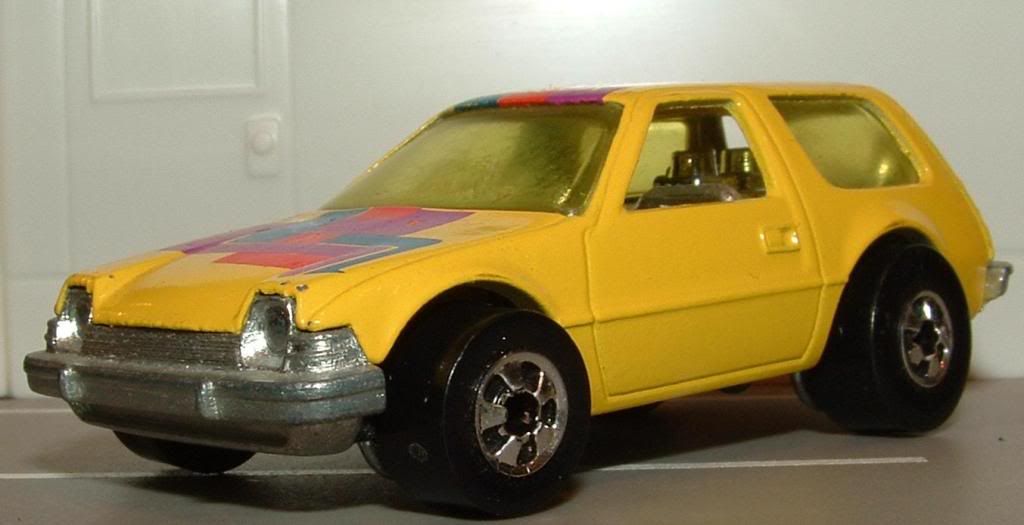
Hot Wheels (wagon; hot rod with oversized engine in the cargo area)

Universal (wagon; scaled up copy of the Hot Wheels without the oversized motor)
Racing Champions (coupe; hood opens the wrong way)
Racing Champions Street Wheels
Johnny Lightning (recast of the Racing Champions model; hood cast shut)
Wheeler

1978-1980:


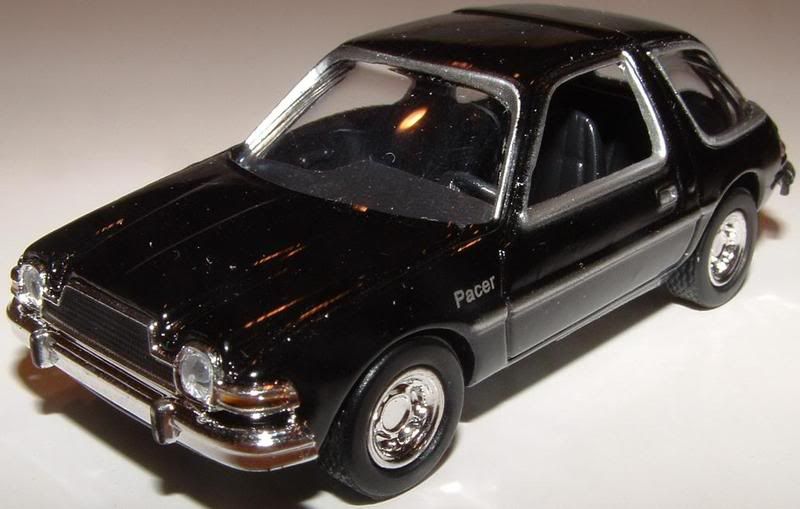
MotorMax (coupe)

Monday, October 25, 2010

Car of the Day:October 25, 2010

The car for today is the Motormax 1974 AMC Hornet.

The AMC Hornet was a compact automobile made by the American Motors Corporation (AMC) beginning with the 1970 model year and continuing through the 1977 model year. The Hornet replaced the compact Rambler American marking the end of the Rambler marque in the American and Canadian markets. Hornets were also assembled in foreign markets under license agreements with AMC that included Vehículos Automotores Mexicanos (VAM) and Australian Motor Industries (AMI). T

he new Hornet became an important vehicle and platform for AMC. It served the company in one form or another for eighteen years, until the 1988 model year. It would outlast all other compact platforms from the competition that included the Chevrolet Nova, Ford Maverick, and Plymouth Valiant. The Hornet was also the basis for AMC's Gremlin, Concord, and the innovative all-wheel drive AMC Eagle.

The Hornet's styling was based on the AMC Cavalier show car. Development of the new model took three years, a million man-hours, and US$40 million.[1] The Hornet marked the return of AMC to its original role as a "niche" marketer specializing in small cars.[1] Introduced in 1969 for the 1970 model year, the Hornet was the first car in a line of new models that AMC would introduce over the following three years, and it set the tone for what designer Richard A. Teague and chief executive officer Roy D. Chapin, Jr., had in mind for the company for the 1970s.[2]
With its manufacturers suggested retail price (MSRP) of US$1,994 for the base model, the Hornet was an economical small family car. However, it took design cues from the popular Ford Mustang and Chevrolet Camaro, and the company's own Javelin with a long hood, short rear deck and sporty looks.[2] The Hornet's 108-inch (2,743 mm) wheelbase platform (two inches or 5.08 centimeters longer than its predecessor the Rambler American) evolved into a number of other models (including the four-wheel-drive Eagle) and was produced through 1988. The Hornet was initially available in a choice of two thrifty straight-six engines or a 304 cu in (5.0 L) V8.

All four versions of the Hornet were mostly carryovers in 1974, with minimal trim changes. The car's front bumper lost its full-width vinyl rub strip, but gained two rubber-faced bumper guards. A larger rear bumper was added to meet new 5 mph legislation, and the license plate was moved up to a position between the taillights.

This was received in a trade with James. Motormax released a set of 6 cars in a drag themed series which as far as I know was released in Canada, but not in the US. While to my knowledge this isn't based on an actual car, it's still a nice example of what a drag car from the 1980s era might have looked like if a Hornet was used.