Showing posts with label Porsche. Show all posts

Sunday, July 1, 2012

Car Of The Day: July 1, 2012


Today's car of the day is Darda's 1986 Porsche 959.


Porsche 959 is a sports car manufactured by Porsche from 1986 to 1989, first as a Group B rally car and later as a legal production car designed to satisfy FIA homologation regulations requiring that a minimum number of 200 street legal units be built.

In 1986, it held the title as the world's fastest street-legal production car. During its production run, it was hailed as the most technologically advanced road-going sports car ever built and the forerunner of all future super cars. It was one of the first high-performance vehicles to use an all-wheel drive system, providing the basis for Porsche's first all-wheel drive Carrera 4 model. In fact, it convinced Porsche executives of the system's viability so well that they chose to make all-wheel drive standard on all versions of the 911 Turbo starting with the 993 variant. In 2004, Sports Car International named the 959 number one on its list of Top Sports Cars of the 1980s.


For more information and pictures of the real car please visit: Porsche 959


A recent RAOK from bunkerjim, this is the first Darda to enter my collection!


Development of the 959 (originally called the Gruppe B) started in 1981, shortly after the company's then-new Managing Director, Peter Schutz, took his office. Porsche's head engineer at the time, Helmuth Bott, approached Schutz with some ideas about the Porsche 911, or more aptly, a new one. Bott knew that the company needed a sports car that they could continue to rely on for years to come and that could be developed as time went on. Curious as to how much they could do with the rear-engined 911, Bott convinced Schutz that development tests should take place, and even proposed researching a new all wheel drive system. Schutz agreed, and gave the project the green light. Bott also knew through experience that a racing program usually helped to accelerate the development of new models. Seeing Group B rally racing as the perfect arena to test the new mule and its all wheel drive system, Bott again went to Schutz and got the go ahead to develop a car, based on his development mule, for competition in Group B.

Porsche developed an already existing engine instead of creating a new one from scratch. The powerplant, a twin-turbocharged six-cylinder boxer engine with an air-cooled block and water-cooled heads, displaced 2.85 liters, about half a liter less than a contemporary 911 engine. It was coupled to a unique manual gearbox offering 5 forward speeds plus a "G" off-road gear, as well as reverse. The motor had originally been developed for the "Moby Dick" race car and then been redeveloped slightly for the short-lived Porsche Indy Car and several other projects before being "tweaked" a last time for use in the 961, the 959's racing counterpart. The water-cooled cylinder heads combined with the air-cooled block, 4-valve heads and sequential turbochargers allowed Porsche to extract 331 kW (444 hp) from the compact, efficient and rugged power unit. The use of sequential twin turbochargers rather than the more usual identical turbochargers for each of the two cylinder banks allowed for smooth seamless delivery of power across the engine RPM band, in contrast to the abrupt on-off power characteristic that distinguished Porsche's other turbocharged engines of the period. The engine was used, virtually unchanged, in the 959 road car as well.

In an attempt to create a rugged, lightweight shell, Porsche adopted an aluminium and Aramid (Kevlar) composite for body use along with a Nomex floor, instead of the steel normally used on their production cars. The vehicle's weight of 3,190 pounds (1,450 kg) helped to achieve its high performance level.
Porsche also developed the car's aerodynamics, which were designed to increase stability, as was the automatic ride-height adjustment that became available on the street car (961 race cars had fixed suspensions). Its "zero lift" aerodynamics were a big part of keeping it drivable. The 959 also featured Porsche-Steuer Kupplung (PSK) which was at the time the most advanced all-wheel-drive system in a production car. Capable of dynamically changing the torque distribution between the rear and front wheels in both normal and slip conditions, the PSK system gave the 959 the adaptability it needed both as a race car and as a "super" street car. Under hard acceleration, PSK could send as much as 80% of available power to the rear wheels, helping make the most of the rear-traction bias that occurs at such times. It could also vary the power bias depending on road surface and grip changes, helping maintain traction at all times. The dashboard featured gauges displaying the amount of rear differential slip as well as transmitted power to the front axle. The magnesium alloy wheels were unique, being hollow inside to form a sealed chamber contiguous with the tire and equipped with a built-in tire pressure monitoring system.

The 1983 Frankfurt Motor Show was chosen for the unveiling of the Porsche Group B prototype. Even in the closing hours of October 9, finishing touches were being applied to the car to go on display the next morning. After the first two prototypes, the bodywork was modified to include air vents in the front and rear wheel housings, as well as intake holes behind the doors. The first prototype modified like this was code named "F3", and was destroyed in the first crash test.

The street version of the 959 debuted at the 1985 Frankfurt Motor Show as a 1986 model, but numerous issues delayed production by more than a year. The car was manufactured in two levels of trim, "Sport" and "Komfort", corresponding to the race version and the street version. First customer deliveries of the 959 street variant began in 1987, and the car debuted at a cost of $225,000 USD per unit, still less than half what it cost Porsche to build each one. Production ended in 1988. In total, 337 cars were built, including 37 prototypes and preproduction models. At least one 959 and one 961 remain in the Porsche historic hall in Stuttgart, Germany.

In 1992/1993, Porsche built eight 959s assembled from spare parts from the inventory at the manufacturing site in Zuffenhausen. All eight were "Komfort"-versions: four in red and four in silver. These cars were much more expensive (DM 747,500) than the earlier ones (DM 420,000). The later cars also featured a newly developed speed-sensitive damper system. The cars were sold to selected collectors after being driven by works personnel for some time and are today by far the most sought-after 959s.
The 959 was not street legal in the United States prior to 1999 when the "Show and Display" law was passed, although an unknown number were imported via the "grey market" during the late 1980s as show pieces. During the model's development Porsche refused to provide the United States Department of Transportation with the four 959s they required for crash testing, and the car was never certified by the National Highway Traffic Safety Administration for street use in the U.S. With the passage of "Show and Display" the crash test requirements were removed and importation of the 959 was allowed, assuming the car could meet the emissions standards applicable in 1987. The 959 can be fitted with a catalytic converter and a rechipped computer which allows it to meet those emissions requirements. As they are pre 1996 they would not be required to pass any emissions testing anymore.

Most owners refuse to modify their 959s, however, and the cars remain collection pieces. Most 959s are in the hands of collectors, but a few do occasionally come to market, with prices in the region of 180,000–250,000 EUR (cars produced in 1987/1988). It is impossible to estimate the price of cars from the highly limited batch of 1992/1993.

The lessons learned from the 959 project about engine management, aerodynamics, suspension tuning, and 4-wheel drive were what enabled the production life of the 911 to be extended to the present day.

Thursday, May 24, 2012

Race Car Of The Day: May 24, 2012


Today's car of the day comes from Firehawk73's collection and is Majorette's 1999 BMW Z3 Coupe.


The Porsche 956 was a Group C sports-prototype racing car designed by Norbert Singer and built by Porsche in 1982 for the FIA World Sportscar Championship. It was later upgraded to the 956B in 1984.

Built to comply with the championship's new Group C regulations which were introduced in 1982, the car was a replacement for Porsche's successful 936 model which competed in the previous Group 6 category of the World Championship. The project began in June 1981, and the first prototype chassis was completed on March 27, 1982, in time for the beginning of the World Championship season. Jürgen Barth tested the first chassis at Porsche's private test track.

The 956 features a chassis made of an aluminium monocoque, a first for the company, helping to allow the car to meet the 800 kg (1,764 lb) weight minimum in Group C. The engine is the same as the one used in the Porsche 936, the Type-935 2.65 L turbocharged Flat-6, producing approximately 635 hp (474 kW). The very first dual clutch gearbox was also designed for the 956, mated to a traditional 5-speed manual.
An improved chassis with better fuel efficiency from a Bosch Motronic electric system was developed for 1984, being termed the 956B. In total, twenty-eight 956s would be built by Porsche from 1982 to 1984, with an unofficial 29th chassis built from spare parts by Richard Lloyd Racing. The 956 was also the first Porsche to have ground effect aerodynamics.

In 1983, 956 chassis #107 was used by Porsche as a testbed for their P01 Formula One engine, later badged as TAG and used by McLaren. The car was able to test some of the characteristics of a Formula One car in order to develop the engine.

The 956 would be officially replaced by the Porsche 962 in 1985, an evolution in the 956's design.


For more information and pictures of the real car please visit: Porsche 956


The 956 made its debut at the Silverstone 6 Hour race, the second round of the World Championship for Makes with Jacky Ickx and Derek Bell driving for the factory. After missing the following round at the 1000 km Nürburgring for developmental reasons, the Ickx/Bell unit reappeared at the 24 Hours of Le Mans. They led the race for the entire 24 hours, eventually taking the overall win - their third win together. As they had already won in 1981 with a Porsche 936 that had used an early version of the 956 engine, their car had start number 1. The two other factory 956 followed them, so the three factory Porsches finished 1-2-3 in the order of their starting numbers.
Boosted by this success, Porsche sold customer versions of the 956 to privateer teams such as Joest Racing, Obermaier Racing, John Fitzpatrick Racing, Richard Lloyd Racing, Kremer Racing and Brun Motorsport who raced them independently of the factory.

The overall all-time lap record for the demanding 20 km Nürburgring-Nordschleife circuit in the Eifel Mountains has been achieved during the qualifying session for the 1983 1000km of Nürburgring, by Stefan Bellof, who drove his 956 around in 6 minutes 11.13 seconds, at an average speed of 202 km/h (126 mph). The race lap record is held by the same Bellof, during the 1983 1000 km Nürburgring, the lap being clocked at 6:25.91.

At the 1985 1000 km of Spa, Bellof died after colliding with Jacky Ickx's newer 962. Safety concerns over the 956 led to the eventual end as teams upgraded to the safer 962. The 956's last win would come courtesy of Joest Racing in the last race of the 1986 WEC season, in what also turned out to be the 956's last race.

Monday, March 26, 2012

Car Of The Day: March 26, 2012


Today's car of the day is Hot Wheels' 1974 Porsche 911.


The Porsche 911 (pronounced as Nine Eleven, German: Neunelfer) is a luxury 2-door sports coupe / GT made by Porsche AG of Stuttgart, Germany. It has a distinctive design, rear-engined and with independent rear suspension, an evolution of the swing axle on the Porsche 356. The engine was also air-cooled until the introduction of the Type 996 in 1998. Since its introduction in 1963, it has undergone continuous development, though the basic concept has remained little changed.

Throughout its lifetime, the 911 has been modified by private teams and by the factory itself for racing, rallying and other forms of automotive competition. It is among the most successful competition cars ever. In the mid 1970s, normally aspirated 911 Carrera RSRs won major world championship sports car races such as Targa Florio, Daytona, Sebring and Nürburgring, even against prototypes. The 911-derived 935 turbo also won the coveted 24 Hours of Le Mans in 1979.

In the 1999 international poll for the award of Car of the Century, the 911 came fifth. It is one of two in the top five that had remained continuously in production (the original Beetle remained in production until 2003), and was until 1998 the most successful surviving application of the air- (now water-) cooled opposed rear-engine layout pioneered by its original ancestor, the Volkswagen Beetle. It is one of the oldest sports coupe nameplates still in production.


For more information and pictures of the real car please visit: Porsche 911


This one is a recent acquisition from Pegers (thanks Dan!) which replaces one that was torn up on the Speed Shift 500 in my younger days.


Model year 1974 saw three significant changes. First, the engine size was increased to 2687 cc giving an increase in torque. Second, was the introduction of impact bumpers to conform with low-speed protection requirements of US law, these bumpers being so successfully integrated into the design that they remained unchanged for 15 years. Thirdly, the use of K-Jetronic CIS Bosch fuel injection in two of the three models in the line up— the 911 and 911S models, retaining the narrow rear arches of the old 2.4, now had a detuned version of the RS engine producing 150 PS (110 kW; 150 hp) and 175 PS (129 kW; 173 hp), respectively.

Sunday, March 25, 2012

Race Car Of The Day: March 25, 2012


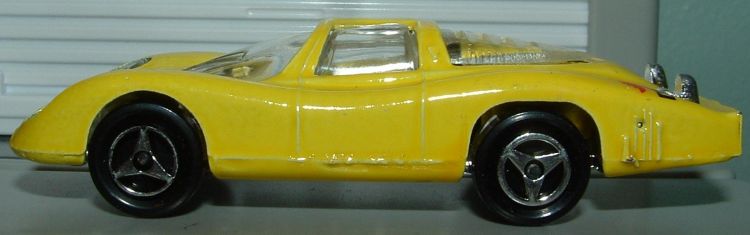
Today's car of the day is Majorette's 1967 Porsche 907.


The 907 was introduced at the 1967 24 Hours of Le Mans. As suggested by Ferdinand Piëch, the position of the driver was moved from the traditional left (as in German road cars) to the right as this gives advantages on the predominant clockwise race tracks.

With a new longtail body, the 907s reached 302 km/h (190 mph) on the straight even though they used the reliable 220 hp Porsche 910 2000cc 6-cyl rather than the more powerful 8-cyl. Also, vented brake disks were used as standard from now. The best Porsche 907 finished 5th, beaten only by Ford and Ferrari with their much bigger engines.

As the record-breaking performances of the 7.0L V8-powered Ford had triggered rumors about a future rule change, Porsche started to prepare themselves in summer of 1967. The 907 was equipped with the 270 hp 2200cc 8-cyl which was then modified for the rules of the new 3 litre prototype category that was announced in late 1967 to come in effect already in 1968. An engine with the full 3000cc would have to be developed first, though, to be introduced in the future Porsche 908.


For more information and pictures of the real car please visit: Porsche 907


I don't normally collect LeMans style racers but this one was in such nice shape and the price was right.  And the cat sticker won me over.


From 1968, the big V8 and V12 prototypes of Ford and Ferrari were banned, and Porsche hoped to secure the World Sportscar Championship and maybe an overall win at Le Mans as the competition at Ford, Matra and Alfa Romeo was not prepared with suitable 3000cc prototypes yet, either. Ferrari even sat out the whole of 1968 as a protest against the rule change. Apart from the former 2000cc-class rivals Alfa Romeo T33/2 and Renault-powered Alpine, 5000cc sportscars were also permitted to enter if at least 50 of them had been built. This loophole was intended to fill the grid with cars dating mainly from 1965, like Ford GT40 and Lola T70.

Porsche was serious. Unlike during the rather modest earlier years, four cars were entered in the 1968 24 Hours of Daytona, supported by 20 mechanics and engineers. The pilots were fitted with cooling vests developed by NASA as the oil-cooler and the hot oil pipes caused heat in the closed cockpit.

After the #53 car of Gerhard Mitter had a big crash caused by tyre failure in the banking, his teammate Rolf Stommelen supported the #54 driven by Vic Elford/Jochen Neerpasch. When the #52 car of the longtime leaders Jo Siffert/Hans Herrmann dropped to second due to a technical problem, these two also drove on the #54 car in case theirs broke down. Due to this, five pilots won the race, and two of them scored also second. The #51 Jo Schlesser/Joe Buzzetta car completed the 1-2-3 side-by-side parade finish that the Ferrari prototypes had shown a year earlier at the banked finish line. The three Alfa Romeo T33/2's were even beaten by a Ford Mustang.

Tuesday, February 28, 2012

Car Of The Day: February 28, 2012


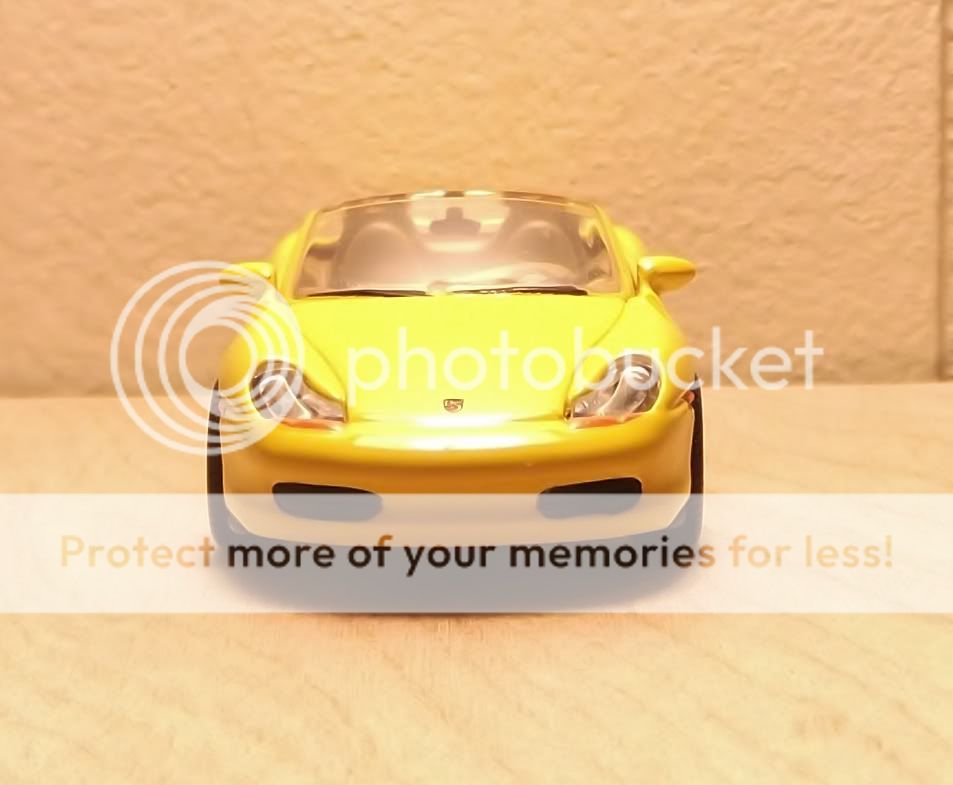
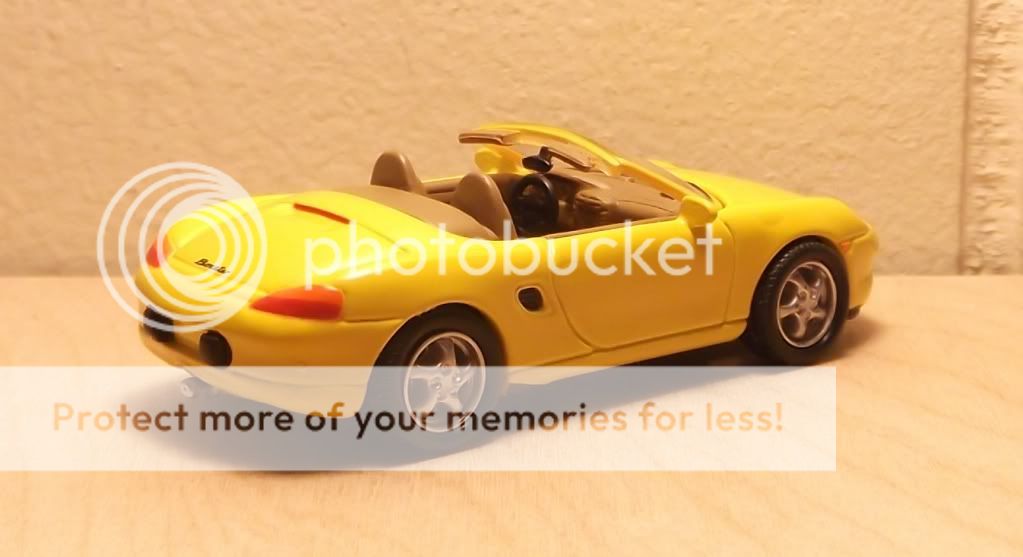
Today's car of the day comes from Firehawk73's collection and is Hot Wheels' 1998 Porsche Boxster.


The Porsche Boxster is a mid-engined roadster built by Porsche. The Boxster is Porsche's first road vehicle to be originally designed as a roadster since the 550 Spyder.
The first-generation Boxster (the 986) was introduced in late 1996; it was powered by a 2.5 litre flat six-cylinder engine. In 2000, the new Boxster S variant was introduced with a larger 3.2 litre motor, and the base model received a more powerful 2.7 litre engine. In 2003, styling and engine output was upgraded on both variants.

In 2005, Porsche unveiled the new generation of Boxsters: the type 987. The 987 is more powerful than its predecessor and featured styling inspired by the Carrera GT. Engine output increased in 2007, when both Boxster models received the engines from their corresponding Porsche Cayman variants. In 2009, the Boxster models received several new cosmetic and mechanical upgrades, further increasing engine output and performance.

Production of the 986 began at the former Porsche 928 facility in Stuttgart, Germany in 1996. Valmet Automotive also manufactured Boxsters under contract to Porsche at a facility in Uusikaupunki, Finland. The Boxster was Porsche's biggest volume seller from its introduction in 1996 until the company introduced the Cayenne sport utility vehicle in 2003.

The Boxster's name is a portmanteau of the word "boxer", referring to the vehicle's horizontally opposed or "boxer" engine, and the word "roadster", referring to the vehicle's two-seat capacity and convertible top.


For more information and pictures of the real car please visit: Porsche Boxster


The Boxster was released ahead of its big brother, the 996. Harm Lagaay's design, inspired by the 356 Cabriolet, Speedster, and 550 Spyder, stimulated a commercial turnaround for Porsche. Through consultation with Toyota, Porsche began widely sharing parts among models and slashed costs. The 986 Boxster had the same bonnet, front wings, headlights, and engine architecture as the 996. Many believe the introduction of the Boxster helped save Porsche from acquisition.

All 986 and 987 Boxsters use the M96, a water-cooled, horizontally opposed ("flat"), six-cylinder engine. It was Porsche's first water-cooled non-front engine. In the Boxster, it is placed mid-engine, while in the 911, rear-engine. The mid-engine layout provides smoothness throughout the rev range, a low center of gravity, near-perfect weight distribution, and neutral handling.

Monday, February 20, 2012

Car Of The Day: February 20, 2012


Today's car of the day is Welly's 1981 Porsche 935 Kremer K3.


The Porsche 935 was introduced in 1976, as the factory racing version of the Porsche 911 turbo prepared for FIA-Group 5 rules. It was an evolution of the Porsche Carrera RSR 2.1 turbo prototype, the second place overall finisher in the 1974 24 Hours of Le Mans.

Beginning with the 1977 season, Porsche offered the 935 to customers entering the World Championship for Makes, in the IMSA GT championship and in the German Deutsche Rennsport Meisterschaft (DRM). The 935 went on to win the 1979 24 Hours of Le Mans overall, and other major endurance races, including Sebring, Daytona, and the 1000 km Nürburgring. Of the 370 races it was entered, it won 123.

Usually, no other make could challenge the Porsche 935, due to the availability of customer models. Each race, at the time, typically featured at least five 935s. As racing became a crowd-pleaser, the diversity of the marque suffered. The large turbocharger was used with mechanical fuel injection which caused turbo lag followed shortly by a fireball spitting from the exhaust and an enormous amount of power (up to 800 hp). The dominance of the 935 was ended by the FIA rules changes coming in effect in 1982, when the six numbered groups were replaced by only three groups, A, B and C.


For more information and pictures of the real car please visit: Porsche 935


I'm pretty sure this one is a Tomica copy.  The seperate cast wing is interesting, but it is not an opening feature.


For 1976, endurance racing had two World Championships: the 1976 FIA World Championship for Makes for Gr. 5 Special Production Cars, and the 1976 World Sportscar Championship season for Group 6 prototypes up to 3.0L. Accordingly, the 935 and the new Porsche 936 were the two-pronged Porsche effort for 1976. Each championship had 7 races, with only Dijon hosting both at the same weekend, while on two other weekends, the races were even run in different countries, which forced Porsche to divide its resources. Jacky Ickx and Jochen Mass were the main drivers, if F1 schedule permitted. Rolf Stommelen, who was recovering from his bad crash in the 1975 Spanish GP, was the backup, along with Manfred Schurti.

Under Group 5 rules, also known as Silhouette rules, several significant modifications were allowed (including bodywork modifications, larger wings, wider axles and water cooling), provided that the basic silhouette of the car remain unchanged when viewed from the front. The 935 engine was a 560 hp (420 kW) (at 7900 rpm) version of the regular 3.0 L flat-6, with 60 mkp torque at 5400 rpm. Boost was between 1,35 and 1,55, consumption 52 litre per 100 km. Capacity was reduced to 2.85 L, and with the turbo charging penalty factor of 1.4, it fit into the 4.0 L class which had a prescribed minimum weight of only 970 kg (2,100 lb). Porsche, having lots of experience in lightweight cars, had managed to get the Carrera RSR prototype under 800 kg. The empty 935 tipped the scales at 900 kg, and weight distribution could be balanced with additional 70 kg. Preseason testing at the fast Paul Ricard circuit showed a top speed of 295 km/h.

Also, in addition to the naturally aspirated 340 hp (250 kW) Carrera RSR introduced in 1974, Porsche offered a customer racing version of the 911 Turbo prepared for the more standard Group 4 rules, the 485 hp (362 kW) Porsche 934. Some customer teams modified their 934 to Gr. 5 rules with body kits supplied by Porsche, these were often designated 934/5. Cologne-based Kremer Racing entered a 935 K1 built on a factory shell which in the first race, the 6h Mugello, finished 2nd behind the Martini Racing sponsored factory entry of Mass/Ickx. Porsches occupied the first seven places ahead of a BMW in 8th, which according to the 20-15-12-10-8-6-4-3-2-1 scheme meant that Porsche had now 20 points, and BMW 3. The factory 935 also scored pole, fastest lap and win at the 6h Vallelunga, where a BMW was second, though, with the best 934 being only 5th.

After the second race, the CSI rule makers insisted that the whale tail hood of the road-going 930 must fit on the race car. The air-to-air intercooler setup under the rear hood had to be altered to a more compact air-to-water layout, which cost Porsche several weeks of testing and half a Million Deutsche Mark.
The hastily modified 935 set again pole and fastest lap at the 6h Silverstone, but due to a clutch problem at the start, the Martini car could finish only 10th, with the 2nd-placed Kremer 935 collecting valuable points for Zuffenhausen. A private BMW 3.5 CSL had beaten it to the finish by a second. Even more worrisome was the fact that BMW Motorsport had entered also a turbo, a 3.2 CSL driven by Ronnie Peterson and Gunnar Nilsson. That new BMW had qualified only 1 second behind the factory 935, but two seconds ahead of the third placed Kremer 935. The powerful BMW did not last long in the race due to gearbox problems.

Initially, Porsche ran the 935 with the 911's original fender-mounted headlights, in two different guises: a sprint version with a wider version of its wheel arches, and a high speed version with modified aerodynamics. The sprint setup was rarely used. However, after carefully studying the rulebooks, Porsche engineers, namely Norbert Singer, discovered a loophole regarding the modifications of fenders that gave them the liberty to remove the headlights to reduce drag and create more downforce, to which the venting slits contribute. This flat nose (also known as the slant nose), with headlights in the front spoiler, became the distinguishing feature of the 935 and was later offered on the roadgoing 930 as the Flachbau, or "flatnose", part of Porsche's Sonderwunsch, or "special wish" program. Also, the 935 now had extended long tail rear fenders, similar to the low drag setup seen years ago on Carrera RS. These fenders also offered more space for engine periphery and efficient cooling.

The 1000 km Nürburgring, usually consisting of 44 laps, was run in 1976 as a 47 lap 1073 km race, putting even more strain on the new Gr. 5 machinery. With Mass and Ickx being at the 1976 Monaco Grand Prix, Rolf Stommelen and Manfred Schurti stepped in to drive the 935 which by now had the new look it became famous with. Probably with the help of higher turbo boost, Stommelen qualified the 935 on Pole with a stunning 7:37,5 (see List of Nordschleife lap times (racing)), while the BMW turbo did not take part. The fastest of only 9 race laps was just over 8min, though, as the engine was not sorted out set, and vibrations caused ignition failure. Again, a reliable Schnitzer Motorsport-entered normal BMW CSL took the win, with the customer 934 of Loos salvaging valuable second place points for Porsche.

The 1976 24 Hours of Le Mans counted towards neither World Championship, but Le Mans is often considered the real championship. For that race, it was possible to use the 935's well-tested original engine setup. The main battle was between the sportscars, with a Renault Alpine setting the pole. The 935 driven by Stommelen/Schurti qualified 3rd and despite the weight and drag of a Group 5 silhouette, finished 4th overall, with one of the Porsche 936 taking the win.

At Zeltweg, Ickx was back, setting the pole, but the throttle link broke before mid race. Derek Bell set fastest lap in the Kremer 935, but nonetheless two BMW Coupés won ahead of a private 934. Porsche had still a narrow lead in the points standings, but only the best 5 of the 7 events would count. BMW had now 3 wins compared to Porsche's two, which meant that Porsche had to win the final two races. The new engine setup was tested at Weissach in a modified 934 while the race cars were shipped overseas. At Watkins Glen, the regular race chassis 002 of Mass/Ickx needed an extra stop for new pads at the Porsche 917 derived brakes, and the test chassis 001 of Stommelen/Schurti won, with the best BMW being 4th. Porsche now had 3 wins and two seconds equaling 90 points, which meant that only another win could add 5 more points to their tally. BMW had also 3 wins, but only one second and a fourth, equaling 85 points. Without a competitive third brand, the winner of the final round would take the World Championship.

In Dijon, the turbo of BMW Motorsport was back, now with 3.5L, and this time the fast Swedes Peterson/Nilsson put it on pole, half a second ahead of Ickx. Again, the transmission was not as strong as the Bavarian Motor Works 750 hp engine, failing before the first of the 6 hours had passed. Three 935 plus two Gr. 5 spec 934/5 won ahead of the best normally aspirated BMW. The 935 and 936 had each won its Championship, and Le Mans, too. The age of turbo engines had begun in endurance racing.


As Porsche hesitated to sell their Evolution models, some teams developed their own ideas, especially Kremer Racing from Cologne, Germany. Parallel to the factory in 1976, they had built a 935 K1, and in 1977, modified their customer 935 to the K2. For 1979, they introduced the 935 K3 (for "Kremer Type 3"; the derivative of the successful K2). Driven mainly by Klaus Ludwig, it won the 24 Hours of Le Mans in 1979, beating all prototypes, in heavy rain, which is usually considered a disadvantage for race cars with windshields. Coming in second was a factory spec model, driven by Rolf Stommelen, and supported by team owner Dick Barbour and actor Paul Newman.

Facing strong competition in the 1980 DRM by the big Zakspeed Ford Capri, the K4 was introduced in mid 1981, for 400 000 Deutsche Mark. Porsche supplied an 3,1L engine with 750-800 hp at 1,5 bar boost for 91 000 DM in total.

Friday, December 30, 2011

Car Of The Day: December 30, 2011


Today's car of the day is Road Champs' 1984 Porsche 928.


The Porsche 928 was a sports-GT car sold by Porsche AG of Germany from 1978 to 1995. Originally intended to replace the company's iconic 911, the 928 attempted to combine the power, poise, and handling of a sports car with the refinement, comfort, and equipment of a luxury sedan to create what some Porsche executives thought would be a vehicle with wider appeal than the compact, quirky and sometimes difficult 911.

Since its inception in 1949, Porsche has manufactured only six front-engined models, four of which were coupes, including the 928. The car has the distinction of being the company's only coupe powered by a front-mounted V8 engine, and the company's first mass-produced V8 powered model.
During 1983 the 928S was the fastest car sold in North America, with a top speed of 146 mph (235 km/h).


For more information and pictures of the real car please visit: Porsche 928


A nice Road Champs model.


By the late 1960s, Porsche had changed significantly as a company, and executives including owner Ferdinand Porsche were playing with the idea of adding a luxury touring car to the line-up. Managing Director Ernst Fuhrmann was also pressuring Ferdinand to approve development of the new model in light of concerns that the current flagship model at the time, the 911, was quickly reaching its maximum potential where it could soon no longer be improved upon. Slumping sales of the 911 seemed to confirm that the model was approaching the end of its economic life cycle. Fuhrmann envisioned the new range-topping model as being the best possible combination of a sports coupe and a luxury sedan, something well equipped and comfortable enough to be easily driven over long distances that also had the power, poise and handling prowess necessary to be driven like a sports car. This set it apart from the 911, which was a pure sports car.

Ordered by Ferry Porsche to come up with a production-feasible concept for his new model, Fuhrmann initiated a design study in 1971, eventually taking from the process the final specs for the 928. Several drivetrain layouts were considered during early development, including rear and mid-engined designs, but most were dismissed because of technical and/or legislative difficulties. Having the engine, transmission, catalytic converter(s) and exhaust all cramped into a small rear engine bay made emission and noise control more difficult, something Porsche was already facing problems with on the 911 and wanted to avoid. After deciding that the mid-engine layout didn't allow enough room in the passenger compartment, a front engine/rear wheel drive layout was chosen. Porsche also may have feared that the U.S. government would soon ban the sale of rear-engined cars in response to the consumer concern over safety problems with the rear-engined Chevrolet Corvair. The Corvair's alleged safety issues were famously detailed in the book Unsafe at Any Speed by consumer advocate Ralph Nader.

Porsche engineers wanted a large-displacement motor to power the 928, and prototype units were built with a 5.0 L V8 producing close to 300 hp (220 kW). Ferdinand Piëch wanted this car to use a 4.6 liter V10 with 88 mm bore spacing based upon Audi's five-cylinder engine. This five-cylinder is a derivative of the Volkswagen Golf EA827 engine, basically a four with another cylinder added. Several members of the Porsche board objected; their official objection was because they wanted Porsche AG to maintain some separation from Volkswagen. The possible reason was that they didn't want their crowning car to be powered by a variant of the lowly VW Golf engine. Interestingly, this same proposed engine [albeit with greater displacement] was eventually built and installed in a production sports car— the Lamborghini Gallardo. To this day, no Porsche has ever used an EA827-based engine. Until 2011 they used a version of the VW VR6 engine in the Cayenne [955], but that motor is not related to the EA827 design.

The first two running prototypes of Porsche's M28 V8 used one four-barrel carburetor, but this was just for initial testing. The cars were sold with the planned Bosch K-Jetronic fuel injection system. When increasing concern within the company over the pricing and availability of fuel during the oil crisis of the 1970s became an issue of contention, smaller engines were considered in the interest of fuel economy. A push began for the development of a 3.3 L 180 hp (130 kW) powerplant they had drawn up specs for, but company engineers balked at this suggestion. Both sides finally settled on a 4.5 L, SOHC 16-valve V8 producing 240 PS (180 kW; 240 hp) (219 hp (163 kW) in North America), which they considered to have an acceptable compromise of performance and fuel economy.

The finished car debuted at the 1977 Geneva Motor Show before going on sale later that year as a 1978 model. Although it won early acclaim for its comfort and power, sales were slow. Base prices were much higher than that of the previous rangetopping 911 model and the 928's front-engined, water-cooled design put off many Porsche purists.

Fuhrmann's replacement, Peter Schutz, decided that the models should be sold side by side, feeling that the 911 still had potential in the company's line-up. Legislation against rear-engined vehicles also did not materialize. Although the 928 developed an avid fan following, it never sold in the numbers Fuhrmann had originally predicted and was discontinued in 1995.

Sunday, October 23, 2011

SUV Of The Day: October 23, 2011


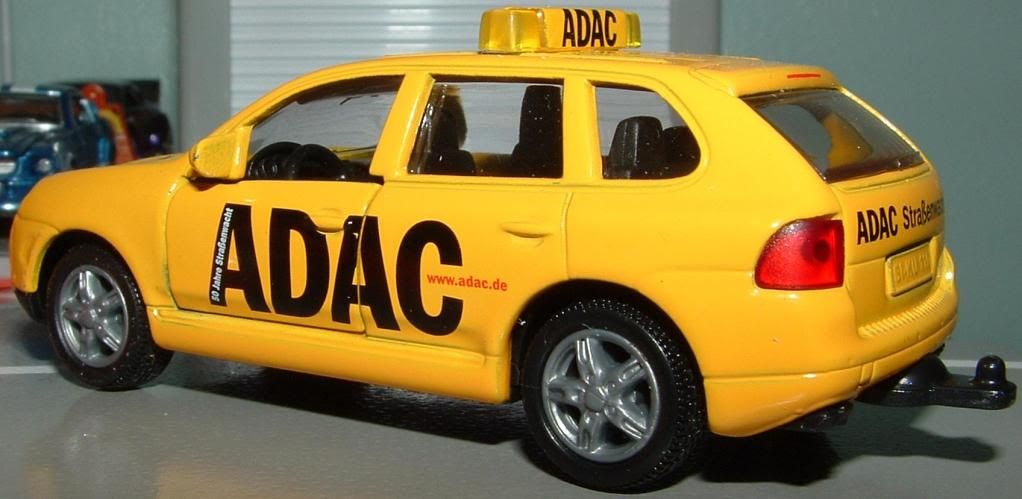
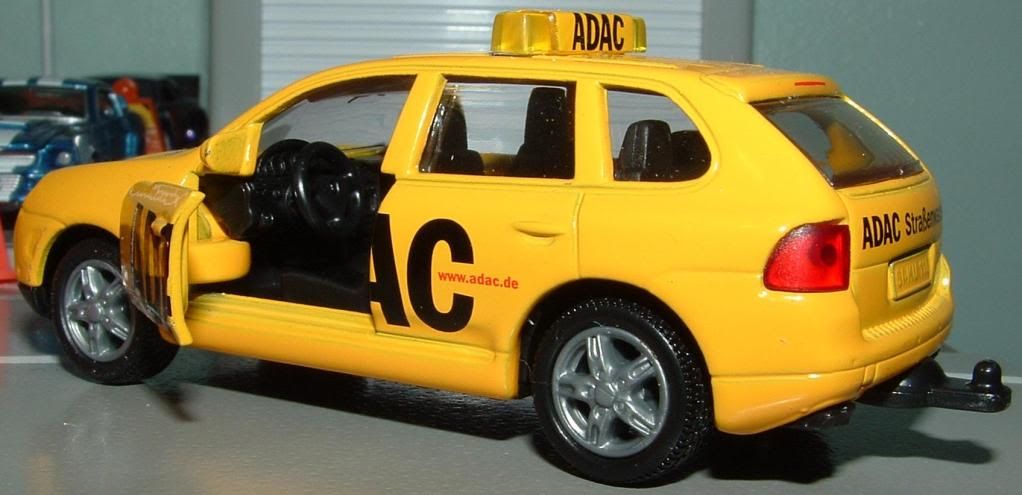
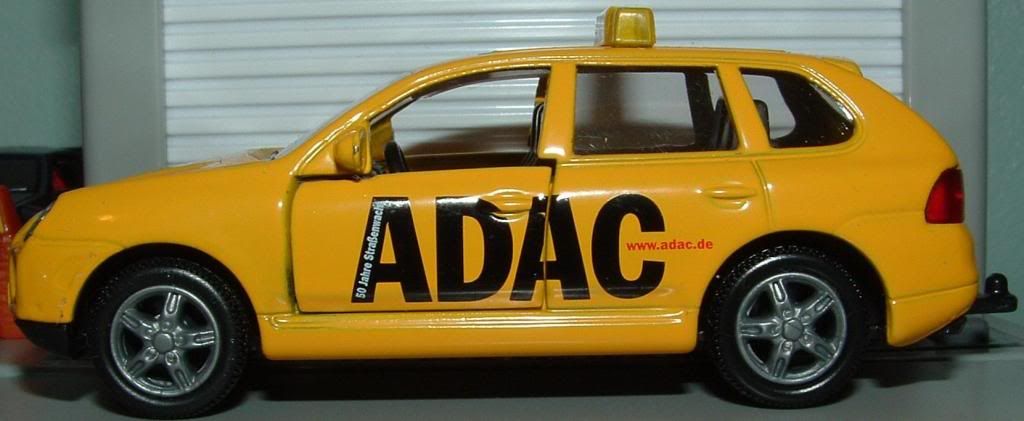
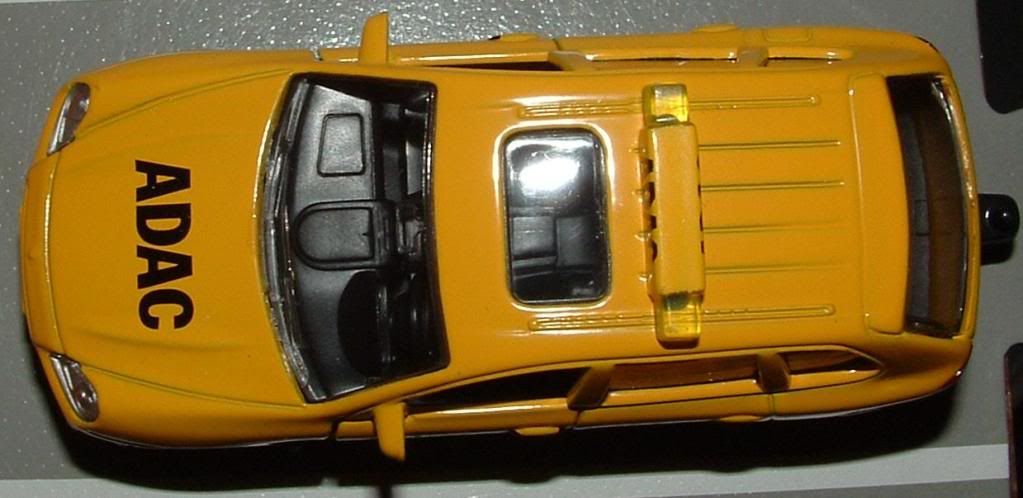
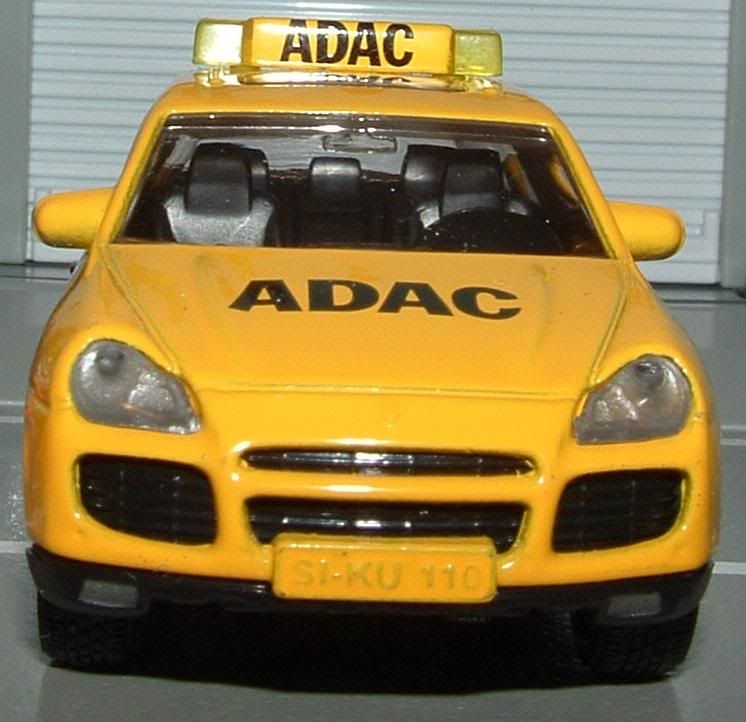
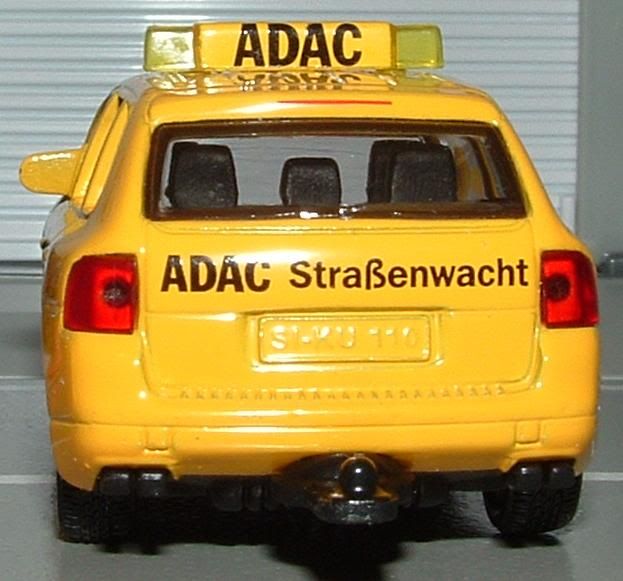
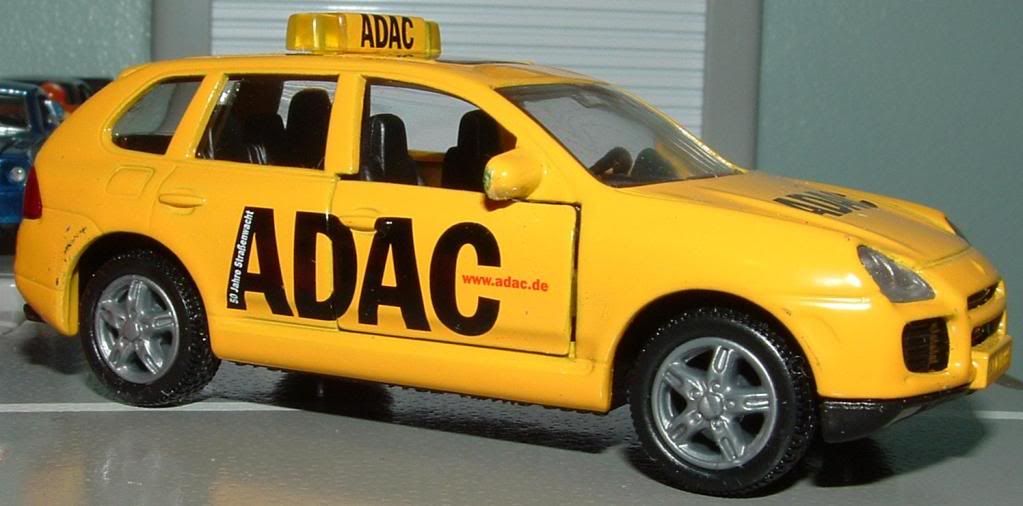
Today's car of the day is Siku's 2003 Porsche Cayenne Turbo.


The Porsche Cayenne is a five seat mid-size luxury crossover manufactured by the German manufacturer Porsche since 2002, with North American sales beginning in 2003. Its platform was developed by Porsche and is shared with the Volkswagen Touareg and the Audi Q7. It is the first V8-engined vehicle built by Porsche since 1995, when the Porsche 928 was discontinued. Since 2008, all engines have featured direct injection technology. The Cayenne's chassis type numbers are as follows: Type 955 (2002–2006), Type 957 (2007–2010), and Type 958 (2011+).

The third-generation Cayenne (Type 958) was unveiled at the 2010 Geneva Motor Show in March following an online reveal on February 25, 2010.


For more information and pictures of the real car please visit: Porsche Cayenne


Porsche, one a name that meant great sports cars, came out with this....thing.... in 2002.  Now they had a luxury sedan also.  And let's not forget that failed hostile takeover of Volkswagen that resulted in Volkswagen buying Porsche instead.  Everything that's wrong with Porsche started with this model right here.  The problem is, these things sell like hotcakes.  So do the Panamera sedans.  There's no accounting for taste...


The Cayenne's frame and doors are sourced from Volkswagen, who uses the frames and doors for the Volkswagen Touareg model. All other aspects of vehicle design, tuning, production are done in house at Porsche.


The Porsche Cayenne entered the market with mixed anticipation. However, the Porsche Cayenne soon proved that it was the performance vehicle among SUV's and was praised for its excellent handling and powerful engines. The lineup initially consisted of the V8-powered Cayenne S and Cayenne Turbo. Later in the model cycle, VR6 and diesel-powered versions joined the lineup.

The 1st generation Cayenne Turbo had 450 horsepower (340 kW), and accelerated from 0 to 60 mph (97 km/h) in 5.3 seconds. A Turbo S version was built in 2006 to compete with the Mercedes-Benz ML63 AMG. The Cayenne Turbo S included a low-range case, a locking differential, and the height-adjustable, off-road suspension also standard on the regular Turbo model. It was powered by a twin-turbocharged 4.5-liter V8 that produced 520 bhp (390 kW) and 700 N·m (520 lb·ft) of torque. Acceleration from 0–60 mph (96 km/h) was 5.0 seconds and the top speed was 171 miles per hour. It featured a 6-speed automatic Tiptronic transmission.

A new Turbo was revealed at the 2008 Beijing auto show. It received 50 hp (37 kW) more power, and now accelerated from 0–60 mph (96 km/h) in 4.9 seconds. Also revealed with the new Turbo was a new 550 horsepower (410 kW) Turbo S. Acceleration from 0–60 mph is 4.7 seconds and has optional ceramic composite brakes.

Tuesday, July 5, 2011

Car Of The Day: July 5, 2011


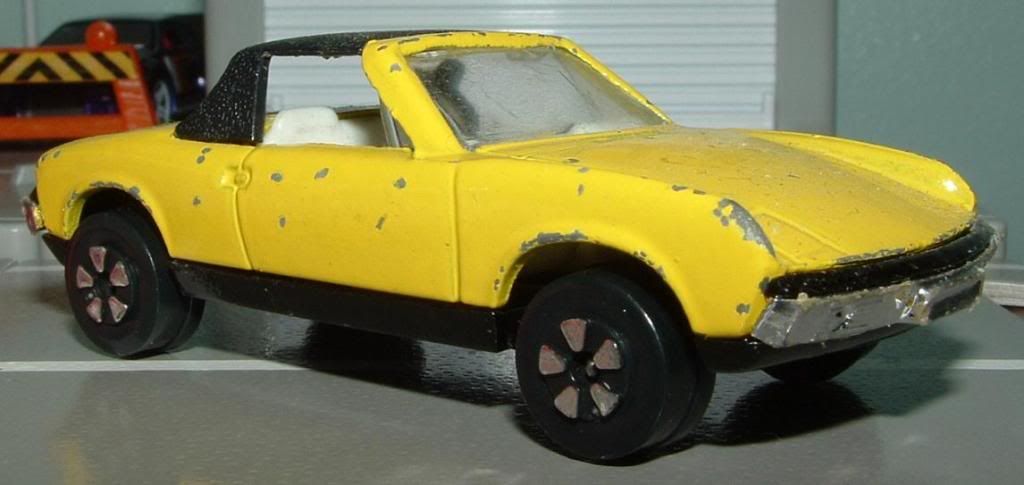
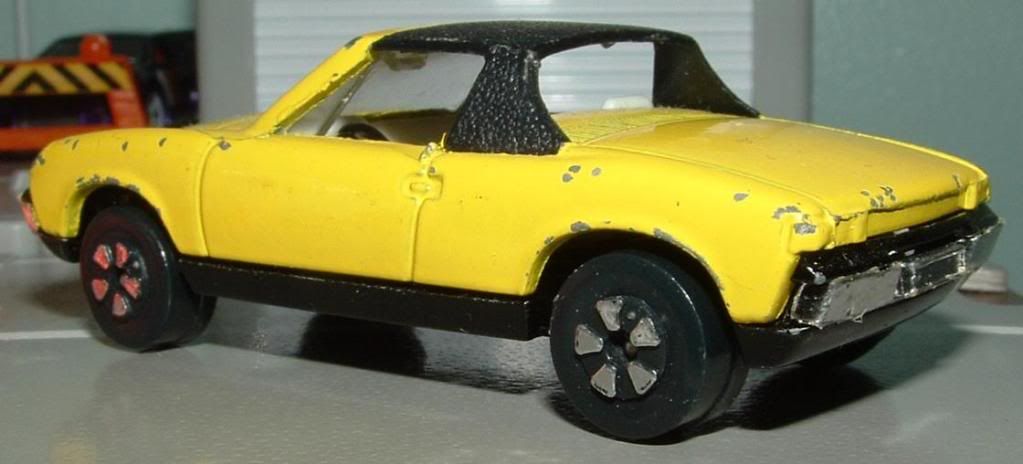
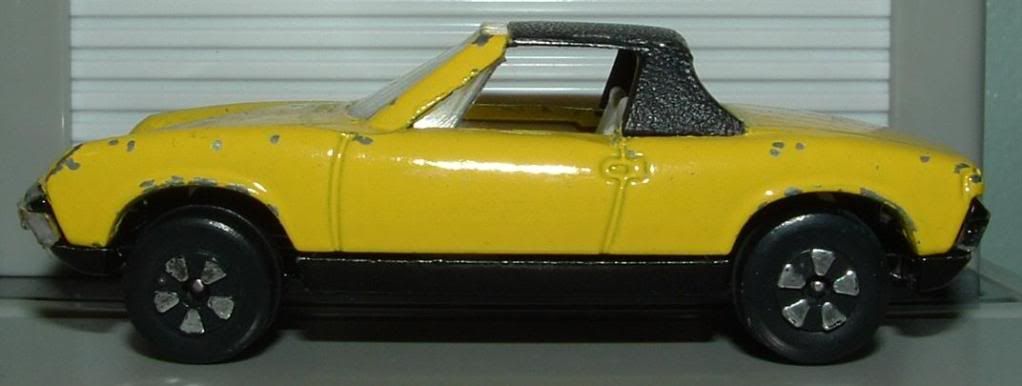
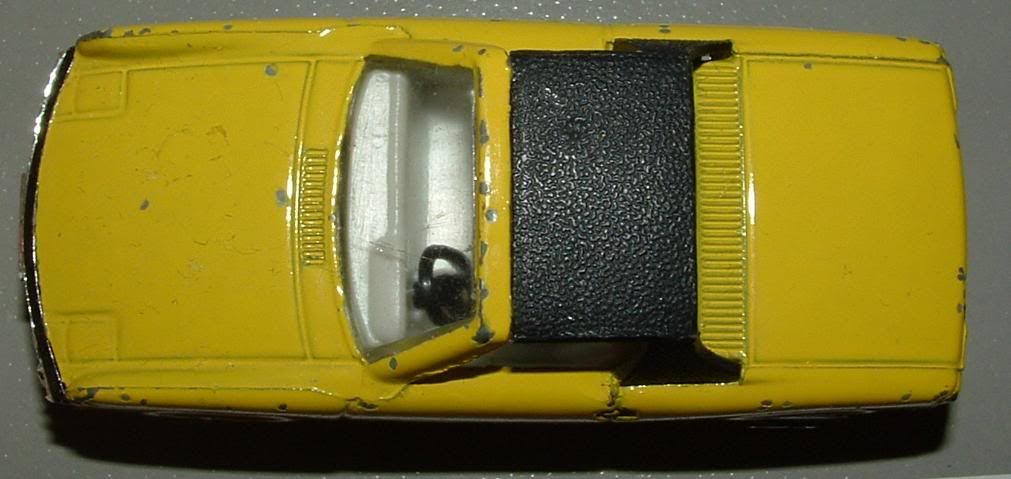
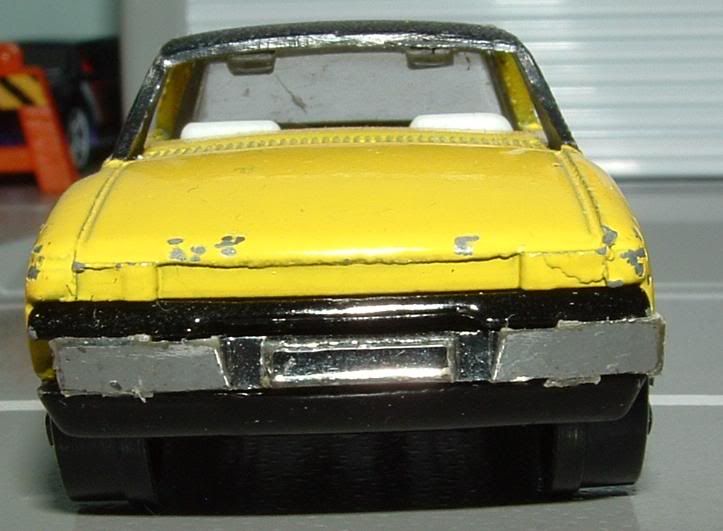
Today's car of the day is Playart's 1972 Porsche 914/4 ("Volkswagen Porsche").


The Porsche 914 or VW-Porsche 914 is a mid-engined, targa-topped two-seat roadster designed, manufactured and marketed collaboratively by Volkswagen and Porsche from 1969 to 1976.


For more information and pictures of the real car please visit: Porsche 914


Oh boy, where do I start with this one?  I had this model as a child.  And I'm extremely blessed to have the bulk of my childhood collection still intact.  This one, however, is not my childhood car.  Playart made the mistake (well, it's not really a mistake since it is somewhat accurate) of calling this one "Volkswagen Porsche".  As a five year old I knew enough to know that "Volkswagen doesn't make Porsche, Porsche makes Porsche!" and decided that this couldn't be a real car.  [JEREMY CLARKSON]Therefore, it needed to die.[/JEREMY CLARKSON]  This car featured a seperate vinyl roof piece in black, which made it look remarkably similar to the dozens of '70s cars that were routinely getting squashed in monster truck racing during the 1980s.  You can guess where this is going...  I stepped on it.  Jumped on it.  Flattened it every which way I could.  The front windshield eventually shattered and I can't remember how the vinyl roof faired, but I do remember this one being one of my favorite cars to flatten with my Matchbox Superchargers monster trucks.  It never made the move from New Jersey to Pennsylvania.  I had it in a bag of other "junk cars" (including some pieces I really wish I still had!) that were supposed to come along with us, but I left it sit at the top of the stairwell where I figured I would remember it.  I didn't.  There were also some other cars in the basement that didn't make it either.  *Sighs*  Aside from those, everything else from my childhood made it intact to my new home!  This is a replacement picked up at the York toy show in 2006.


By the late 1960s, both Volkswagen and Porsche were in need of new models; Porsche was looking for a replacement for their entry-level 912, and Volkswagen wanted a new range-topping sports coupe to replace the Karmann Ghia. At the time, the majority of Volkswagen's developmental work was handled by Porsche, part of a setup that dated back to Porsche's founding; Volkswagen needed to contract out one last project to Porsche to fulfill the contract, and decided to make this that project. Ferdinand Piëch, who was in charge of research and development at Porsche, was put in charge of the 914 project.
Originally intending to sell the vehicle with a flat four-cylinder engine as a Volkswagen and with a flat six-cylinder engine as a Porsche, Porsche decided during development that having Volkswagen and Porsche models sharing the same body would be risky for business in the American market, and convinced Volkswagen to allow them to sell both versions as Porsches in North America.

On March 1, 1968, the first 914 prototype was presented. However, development became complicated after the death of Volkswagen's chairman, Heinz Nordhoff, on April 12, 1968. His successor, Kurt Lotz, was not connected with the Porsche dynasty and the verbal agreement between Volkswagen and Porsche fell apart.

In Lotz's opinion, Volkswagen had all rights to the model, and no incentive to share it with Porsche if they would not share in tooling expenses. With this decision, the price and marketing concept for the 914 had failed before series production had begun. As a result, the price of the chassis went up considerably, and the 914/6 ended up costing only a bit less than the 911T, Porsche's next lowest price car. The 914/6 sold quite poorly while the much less expensive 914-4 became Porsche's top seller during its model run, outselling the Porsche 911 by a wide margin with over 118,000 units sold worldwide.