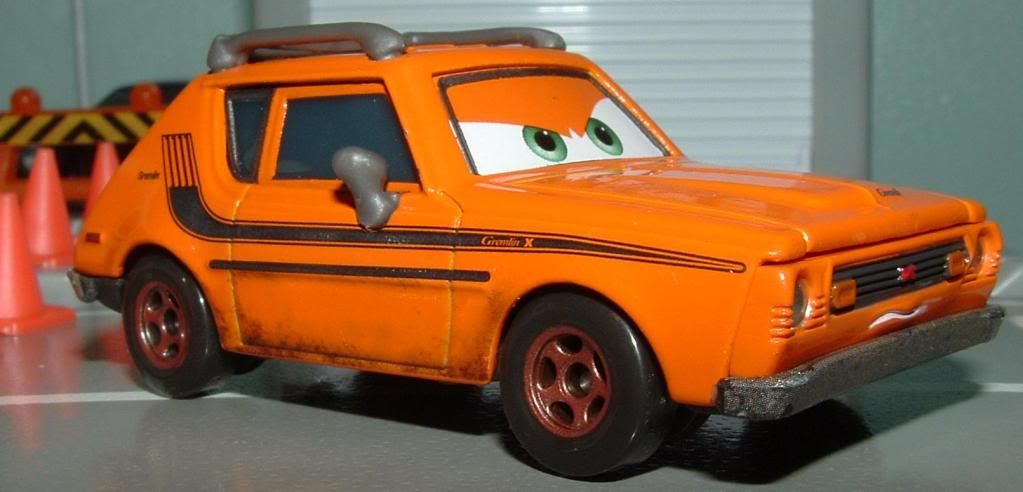
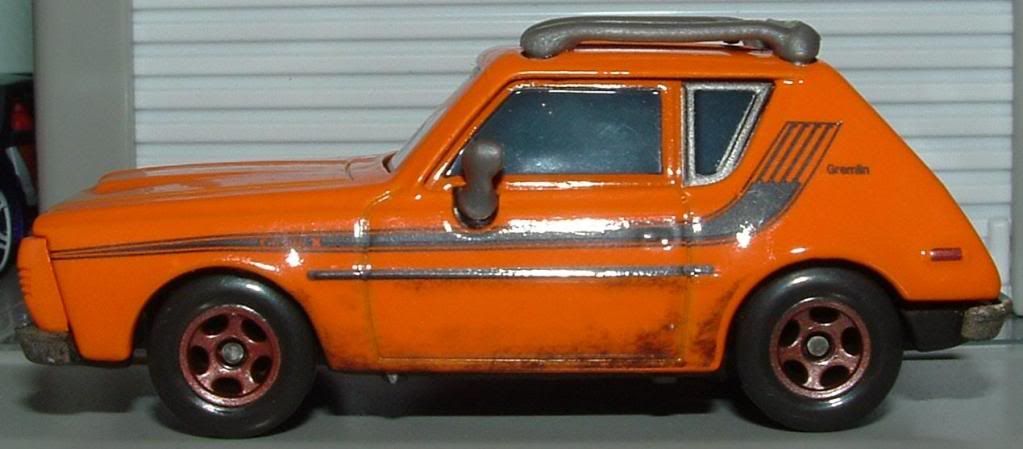
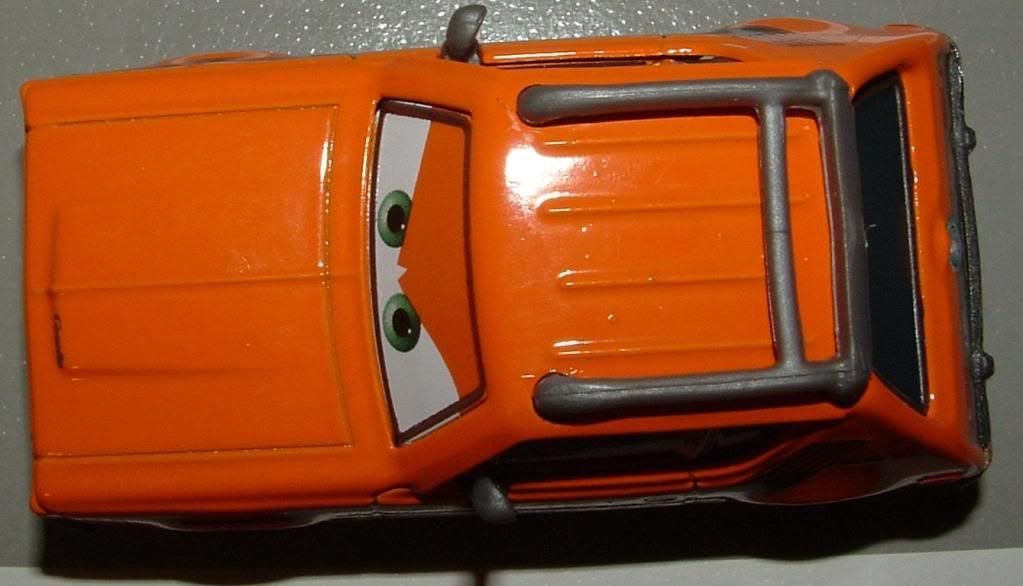
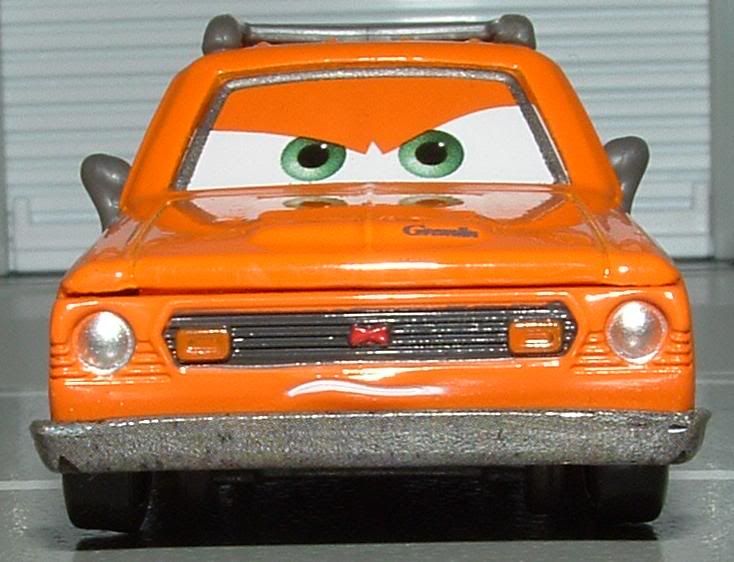
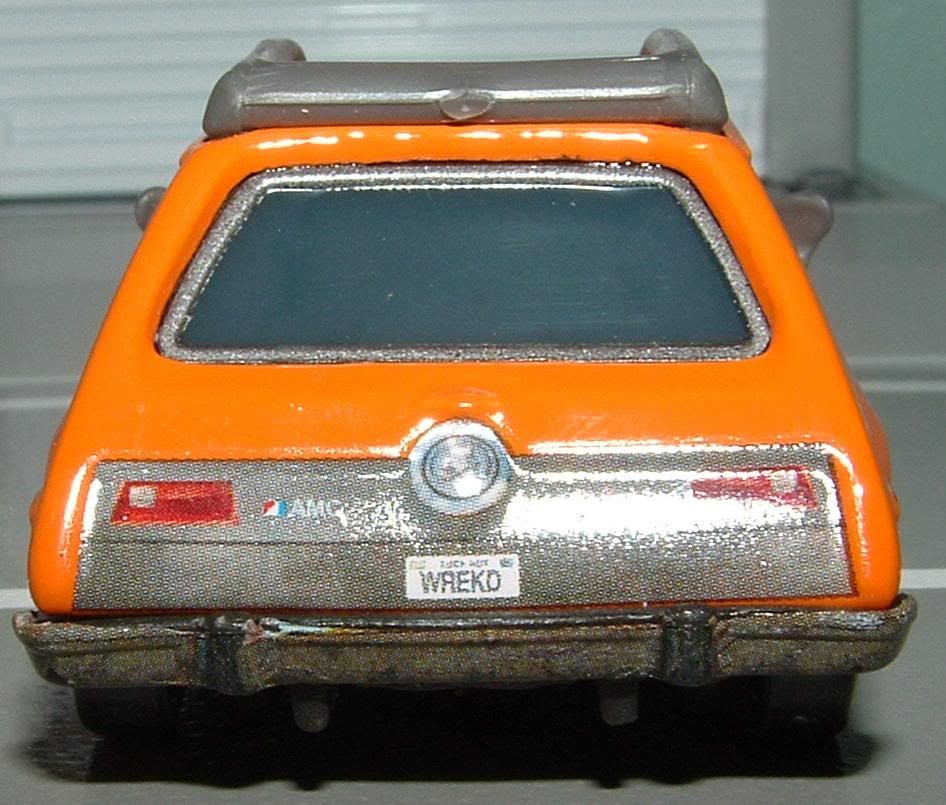
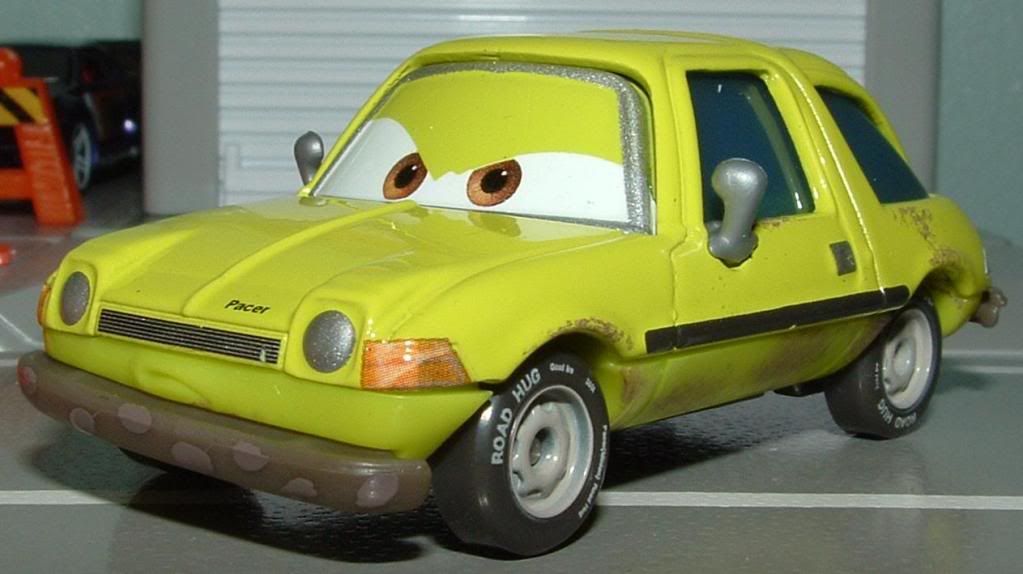
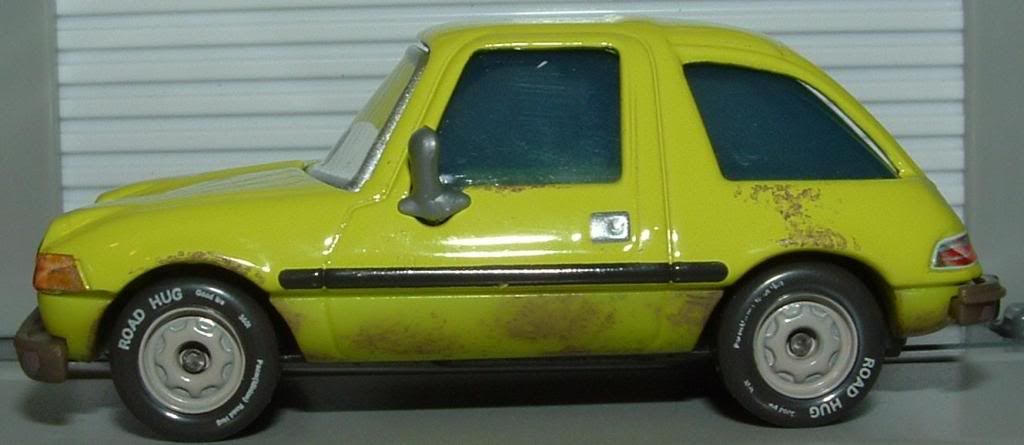
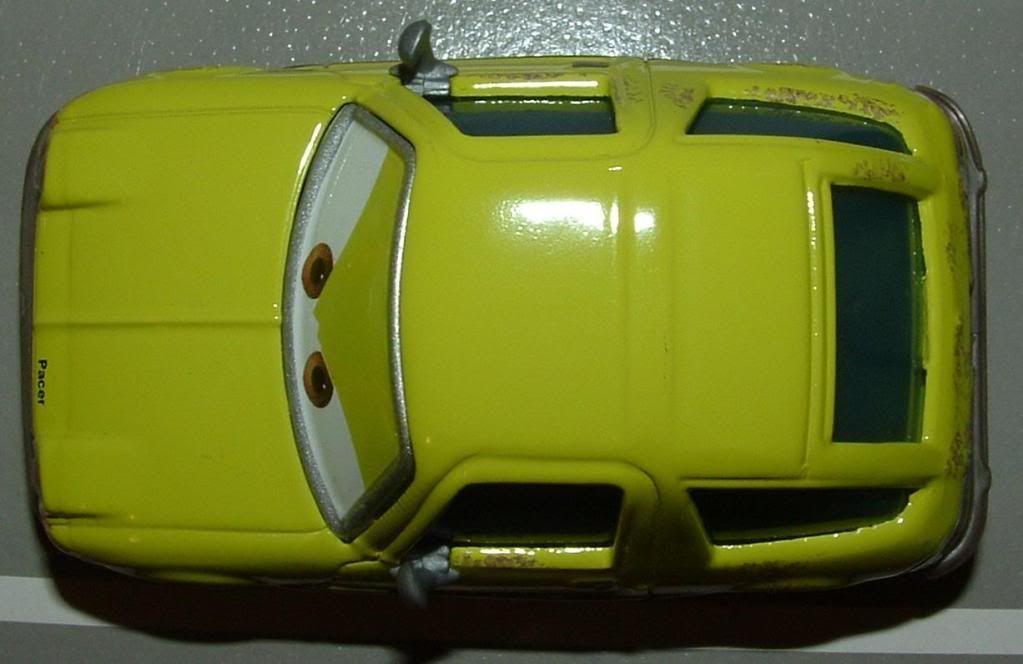
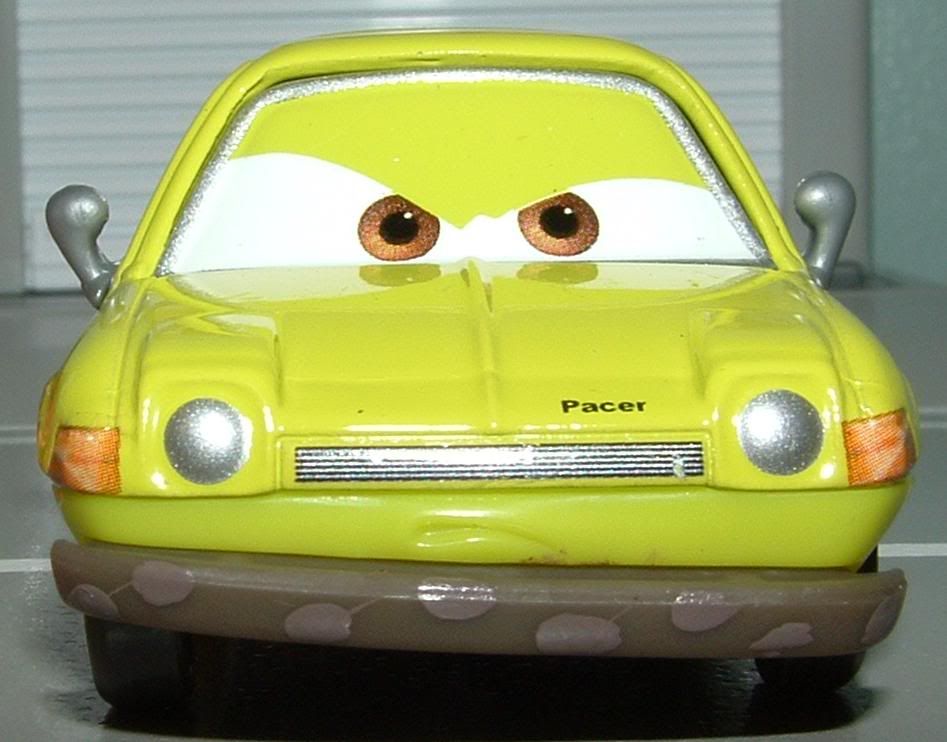
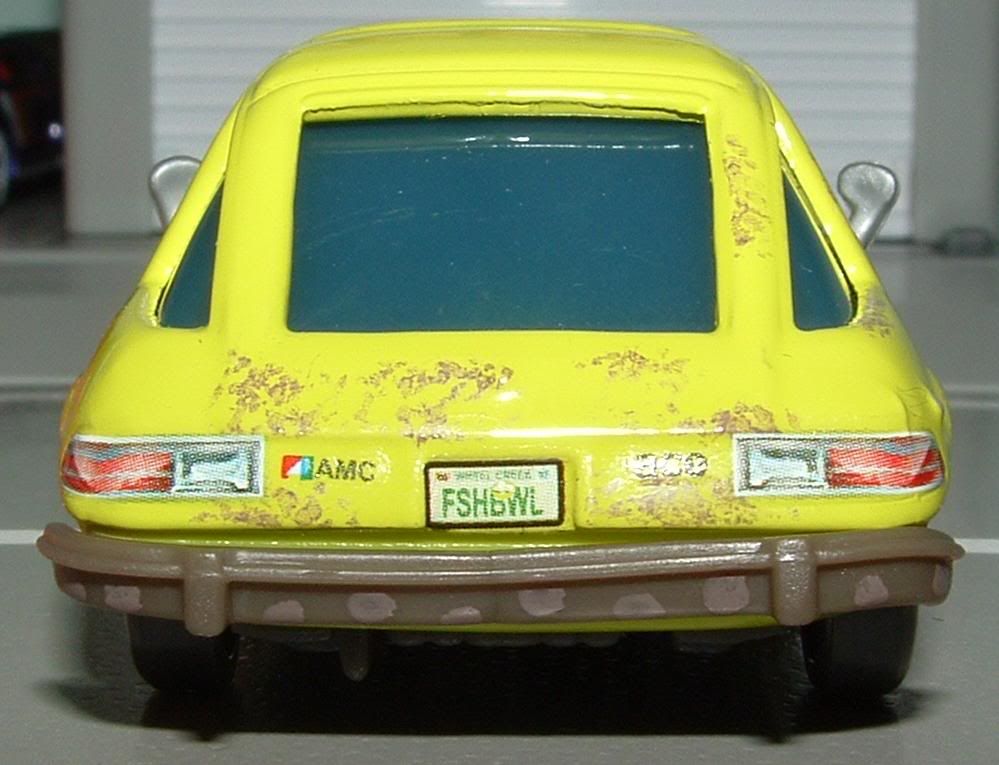
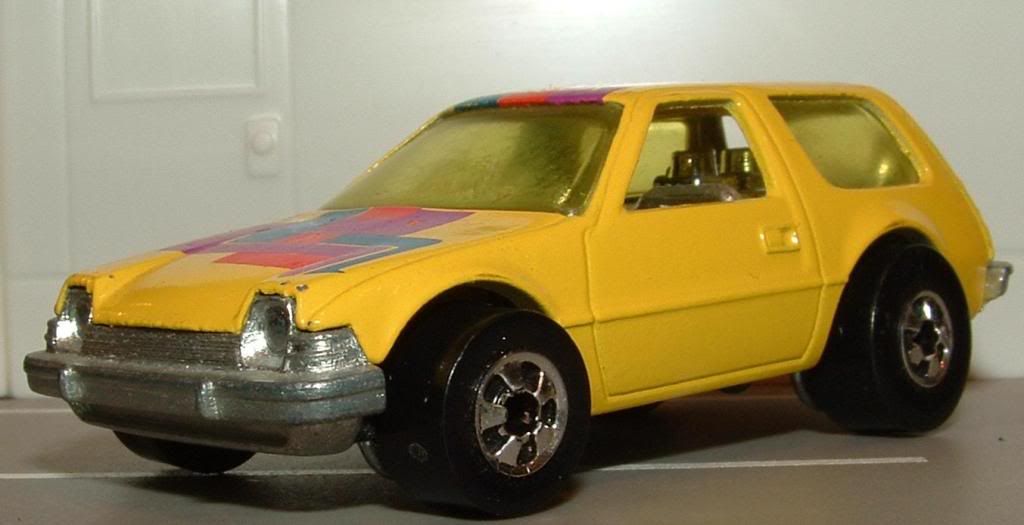
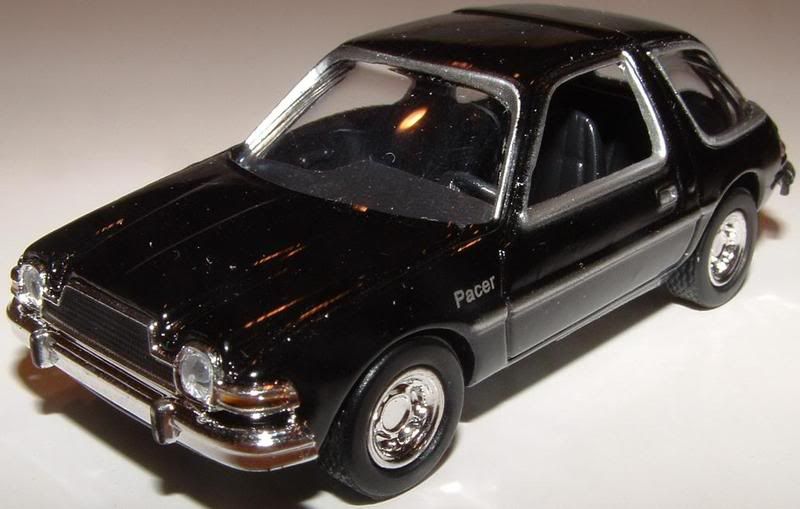
Today's car of the day is Mattel's Disney Pixar "Cars 2" 1975 AMC Pacer (Acer).
The AMC Pacer is a two-door compact automobile produced in the United States by the American Motors Corporation between 1975 and 1980. Its initial design idea was started in 1971. The car's unusual rounded shape with massive glass area greatly contrasted with the three-box architecture with "square, boxy designs" incorporating upright grilles and slab-sides of the era. The Pacer was described as "the seventies answer to George Jetson's mode of transportation" at a time when "Detroit was still rolling out boat-sized gas guzzlers." The large amount of glass led Car and Driver to dub it "The Flying Fishbowl". The Pacer's "jellybean" body style is a readily recognized icon of the 1970s.
For more information and pictures of the real car please visit:
AMC Pacer
I was excited to stumble across some of the characters from the latest Pixar movie tonight. I don't think I will be getting all of the cars for this movie, but I will be chasing after the ones that appeal to me. And you all know me and AMC- so this one was a no brainer! I do find it annoying that the AMCs serve as the enemies for this movie and are called lemons. The '70s were a bad period for cars in general and American cars in particular, but the AMC offerings were better than their domestic competitiors (Pinto...KABOOM and Vega....rust anyone?). But neither of those is distinctive-looking, something the AMC duo has in spades, so hence we end up with them as the villains. I must admit that this round of "Cars" characters has resulted in some very realistic replicas! The Gremlin and Pacer both in particular, but the vintage Topolino also counts.

AMC's chief stylist Richard A. Teague began work on the Pacer in 1971, anticipating an increase in demand for smaller vehicles through the decade.
Car and Driver magazine noted that "AMC said it was the first car designed from the inside out. Four passengers were positioned with reasonable clearances and then the rest of the car was built around them as compactly as possible."
Designed to appear futuristic, the shape was highly rounded with a huge glass area, and was very unusual for its time. Road & Track magazine described it as "fresh, bold and functional-looking".
Development was under Product Group Vice President Gerald C. Meyers, whose goal was to develop a car that was truly unique: "...everything that we do must distinguish itself as being importantly different than what can be expected from the competition..."
A number of futuristic ideas were explored by AMC. However, the automaker lacked adequate resources to build components from scratch and needed to use outside suppliers or adapt its existing parts and use its production facilities. Unique for a comparatively small car, the Pacer was as wide as a full-size American car of the era. Contrary to myth, it was not widened six inches (152.4 mm) to make room for the rear-wheel drive configuration. The editor of Road & Track asserted that front-wheel drive, as well as a transverse mid-engined configuration, were among "various mechanical layouts...tossed around by the idea people at AMC", adding that "it's unlikely they ever had much hope of being able to produce anything other than their traditional front engine and rear drive, using components already in production."
The introductory 1975 AMC advertising and literature proclaimed it as "the first wide small car". The width was dictated partly by marketing strategy—U.S. drivers were accustomed to large vehicles, and the Pacer's occupants had the impression of being in a larger car—and partly by the fact that AMC's assembly lines were already set up for full-size cars.
Also unique at the time, the passenger door was four inches (101 mm) longer than the driver's. This made passenger loading easier, particularly from the rear seats; and they would also tend to use the safer curb side in countries that drive on the right. Ford used this design element in the 1990s Ford Windstar minivan.
Teague's low-drag design, which predated the fuel crisis and the flood of small foreign imports into the American market, was highly innovative. Its drag coefficient of 0.43 was remarkably low for that time. Teague even eliminated rain gutters, smoothly blending the tops of the doors into the roof—an aerodynamic detail that, although criticized at the time for allowing rain onto the front seat, has become the norm in today's designs.
The Pacer was also among the first production cars in the U.S. to feature rack-and-pinion steering. The body was designed with the aim that structural lines protected it from hit damages, AMC engineers claimed that they succeeded in more than 50% of the car surface.
In the mid-1970s the U.S. government mandated major safety improvements for the 1980 model year, to include 50-mile-per-hour (80 km/h) front-end crash testing, 25-mile-per-hour (40 km/h) side crash testing and 30-mile-per-hour (48 km/h) rollover testing, as well as installation of bumpers to resist 5-mile-per-hour (8 km/h) impact at the front and 10-mile-per-hour (16 km/h) at the rear. The Pacer was designed to these specifications, and also had laminated safety glass in the windshield.
General Motors, Ford, and Chrysler persuaded the government that it was not financially viable to modify existing production cars to comply with the new regulations, and that instead each company would be put to the enormous expense of producing new, safety-compliant vehicles. Accordingly the government requirements were reduced, which led to the deletion of several safety features from the production Pacer—for example the roll bar over the passenger compartment, and the bump in the roof that accommodated it. The Pacer's remaining safety features were not strongly advertised, and seldom influenced a potential customer's purchasing decision. The car's extra weight—due in part to the safety equipment and the abundance of heavy glass—hurt fuel economy: production models tested by the United States Environmental Protection Agency (EPA) gave 16 miles per US gallon (15 L/100 km; 19 mpg-imp) in the city, but 26 miles per US gallon (9.0 L/100 km; 31 mpg-imp) or better on the highway (depending on driving habits and transmission), thanks to aerodynamic efficiency.
Originally the car was designed for a Wankel rotary engine. In 1973, AMC signed a licensing agreement with Curtiss-Wright to build Wankels for cars and Jeep-type vehicles. (The agreement also permitted Curtiss-Wright to sell rotaries elsewhere.) Later, AMC decided instead to purchase the engines from General Motors (GM), who were developing them for use in their own cars. However, GM canceled development in 1974 for reasons that included durability issues, the fuel crisis, tooling costs (for the engines and also for a new product line designed around the rotary's ultra-compact dimensions) and the upcoming (late 1970s) U.S. emissions legislation. It was also thought that the high-revving Wankel would not suit Americans accustomed to low revs and high torque.
General Motors's change of plans left the Pacer without an engine. American Motors took a calculated risk and introduced the new model. The company's over commitment to the project resulted in entrapment with so much money and effort in the car's design. Engineers hastily reconfigured it to accept their existing straight-six engine. This involved a complete redesign of drivetrain and firewall to keep the longer engine within the body dimensions designed for the Wankel, but allowed the Pacer to share many mechanical components with other AMC models.
The "outside of the box" thinking incorporated by AMC in the Pacer as the first "wide, small car" attempted to capture a revolutionary change in marketplace. However, a radical departure from what was accepted by consumers as "good styling" was a risky strategy. Only the largest firms can stick with a radical element until it "grows", and the automaker’s dominance in the marketplace may eventually establish it as a standard feature. However, the styling research axiom no longer applied by the late 1970s that if a car with some controversial styling was liked by at least half of the potential market segment; then chances were good that this feature was a differential advantage for the manufacturer. The AMC Pacer incorporated many controversial styling and design innovations led to its market failure after five model years. American Motors created the Pacer by identifying emerging trends and design technologies, but it faced a small window of opportunity since a product that comes out either too early or too late can fail even if the opportunity was there initially. A further complication was the purchasing dynamics and the Pacer's design was focused on maximizing the internal sense of space, while the market focused on external dimensions. Many of the attributes the Pacer incorporated became the goal of all manufacturers in the two decades that followed.
With an uncommonly wide and short body for a small car, the Pacer’s design is still considered controversial while its powerplants did not contribute to fuel economy. Nevertheless, “the foresight by Teague and AMC was correct” with approaches to meet the evolving U.S. government regulations covering automobiles (such as the Highway Safety Act of 1970 and the new National Highway Traffic Safety Administration).