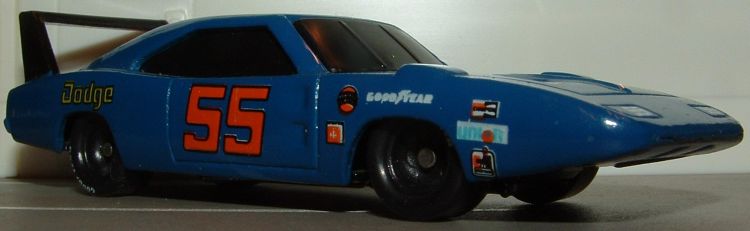
Today's car of the day is Racing Champions' 1969 Dodge Charger Daytona NASCAR stock car (Tiny Lund).
Dodge, an American automobile brand, has produced three separate vehicles with the name Dodge Charger Daytona, all of which were modified Dodge Chargers. The name is taken from Daytona Beach, Florida, which was an early center for auto racing and still hosts the Daytona 500, one of NASCAR's premier events. The first use of the Daytona name on a car was on a version of the Studebaker Lark. The Daytona was the performance model of the compact Lark and it was produced from 1963-1966.
With the failure of the 1969 Dodge Charger 500 on the highbanks of the superspeedways (tracks of a mile, or more in length), the 1969 Dodge Charger Daytona was created. It was intended to be a high performance, limited edition version of the Dodge Charger produced in the summer of 1969 for the sole purpose of winning high profile NASCAR races. It won its first race out, the inaugural Talladega 500 in the fall, although it was a rather hollow victory as all of the top names had left the track on Saturday in a boycott of the 1969 Talladega race. Buddy Baker in the #88 Chrysler Engineering Dodge Charger Daytona was the first driver in NASCAR history to break the 200 mph mark on March 24, 1970 at Talladega. The 1969 Dodge Daytona managed to win 2 races in 1969 and another 4 in 1970 for a total of 6. It's successor, the 1970 Plymouth Superbird managed to win 8 races - all in 1970. (In a bit of irony, in 1969 a Daytona won at Talladega, and a Ford Torino Talladega won at Daytona.) These compare with 29 NASCAR victories for the 1969 Ford Torino Talladega, and 8 for the 1969 Mercury Cyclone Spoiler II. Ironically, the 1969 Dodge Charger 500 managed to win 22 NASCAR races over the 1969 and 1970 seasons; however, all but one of those victories came on the short tracks - several of which were still being run on dirt at the time.
One of the five famous aero-cars, the Dodge Daytona featured special body modifications that included a 23 in (584 mm) tall stabilizer wing on the rear deck, a special sheetmetal "nose cone" that replaced the traditional upright front grille, a flush rear backlight (rear window area), a 'window cap' to cover the original Charger's recessed rear window, specific front fenders and hood that were modeled after the upcoming 1970 Charger, stainless steel A-pillar covers and fender mounted tire clearance/brake cooling scoops. The Daytona was built on the 1969 Charger's 500 trim specifications, meaning that it carried a heavy-duty suspension and brake setup and was equipped with a 440 CID Magnum engine as standard. Of special note to collectors is the optional 426 CID Hemi V8 engine, which only 70 of the 503 Daytonas carried. It had a corporate cousin in the "one year only" 1970 Plymouth Superbird.
The "Winged Warriors", as they were affectionately known, did not compete for long in NASCAR's top Cup series. Because of their exceptional speed and performance, NASCAR subsequently changed the rule book, effectively banning all five of the Aero Cars from Dodge, Ford, Mercury, and Plymouth from competition by the end of 1970. See also Plymouth Superbird, Ford Torino Talladega and Mercury Cyclone Spoiler II for additional information about the aero cars.
For more information and pictures of the real car please visit:
Dodge Charger Daytona &
Tiny Lund
This may not be a very highly detailed replica, but as far as I know it's the only one available of this car. I wish that Racing Champions had offered these with an interior and clear glass.
DeWayne Louis "Tiny" Lund (November 14, 1929–August 17, 1975) was a NASCAR driver. He was ironically nicknamed "Tiny" due to his rather large and imposing size.
Lund started racing at a young age on a motorcycle, then moved up to midget cars and sprint cars. He served in the Korean War in the United States Air Force, and in 1955 decided to try stock car racing.
It is also noted that as an adult, Lund stood 6-feet-5-inches-tall and weighed about 270-lbs.
Lund went south with a 1955 Chevrolet and competed in the Lehi, Arkansas, event, with sponsorship from Carl Rupert and his safety belt company. The race was dominated by Speedy Thompson and his Pete DePaolo-owned Ford. Lund qualified mid-pack but his event ended in an accident on lap 65. Lund's flipped end over end and his safety belt broke. He was bruised and had a broken arm.
For 1956, Lund teamed up with Gus Holzmueller, and their best result was a fourth-place finish at Columbia, South Carolina. Lund also ran a few events for A.L. Bumgarner. In 1957 Lund split between Bumgarner's Pontiacs and a Petty Enterprises Oldsmobile. With Bumgarner Lund nearly won an event at the Cleveland County Fairgrounds. He won the pole position, and was leading until a right rear axle gave out. Lund had two other poles on the season. Lund left Bumgarner and became a journeyman for 1958. He won a pair of pole positions at Gastonia and Hillsboro. In 1959 he fielded self-owned Chevrolets. Lund did not have major success, and he was rideless by 1963.
In February 1963, Lund went down to Daytona shopping around for any ride. Lund's friend Marvin Panch, the driver for the Wood Brothers racing team, had an accident while testing an experimental Ford-powered Maserati sports car for the second Daytona Continental three-hour sportscar race (a precursor to the Rolex 24). Panch's car swerved out of control, flipped over and burst into flames. Lund ran into the inferno and managed to pull Panch out of the wreckage. For his actions, Lund was awarded the Carnegie Medal of Honor.
Panch, in hospital, asked Lund to race his car and Glen Wood agreed. He timed in fourth in individual qualifying trials, and finished sixth in the second qualifying race. Lund took the green flag from 12th on the grid.
The start of the race was delayed due to heavy rains, and then the first 10 laps were run under caution. As the green flag waved on the Great American Race, it was Fireball Roberts on pole and "Flying" Fred Lorenzen outside of him. Lorenzen led the race. Lund worked his way through the field. The Wood Brothers team had an ace up their sleeve - they planned to complete the race on one stop less than the field. Lund managed to take the lead very late in the race. Lorenzen passed Lund with 10 laps left to go, but Lorenzen ran out of gas and had to dive down pit road out of contention. Then Ned Jarrett made the pass on Lund for the top spot but with three to go he also ran out of gas. Lund's car ran out of fuel on the final lap, but he managed to coast home to win the 1963 Daytona 500.
Lund's victory jumpstarted what had been a dead career. Lund stayed in the Wood Brothers Ford for several races after Daytona, and came close to another victory in the Southeastern 500 before his motor gave out. Marvin Panch returned and Lund was without a ride. Holman-Moody gave him a car for several big races at Atlanta, Daytona and Charlotte without success. For 1964 he was back to journeyman status. He hooked up with a series of lesser known owners before vaulting into the lead in the Columbia 200 before overheating. Late in the year, he settled in with Lyle Stelter and despite little success they continued their partnership into the 1965 season. With Stelter Lund got his second career victory in that year's Columbia 200, qualifying in fourth and taking the lead from Ned Jarrett before rains came and washed out the second half of the event. In 1966, he continued his partnership with Stelter. Lund was leading at Spartanburg before a differential failed and at Manassas before his engine blew up. Lund did win at Beltsville Speedway. Lund had 21 Did Not Finish (DNFs) that season.
For 1967, he teamed once again with Stelter for the majority of the year but it was with Petty Enterprises in the #42 Plymouth with which he had most of his success. Lund finished fourth in the Daytona 500 despite running out of fuel with a lap to go behind the Ford factory contingent of USAC star Mario Andretti and Fred Lorenzen, handing third to perennial independent James Hylton. Lund finished fifth in the World 600 in that same ride. He struggled in Stelter's Fords despite a promising run in Fonda, New York, where he qualified second and lead some before an axle broke. Lund and Stelter parted at season's end.
For 1968, he teamed with Big Bud Moore and his Mercury's. Lund also ran Moore's cars in the new NASCAR Grand American division designed for pony cars like Mustangs and Camaros. Lund finished fifth in the Firecracker 400 and a fourth in Rockingham highlighted his short Grand National season, but he won the Grand American championship. In 1969, he continued to race in the Grand American division and ran one Grand National race, guesting for Bill France, Sr. in the inaugural Talladega 500. The race was known for a driver's boycott over tire safety protests. Lund drove into the lead but his clutch packed in and he was classified ninth.
In 1968, Lund appeared as one of the race drivers in the racing scene of the MGM movie 'Speedway' which starred Elvis Presley and Nancy Sinatra.
After 1971, Lund began to fade from the Grand National limelight and moved to the new Grand National East Division (the replacement for the Grand American Series) and short track Late Model Sportsman (now Nationwide Series). Lund won the Sportsman season opener at Daytona twice and continued to rack up victories on short tracks that he had raced on as a youth. In 1975, he entered an A.J. King Dodge in the Talladega 500 as first alternate; when Grant Adcox's car was withdrawn from the event, Lund was in and after a short track event that Saturday was flown down in Bobby Allison's private airplane. The race was delayed a week by heavy rains but on August 17 the green flag was waved by Juan Manuel Fangio.
On the seventh lap, Lund and J. D. McDuffie collided on the backstretch; Lund and McDuffie spun down the track as it turned into chaos behind them. Rookie Terry Link was spun straight into the drivers' door of Lund's Dodge and Link's Pontiac exploded in flames. Two spectators in the infield climbed over the catch fence, and with help from driver Walter Ballard, pulled Link from his car and managed to revive him. Lund, however, was pronounced dead at the scene. Drivers in race were not informed of the tragedy.