A blog focusing on 1/64 diecast from such popular brands as Hot Wheels, Matchbox, Johnny Lightning, M2 Machines, GreenLight, Tomica, Yat Ming, Majorette, MotorMax, Siku, Corgi, Guisval, Playart, Ertl, Zylmex, Racing Champions, & many more. Swifty's Garage features a daily Car Of The Day and news updates from your favorite brands!
Showing posts with label Konami. Show all posts
Wednesday, June 20, 2012
SUV Of The Day: June 20, 2012
Today's car of the day comes from Dean-O-mite's collection and is Konami's 2004 Subaru Forester XT.
The Subaru Forester is a crossover manufactured since 1997 by Fuji Heavy Industries and sold under the Subaru brand. Available in Japan from 1997, the Forester shares its platform with the Impreza. It was introduced in 1997 as a compact crossover SUV. After ten years of production, it grew to a mid-size crossover SUV.
The second generation was introduced in 2003, based on the new Impreza platform, featuring several fine-tune improvements over the past model. The 2003 Forester features weight-saving refinements such as an aluminum hood, perforated rails, and a hydro-formed front sub-frame. The most noticeable change was the offering of 2.5 L versions (normally aspirated and turbocharged) and in the U.S. the introduction of the turbo charged 2.5L model.
For more information and pictures of the real car please visit: Subaru Forester
This is the only casting of the Forester in small-scale (it also comes painted in metallic burgundy). It was offered by Konami in a short-lived series called "J Owners Collection," which were intended as toys for kids instead of the collector pieces Konami is more traditionally known for here. The Forester is about 1/60 scale, instead of the smaller, true 1/64 of the collector/trading series, and of course, the opening doors and bouncy suspension are fun even for an adult, and were never offered on the higher-end models.
In the U.S., in 2003, a turbocharged Forester, the XT, was released alongside the naturally aspirated X and XS in the United States as a 2004 model. However, the same model had been available since the late 1990s elsewhere in the world. The X and XS models feature a 2.5 L SOHC engine, while the XT model features a 2.5 L turbocharged DOHC engine. Both engines have timing belt driven camshafts. The XT model uses the same Mitsubishi TD04 turbocharger used in the Subaru Impreza WRX. The engine in the 2004 to 2005 Forester XT is the EJ255. Those seeking additional power for their Forester XT can replace the turbocharger and intercooler with used STI components which are readily available. All Forester 2.5 L engines are of the interference engine type.
MY03-04 Models has a 4-Star ANCAP safety rating MY05 Forester Model had a mid-life update. The update increased its ANCAP safety rating to 5 Stars.
In 2006, the turbocharged engine (powering the Forester XT) was awarded International Engine of the Year. This engine is also used in the Subaru Impreza WRX, as well as the re-badged Saab 9-2X.
Friday, January 20, 2012
Car Of The Day: January 20, 2012
Today's car of the day is Konami's 1978 Toyota Starlet.
The Toyota Starlet is a small automobile manufactured by Toyota from 1973 to 1999, replacing the Publica, but retaining the Publica's "P" code and generation numbering. The Starlet was marketed as the Publica in some Toyota export markets.
For more information and pictures of the real car please visit: Toyota Starlet
This is one of the most prized cars in my entire collection. Yes, this tiny little Japanese economy hatchback is special- this is what my Mom had when I was growing up. Hers was a silver '81 (had a facelift) and it really was a great car. I never in a million years expected anyone to do a Starlet in 1/64, so when I saw Konami was doing one it became an obsession to obtain one. There are two colors but I only have this one (the green one is high on my want list, however!). My hope is that eventually Tomica will get around to doing a Limited Vintage Neo of the '81 in silver, but I'm not holding my breath. It doesn't hurt its prospects that due to being rear wheel drive it has been a fairly popular drift car over the years and that this is pretty much the definitve generation of the Starlet (not to mention the only generation to be sold in the USA).
The 60 series, introduced in 1978 was better known, being the first to be extensively sold outside Japan. It was offered with 993 (KP60 2K), 1,166 (KP62 3K) and 1,290 cc (KP61 4K) engines. Three- and five-door hatchbacks were offered in export markets, although a distinctive 5-door wagon variant was sold in Japan, Hong Kong and Germany. Trim levels were Standard, De Luxe (also known as DX in some markets), GL, XL, S, and SE.
In 1980 the Starlet was facelifted to include square headlights and a second facelift followed in 1983 to incorporate a slant nose front end, and lower hatch opening.
The KP61 was the only Starlet ever sold in the USA from 1981 to 1984, and the Toyota Corolla FX replaced it in 1985. The 1981–1982 models came with standard 5-speed manual transmission and tachometer. It is an equivalent to other markets' S model. The 1983–1984 models were additionally offered with Electronic Fuel Injection (EFI) with the 4K engine, but with 4-speed manual transmission, and similar to other markets' XLi model.
Thursday, January 5, 2012
Today's car of the day is Konami's 1967 Toyota Corona 1600 GT5.
The Toyota Corona is an automobile manufactured by the Japanese automaker Toyota between 1957 and 2002. Traditionally, the competitor from Nissan was the Nissan Bluebird. The word Corona is Latin for "crown". It was sold at Toyopet Store dealership channels in Japan.
The Corona became massively successful in export markets: confusion easily arises because Toyota (like Volkswagen with their Passat and Mitsubishi with their Colt) applied model names inconsistently in different places. Following the 1969 parallel introduction of the Corona Mark II (which in certain markets mutated into the Cressida in 1977) there were disparate models sharing the Corona name. As time went by, models branded in much of Asia as Coronas turned up in European markets as Carinas, while ten years later in North America the Corona was successfully replaced by the larger Camry. In addition, because of the similarities in names, it is a very common mistake to confuse the Corona with the much smaller Toyota Corolla.
For more information and pictures of the real car please visit: Toyota Corona
Konamis are beautiful. It's a pity they were only available for a few short years. And yes, this is the same Konami that's most famous in the USA for making video games.
The third generation was introduced September 1964, and was known in Japan for its range of body styles offered. Aside from the sedan, variants included a two-door hardtop, a three-door van, a five-door station wagon (also as a van), two pickup variants, one of which had an extended cab with a canopy, and a five-door hatchback, which looked reminiscent of a Renault 16. The Corona appeared with a distinctly different appearance on the front of the vehicle, utilizing a slanted front and encompassing quad headlights within the boundaries of the grille. Previous generations used a single, two-way headlight installed on top and separate from the grille. The Italian designer Battista Farina assisted in the appearance of the new Corona. The 40-43 series were reserved for sedans, while commercial vehicles (and wagons) were in the 46 and 47 series. Hardtops received 50-55 series model codes, while 56 was reserved for the five-door hatchback.
A public demonstration of the new Corona's performance was done on the Meishin Expressway, where the new model was tested to 100,000 kilometres (62,137.1 mi), and was able to sustain speeds of 140 km/h (87 mph). The Corona was released one year after the debut of the Corona's traditional competitor, the Nissan Bluebird. Toyota introduced a smaller vehicle to address the market that needed a more fuel efficient vehicle, called the Toyota Corolla in March 1968. This allowed the Corona to increase in size and offer more passenger and cargo room over previous generations. 0–97 km/h (0–60 mph) time was 15.1 seconds.
Originally, commercial models (three-door van, pickup, and double-cab pickup) utilized the 1,198 cc 2P engine, with 55 PS (40 kW) at 5,000 rpm. This allowed for a maximum load of 500 kg (1,100 lb) for the two-seater versions and 300 kg (660 lb) for the five-seaters. Top speed for the 1.2 litre Corona is 110 km/h (68 mph). In January 1967 this also became available as a five-door van. In May 1967, the larger and more powerful 3P (1.35 litre) and 2R (1.5 litre) engines became available, replacing the lesser 2P in most markets. Power of these were 77 and 65 PS (57 and 48 kW) respectively.
The Toyota automatic transmission, dubbed Toyoglide, was introduced on this version of the Corona. The 4R (12R in Australian versions) engine that had a displacement of 1,587 cc was equipped with a twin SU carburetor (Australian models with 12R engine had one double barrel Aisin downdraft carburetor), and was capable of 90 bhp (67 kW; 91 PS). Disc brakes were also introduced for the front wheels. Exports of this Corona proved popular in the USA and Europe, with increased engine performance and durability improvements over previous versions. In September 1967 alone, Toyota produced 80,000 cars, with 30,000 being Coronas.
In 1967 in Japan, the 1,587 cc DOHC 9R engine was available in the RT55 1600GT 2-door coupe. This engine was essentially the 4R engine with a new twincam head based on the same technology as the twincam engine in the 2000GT.
This was the first Corona assembled in New Zealand, from February 1967 at Steel Brothers' Motor Assemblies in Christchurch.
Thursday, November 10, 2011
Car Of The Day: November 10, 2011
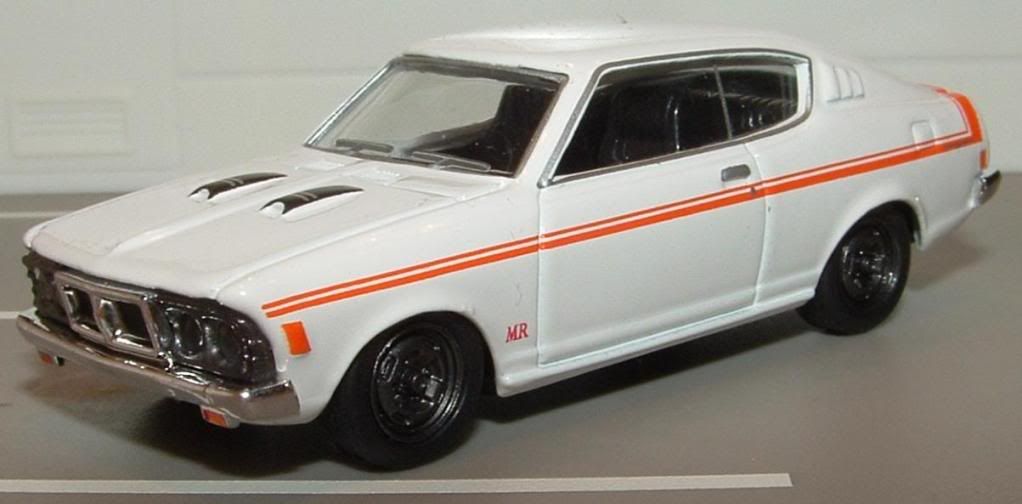
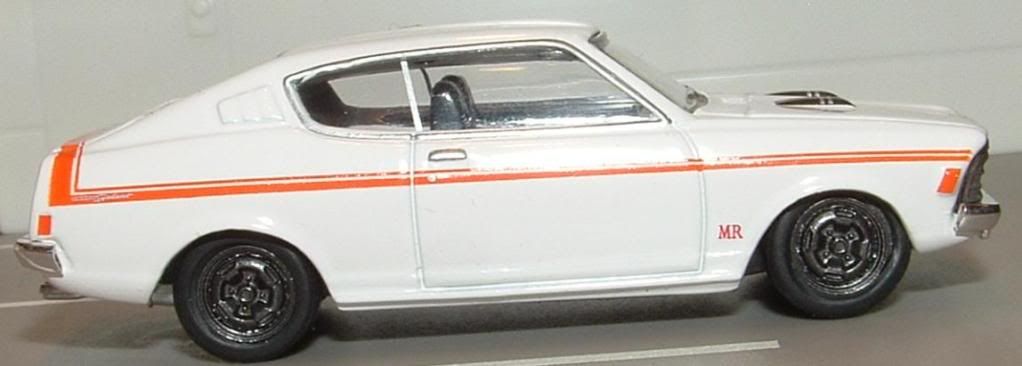
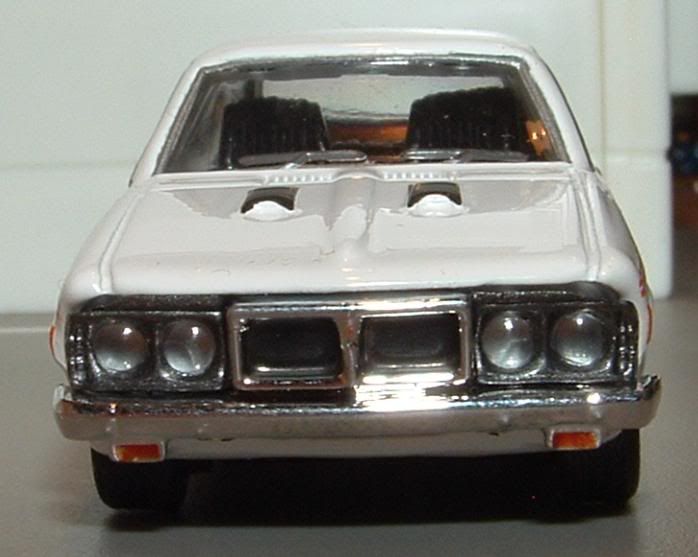
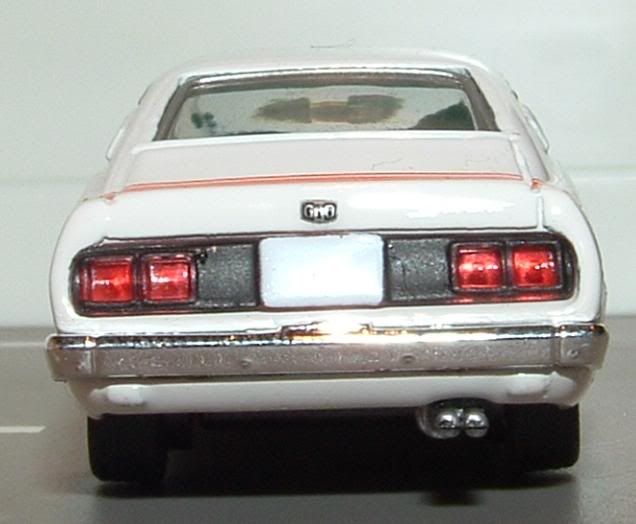
Today's car of the day is Konami's 1970 Mitsubishi Galant GTO MR.
The Mitsubishi Colt Galant GTO (Gran Turismo Omologato) was first shown as the Galant GTX-1 showcar at the 1969 Tokyo Motor Show. Sales began in November 1970, when it was the flagship hardtop variant of Mitsubishi Heavy Industries's then-new Colt Galant sedan.
The Colt Galant GTO exterior was penned by Hiroaki Kamisago, who had previously been sent by Mitsubishi to study at the Art Center College of Design in Pasadena, California, it incorporated many stylistic cues from contemporary American muscle cars like the Mustang, Firebird and Cougar, including a long hood, raised cut-off ducktail rear, and rounded quad-headlamps and tail-lamps. It was also the first Japanese passenger car to have full, roll down, side windows and a pillarless design.
Mitsubishi Racing Development (AKA Colt Speed) intended the Colt Galant GTO to compete in the prestigious JCCA Grand Prix circuit. However, the OPEC oil embargo of 1973 sounded the demise of GP racing, so the GTO race program was mothballed. Nevertheless, GTO's were successful in Rallying, including the famous Japanese Alpine Rally.
Initially, there were three Colt Galant GTO models offered, all powered by the Saturn engine: the M1 (1600 cc SOHC, 4-speed), M2 (1,600 cc SOHC, 5-speed) and the top-spec MR (1,600 cc twin-carb, DOHC 5-speed), a 125 horsepower (93 kW) version only available in Japan.
In 1972 Mitsubishi upgraded the power plants with their new Astron units. The range now consisted of the LS (2,000 cc single-carb, automatic transmission), GS (2,000 cc twin-carb, 5-speed manual) and GS-R (2,000 cc twin-carb, 5-speed manual). They were also given a mild facelift to distinguish them, comprising a one-piece slats-type grille and three-piece tail lights. Additionally, the 125 hp (93 kW) GS-R had wider 185-section tires, flared guards and a black-painted rear panel between the lights.
There was a second styling tweak in 1974 when the car gained a honeycomb-style front grille. The last Colt Galant GTO's produced gained the Astron 80 engine with Mitsubishi's Silent Shaft system. After relatively long production run, the GTO was finally replaced by Galant Lambda/Sapporo in December 1976, although production continued into 1977.
For more information and pictures of the real car please visit: Mitsubishi Galant GTO MR
Here's an example of what Japan did best at that time. They took a good look at all of the current automotive trends at the time and managed to make a car that demonstrated almost every single one of them. This car oozes the '70s from every single angle. From the quad round headlights to the hoodscoops, to the massive C-pillar supporting a fastback roofline, to the blacked out hoodscoops and rear taillight panel, and the bold stripes. About the only '70s trend this one misses is that it isn't a wildly-painted conversion van...
Mitsubishi chose not to aggressively export the Colt Galant GTO. Besides the home market of Japan, few examples (all right hand drive) were sold abroad. Most were distributed to New Zealand, and smaller numbers ended up in various Asian countries as well as the United Kingdom. At the time, Mitsubishi rarely used their own brand name abroad, so many were sold simply as the "Colt Galant GTO". Surviving examples are uncommon.
Subscribe to:
Posts (Atom)