A blog focusing on 1/64 diecast from such popular brands as Hot Wheels, Matchbox, Johnny Lightning, M2 Machines, GreenLight, Tomica, Yat Ming, Majorette, MotorMax, Siku, Corgi, Guisval, Playart, Ertl, Zylmex, Racing Champions, & many more. Swifty's Garage features a daily Car Of The Day and news updates from your favorite brands!
Showing posts with label Pontiac. Show all posts
Monday, July 30, 2012
Car Of The Day: July 30, 2012
Today's car of the day comes from Dean-O-mite's collection and is Tack Cheung / Toy Century's 1999 Pontiac GTO Concept.
The original GTO was the brainchild of Pontiac engineer Russell Gee, an engine specialist; Bill Collins, a chassis engineer; and Pontiac chief engineer John DeLorean. The GTO name, which was DeLorean's idea, was inspired by the Ferrari 250 GTO, the successful race car. It is an Italian abbreviation for Gran Turismo Omologato, ("Grand Tourer Homologated") which means officially certified for racing in the Grand tourer class.
During the 1999 Detroit Auto Show, a GTO concept car with a heritage-inspired "Coke-bottle" shape, grille, and hood scoop, was introduced to the world. It was only a design experiment and had no engine. The concept never made it into production, but created its own unique following at the time.
For more information and pictures of the real car please visit: Pontiac GTO
This GTO Concept was made by Tack Cheung, of China, but was marketed under the Toy Century name in the United States, using the same initials to create a more Americanized brand name. Tack Cheung / Toy Century also made the GTO Concept as a larger scale remote control car and a friction powered toy. This small-scale version was marketed as a light-up keychain, and features free-rolling wheels and soft rubber-like tires. The front fog lights illuminate by pressing a small button on the undercarriage. The key ring attaches under the rear bumper with a small screw, and was very easily removed. -Dean-O-mite
Launched at the 1999 Detroit Motorshow (NAIAS) the GTO Concept pays homage to one of the greatest muscle cars; the Pontiac GTO. Careful examination of its lines suggests connections to past GTOs and current Pontiac styling cues. The side profile hints at the famous 'Coke bottle' look introduced on '66/'67 GTOs and refined with '68/'69 models. The shape of the rear quarter windows is reminiscent of the '68/'69 GTOs. A hood-mounted tachometer pod first appeared in 1967. Split grilles were a GTO mainstay, as well as a signature shape on many other Pontiacs. The two hood scoops are a Firebird/Trans Am cue and a logical extension of the '71/'72 GTO twin hood scoops. The tapered, taillight/rear decklid treatment distinguished the 1966 GTO. Honeycomb wheels were optional on '71 and '72 GTOs, plus they were a long-time Firebird favorite. Large driving lights, bold body ribs, and Wide Track stance are seen on many 1999 Pontiacs like the Grand Prix and Grand Am.
Even though Concept GTO has expanded on traditional Pontiac characteristics, it is very much a new car, one that would be at home in the 21st century. Large, 19-inch diameter front wheels, 20-inch rear wheels, and ultra-low profile, 40-series tires are a world apart from the 14-inch bias ply US Royal red line tires included in the original GTO option package. The low stance, radically raked windshield, long wheelbase in relation to the body overhang, and almost vertical rear panel are futuristic touches.
Thursday, June 14, 2012
Car Of The Day: June 14, 2012
Today's car of the day comes from craftymore's collection and is Zylmex's 1982 Pontiac Firebird Trans-Am Funny Car.
The Pontiac Firebird was built by the Pontiac division of General Motors between 1967 and 2002. The Firebird was introduced the same year as the automaker's platform-sharing model, the Chevrolet Camaro. This coincided with the release of the 1967 Mercury Cougar, which shared its platform with another pony car, the Ford Mustang.
The vehicles were powered by various four-cylinder, six-cylinder, and V8 engines sourced from several GM divisions. While primarily Pontiac-powered until 1977, Firebirds were built with several different engines from nearly every GM division until 1982 when GM began to discontinue engines it felt were unneeded and either spread successful designs from individual divisions among all divisions or use new engines of corporate architecture.
The Firebird and Camaro were completely redesigned for the 1982 model year, with the windshield slope set at 62 degrees, (about 3 degrees steeper than anything GM had ever tried before), and for the first time, a large, glass-dominated hatchback that required no metal structure to support it. Two concealed pop-up headlights, a first on the F-Body cars, were the primary characteristic that distinguished the 3rd Gen Firebird from its both its Camaro sibling and its prior form; (a styling characteristic carried into the 4th Gen's design). In addition to being about 500 lbs (227 kg) lighter than the previous 2nd Gen design, the 3rd Generation Firebird was the most aerodynamic product GM had ever released. Wind tunnels were used to form the new F-Body platform's shape, and Pontiac took full advantage of it. The aerodynamic developments extended to the finned aluminum wheels with smooth hubcaps and a functional rear spoiler.[/quote]
Received this cool Zee from Noirguru. It was mint on card and liberated for cotd. TY Jermaine.
Monday, June 4, 2012
Car Of The Day: June 4, 2012
Today's car of the day comes from Firehawk73's collection and is GreenLight's 1971 Pontiac GTO.
The Pontiac GTO is an automobile built by Pontiac Division of General Motors in the United States from 1964 to 1974, and by GM subsidiary Holden in Australia from 2004 to 2006. It is considered an innovative, and now classic muscle car of the 1960s and 1970s. From 1964 until midway through 1973 it was closely related to the Pontiac Tempest/LeMans and for the 1974 model year it was based on the Pontiac Ventura. The 21st century GTO is essentially a left-hand drive Holden Monaro, itself a coupe variant of the Holden Commodore.
For more information and pictures of the real car please visit: Pontiac GTO
The 1971 GTO had another modest facelift, this time with wire-mesh grilles, horizontal bumper bars on either side of the grille opening, more closely spaced headlamps, and a new hood with the dual scoops relocated to the leading edge, not far above the grille. Overall length grew slightly to 203.3 inches (516 cm).
A new corporate edict, aimed at preparing GM for no-lead gasoline, forced an across-the-board reduction in compression ratios. The Ram Air engines did not return for 1971. The standard GTO engine was still the 400 CID V8, but now with 8.2:1 compression. Power was rated at 300 hp (220 kW) SAE gross at 4,800 rpm and torque at 400 lb·ft (542 N·m) at 3,600 rpm. It had 255 hp (190 kW) SAE net at 4,400 rpm in the GTO and 250 hp (190 kW) SAE net at 4,400 rpm in the Firebird.
An engine option was the 455 CID V8 with four-barrel carburetor, 8.4 to 1 compression ratio and 325 hp (242 kW) at 4,400 rpm, which was only available with the Turbo Hydra-matic TH-400 transmission. It had 260 hp (190 kW) SAE net at 4,000 rpm in the GTO and 255 hp (190 kW) SAE net in the Firebird. This engine was not available with air induction.
The top GTO engine for 1971 was the new 455 HO with 8.4 compression, rated at 335 hp (250 kW) at 4,800 rpm and 480 lb·ft (651 N·m) at 3,600 rpm. It had 310 hp (230 kW) SAE net at 4,400 rpm in the GTO and 305 hp (227 kW) SAE net in the Firebird Trans Am or Formula 455 with air induction. The 1971 Pontiac brochure declared that this engine produced more NET horsepower than any other engine in its history. That would imply the 400 CID V8 Ram Air engines had less than 310 hp net. While rated at 335 hp gross, in order to suggest it had less power than it did, you could say it should have been rated at 375 hp gross to compare with other Pontiac engines. This engine had more NET horsepower than the 1970 455 CID V8 GTO, which was essentially the regular engine found in other Pontiacs with a GTO exhaust system, and was continued in 1971 as the second option above.
For 1971,the standard rear-end was an open 10 bolt. Posi-traction 10 bolt rear ends were available as an option on 400 CI engine equipped GTO's, while all 455 CI GTO's were available with a 12 bolt open or optional 12 bolt posi-traction rear-end.
Motor Trend tested a 1971 GTO with the 455, four-speed transmission, and 3.90 axle, and obtained a 0-60 mph time of 6.1 seconds and a quarter mile acceleration of 13.4 seconds at 102 mph (164 km/h).
The Judge returned for a final year, With the standard equipment being the Mountain Performance package was the 455 HO. Only 357 were sold before The Judge was discontinued in February 1971, including 17 convertibles today the rarest of all GTOs, aside from the 1969 Ram Air IV convertible. Only 10,532 GTOs were sold in 1971, 661 of which were non-Judge equipped convertibles.
David Pearson drove a 1971 GTO in the Winston Cup Series.
Friday, April 27, 2012
Car Of The Day: April 27, 2012
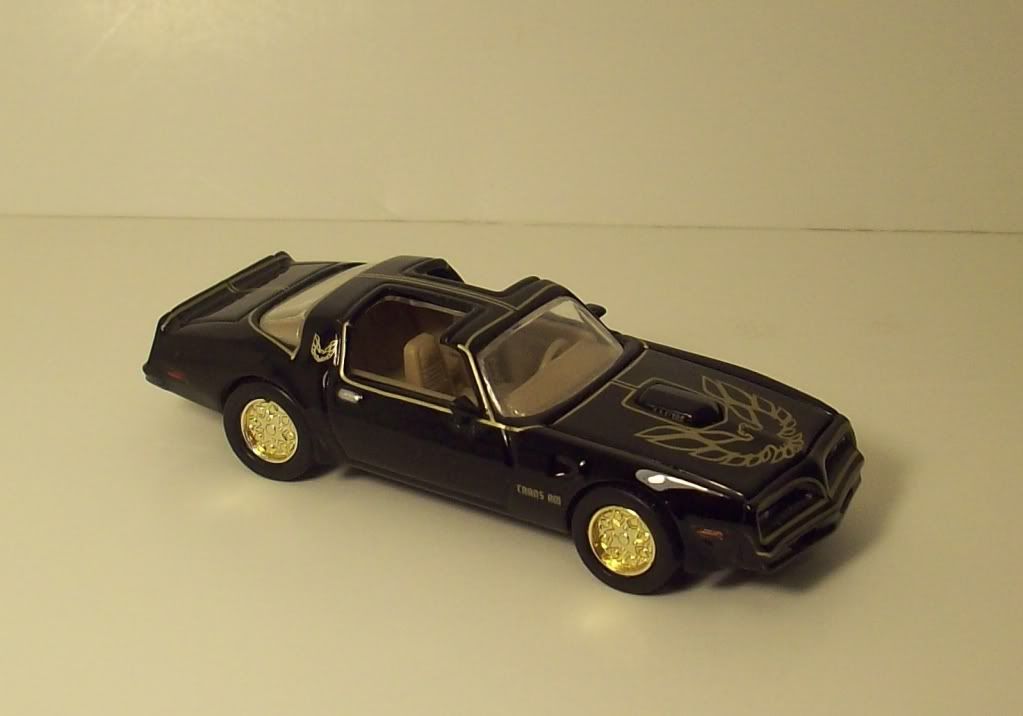
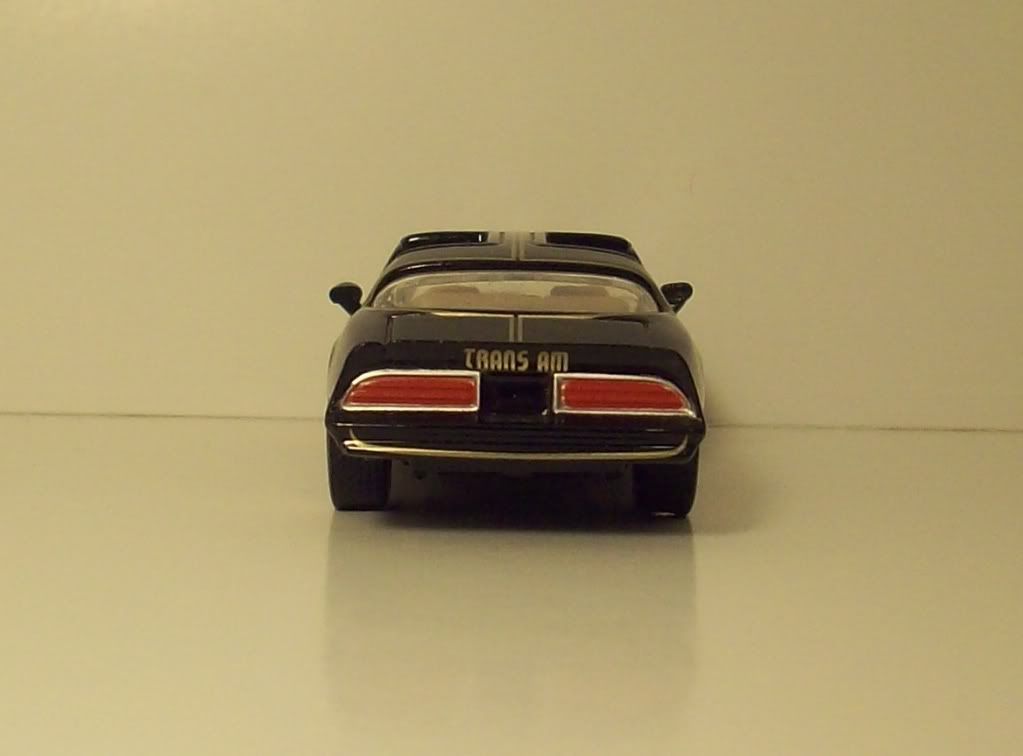
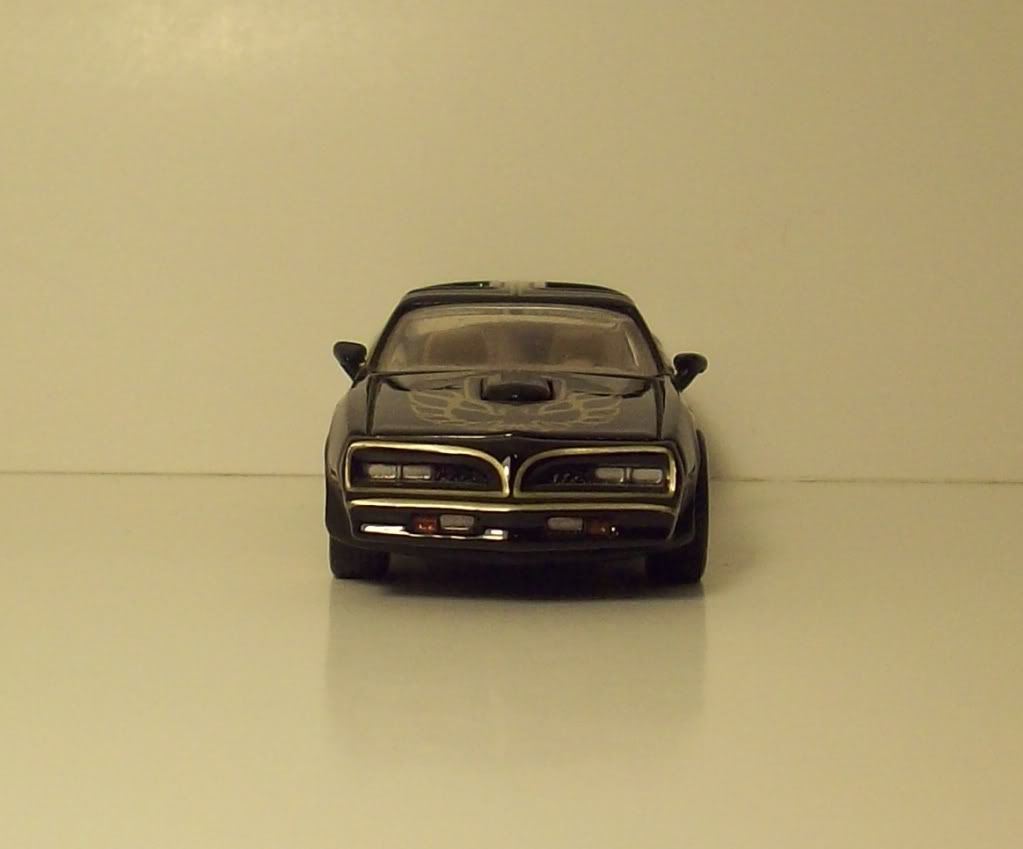
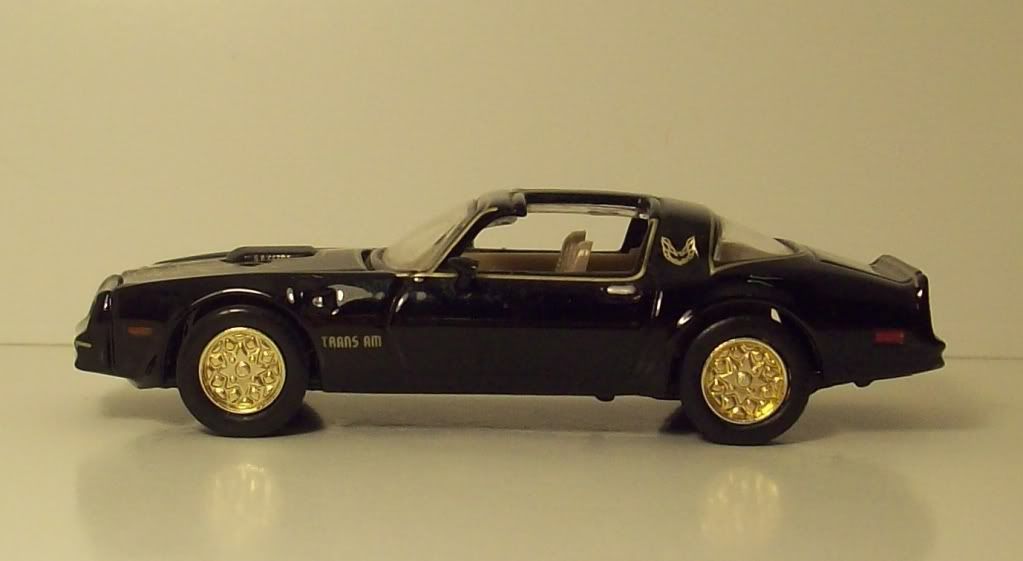
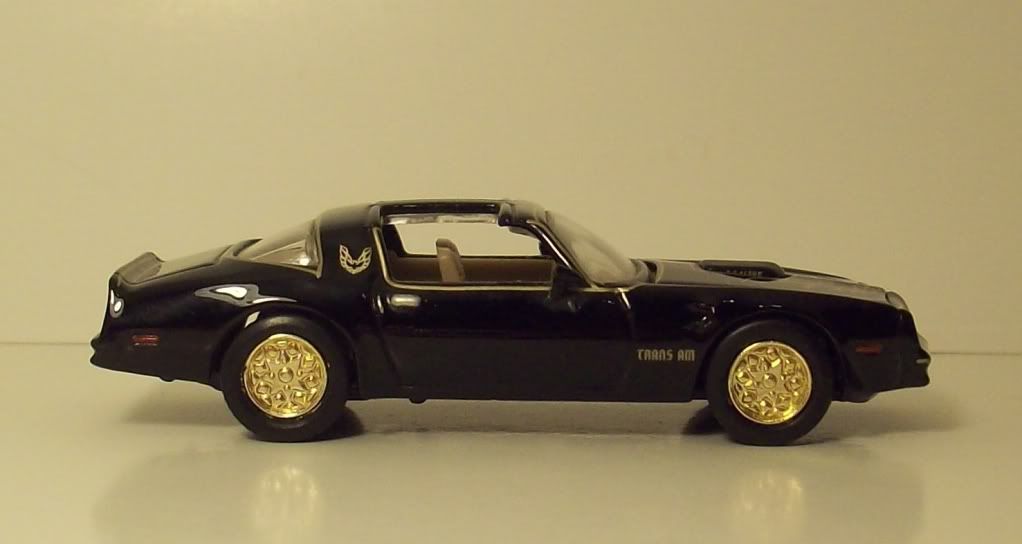
Today's car of the day comes from Firehawk73's collection and is Racing Champions' 1977 Pontiac Firebird Trans Am.
The Pontiac Firebird was built by the Pontiac division of General Motors between 1967 and 2002. The Firebird was introduced the same year as the automaker's platform-sharing model, the Chevrolet Camaro. This coincided with the release of the 1967 Mercury Cougar, which shared its platform with another pony car, the Ford Mustang.
The vehicles were powered by various four-cylinder, six-cylinder, and V8 engines sourced from several GM divisions. While primarily Pontiac-powered until 1977, Firebirds were built with several different engines from nearly every GM division until 1982 when GM began to discontinue engines it felt were unneeded and either spread successful designs from individual divisions among all divisions or use new engines of corporate architecture.
For more information and pictures of the real car please visit: Pontiac Firebird
In 1976, Pontiac celebrated their 50th Anniversary, and a special edition of the Trans Am was released. Painted in black with gold accents, this was the first anniversary Trans Am package and the first production Black and Gold special edition. In 1977, Pontiac offered the T/A 6.6 Litre 400 (RPO W72) rated at 200 hp (150 kW), as opposed to the regular 6.6 Litre 400 (RPO L78) rated at 180 hp (130 kW). In addition, California and high-altitude cars received the Olds 403 engine, which offered a slightly higher compression ratio and a more usable torque band than the Pontiac engines of 1977. The 1977 Trans-Am Special Edition became famous after being featured in Smokey and the Bandit. Later on the 1980 Turbo model was used for Smokey and the Bandit II.
Beginning in 1978, Pontiac engineers reversed years of declining power by raising the compression ratio in the Pontiac 400 through the installation of different cylinder heads with smaller combustion chambers (1977 Pontiac 400 engines also had the 350 heads bolted to the 400 blocks, these heads were known as the 6x-4 heads)(taken from the Pontiac 350). This increased power by 10% for a total of 220 during the 1978–79 model years. The 400/403 options remained available until 1979, when the 400 CID engines were only available in the 4-speed transmission Trans Ams and Formulas (the engines had actually been stockpiled from 1978, when PMD had cut production of the engine). 1979 marked the 10th Anniversary of the Trans Am, and a special anniversary package was made available: silver paint with a silver leather interior. The 10th Anniversary cars also featured a special Firebird hood decal, which extended off of the hood and onto the front fenders. In 1979 Pontiac sold 116,535 Trans Ams which still holds the record to this day.
Up until the 1979 models, the performance of 400-equipped Firebirds could still be brought up to pre-1970 levels by disabling emissions equipment- removing the catalytic converter and blocking off the exhaust gas recirculation system- and opening up the block off plate to make the hood scoop functional. However, in 1980, due to ever-increasing emissions restrictions, Pontiac dropped all of its large displacement engines.
1980 therefore saw the biggest engine changes for the Trans Am. The 301, offered in 1979 as a credit option, was now the standard engine. Options included a turbocharged 301 or the Chevrolet 305 small block.
In the final year of the Second Generation Firebirds (1981), Trans Am still used the same engines as it had in the previous model year, with the only change being the addition of a new electronic carburetion system.
Friday, February 24, 2012
Race Car Of The Day: February 24, 2012
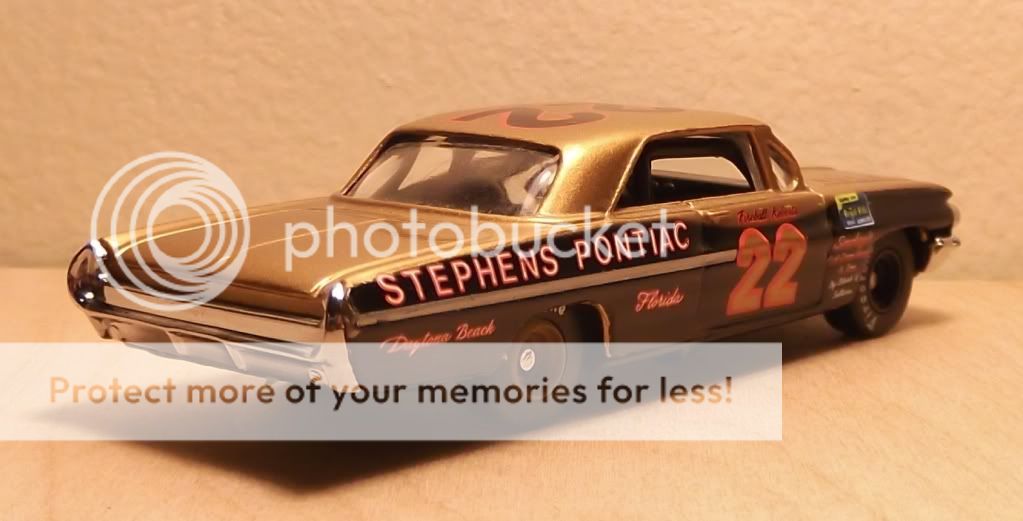
Today's car of the day comes from Firehawk73's collection and is RCCA's 1962 Pontiac Catalina NASCAR stock car (Fireball Roberts).
The 1961 full-sized Pontiacs were completely restyled with more squared-off bodylines, the reintroduction of the split grille first seen in 1959 and dropped for 1960 and an all-new Torque-Box perimeter frame with side rails replacing the "X" frame chassis used since 1958. The new frame not only provided greater side-impact protection than the "X" design but also improved interior roominess.
Rooflines were more squared off on four-door models with the six-window styling dropped on pillared sedans and wider C-pillars with flat rear windows on four-door hardtops. A revised version of the 1959-60 "bubbletop" roof was used on two-door hardtops. Wrap-around windshields were dropped in favor of flatter glass work for improved entry and exit to the front seat.
The new body was somewhat smaller and lighter than the 1960 model with wheelbase down three inches (76 mm) to 119, overall length reduced by the same to 210 in (5,300 mm) and width dropping nearly two inches to 78.2 from 80 in (2,032.0 mm) 1960. The front and rear track of the '61-62 Pontiac was reduced to 62.5 in (1,590 mm) front and rear. The new '61 Pontiac was advertised as "All Pontiac...On a New Wide Track."
All engines were again 389 cu in (6.4 l) V8s as in previous years. Standard engines were two-barrel units rated at 215 hp (160 kW) with the three-speed manual transmission or 267 hp (199 kW) with the optional Hydramatic, with a 230 hp (170 kW) regular-fuel economy V8 offered as a no-cost option with the Hydramatic. Offered as extra-cost options were more powerful versions of the 389 including a 303 hp (226 kW) version with four-barrel carburetor or 318 hp (237 kW) Tri-Power option. New to the option list were two higher performance versions of the 389, including a four-barrel 333 hp (248 kW) unit and a 348 hp (260 kW) Tri-Power option, both with higher 10.75:1 compression ratios. A 363 hp (271 kW) engine was offered to drag racers. Late in the '61 season the 421 cu in (6.9 l) Super Duty was released for sale.
A new three-speed Roto Hydramatic automatic transmission replaced the previous four-speed unit for 1961. The new transmission was slimmer and lighter than the older four-speed Hydramatic, which was continued on the larger Star Chief and Bonneville models. Also new for 1961 was a four-speed manual transmission with Hurst floor shifter, available on special order.
The 1962 Pontiacs received a heavy facelift of the 1961 design with more rounded body contours and new rooflines on two-door hardtops featuring convertible-like bows. Catalina sedans and coupes got a 1-inch (25 mm) wheelbase increase, after spending 1961 on a 119-inch (3,000 mm) length shared with full-sized Chevys (Safari wagons retained the 119-inch (3,000 mm) wheelbase through 1964).
Most regular engine/transmission offerings were carried over from 1961 with the 389 cu in (6.4 l) Trophy V8, ranging in power ratings from 215 hp (160 kW) to 348 hp (260 kW). A small number of 1962 Catalinas and other Pontiacs were built with a "non-streetable" 421 cu in (6.9 l) Super Duty V8 with two four-barrel carburetors and 405 hp (302 kW), as a US$2,250 option (when the base Catalina listed at US$2,725), along with various "over the counter" performance options offered by Pontiac including aluminum bumpers and even lighter frames with drilled holes (which were dubbed the "Swiss Cheese" frames).
For 1963, Catalinas and other full-sized Pontiacs featured cleaner, squared-off bodylines and vertical headlights flanking the split grille, but retained the same dimensions and basic bodyshell of 1961-62. Engine offerings were revised as the 333 hp (248 kW) and 348 hp (260 kW) versions of the 389 V8 were dropped in favor of "production" versions of the larger 421 cu in (6.9 l) rated at 338 horsepower (252 kW) with four-barrel carburetor, 353 hp (263 kW) with Tri-Power, or a 370 hp (280 kW) "HO" with Tri-Power . The 405 hp (302 kW) Super Duty 421 was still offered to racing teams during the early portion of the model year but discontinued after General Motors ordered Pontiac (and Chevrolet) to "cease and desist" from factory-supported racing efforts in February 1963. New options for 1963 included a tilt steering wheel that could be adjusted to six different positions, AM/FM radio and cruise control.
A 1963 Catalina convertible modified by California hot-rodder Bill Straub was used as a tow vehicle in the NASA M2-F1 program.
Mild facelifting including new grilles and taillights highlighted the 1964 full-sized Pontiacs. Engine/transmission offerings were unchanged from 1963 except for a new GM-built Muncie four-speed manual replacing the Borg-Warner T-10 unit. Also new for 1964, was the 2+2 option package available on Catalina two-door hardtops and convertibles that included bucket seats, heavy-duty suspension and other performance equipment, along with the same selection of 389 cu in (6.4 l) and 421 cu in (6.9 l) V8s found in other Catalinas.
Throughout most of the 1960s when Pontiac annually captured third place in industry sales, behind Chevrolet and Ford, the Catalina was also often the industry's third best-selling full-sized car behind the first-place Chevrolet Impala and second-place Ford Galaxie 500. The Catalina's success in the low-medium priced field led many competitors to respond with similar products such as the 1961 Chrysler Newport, a less-expensive Chrysler that was priced lower than base models bearing the Chrysler nameplate in recent previous years; and the 1962 Dodge Custom 880 and 1963 Mercury Monterey, both of which were introduced as full-fledged low-medium priced full-sized cars in size and power that followed unsuccessful efforts by Mercury and Dodge to bring out downsized full-sized cars.
In 1964, even Pontiac's mid-priced rivals within General Motors responded to the Catalina's success in the marketplace as well as to capture Chevy Impala owners "trading up" to cars from upscale GM divisions. Buick took its lowest-priced big car, the LeSabre, and lowered the base sticker price further by substituting a smaller 300 cu in (4.9 l) V8 engine and two-speed automatic transmission from its intermediate-sized cars in place of the 401 cu in (6.6 l) V8 and three-speed automatic used in other big Buicks. Oldsmobile went even further by creating a whole new full-sized series, the Jetstar 88, which was $75 lower than the Dynamic 88 series (but still a few dollars higher than comparable Pontiac Catalina models) and also got a smaller engine - a 330 cu in (5.4 l) V8 and two-speed automatic transmission from the intermediate F-85/Cutlass line, along with smaller 9.5 in (240 mm) brake drums (also from the GM intermediates) compared to the 11–12 in (280–300 mm) drums still found on all other GM full-sized cars from the bare-bones six-cylinder Chevrolet Biscayne to the Cadillac 75 limousine. And since the Catalina was still priced lower than the Jetstar and LeSabre, the lowest-priced full-sized Pontiac was often perceived by buyers as a better value in the marketplace due to its larger standard V8 engine and three-speed automatic transmission, and (in comparison to the Jetstar 88) bigger brakes.
For more information and pictures of the real car please visit: Pontiac Catalina & Fireball Roberts
Edward Glenn Roberts, Jr. (January 20, 1929 – July 2, 1964), nicknamed "Fireball", was one of the pioneering race car drivers of NASCAR.
Roberts was born in Tavares, Florida, and raised in Apopka, Florida where he was interested in both auto racing and baseball. He was a pitcher for the Zellwood Mud Hens, an American Legion baseball team, where he earned the nickname "Fireball" because of his fast ball, not his driving style, which is sometimes disputed. He enlisted with the Army Air Corps in 1945, but was discharged after basic training because of asthma.
He attended the University of Florida and raced on dirt tracks on weekends. In 1947, at the age of 18, he raced on the Daytona Beach Road Course at Daytona for the first time. He won a 150-mile race at Daytona Beach the following year.
Roberts continued to amass victories on the circuit, despite the changes in NASCAR as it moved away from shorter dirt tracks to superspeedways in the 1950s and 1960s. In his 206 career NASCAR Grand National races, he won 33 times and had 32 poles. He finished in the top five 45 percent of the time. He won both the Daytona 500 and Firecracker 250 events in 1962 driving a black and gold 1962 Pontiac built by car builder legend Smokey Yunick.
In 1961 Roberts, temporary President of the Federation of Professional Athletes was in dispute with NASCAR President Bill France over the Teamsters' Union affiliate - the FPA - which he and Curtis Turner had helped organize and France was trying to kill. Unlike the banned Curtis Turner and Tim Flock, Roberts soon returned to the NASCAR fold.
On May 24, 1964, at the World 600 in Charlotte, Roberts had qualified in the eleventh position and started in the middle of the pack. On lap 7, Ned Jarrett and Junior Johnson collided and spun out and Roberts crashed trying to avoid them. Roberts' Ford slammed backward into the inside retaining wall, flipped over and burst into flames. Witnesses at the track claimed they heard Roberts screaming, "Ned, help me!" from inside his burning car after the wreck. Jarrett rushed to save Roberts as his car was engulfed by the flames. Roberts suffered second- and third-degree burns over 80 percent of his body and was airlifted to a hospital in critical condition. Although it was widely believed that Roberts had an allergic reaction to flame-retardant chemicals, he was secretly an asthmatic and the chemicals made his breathing worse.
Roberts was able to survive for several weeks, and it appeared he might pull through. But Roberts' health took a turn for the worse on June 30, 1964. He contracted pneumonia and sepsis and slipped into a coma by the next day. He died on July 2, 1964.
Roberts' death, as well as the deaths of Eddie Sachs and Dave MacDonald at the Indianapolis 500 six days later, led to an increase in research for fire-retardant uniforms. It also led to the development of the Firestone RaceSafe fuel cell, and all race cars today use a foam-backed fuel cell to prevent severe fuel spillage of the massive degree that Roberts had. Also, fully fire-retardant coveralls would be phased in leading to the now mandatory Nomex racing suits. Roberts had just lost close friend Joe Weatherly in the January Motor Trend 500 at Riverside, California, making 1964 a black year for major league auto racing.
Prior to his death, there were many sources that Roberts was retiring, since he had taken a prominent public relations position at the Falstaff Brewing Company and the race in which he was killed was to be one of his final races of his career.
Despite having his career cut short and having never won a Grand National title, Fireball Roberts was named one of NASCAR's 50 Greatest Drivers.
Other career awards he won include induction into the International Motorsports Hall of Fame in 1990, and the Motorsports Hall of Fame of America in 1995.
In 2000 the city of Concord, North Carolina named a street near Charlotte Motor Speedway in his honor.
Ned Jarrett has stated that his decision to retire was prompted by Roberts' death.
After Roberts' death, NASCAR mandated that all drivers must wear flame retardant coveralls while on track. They also instituted the five point safety harness, and the special, contoured drivers seat, all three of which are still requirements on all NASCAR entrants.
Tuesday, February 21, 2012
Car Of The Day: February 21, 2012
Today's car of the day comes from Firehawk73's collection and is Racing Champions' 1966 Pontiac GTO.
The Pontiac GTO is an automobile built by Pontiac Division of General Motors in the United States from 1964 to 1974, and by GM subsidiary Holden in Australia from 2004 to 2006. It is considered an innovative, and now classic muscle car of the 1960s and 1970s. From 1964 until midway through 1973 it was closely related to the Pontiac Tempest/LeMans and for the 1974 model year it was based on the Pontiac Ventura. The 21st century GTO is essentially a left-hand drive Holden Monaro, itself a coupe variant of the Holden Commodore.
For more information and pictures of the real car please visit: [url=http://en.wikipedia.org/wiki/Pontiac_GTO]Pontiac GTO[/url]
Pontiac's intermediate line was restyled again for 1966, gaining more curvaceous styling with kicked-up rear fender lines for a "Coke-bottle" look, and a slightly "tunneled" backlight. The tail light featured a rare louvered cover, only seen on the GTO. Overall length grew only fractionally, to 206.4 inches (524 cm), still on a 115 inch (292 cm) wheelbase, while width expanded to 74.4 inches (189 cm). Rear track increased one inch (2.5 cm). Overall weight remained about the same. The GTO became a separate model series, rather than an optional performance package, with unique grille and tail lights, available as a pillared sports coupe, a hardtop sans pillars, or a convertible. Also an automotive industry first, plastic front grilles replaced the pot metal and aluminum versions seen on earlier years. New Strato bucket seats were introduced with higher and thinner seat backs and contoured cushions for added comfort and adjustable headrests were introduced as a new option. The instrument panel was redesigned and more integrated than in previous years with the ignition switch moved from the far left of the dash to the right of the steering wheel. Four pod instruments continued, and the GTO's dash was highlighted by walnut veneer trim.
Engine choices remained the same as the previous year. A new rare engine option was offered: the XS engine option consisted of a factory Ram Air set up with a new 744 high lift cam. Approximately 35 factory installed Ram Air packages are believed to have been built, though 300 dealership installed Ram Air packages are estimated to have been ordered. On paper, the package was said to produce the same 360 hp (270 kW) as the non-Ram Air, Tri Power car, though these figures are believed to have been grossly underestimated in order to get past GM mandates.
Sales increased to 96,946, the highest production figure for all GTO years. Although Pontiac had strenuously promoted the GTO in advertising as the "GTO Tiger," it had become known in the youth market as the "Goat." Pontiac management attempted to make use of the new nickname in advertising but were vetoed by upper management, which was dismayed by its irreverent tone.
Tuesday, February 14, 2012
Car Of The Day: February 14, 2012
The Pontiac Firebird was built by the Pontiac division of General Motors between 1967 and 2002. The Firebird was introduced the same year as the automaker's platform-sharing model, the Chevrolet Camaro. This coincided with the release of the 1967 Mercury Cougar, which shared its platform with another pony car, the Ford Mustang.
The vehicles were powered by various four-cylinder, six-cylinder, and V8 engines sourced from several GM divisions. While primarily Pontiac-powered until 1977, Firebirds were built with several different engines from nearly every GM division until 1982 when GM began to discontinue engines it felt were unneeded and either spread successful designs from individual divisions among all divisions or use new engines of corporate architecture.
For more information and pictures of the real car please visit: Pontiac Firebird
The first generation Firebirds had a characteristic Coke bottle styling. Unlike its cousin, the Chevrolet Camaro, its bumpers were integrated into the design of the front end and its rear "slit" taillights were inspired by the Pontiac GTO. Both a two-door hardtop and a convertible were offered through the 1969 model year. Originally the car was a "consolation prize" for Pontiac, who had initially wished to produce a two-seat sports car of its own design, based on the original Banshee concept car. However, GM feared such a vehicle would directly compete with Chevrolet's Corvette, and the decision was made to give Pontiac a piece of the pony car market by having them share the F-body platform with Chevrolet.
The base model Firebird came equipped with the OHC inline-6 and a single-barrel carburetor. The next model, the Sprint, had a four-barrel carburetor, developing 215 hp (160 kW). Most buyers opted for one of the V8 engines: the 326 CID (5.3 L) with a two-barrel carburetor producing 250 hp (186 kW); the "H.O." (High Output) engine of the same displacement, but with a four-barrel carburetor and producing 285 hp (213 kW); or the 400 CID (6.6 L) from the GTO with 325 hp (242 kW). A "Ram Air" option was also available in 1968, providing functional hood scoops, higher flow heads with stronger valve springs, and a different camshaft. Power for the Ram Air package was the same as the conventional 400 H.O., but the engine peaked at a higher RPM. The 230 CID (3.8 L) engines were subsequently replaced by 250 CID (4.1 L) ones, the first developing 175 hp (130 kW) using a single-barrel carburetor, and the other 215 hp (160 kW) with a four-barrel carburetor. Also for the 1968 model, the 326 CID (5.3 L) engine was replaced by one with a displacement of 350 CID (5.7 L). An "H.O." version of the 350 CID with a revised cam was also offered starting in that year, developed 320 hp (240 kW). Power output of the other engines was increased marginally. In 1969, a $725 optional handling package called the "Trans Am Performance and Appearance Package,", named after the Trans Am Series, which included a rear spoiler, was introduced. Of these first "Trans Ams," only 689 hardtops and eight convertibles were made. There was an additional Ram Air IV option for the 400 CID engine during that year, complementing the Ram Air III; these generated 345 and 335 hp (250 kW) respectively. The 350 "H.O." engine was revised again with a different cam and cylinder heads resulting in 330 hp (250 kW). During 1969 a special 303 cu in (5.0 L) engine was designed for SCCA road racing applications that was not available in production cars.
The styling difference from the 1967 to the 1968 model was the addition of Federally mandated side marker lights: for the front of the car, the blinkers were made larger and extended to wrap around the front edges of the car, and on the rear, the Pontiac (V-shaped) Arrowhead logo was added to each side. The front door vent-windows were replaced with a single pane of glass. The 1969 model received a major facelift with a new front end design made of an Endura bumper housing the headlights and grilles. The instrument panel and steering wheel were revised. The ignition switch was moved from the dashboard to the steering column with the introduction of GM's new locking ignition switch/steering wheel.
Due to engineering problems that delayed the introduction of the all-new 1970 Firebird beyond the usual fall debut, Pontiac continued production of 1969 model Firebirds into the early months of the 1970 model year (the other 1970 Pontiac models had been introduced on September 18, 1969). By late spring of 1969, Pontiac had deleted all model-year references on Firebird literature and promotional materials, anticipating the extended production run of the then-current 1969 models.
Wednesday, February 8, 2012
Car Of The Day: February 8, 2012
Today's car of the day comes from Firehawk73's son Jacob's collection and is Johnny Lightning's 1963 Pontiac Tempest funny car.
The Pontiac Tempest was an entry-level compact produced by the Pontiac Motor Division of General Motors, introduced in September 1960 for the 1961 model year.
Sharing the new monocoque (unibody) Y platform with the Buick Special and Skylark, and Oldsmobile F-85 and Cutlass, the model also appeared under the LeMans nameplate (largely beginning with the 1962 model year, though Pontiac also manufactured a few 1961 LeMans coupes).
For 1964, the platform was redesigned with a full-size frame, and renamed A-body. The Tempest name was discontinued after the 1970 model year in favor of LeMans, a nameplate previously used for upmarket versions of that series.
For more information and pictures of the real car please visit: Pontiac Tempest
Despite sharing some of the Oldsmobile's sheet metal, the original Tempest featured an innovative drivetrain — a rear-mounted transaxle coupled to a torque shaft arcing in a 3 in (76 mm) downward bow within a longitudinal tunnel — coupling the forward engine and rear transmission into one unit and eliminating vibration. The arrangement, known as "rope drive", had been previously used in the 1951 Le Sabre concept car.
The combination of the rear-mounted transaxle and the front-mounted engine gave the car very nearly an ideal 50/50 front/rear weight distribution, enabled four-wheel independent suspension, and eliminated the floor "hump" forward of the front seat which accommodated the transmission in a conventional layout, such as the front engine/front transmission used in the Tempest's Buick and Oldsmobile sister cars.
John Z. DeLorean, designer of the Tempest, was the division's chief engineer and a Packard veteran who would later become the division's head and later still would become widely known for founding the DeLorean Motor Company. The Tempest was Motor Trend magazine's 1961 Car of the Year. Road & Track praised the Tempest as "exceptionally roomy" and "one of the very best utility cars since the Ford Model A."
Power came from a 195 in³ (3.2 L) straight-4, marketed as the "Trophy 4", derived from the right cylinder bank of Pontiac's 389 in³ V8, the standard powerplant Pontiac used in its larger cars, such as the Bonneville and Catalina. The engine was advertised as a gas-saving economy motor for thrifty consumers, but Pontiac also saved money because it could run the engine down the same assembly line as the 389. There were three versions of the engine: an 8.6:1, low compression, single-barrel carburetor; a 10.25:1 high-compression with single barrel; and a high-compression engine with a four-barrel carburetor. While the single-barrel version produced 110–140 hp (82–104 kW; 112–142 PS), the four-barrel was capable of 155 hp (116 kW; 157 PS) (SAE gross) at 4,800 rpm and 215 ft·lbf (292 N·m) of torque at 2,800 rpm. All three versions had a fuel economy ranging from 18-22 mpg, and the engine was generally reliable though it had a reputation as the "Hay Baler", a derogatory label applied by dealer mechanics (ostensibly from farm states) who experienced the violent kicks it could produce when out of tune.
Another departure from the other Y-body cars, lesser but still notable, were the wheels. Both Buick and Oldsmobile had standardized their Y-body cars on an odd 9.5 in (24 cm) brake drum with four lug studs on a 4.5 in (11 cm)-diameter circle (a "four-on-four-and-a-half" bolt pattern), with 14 in (36 cm) wheels, shared by no other GM cars at the time. Pontiac went with a 9 in (23 cm) drum, but used five studs on the same bolt circle ("five-on-four-and-a-half") and 15 in (38 cm) wheels. This was a second configuration shared by no other GM cars but would be identical to the wheels on the Ford Mustang when released some four years later in mid-1964. Perhaps only coincidentally, the Pontiac plant that produced the Tempest's undercarriage was in Los Angeles, across the street from the Ford plant where the Mustang's was developed.
Of particular note is that the innovative aluminum Buick-built 215 in³ (3.5 L) V8 was optional in the Tempest in 1961 and 1962. (This also had first appeared in the LeSabre.) It is estimated that just 3,662 Tempests were ordered with the 215 engine, or about 1% of production. This motor produced, in its various incarnations, from 155–215 hp (116–160 kW; 157–218 PS) despite weighing just 330 lb (150 kg) installed. The Pontiac 215 blocks are distinct from other Buick 215 blocks because in addition to the factory Buick markings they were hand-stamped at the Pontiac plant with the Vehicle Identification Numbers of the individual cars they were installed in. Thus, in 1961 all Pontiac 215 blocks begin "161P"; the 1962 cars, "162P". Further code numbers told whether the car had an automatic or manual transmission. In 1961, this would have been either a three-speed column-shifted manual with a non-synchromesh first gear or a two-speed automatic controlled by a small lever on the dash to the right of the ignition. This automatic—called "TempesTorque" in company literature but unmarked on the unit itself until 1963—was a type of Powerglide similar to, but sharing very few parts with, the one in the Chevrolet Corvair. (The next year, a floor-mounted, fully synchronized four-speed manual was added.) At its introduction, the Tempest was only available as a four-door pillared sedan and as a Safari station wagon. A pair of two-door coupes, one of which was named LeMans, were added at the end of 1961, both in the 1961 body style.
By the time the 1962 models arrived, LeMans, primarily a trim package upgrade featuring front bucket seats, also came as a new convertible. There were now a total of four models: station wagon, sedan, coupe, and convertible. All four came as Tempest; customers who wanted a more deluxe coupe or convertible could pay extra for Tempest LeMans. There was no LeMans station wagon or sedan. And although Oldsmobile and Buick had pillarless hardtops (the Cutlass and Skylark, respectively), there was no pillarless hardtop LeMans. In 1963, the LeMans became a separate series, reaching nearly 50% of all combined Tempest and LeMans production.
The 1963 version, slightly larger and heavier than the previous two years (now designated a "senior compact"), and with a redesigned transaxle that improved handling, offered a high-performance option much more powerful than the scarcely ordered 215. The 215 was replaced by Pontiac's new 326 in³ (5.3 L) V8, a motor with the same external dimensions of the venerable 389, but different internals, designed to produce more torque. A new version of the automatic transmission (now officially stamped "TempesTorque" on the case) was designed with beefier internals to handle it; the four-speed was not, so few, if any, V8 cars were built with four speeds (the three-speed remained for both motors, however). The high-compression 326's output was 260 hp (194 kW; 264 PS) and 352 ft·lbf (477 N·m) of torque. The actual displacement was 336 in³, but according to lore, since no GM division compact was allowed to have a motor larger than the Corvette's 327, the advertised number was 326. The cast-iron mill brought weight up 260 lb (120 m) 260 pounds over a 195 in³ Trophy 4 and weight distribution changed only marginally to 54/46. Performance was strong enough that Car Life magazine stated; "No one will wonder why they didn't use the 389," and fuel economy with the 326 ranged up to 19 mpg. The V8 option proved popular: 52% of the 131,490 Tempests and LeMans sold in 1963 were ordered with the 326. The 326 sold in the 1963 cars is a one year-only motor; the next year the displacement was adjusted so that it was actually 326 in³.
Super DutyPerhaps the most famous Tempests built were the 1963 Super Duty cars. Just 14 in number and built to compete in the NHRA Factory Experimental class, they were built at the Pontiac plant in Michigan over Christmas 1962 with the knowledge of the impending General Motors ban on factory racing. Among those who successfully raced the Tempest Super Duty cars was Wild Bill Shrewsberry who drove for Mickey Thompson in the 1963 NHRA Winternationals with average times in the low 12-second range. Shrewsberry still owns his car and it is still equipped with Pontiac's "Powershift" transaxle as retrofitted later in the 1963 season. Developed specifically for the Super Duty, this was essentially two Powerglide automatics in a single four-speed unit, allowing clutchless shifting in much the same manner as modern drag racing transmissions.
On October 31, 2008, one of the most rare factory race cars, the missing Stan Antlocer Super Duty Tempest LeMans Coupe was auctioned on eBay. The seller started the auction at $500 being unaware of the car's true value. Eventually, the car was sold for $226,521.
Wednesday, January 25, 2012
Car Of The Day: January 25, 2012
Today's car of the day is Zymex's 1985 Pontiac Fiero.
The Pontiac Fiero is a mid-engined sports car that was built by the Pontiac division of General Motors from 1984 to 1988. The Fiero—meaning "proud" in Italian and "wild", "fierce", or "ferocious" in Spanish—was designed by George Milidrag and Hulki Aldikacti as a Pontiac sports car. The Fiero was the first two-seater Pontiac since the 1926 to 1938 coupes, and also the first and only mass-produced mid-engine sports car by a U.S. manufacturer. Many technologies incorporated in the Fiero design such as plastic body panels were radical for its time. Alternative names considered for the car were Sprint, P3000, Pegasus, Fiamma, Sunfire, and Firebird XP. The Fiero 2M4 (2-seat, Mid-engine, 4-cylinder) was on Car and Driver magazine's Ten Best list for 1984. The 1984 Fiero was the Official Pace Car of the Indianapolis 500 for 1984, beating out the new 1984 Chevrolet Corvette for the honor.
370,168 Fieros were produced over the relatively short production run of five years; by comparison, 163,000 Toyota MR2s were sold in its first five years. At the time, its reputation suffered from criticisms over performance, reliability and safety issues. Today however, compared to less adventurous attempts at two-seaters such as the Ford EXP, the unique style of the Fiero compared to other American cars has left it a cult following as a collectible car. It remains a popular chassis for rebodies and electric conversions.
For more information and pictures of the real car please visit: Pontiac Fiero
The Pontiac Fiero has been covered extensively in 1/64 scale with models from Hot Wheels, Matchbox (racing), Majorette (racing), Ertl, Zylmex, and MotorMax Fresh Cherries. This one and the Fresh Cherries casting are the two best, and I think if this was given premium wheels and upgrade paint & tampos it would be the hands down winner.
Already selling the Corvette, General Motors management and accountants were opposed to investing in a second two-seater sports car. But in 1979, during the oil crisis, management saw a market opportunity for a fuel-efficient sporty commuter car, and design work on the Fiero commenced. To this end, it was fitted with a fuel efficient version of GM's 2.5 L four-cylinder "Iron Duke" engine capable of 27 mpg-US (8.7 L/100 km; 32 mpg-imp) in the city and 40 mpg-US (5.9 L/100 km; 48 mpg-imp) on the highway with the economy-ratio transmission option. These figures are U.S. Environmental Protection Agency test-circuit results, published by Pontiac, and confirmed from multiple sources. It was impressive mileage for a 2.5-liter engine of the period, and still good by today's standards, but the three-speed automatic reduced highway mileage to only 32 mpg-US (7.4 L/100 km; 38 mpg-imp). With respect to fuel economy, the Fiero would appeal to a market niche for which the Corvette with its V8 engine was unsuitable.
A mid-engine layout was chosen as a way to reduce both aerodynamic drag and vehicle weight to improve fuel efficiency, and also for its handling, traction, and braking benefits. The sports car potential of the mid-engine layout was not fully realized when the Fiero debuted. In line with its market position, the tires, brakes, and some suspension components were carried over from other GM economy cars (like the Chevrolet Citation and Chevrolet Chevette) so the Fiero could be priced appropriately. As a result, the handling and cornering abilities of the initial Fiero were merely on par with other contemporary sporty coupes (Road & Track 1985). The public had high expectations for the Fiero with its mid-engine layout and futuristic styling, which resembles more exotic mid-engine sports cars costing much more. While initially garnering good reviews for its handling (Motor Trend 1984), the Fiero soon received disappointing reviews, as the automotive critics expected higher performance from a mid-engine two-seater. Despite the critical press, the Fiero sold extremely well and Pontiac operated three shifts at the factory during 1984, and could not keep up with initial demand.
The sharing of suspension components with other GM cars meant the rear suspension and powertrain was almost identical to that of the Chevrolet Citation and Pontiac Phoenix; the Fiero even included rear tie rod ends attached to a "steering knuckle", although these were hard-mounted to the engine cradle and only used for maintaining the rear tire alignment. The front suspension was derived from the Chevrolet Chevette, and Chevette enthusiasts found that they could upgrade their undersized front brakes and rotors using Fiero parts.
By 1985, the oil crisis was a thing of the past and demand developed for a Fiero having more engine power and better sports car performance. Pontiac responded by introducing the GT model which included upgraded suspension tuning, wider tires, and a V6 engine having 43 horsepower (32 kW) more than the base four-cylinder. In 1986, the GT model was restyled to look even more sleek.
Numerous changes were made to the 1988 Fiero. The most significant was a completely redesigned suspension (and parts of the space frame) to realize the potential of the mid-engine layout. Now unique to the Fiero, the new suspension included new two piece brake calipers and upgraded brake rotors for 1988. The available I4 and V6 engines benefited from evolutionary improvements, but the planned availability of turbochargers and newer DOHC engines did not happen before production ended.
Officially, production ended because of an internal GM forecast of insufficient future profits due to an expected decrease in overall demand for two-seater sports cars, however this decision was commensurate with heavy media coverage of Fiero engine fires. GM's forecast may have been a year premature, as the actual sales in 1988 were lower than prior years but still double the forecast.
Monday, January 9, 2012
Car Of The Day: January 9, 2011
Today's car of the day is Hot Wheels California Customs' 1988 Pontiac Banshee.
The Pontiac Banshee is a line of concept cars designed by General Motors. Four of these "dream cars" were fabricated as design exercises beginning in 1964. They were intended to establish exterior and interior design themes that would be modified for production versions of Pontiac sports cars.
For more information and pictures of the real car please visit: Pontiac Banshee
This is a recent purchase from Firehawk73 (thanks Paul!). Early examples of this casting (but not this particular variation) have a raised "PONTIAC" cast into the rear fascia. I don't have one of those. I don't have a lot of variations of this car- I refused to add concept cars to my collection until after seeing the movie "Demolition Man" so this was one I passed on as a kid as a result. I've made up for that- I still don't go out of my way for concept cars but if they turn up at a good price I buy them.
Known within GM as the "Banshee IV", this car was unveiled in 1988 the two-door, four-seat Banshee IV had a sleek and sensuous futuristic design. Its fiberglass body was painted bright red, while its triangular hood was matte black. A 230 horsepower fuel-injected, single overhead cam V8 engine powered the rear wheels. A heads-up display system (HUD) projected information about speed, engine RPM, and fuel level on the windshield in the driver's field of vision. The dashboard featured video displays and numerous buttons; the steering wheel alone contained about twenty. The dual rear wings were also adjustable. Like its predecessors, it was intended to establish exterior and interior design themes that would be modified for production versions of the Pontiac Firebird and Pontiac Trans Am sports cars. The Banshee IV successfully influenced the overall appearance for the fourth generation of the Firebird, the Trans Am, as well as extending to the fourth generation of the Chevrolet Camaro. It was 201" long.
Subscribe to:
Posts (Atom)