Showing posts with label Tomica. Show all posts

Thursday, October 4, 2012

Car Of The Day: October 4, 2012


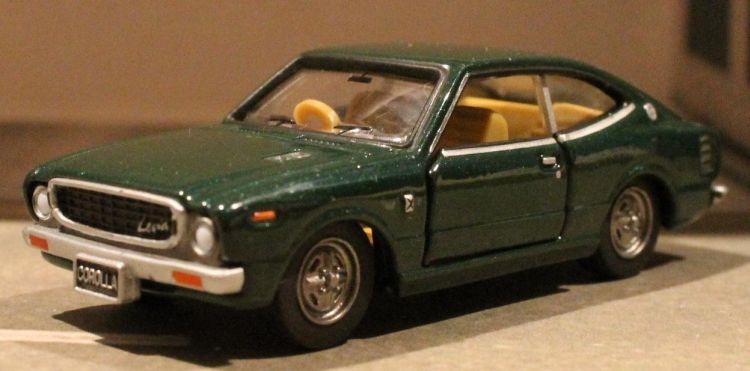
Today's car of the day is Tomica Limited's 1974 Toyota Corolla Levin.


The Toyota Corolla is one of a line of subcompact and compact cars manufactured by the Japanese automaker Toyota, which has become very popular throughout the world since the nameplate was first introduced in 1966. In 1997, the Corolla became the best selling nameplate in the world, surpassing the Volkswagen Beetle. Over 39 million Corollas have been sold as of 2012. The series has undergone several major redesigns.

The name Corolla is part of Toyota's naming tradition of using the name Crown for primary models: the Corona, for example, gets its name from the Latin for crown; Corolla is Latin for small crown; and Camry is an Anglicized pronunciation of the Japanese for crown, kanmuri. The Corolla has always been exclusive in Japan to Toyota Corolla Store locations, and manufactured in Japan with a twin, called the Toyota Sprinter, sold at a specific Japanese Toyota dealership called Toyota Auto Store, then renamed Toyota Vista Store in 1980.

Corollas are manufactured in Japan and in Brazil (Indaiatuba, São Paulo), Canada (Cambridge, Ontario), China (Tianjin), India (Bangalore), Indonesia, Malaysia, Pakistan, Philippines, South Africa (Durban), Taiwan, Thailand, Turkey and Venezuela. Production has previously been made in Australia (Victoria) and the United Kingdom (Derbyshire). Production in the United States (at NUMMI in Fremont, California) ended in March 2010.

The Corolla's chassis designation code is "E", as described in Toyota's chassis and engine codes.

Early models were mostly rear-wheel drive, later models were mostly front-wheel drive and some models were four-wheel drive. Its traditional competitor almost from the very beginning has been the Nissan Sunny also introduced the same year as the Corolla in Japan.


For more information and pictures of the real car please visit: Toyota Corolla Levin


Another Hershey show find, I couldn't leave this one behind.


The Corolla E30 was the third generation of cars sold by Toyota under the Corolla nameplate. It was built from August 1974 to July 1981 and marked Toyota's greatest growth in the United States in the wake of the fuel crisis. In addition to its sister model, the Sprinter, there was a redesigned-body version built by Toyota affiliate Daihatsu, called the Daihatsu Charmant. While there were certain fourth-generation models with a longer model life, this generation, when considered as a whole, was the longest-lived one, possibly due to the worldwide recession in the 1970s. A large range of cars were built using this chassis, including Corollas, Sprinters, Daihatsu, and the sporty Levin and Trueno models with the DOHC motor, with a fuel injection upgrade added to Japanese Levin models in January 1977.

The 3K engine was used in certain markets and later the 4K, while most Japanese and American models had the bigger 2T engine. A "Toyoglide" 2/3-speed automatic transmission was added as well as a four-speed and five-speed manual transmission, driving to the rear wheels. A three-door "liftback" (E50) and sports coupé (E51) was added in 1976. The E40 and E60 series were assigned to the Sprinter variants.
Even though the E30 and E50 series were replaced by the E70 series in August 1979 in most markets, the original E30 series and the facelifted E50 series both continued production until July 1981.


Road & Track was critical of the 1975 Corolla, calling it "large and heavy" and "expensive" compared to the Honda Civic and Datsun B210. They also criticized the "relatively crude rear suspension", lack of interior space, and poor fuel economy when compared to the VW Rabbit. The base model cost US$2,711 in 1975, but only the $2989 "deluxe" model had features comparable to the contemporary pack.

Emissions became a problem further into the 1970s especially with the 3K engine, which became popular because of its low fuel consumption. Its replacement, the 4K engine, came with emissions equipment but only produced 60 hp (45 kW), despite a greater 1290 cc displacement.

The E30 series 2T-C engines outmatched rival Datsun B210's engine output.

Monday, July 2, 2012

RV Of The Day: July 2, 2012


Today's car of the day comes from juantoo3's collection and is Tomica's 1978 Winnebago Chieftain.


Winnebago Industries Inc. is a manufacturer of motor homes, a type of recreational vehicle or RV, in the United States. It is based in Forest City, Iowa.


For more information and pictures of the real car please visit: Winnebago


I've always liked the looks of this RV.  It's like nothing else on the road!


The company was founded by Forest City businessman John K. Hanson in February 1958. At the time, the town, located in Winnebago County, Iowa, was undergoing an economic downturn, so Hanson and a group of community leaders convinced a California firm, Modernistic Industries, to open a travel trailer factory in a bid to revive the local economy.

Surviving a rough beginning, the entire operation was purchased by five Midwesterners, with Hanson serving as president. In 1960 the name of the company was changed to Winnebago Industries. To improve quality, Winnebago Industries manufactured furniture and other components designed specifically for its travel trailers. One such innovation was the "Thermo-Panel," which was a strong, lightweight sidewall that was a characteristic of Winnebago products.

In 1966 the first motor home rolled off the Winnebago Industries assembly lines. These motor homes were sold at a price approximately half of what was being charged for competitors’ models, which led to its ubiquity and popularity in the RV community. The brand name has become synonymous with "motor home" and is commonly used as a genericized trademark for such vehicles, whether they were produced by the company or not.

Through the 1970s and into the 1980s model names were influenced by the Native American tribe of the same name and included the Brave, Chief Black Hawk, the Indian, the Chieftain, and the Warrior. Older Winnebago RVs are often recognizable by the painted "w" (also called the "flying W") on the side of the vehicle, with a stripe that connects the front and back of the camper.

In 1973, the company introduced a new model, the Minnie Winnie, built on the Dodge B-series van chassis. It was about 19-1/2 feet (5.9 m) long (despite the name, longer than the shortest contemporary Brave model). Longer models were added through the years. This model continued (using Chevrolet or Ford chassis after 1980) until the name was retired after the 2006 model year, when at 30 feet (9.1 m), it was not exactly "minnie" anymore. As gas prices went up over time, the company made smaller models available, such as the "Winnie Wagon", with a low profile and pop-top.

The company also developed a line of smaller units slightly larger than a passenger van built using various bodies and powerplants from two European automobile and truck manufacturers. The "LeSharo" used Renault parts, and the "Rialta" has a VW T-4 (a.k.a. "EuroVan") cab, the 2.5 liter 5-cylinder motor, 2.8 liter VR6 with 140 BHP and 2.8 V6 engine with 201 BHP. Distinct from the "Rialta", Volkswagen contracted to have the camper conversions of the T-4 to be done by Winnebago Industries, a radical departure from using the Germany-based Westfalia company that had become famous for building the VW Type 2 campmobile models since the 1950s (through 1991). This tradition continues today with Winnebago's use of the Mercedes-Benz Sprinter chassis.

The Winnebago Industries Charles City, Iowa manufacturing plant was closed on August 1, 2008. Also in 2008, Winnebago Industries celebrated its 50th anniversary along with the production of its 400,000th unit. About 270 people were employed at the plant when production ended. According to a news release from the company, the Charles City, Iowa manufacturing plant was closed because of dramatic changes in the market since its opening in 2004. Winnebago officials credit the declining U.S. economy, higher fuel prices, decreasing consumer confidence and difficulties getting loans have contributed to a decrease in overall motor home demand. Retail sales have declined by double-digit percentages for seven of the last eight months for the industry. Yet, in 2009, a hardwoods department and "B-Van" department both reopened and now employ around 150 employees.

Winnebago Industries entered a new chapter when the company purchased SunnyBrook RV in December 2010, re-entering the towable manufacturing market for the first time since 1983.

Thursday, June 28, 2012

Car Of The Day: June 28, 2012


Today's car of the day comes from juantoo3's collection and is Tomica Volkswagon 1200 LSE.


The Volkswagen Beetle, officially called the Volkswagen Type 1 (or informally the Volkswagen Bug), is an economy car produced by the German auto maker Volkswagen (VW) from 1938 until 2003. With over 21 million manufactured in an air-cooled, rear-engined, rear-wheel drive configuration, the Beetle is the longest-running and most-manufactured car of a single design platform anywhere in the world.


For more information and pictures of the real car please visit: Volkswagen 1200


Name a diecast manufacturer that hasn't done a Beetle.  It's possible (M2 comes to mind immediately), but challenging.  Here's Tomica's version.


The Beetle underwent significant changes for the 1967 model. While the car appeared similar to earlier models, much of the drivetrain was noticeably upgraded. Some of the changes included a larger-displacement engine for the second year in a row. Horsepower had been increased to 37 kW (50 hp) the previous year, and for 1967 it was increased even more, to 40 kW (54 hp).
On U.S. models, the output of the electrical generator was increased from 180 to 360 watts, and upgraded from a 6-volt to a 12-volt system. The clutch disc also increased in size, and changes were made to the flywheel, braking system, and rear axle. New standard equipment included two-speed windscreen wipers, reversing lights, a driver's armrest on the door, locking buttons on the doors, and a passenger's side exterior mirror.

The 1967 model weighed 840 kg (1,900 lb), which was a typical weight for a European car at this time.
That same year, in accord with the newly enacted U.S. Federal Motor Vehicle Safety Standard 108, the clear glass headlamp covers were deleted; the headlamps were brought forward to the leading edge of the front fenders, and the sealed-beam units were exposed and surrounded by chrome bezels. For the 1968 model year, Beetles sold outside North America received the same more upright and forward headlamp placement, but with replaceable-bulb headlamps compliant with ECE regulations rather than the U.S. sealed beams.

Friday, June 22, 2012

Car Of The Day: June 22, 2012


Today's car of the day comes from Dean-O-mite's collection and is Tomica's 2002 Honda CR-V.


The Honda CR-V is a compact SUV (now called crossover in North America), manufactured since 1995 by Honda. It was loosely derived from the Honda Civic to satisfy a public demand for a sport-utility vehicle from Honda. There are discrepancies as to what "CR-V" stands for, Honda sales literature in UK reportedly made references to "Compact Recreational Vehicle", other Honda references (including the official Honda Japan CR-V Fact Book and Honda Worldwide) cite "Comfortable Runabout Vehicle". It is produced in both four-wheel drive and front-wheel drive, with availability differing by market.


For more information and pictures of the real car please visit: Honda CR-V


This is the kind of casting that has made Tomica one of the most charming diecast companies in the world: a basic transportation vehicle, which would be a common sight on streets throughout the world. No other model maker has made a CR-V in small-scale, while Tomica has covered the first generation (as a motorized Tomica), this second gen., and the new, fourth generation is scheduled to appear in the Tomica line-up later this year.


The bigger and heavier second generation CR-V was a full redesign, based on the seventh generation Civic, and powered by the K24A1 engine. North American versions of the new engine produced 160 hp and 162 lb ft of torque. Per new SAE regulations, the same engine is now rated at 156 hp and 160 lb ft. Despite the power increase, the new CR-V retained the fuel economy of the previous model, thanks in part to the engine's i-VTEC system. The newly developed chassis had increased torsional and bending rigidity, while the new suspension possessed front toe control link MacPherson struts and a rear reactive-link double wishbone; the compact rear suspension increased cargo space to 72 cu ft. The second generation CR-V was Car and Driver magazine's Best Small SUV for 2002 and 2003.


Changes between model years 2002, 2003, and 2004 were very minor. The success of the CR-V prompted Honda to introduce an entry-level SUV, the Element.

Thursday, May 24, 2012

Race Car Of The Day: May 24, 2012


Today's car of the day comes from Firehawk73's collection and is Majorette's 1999 BMW Z3 Coupe.


The Porsche 956 was a Group C sports-prototype racing car designed by Norbert Singer and built by Porsche in 1982 for the FIA World Sportscar Championship. It was later upgraded to the 956B in 1984.

Built to comply with the championship's new Group C regulations which were introduced in 1982, the car was a replacement for Porsche's successful 936 model which competed in the previous Group 6 category of the World Championship. The project began in June 1981, and the first prototype chassis was completed on March 27, 1982, in time for the beginning of the World Championship season. Jürgen Barth tested the first chassis at Porsche's private test track.

The 956 features a chassis made of an aluminium monocoque, a first for the company, helping to allow the car to meet the 800 kg (1,764 lb) weight minimum in Group C. The engine is the same as the one used in the Porsche 936, the Type-935 2.65 L turbocharged Flat-6, producing approximately 635 hp (474 kW). The very first dual clutch gearbox was also designed for the 956, mated to a traditional 5-speed manual.
An improved chassis with better fuel efficiency from a Bosch Motronic electric system was developed for 1984, being termed the 956B. In total, twenty-eight 956s would be built by Porsche from 1982 to 1984, with an unofficial 29th chassis built from spare parts by Richard Lloyd Racing. The 956 was also the first Porsche to have ground effect aerodynamics.

In 1983, 956 chassis #107 was used by Porsche as a testbed for their P01 Formula One engine, later badged as TAG and used by McLaren. The car was able to test some of the characteristics of a Formula One car in order to develop the engine.

The 956 would be officially replaced by the Porsche 962 in 1985, an evolution in the 956's design.


For more information and pictures of the real car please visit: Porsche 956


The 956 made its debut at the Silverstone 6 Hour race, the second round of the World Championship for Makes with Jacky Ickx and Derek Bell driving for the factory. After missing the following round at the 1000 km Nürburgring for developmental reasons, the Ickx/Bell unit reappeared at the 24 Hours of Le Mans. They led the race for the entire 24 hours, eventually taking the overall win - their third win together. As they had already won in 1981 with a Porsche 936 that had used an early version of the 956 engine, their car had start number 1. The two other factory 956 followed them, so the three factory Porsches finished 1-2-3 in the order of their starting numbers.

Boosted by this success, Porsche sold customer versions of the 956 to privateer teams such as Joest Racing, Obermaier Racing, John Fitzpatrick Racing, Richard Lloyd Racing, Kremer Racing and Brun Motorsport who raced them independently of the factory.

The overall all-time lap record for the demanding 20 km Nürburgring-Nordschleife circuit in the Eifel Mountains has been achieved during the qualifying session for the 1983 1000km of Nürburgring, by Stefan Bellof, who drove his 956 around in 6 minutes 11.13 seconds, at an average speed of 202 km/h (126 mph). The race lap record is held by the same Bellof, during the 1983 1000 km Nürburgring, the lap being clocked at 6:25.91.

At the 1985 1000 km of Spa, Bellof died after colliding with Jacky Ickx's newer 962. Safety concerns over the 956 led to the eventual end as teams upgraded to the safer 962. The 956's last win would come courtesy of Joest Racing in the last race of the 1986 WEC season, in what also turned out to be the 956's last race.

Friday, May 11, 2012

Car Of The Day: May 11, 2012


Today's car of the day is Tomica's 1975 Lotus Europa.


The Lotus Europa is a two door mid-engined GT coupé built by Lotus Cars from 1966 to 1975. In 2006 Lotus began production of a totally new, Lotus Elise-derived design, a mid-engined GT coupé named Europa S.

The original Europa used Lotus founder Colin Chapman's minimalist steel backbone chassis that was first used in the Lotus Elan, while also relying on its fibreglass moulded body for structural strength. The Europa was based on a prototype built to compete for Henry Ford II's contract to build a Le Mans race car in the early 1960s.

The Europa was designed and built to be an embodiment of Chapman's oft-stated philosophy of automotive design: "Simplify, then add lightness."

The four-wheel independent suspension was typical of Chapman's thinking. The rear suspension was a modified Chapman strut, as used for Chapman's earlier Formula racing car designs. Owing to the rubber suspension bushes used to isolate engine vibration from the car body, the true Chapman strut's use of the drive shaft as the lower locating link could not be followed whilst still giving the precise track and handling desired. The forward radius arms were increased in size and rigidity, to act as a semi-wishbone. A careful compromise between engine mounting bush isolation and handling was required, culminating eventually in a sandwich bush that was flexible against shear but stiff in compression and tension. The car's handling prompted automotive writers to describe the Europa as the nearest thing to a Formula car for the road. Aside from the doors, bonnet (hood), and boot (trunk), the body was moulded as a single unit of fibreglass.
In all, Lotus built about 9,300 Europas.


For more information and pictures of the real car please visit: Lotus Europa


A great looking model from Tomica.


The concept originated during 1963 with drawings by Ron Hickman, director of Lotus Engineering (Designer of the original Lotus Elan, as well as inventor of the Black and Decker Workmate), for a bid on the Ford GT40 project. That contract went to Lola Cars as Colin Chapman wanted to call the car a Lotus and Henry Ford II insisted it would be called Ford. Chapman chose to use Hickman's aerodynamic design (with a still respectable today drag coefficient of Cd 0.29) as the basis for the Europa production model; originally intended to succeed the ageless Lotus 7. Because VW owned the rights to the Europa name in Germany, cars for sale in Germany were badged Europe rather than Europa.


The Europa S2, or Type 54, was introduced in April 1968. It used the same Renault engine as the Type 46, but offered a number of refinements, including electric windows, fully adjustable seats, a new interior, and a polished wooden fascia for the dashboard. Per request of the automotive insurance industry, Lotus switched to bolt fasteners (instead of resin bonding) to attach body to frame. A small number of Type 54s were modified to be "federalized", that is, made suitable for export to the United States. The Federal Type 54 was slightly modified. They were actually recalled because of the headlamps being too low (a "bug eye" headlamp raiser was to be installed). The Federal 54 had the low fenders of the European 54, but larger engine of the type 65. Perhaps 200 of these were made.

In 1969-70, the Type 65 (also known as S2 Federal) was born specifically for export to the US, with additional changes to the body, chassis, suspension and the powerplant to better comply with U.S. D.O.T. standards. Production of the 54 continued for cars supplied to the rest of the world. Among the changes, the engine was a slightly modified emission controlled Renault 16TL 1565 cc engine producing 80 hp rather than the 1470 cc engine of the Type 54. The front suspension was changed to make the front end of the car taller along with taller front fenders to raise the headlamps. Road&Track Magazine tested the Federal S2 and recorded 0-60 mph in 9.6 seconds with a top speed of 116 mph (187 km/h). 3,615 S2s were produced.

Wednesday, March 14, 2012


Today's car of the day comes from Firehawk73's collection and is Tomica's Mercedes-Benz 300SL.


The Mercedes-Benz 300SL was introduced in 1954 as a two-seat, closed sports car with distinctive gull-wing doors. Later it was offered as an open roadster. It was the fastest production car of its day.

Built by Daimler-Benz AG and internally numbered W198, the fuel-injected road version was based (somewhat loosely) on the company's highly successful competition-only sports car of 1952, the somewhat less powerful carbureted Mercedes-Benz 300SL (W194).

The road model was suggested by Max Hoffman. Being intended for customers in the booming post-war American market it was introduced at the 1954 New York Auto Show, unlike previous models introduced at either the Frankfurt or Geneva shows. In Mercedes-Benz fashion, the "300" referred to the engine's three litre cylinder displacement. The "SL" stood for "Sport Leicht" (Sport Light).

The 300SL was best known for both its distinctive gull wing doors and being the first-ever four-stroke car equipped with a gasoline direct injection. The gull wing version was available from March 1955 to 1957. Production of the roadster ended in 1963 with the introduction of the 230SL.


For more information and pictures of the real car please visit: Mercedes-Benz 300SL


New York Mercedes distributor Max Hoffman, Daimler-Benz's official importer in the USA, suggested to DBAG management in Stuttgart that a street version of the 300SL would be a commercial success, especially in America.

The racing W194 300SL was built around a tubular chassis to offset its relatively underpowered carbureted engine. Designed by DBAG's chief developing engineer, Rudolf Uhlenhaut, the metal skeleton saved weight while still providing a high level of strength. Its unique architecture gave birth to the model's distinctive gull wing doors, as part of the chassis passed through what would be the lower half of a standard door. Even with the upward opening doors, the 300SL had an unusually high sill, making entry and exit from the car's cockpit problematic. A steering wheel with a tilt-away column was added to improve driver access.
The 300SL's body was mainly steel, except for the aluminum hood, doors and trunk lid. It could also be ordered with an all-aluminium outer skin at tremendous added cost, saving 80 kg (176 lb).
More than 80% of the vehicle's total production of approximately 1400 units were sold in the US, making the Gull wing the first Mercedes-Benz which sold in bulk outside its home market and confirming the validity of Hoffman's suggestion. The 300SL is credited for changing the company's image in America from a manufacturer of solid, but staid, automobiles to that of a producer of sporty cars.

Tuesday, January 24, 2012

Crossover Of The Day: January 24, 2012


Today's car of the day is Tomica's 2011 Nissan Juke.


The Nissan Juke is a mini-crossover released by the Japanese car manufacturer Nissan during 2010. The production version made its debut at the 2010 Geneva Motor Show in March, and was introduced to North America at the 2010 New York International Auto Show.

On 11 February 2009 Nissan announced that the model would go into production at the Nissan Motor Manufacturing (UK) Ltd (NMUK) plant in Washington, UK, during 2010 following its appearance as the Nissan Qazana concept car at the 2009 Geneva Motor Show. The Washington plant manufactures for the European market, while Nissan's facility in Oppama, Japan, produces the vehicle for all other countries and is the sole supplier of the all-wheel drive variant. The car was launched in the UK on 24 September 2010.
In Japan, where the car was launched on 9 June 2010, orders totalled 10,943 units in its first month, surpassing Nissan's monthly target of 1,300 by a wide margin. By 5 October 2010, Japanese sales had increased to 20,000 while European and US figures also exceeded expectations with orders for 30,000 and 17,500 cars taken for the respective markets.


For more information and pictures of the real car please visit: Nissan Juke


My thoughts on this car are well known (Nissan Joke, Nissan Puke).  That said, the Tomica model falls short of replicating it well- it's made an ugly vehicle even uglier.  Matchbox needs to do this one and do it justice.


The Juke was designed at Nissan Design Europe in London and refined at Nissan's Design Centre in Japan. It is based on the Nissan B platform.

The car's profile is dominated by the prominent wheel arches and the body's high waistline, which combine to give an impression of strength and which contrast with the slim side windows. Echoing a style first seen on the Maxima, Nissan's high performance electric coupé concept shown at the 2007 Frankfurt Auto Show, the glasshouse resembles a crash helmet visor. A coupé-like appearance is achieved by the rear door handles being located near the C-pillars, within the window frame. The sport motif continues inside with the red- or grey-painted centre console bearing similarity to a motorcycle fuel tank.

The front end features a stacked array of lights. Running lamps and indicators are mounted atop the front wings, their lenses visible from inside the cabin as an aid to manoeuvring. Below them, under the lower edges of an expansive, curved grille, the main headlamps are intended to be reminiscent of those fitted to rally cars during the 1960s and 1970s. Where fitted, fog lamps are situated on a third level within the sump guard at the bottom.

Common to all but base models is Nissan's Integrated Control System, dubbed I-CON: a command module that sits in the lower dashboard, which manages both the climate control and the vehicle's drive mode (Normal, Sport or Eco). Its display and nomenclature change according to the function selected.

Monday, January 16, 2012


Today's car of the day is Tomica's 1978 Volkswagen Golf.


The Volkswagen Golf is a small family car manufactured by Volkswagen since 1974 and marketed worldwide across six generations, in various body configurations and under various nameplates – as the Volkswagen Rabbit in the United States and Canada (Mk1 and Mk5), and as the Volkswagen Caribe in Mexico (Mk1).

The front-wheel drive Golf was Volkswagen's first successful replacement for the air-cooled Volkswagen Beetle. Historically, the Golf is Volkswagen's best-selling model and the world's third best-selling model, with more than 25 million built by 2007.

Most production of the Golf was initially in the 3-door hatchback style. Other variants include a 5-door hatchback, estate/wagon (Variant, from 1993), convertible (Cabriolet and Cabrio, 1979–2002), and a Golf-derived notchback saloon/sedan, variously called Volkswagen Jetta, Volkswagen Vento or Volkswagen Bora (from 1979). The cars have filled many market segments, from basic personal cars, to high-performance hot hatches.

Every generation of Golf has been a runner-up in the European Car of the Year awards, but only one has been a winner, the Golf Mk3 in 1992.


For more information and pictures of the real car please visit: Volkswagen Golf


This is one of my childhood survivors.  I had a few Tomicas as a kid, and I actually ran across the bulk of them tonight.  The wheels and axles took the brunt of the abuse, though the left side A-pillar is showing slight bending.


Like its predecessor the Volkswagen Beetle, the Volkswagen Golf Mk1 has proven to be influential. In continuous production since 1974, the Golf was one of the first widely successful front-wheel drive hatchbacks. In the USA, the Morris Mini, Honda N360 and Fiat 128 saw only limited success, but it was the Rabbit, along with the Honda Civic that sparked another generation of European-derived front-wheel drive American compacts, such as the Dodge Omni, Escort and Cavalier in the 1980s, just as the Beetle inspired Falcon and Corvair in 1960s and subcompact Vega and Pinto in the 1970s.
Replacing the Beetle was a vital goal for Volkswagen's continued survival. By the early 1970s, the company had fallen into financial difficulties and Beetle sales began to decline sharply. Water-cooled, front-engine, rear-wheel drive small cars began enjoying customer loyalty.

The solution arrived with Auto Union. They had attracted a small following with their technologically advanced Audi front wheel drive medium sedans. Volkswagen had acquired the Ingolstadt-based company in 1964 from Daimler-Benz. Audi's expertise in water-cooled engines and front-wheel drive would be essential in developing a new generation of Volkswagens. FWD offered more performance with lighter weight and more room in a smaller package. The Audi technology in the Golf would regain for Volkswagen the engineering lead over rear drive cars that Ferdinand Porsche had bestowed on the original Beetle over its large conventional peers. The small Golf had to succeed in replacing the high volume Volkswagen sedan. The upmarket Dasher/Passat would be VW's first front wheel drive car, and it was relatively well received for its lower volume market. The Golf would adopt an efficient "two-box" layout with a steep hatch rather than a formal trunk, which would be later added in the Jetta. The water-cooled engine would be mounted transversely in the front. Work on the Golf began in 1969, shortly after Kurt Lotz became head of Volkswagen.


The first Golf (VW internal designation Typ 17) began production in 1974, although it was marketed in the United States and Canada from 1975 to 1984 as the Volkswagen Rabbit and in Mexico as the Volkswagen Caribe. It was a water-cooled, front wheel drive design in a hatchback body style. It featured firmly sprung and damped, independent Macpherson strut front suspension and semi-independent Twist-beam rear suspension, that gave crisp handling and good roadholding, without being too uncomfortable. The Golf was Australian Wheels magazine's Car of the Year for 1975 and Irish Semperit Irish Car of the Year for 1978 and British What Car? magazine's Car of the Year for 1981. The Golf name is derived from the German word for Gulf Stream — and the period in its history when VW named vehicles after prominent winds, including also the Passat (after the German word for Trade wind), Jetta (after the Jet stream), Bora (after Bora) and Scirocco (after Sirocco). "Golf" is also a sport, a theme that is shared with the Volkswagen Polo. Much was made of the pun in advertising and special editions (Golf Match, Driver, etc.) and the 'golf ball' gearchange knob on the early Golf GTI.

The Golf was designed by Italian automobile architect / designer Giorgetto Giugiaro, of the ItalDesign design studio. Giugiaro had also designed the Alfasud and the Lotus Esprit Mk1.

The car changed little before being replaced (in Europe) by the Mark 2 version in 1984. However, air conditioning became available as an option on the domestic market in August 1975. The possibility to retrofit the installation, together with a larger battery, was offered to existing owners.

Contrary to popular myth, the Mk1 Golf GTI was not the first hot hatch by quite a margin. The Renault 5 Alpine (called Gordini in the UK) comfortably predates the GTI, and is actually slightly faster than the Mk1 Golf GTI, managing 0-60 mph in the same 9.6 seconds or so as the first 1600 GTI, but squeezing out a further 2 mph (3.2 km/h) over the Golf. Nevertheless, the Golf GTI was perhaps the first hot hatch with mass market appeal, and many other manufacturers since have created special sports models of their regular volume-selling small hatchbacks. The idea behind was rather straightforward - take a basic-transportation economy car and give it a high-performance package, making it practical and sporty. It was one of the first small cars to adopt mechanical fuel injection for its sports version, which raised power output of the 1588 cc engine to 110 PS (81 kW; 108 hp). In 2004, Sports Car International declared the Golf Mk1 GTI to be the 3rd best car of the 1980s.

There was a minor facelift in 1980 which saw the adoption of larger rear lamp clusters (more in line with Giugiaro's original concepts), moulded black plastic bumpers, a new dashboard with a more modern-looking instrument display featuring LED warning lights, and for US versions rectangular headlights.