Showing posts with label Siku. Show all posts

Sunday, July 15, 2012

Car Of The Day: July 15, 2012


Today's car of the day comes from Dean-O-mite's collection and is Siku's 2009 Gumpert Apollo Speed.


The Gumpert Apollo is a sports car produced by German automaker Gumpert Sportwagenmanufaktur GmbH in Altenburg. The Apollo is a 2,400 lb street-legal race car. It is a mid-engined, rear wheel drive two-seater constructed on a tubular chromoly frame, with fiberglass or optional carbon fiber body panels. Gumpert claim the design of the Apollo is optimized so that the car could drive upside-down in a tunnel if driven at sufficiently high speeds (over 190 mph).


For more information and pictures of the real car please visit: Gumpert Apollo


A rare German sports car with a top speed of 224 miles per hour, with a 0-120mph time of 9.1 seconds - sounds like a car should be represented in small scale. Thankfully, Siku, with their German roots, felt the same way. The Gumpert Apollo would not be a car I knew about, had it not been for this Siku model. And I love that Siku replicated the opening gull-wing doors, too.


There are 3 engine types available:
- Base version - approximately 650 HP
- Sport version - approximately 700 HP
- Race version - approximately 800 HP
Speed overview (650HP):
- Top speed is 360.4 km/h (223.9 mph)
- 0-100 km/h (62 mph) reached in 3.1 seconds
- 0-200 km/h (120 mph) in 9.1 seconds.


Production of the Apollo started in October 2005 for the 2006 model year. For 2007, they released the Gumpert Apollo Sport. Two years later, Gumpert released their latest, the Apollo Speed.


Tuesday, June 19, 2012

SUV Of The Day: June 19, 2012


Today's car of the day comes from Dean-O-mite's collection and is Siku's 2008 Audi Q7.


The Audi Q7 is a full-size luxury crossover SUV unveiled in September 2005 at the Frankfurt Motor Show. Production of the Q7 began in autumn of 2005 in Bratislava, Slovakia. It is the first SUV offering from Audi and went on sale in North America for the 2007 model year. Later, Audi's second SUV, the Q5, was unveiled as a 2009 model. Audi has since unveiled a third SUV model, the Q3, going on sale in the 3rd quarter of 2011.

The Q7 utilizes a modified version of the Volkswagen Group PL71 platform. Previewed by the Audi Pikes Peak Quattro concept car, the Q7 is designed more for on-road use, and was not meant for serious off-road use where a transfer case is needed. Although it lacks a low-range transfer case, it has quattro permanent four wheel drive system with a central differential lock, and an adjustable-height air suspension which helps in off road situations.


For more information and pictures of the real car please visit: Audi Q7


This Siku is a pretty traditional (approx.) 1/55 scale. I am particularly fond of the separate headlight and tail light lenses, and the simulated rubber tires are also nice. The largest fault in my eyes, is the solid gray wheels - not so much because they are gray, but because they are gray even in between the spokes.
I narrowed this one down to a 2008 Q7 based on information from Wikipedia. Although the Q7 has been available for sale in Europe since 2005, and in North America and other markets since 2007, the 4.2 emblem without an accompanying TDI, is the key. The 4.2 gasoline engine was first available in 2008, per Wikipedia, and the 2009 Q7 received a styling facelift.


Despite its multiple airbags and safety electronics, such as Electronic Stability Programme (ESP), the Q7 scored only four stars out of five in the Euro NCAP crash test for adult occupant protection. According to Audi, this was caused by a design error, and has since been fixed in cars manufactured after the test which should allegedly lead to five stars. Official tests to prove this remains to be done as of March 2009.

However in the United States, the Q7 received five out of five stars from the National Highway Traffic Safety Administration (NHTSA) safety test for both front and side impacts. The Insurance Institute for Highway Safety awarded the Q7 its Top Safety Pick, with Good ratings in all 14 measured categories of the front and side impact test.


In early 2005, Nissan North America Inc. filed a lawsuit against Audi over the use of the letter "Q" as a model name.

Audi is using the "Q" for the designation of their quattro four-wheel drive system, used in production cars for over twenty-five years (Audi's quattro trademark is actually an umbrella term for several types of four wheel drive systems developed by Torsen, Haldex Traction AB, and Borg-Warner, the latter being used in the Q7). Nissan's Infiniti marque had been using Q as the name for sedans (the Q45) and SUVs (the QX4 and QX56) since 1989.

A settlement between Audi AG and Nissan was reached in late 2006. The agreement stipulates that Audi will only use the Q-prefix for two models, the Q5 and the Q7.

Sunday, October 23, 2011

SUV Of The Day: October 23, 2011


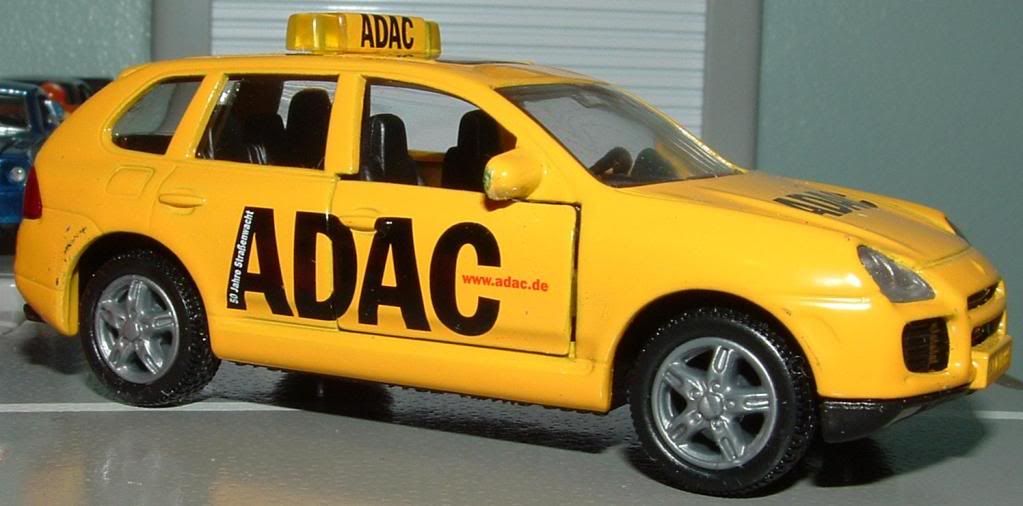
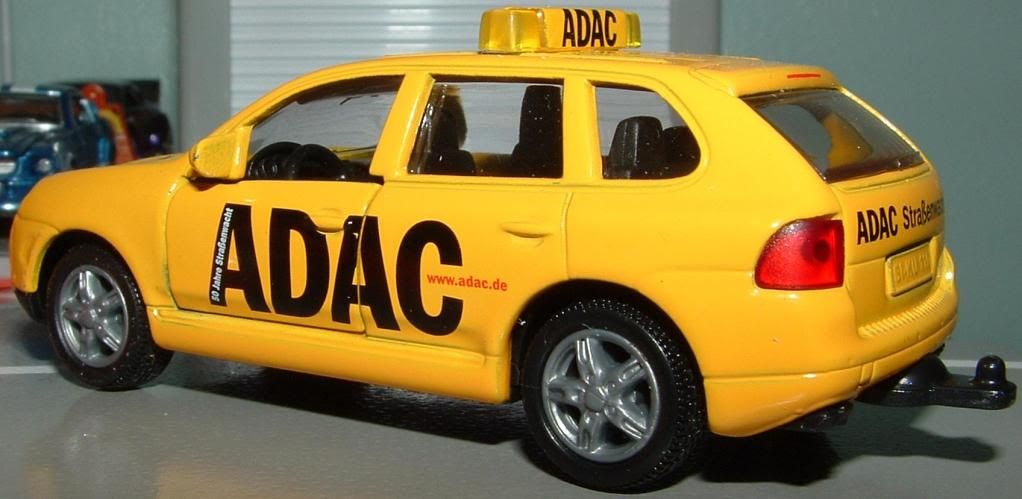
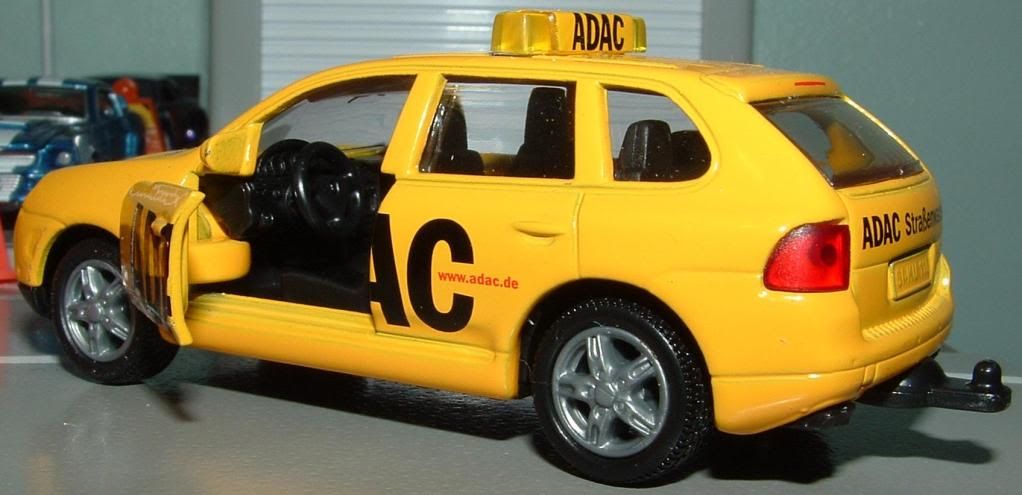
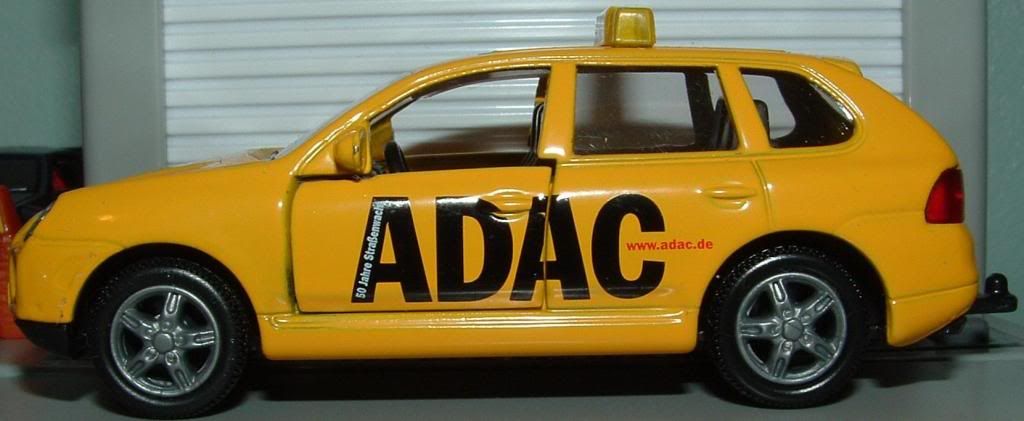
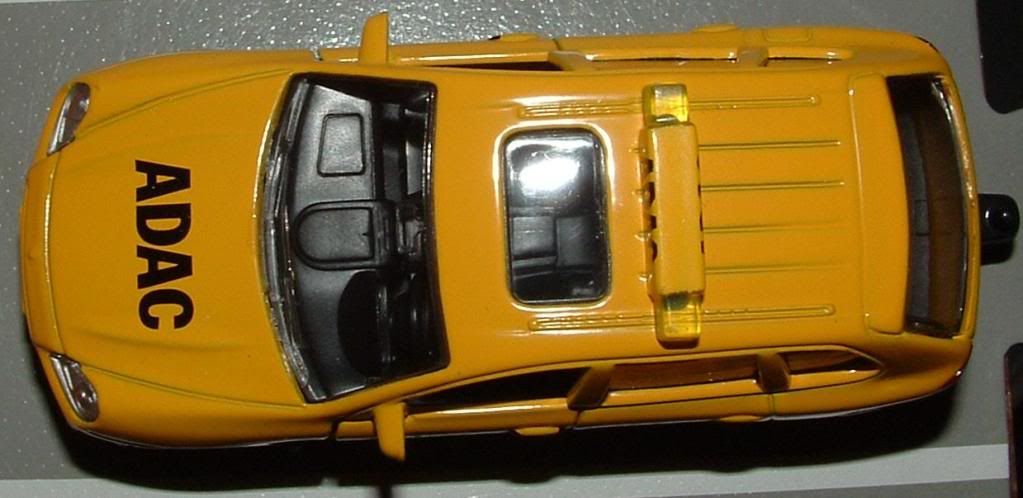
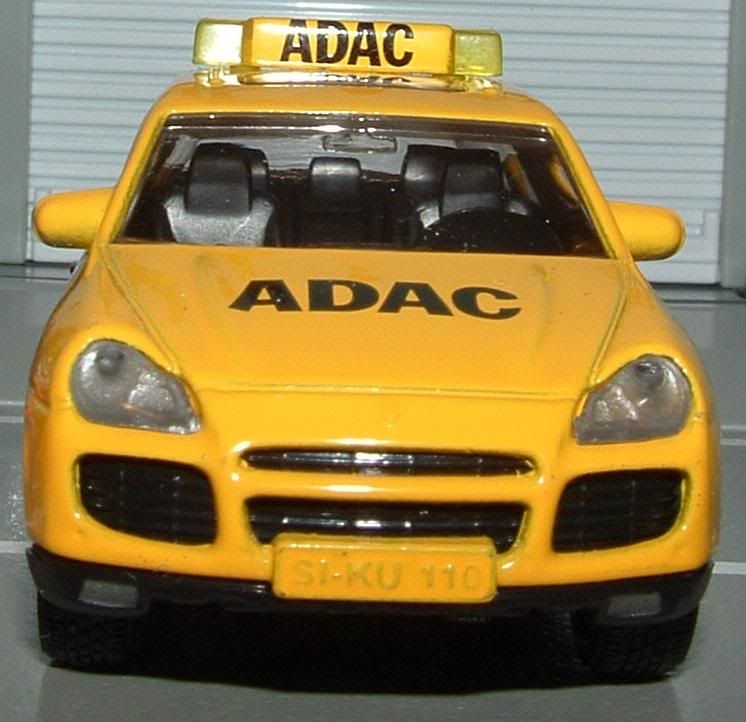
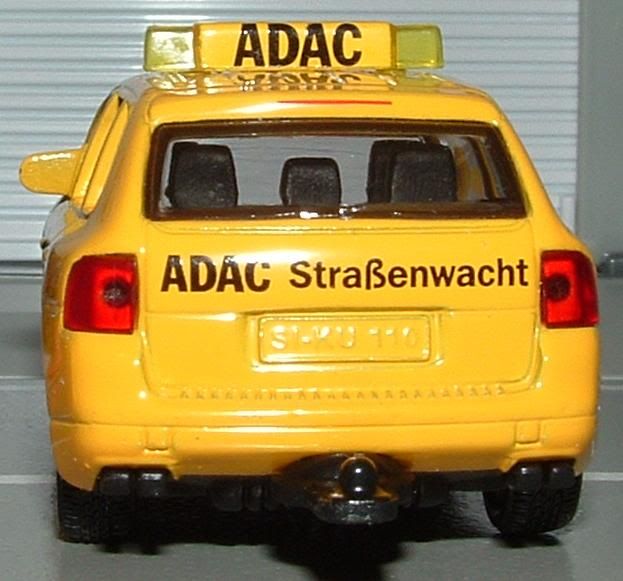
Today's car of the day is Siku's 2003 Porsche Cayenne Turbo.


The Porsche Cayenne is a five seat mid-size luxury crossover manufactured by the German manufacturer Porsche since 2002, with North American sales beginning in 2003. Its platform was developed by Porsche and is shared with the Volkswagen Touareg and the Audi Q7. It is the first V8-engined vehicle built by Porsche since 1995, when the Porsche 928 was discontinued. Since 2008, all engines have featured direct injection technology. The Cayenne's chassis type numbers are as follows: Type 955 (2002–2006), Type 957 (2007–2010), and Type 958 (2011+).

The third-generation Cayenne (Type 958) was unveiled at the 2010 Geneva Motor Show in March following an online reveal on February 25, 2010.


For more information and pictures of the real car please visit: Porsche Cayenne


Porsche, one a name that meant great sports cars, came out with this....thing.... in 2002.  Now they had a luxury sedan also.  And let's not forget that failed hostile takeover of Volkswagen that resulted in Volkswagen buying Porsche instead.  Everything that's wrong with Porsche started with this model right here.  The problem is, these things sell like hotcakes.  So do the Panamera sedans.  There's no accounting for taste...


The Cayenne's frame and doors are sourced from Volkswagen, who uses the frames and doors for the Volkswagen Touareg model. All other aspects of vehicle design, tuning, production are done in house at Porsche.


The Porsche Cayenne entered the market with mixed anticipation. However, the Porsche Cayenne soon proved that it was the performance vehicle among SUV's and was praised for its excellent handling and powerful engines. The lineup initially consisted of the V8-powered Cayenne S and Cayenne Turbo. Later in the model cycle, VR6 and diesel-powered versions joined the lineup.

The 1st generation Cayenne Turbo had 450 horsepower (340 kW), and accelerated from 0 to 60 mph (97 km/h) in 5.3 seconds. A Turbo S version was built in 2006 to compete with the Mercedes-Benz ML63 AMG. The Cayenne Turbo S included a low-range case, a locking differential, and the height-adjustable, off-road suspension also standard on the regular Turbo model. It was powered by a twin-turbocharged 4.5-liter V8 that produced 520 bhp (390 kW) and 700 N·m (520 lb·ft) of torque. Acceleration from 0–60 mph (96 km/h) was 5.0 seconds and the top speed was 171 miles per hour. It featured a 6-speed automatic Tiptronic transmission.

A new Turbo was revealed at the 2008 Beijing auto show. It received 50 hp (37 kW) more power, and now accelerated from 0–60 mph (96 km/h) in 4.9 seconds. Also revealed with the new Turbo was a new 550 horsepower (410 kW) Turbo S. Acceleration from 0–60 mph is 4.7 seconds and has optional ceramic composite brakes.

Saturday, September 17, 2011

Minivan of The Day: September 16, 2011 (Belated)


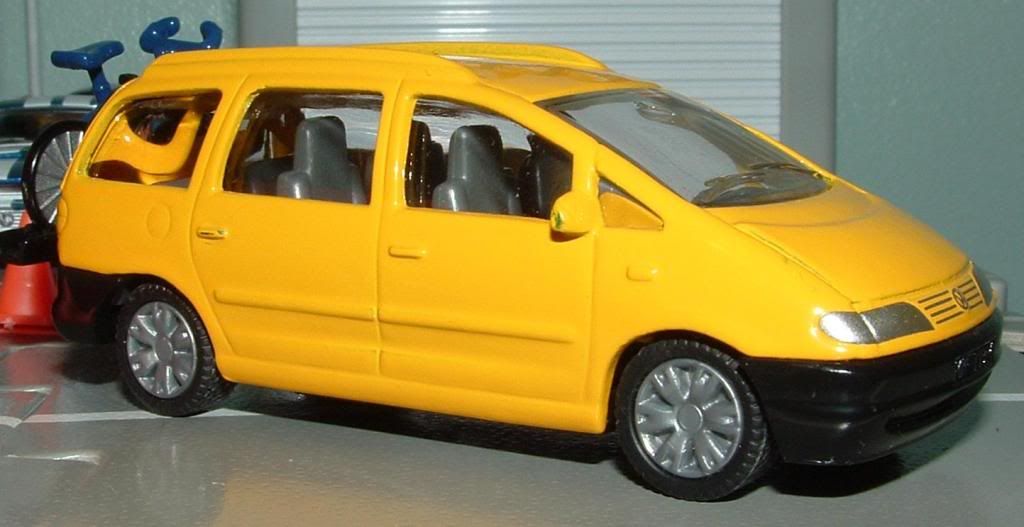
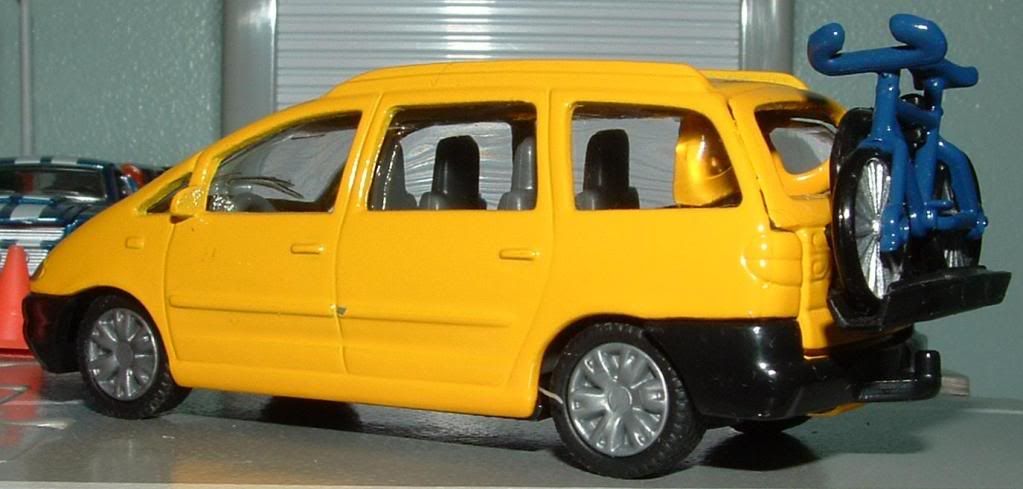
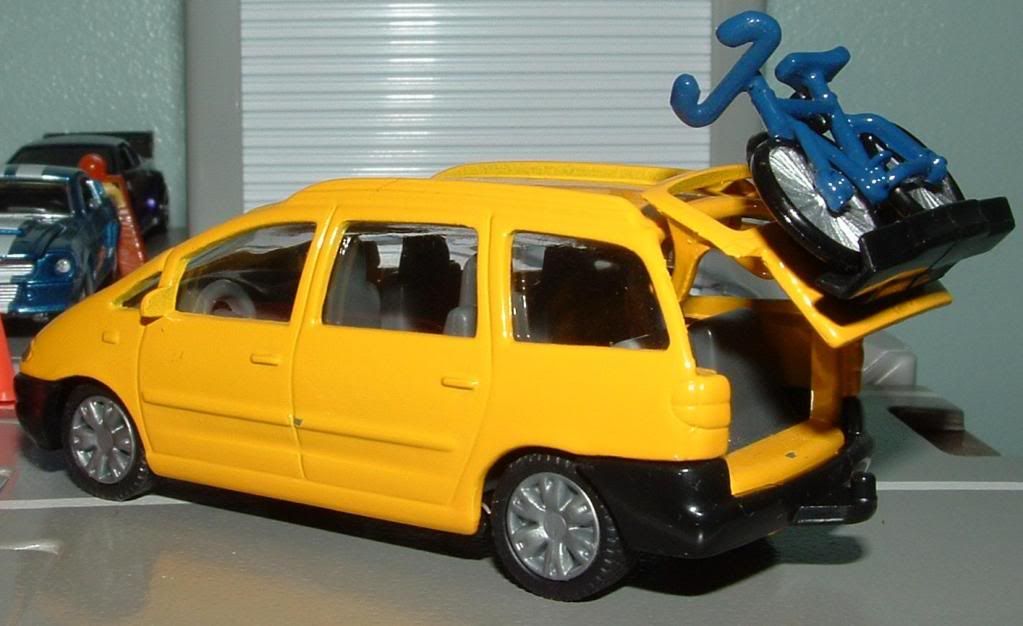
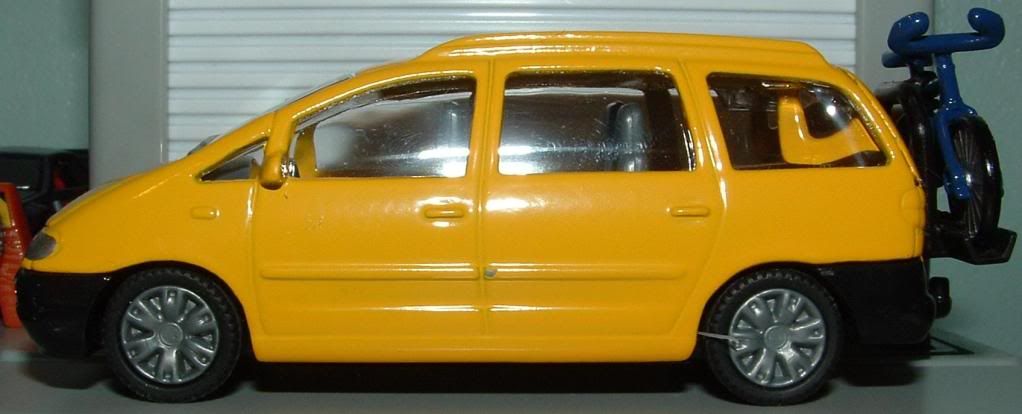
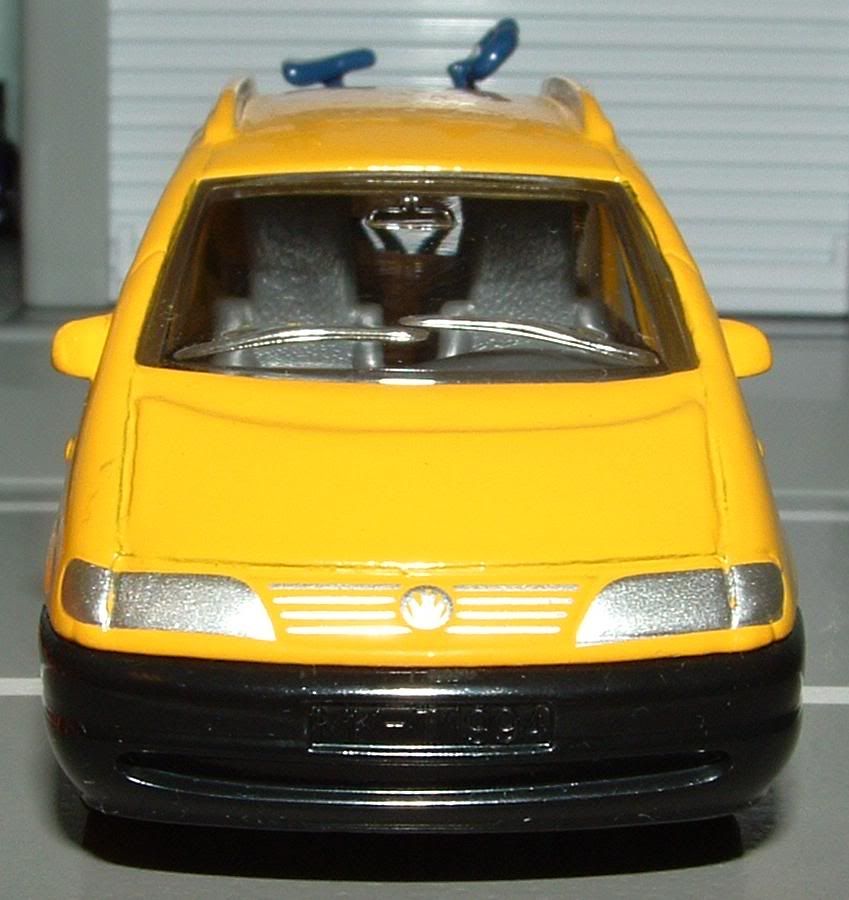
Today's car of the day is Siku's 1995 Volkswagen Sharan.


The Volkswagen Sharan is a large MPV produced by the German automaker Volkswagen since 1995.


For more information and pictures of the real car please visit: Volkswagen Sharan


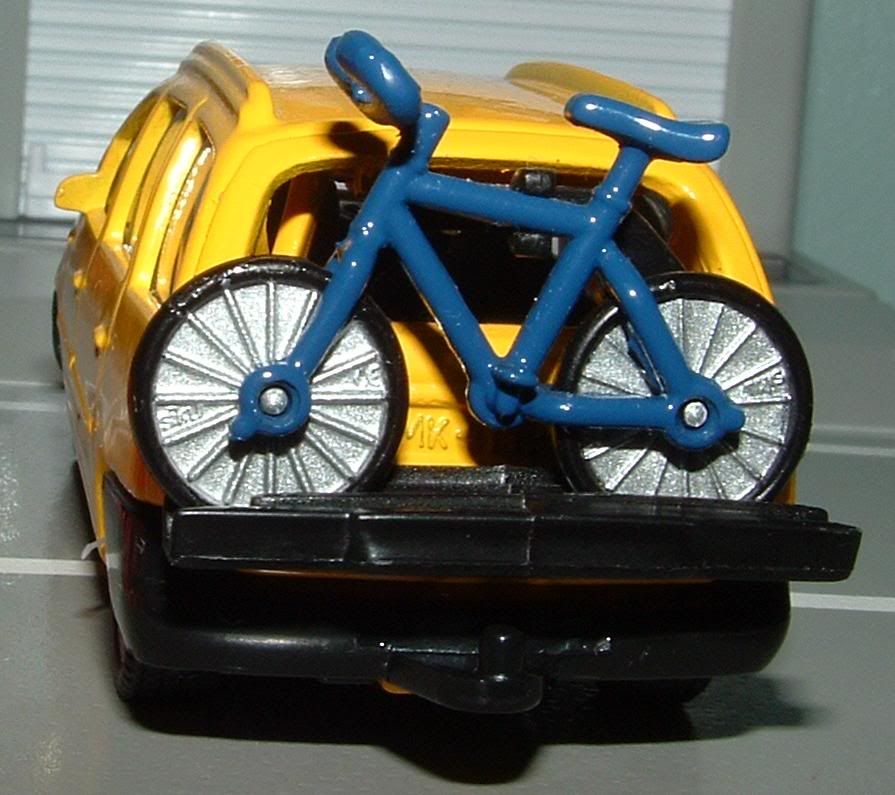
Another recent purchase from pjedsel (thanks John!), this one sports a cool bicycle hanging from a rack on the hatch.


The name Sharan is derived from a Persian word meaning "Carrier of Kings". The Volkswagen Group subsequently rebadged the Sharan in 1996, and sold it as the SEAT Alhambra alongside the Sharan. All variants were produced at the joint venture plant AutoEuropa in Portugal, alongside the closely-related Ford Galaxy. Each of the three MPV models had its own subtle differences in exterior, and, for the Galaxy, in interior design. The first generation's initial design was completed under Greg M Greeson, an American designer employed in Volkswagen's Advanced Design Studio in Duesseldorf, Germany from 1989-1990.

As of 2007, the annual production for the Sharan is in the 50,000 unit range; it is sold in Europe, South Africa and some Asia-Pacific and Latin American countries. In Mexico it was available with the 1.8L Turbo 4 cil 150 hp (112 kW) with 5 speed Tiptronic automatic gearbox in Comfortline trim only, while in Argentina it is available with the 1.8L Turbo and the 1.9L TDI 115 hp 4-cylinder engines, in both 5-speed manual and 5-speed Tiptronic transmissions in Trendline trim only.

In total VW almost sold 670.000 units of its Sharan over 15 years of time. The Sharan is not sold in the United States and Canada. Originally this was due to an agreement between Ford and Volkswagen, leaving the market free from competition for Ford's Aerostar minivan. More recently, Volkswagen decided not to introduce the Sharan in North America, ceased developing the Microbus concept, and instead introduced a badge-engineered variant of the Chrysler minivans as the Routan. This was launched in 2009, and replaced the Sharan in Mexico, the only North American country in which it was sold.


Oddly enough, Volkswagen would rather sell a rebadged Dodge Caravan in the USA than bring the current generation Sharan stateside.