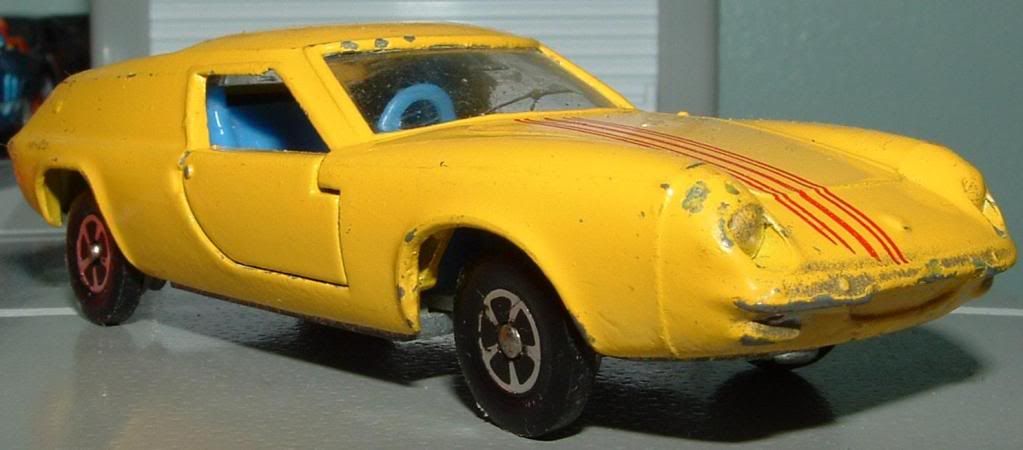
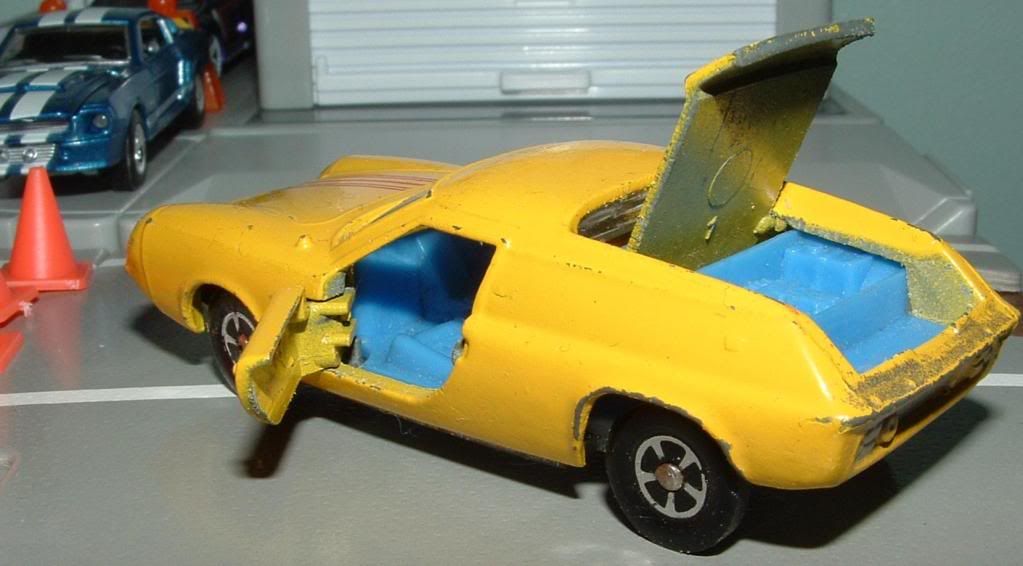
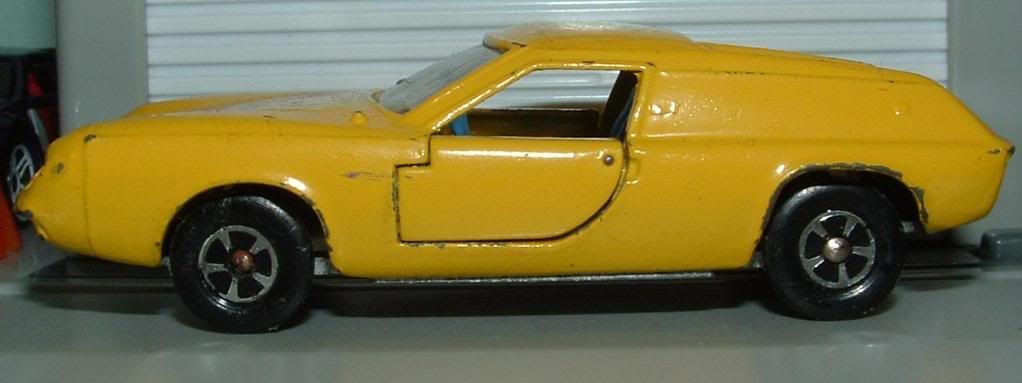
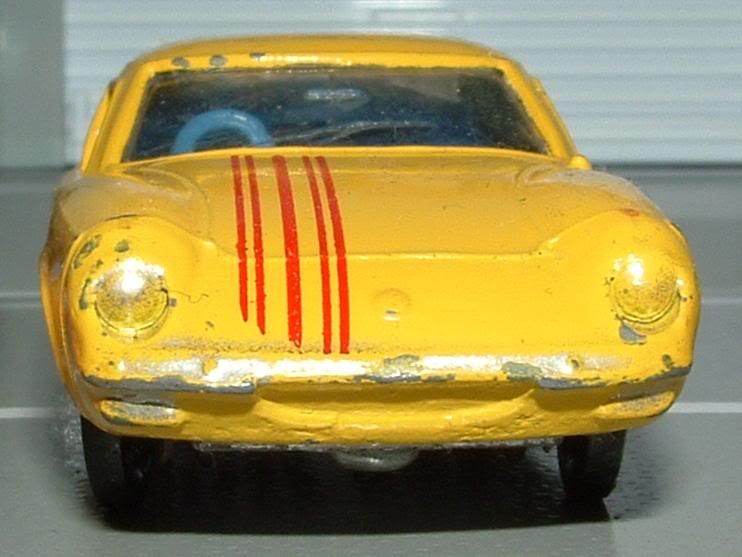
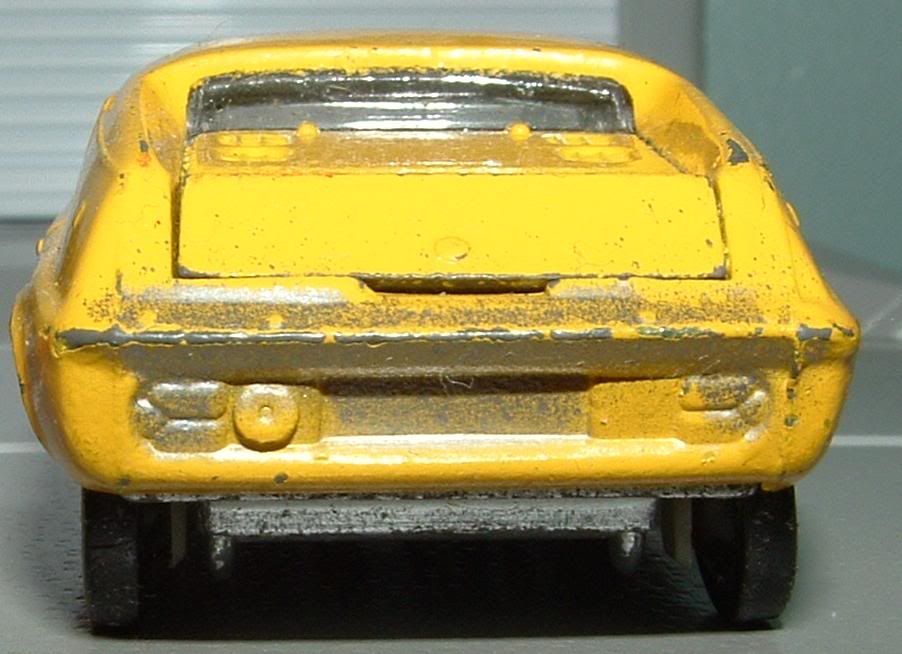
Today's car of the day comes from juantoo3's collection and is Impy Lone Star Road Master Flyers Super Cars' 1966 Alfa Romeo Spider.

The Alfa Romeo Spider (105/115 series) is a roadster produced by the Italian manufacturer Alfa Romeo from 1966 to 1993 (190 Spiders were badged as 1994 Commemorative Editions for the North American market). Widely regarded as a design classic, it remained in production for almost three decades with only minor aesthetic and mechanical changes. The three first series were assembled by Pininfarina in Grugliasco and the fourth series in San Giorgio Canavese. The last Spider was produced in April 1993, it was also the last rear wheel drive Alfa Romeo produced before Alfa Romeo 8C Competizione was introduced. On May 23, 2012, Fiat announced it will be developing a new Spider for 2015 with Mazda based on the Mazda MX-5 platform.

For more information and pictures of the real car please visit: Alfa Romeo Spider

Impys (also known as Lone Stars or Road Masters) are lovely models from the 60s, a bit larger than regular wheel MBX and usually much better appointed, typically with jewelled headlights (this one has painted headlights), opening boot and bonnet (these are English cars, afterall!). This model has the later Speed Wheels, but finding an Alfa Spider with an intact windshield is something special, as the windshield was usually the first thing to go in playwear.

The first presentation of the car, as a prototype, was at the Turin Motor Show in 1961. However, the continuing success of existing models and the economic challenges facing Italy at the time meant that the first pre-launch production Spiders began to emerge from the Pininfarina production line only at the end of 1965.
Based on the Giulia 105 series chassis, the Spider was launched in the 36th Geneva Motor Show in March 1966. Unnamed at launch, the name "Duetto" was chosen in a write-in competition in Italy. The Italian firm of Pininfarina was responsible for the design of the body; in fact, the Duetto was the last project with which founder Battista "Pinin" Farina was personally associated. Franco Martinengo was the Design Director at Pininfarina at that time. Pininfarina were also responsible for the manufacture of the vehicle's monocoque construction (designed with the relatively new principles of crumple zones incorporated into the front and rear). The engine was a 1570 cc variant of the Alfa Romeo twin cam four cylinder engine, had dual Weber two-barrel side-draft carburetors, and produced 109 hp (81 kW). Sparsely fitted inside but including five speed manual transmission, disc brakes and independent front suspension, the price on launch in Italy was 2,195,000 lire. In the United States the car sold for $3,950 (compared to $3,991 for a Lotus Elan and $2,607 for an MGB.) In the United Kingdom the car's price was close to a Jaguar E-Type.
The original "Duetto" was in production from 1966–1967; replaced in late 1967 by the 1750 Spider Veloce, powered by a 118 hp (88 kW) 1779 cc engine. In Europe this was fitted with two twin carburettors, whereas models for the North American market (from MY 1969) had SPICA (Società Pompe Iniezione Cassani & Affini) mechanical fuel injection. Modifications were also made to the suspension, brakes, electrics and wheels and tires though the car looked effectively the same. Visible differences were limited to the rear-view mirror repositioned to the door, and different badging on the tail. During the production run, the front repeater lights were moved ahead of the wheelarches. The car's official title was 1750 Spider Veloce, the name "Duetto" being dropped from this point on.
A new Spider 1300 Junior, with a 1290 cc engine producing 89 hp (66 kW), was introduced in 1968. This lacked various features of the 1750, including the plastic headlamp fairings, the brake servo, hubcaps and opening quarterlight.
Due to its round (or long) tail, the Series 1 Spider is sometimes known by the nickname of "Osso di Seppia" - Italian for "cuttlefish bone". This particular car was the model featured in the 1967 movie The Graduate, driven by Ben, the character played by Dustin Hoffman.