A blog focusing on 1/64 diecast from such popular brands as Hot Wheels, Matchbox, Johnny Lightning, M2 Machines, GreenLight, Tomica, Yat Ming, Majorette, MotorMax, Siku, Corgi, Guisval, Playart, Ertl, Zylmex, Racing Champions, & many more. Swifty's Garage features a daily Car Of The Day and news updates from your favorite brands!
Friday, March 9, 2012
Minivan Of The Day: March 9, 2012
Today's car of the day is Pioneer's 1995 Toyota Previa.
The Toyota Previa, also known as the Toyota Estima in Japan and the Toyota Tarago in Australia, is an MPV or multi-purpose vehicle (known as a minivan in North America) produced by Toyota Motor Corporation since 1990. The name "Previa" comes from the Italian for "preview," as Toyota saw the first Previa as a vehicle that would preview technologies used in future minivans. Along with the Toyota Sienna, Previa is the largest minivan in toyota's range, located above the Wish.
For more information and pictures of the real car please visit: Toyota Previa
The Previa is one of the few minivans that stands out in a crowd. Along with the GM "Dustbuster" minivans it's hard to mistake a Previa for anything else. Unfortunately traditional boxy minivans (mostly Chryslers) continued to outsell them so we ended up with the Sienna here in the USA. Not the greatest replica out there, but there aren't exactly a lot of choices if you want this generation Previa in this scale. The trailer hitch is gigantic and the graphics are loud (wouldn't a camo paint scheme be more appropriate- I mean how is this blending in unless you're hunting Care Bears or My Little Ponies?). Which brings us to "Hunting Camp"... They'd never get away with that these days!
The first generation, introduced in 1990, had only one sliding side door for the rear passengers. It featured a unique mid-engined platform, where the inline four cylinder gasoline-powered engine was installed almost flat (at a 75-degree angle), beneath the front seats. Installing the engine in this configuration allowed moderately easy access to the spark plugs, which were located underneath a panel on the upper left-side of the vehicle, after removing the front passenger seat, the carpet, and an access panel. All engine-driven accessories, such as the alternator, power steering pump, air conditioning compressor, and radiator fan, are accessible from the front hood, driven off the front of the engine by an accessory driveshaft, and is known as the Supplemental Accessory Drive System, or "SADS." This allows for even front/rear weight distribution, which benefits ride quality and handling. However, it also prevents the installation of a larger engine, while the cost could not be relayed by sharing the platform with other vehicles.
The first generation Previa was 4,750 mm (187.0 in) long and 1,803 mm (71.0 in) wide. In Japan, two smaller versions, the Toyota Estima Lucida and Toyota Estima Emina, were produced, which were approximately 110 mm (4.3 in) narrower and 70 mm (2.8 in) shorter than the standard model. The reason for the difference between the smaller Emina and Lucida models is the vehicle tax system in Japan, which is based on the product of length and width of the car. The smaller variants fall in to a lower tax band. The Estima Emina and Estima Lucida were also available with a 2.2 litre diesel engine (3C-T and 3C-TE).
The first generation Previa was available in both rear- and all-wheel drive versions (called All-Trac) and powered by a 135 hp (101 kW) JIS (99 kW) 4-cylinder 2.4-litre fuel injection engine. Available with a 4-speed automatic or 5-speed manual gearbox, this Previa also seated seven or eight people, with three seating configurations offered (North America only received the seven passenger configurations, however). All configurations have a driver and front passenger seat forward, and a three-seat bench seat at the rear that splits and folds flat against the sides of the cabin. The 8-seat configuration contains a 2/1 split swiveling bench seat in the middle row, while the 7-seat configurations contain either two independently swiveling captain's chairs (referred to as "Quad Seating"), in the middle row or a two seat bench offset towards the driver's side. The third row is also better upholstered in the 7-seat version. It was available with either 4-wheel disc brakes or traditional front disc/rear drum brake setup, with Anti-Lock Brakes (ABS) as an option.
In the United States, the Previa was sold from 1991 through 1997. It was imported from Japan to compete with Chrysler Corporation's successful Dodge Caravan minivan, and its twins Chrysler Town and Country and Plymouth Voyager. The Previa quickly became a common vehicle in the US, despite its relatively high price and poor fuel economy mainly due to the popularity of Japanese vehicles in the United States at a time when domestic vehicles were perceived to be of inferior quality. The mid-engine design proved to have a special weakness – the inability to increase engine size, which proved a significant problem as American drivers were used to having more power; the Dodge/Plymouth/Chrysler models were sold with available V6 engines. Starting in 1994, Toyota solved this problem by offering a Roots-type supercharger with air-to-air intercooler, providing 6psi of boost (these models were called the "S/C"), bringing the engine power up to a competitive 160 hp (120 kW). Initially, the S/C engine was only available as an option on the LE in 1994 and all models in 1995. For 1996, the normally aspirated engine was discontinued, and the S/C became the standard engine on all trim levels. The United States version of the Previa was discontinued after the 1997 model year, replaced by the more traditionally designed, front-wheel-drive, U.S.-designed and -built, Camry-based Sienna. A few Americans have obtained the newer Previa model (and first generation Japan-spec Estimas), but the U.S. DOT and EPA restrictions against "grey-market" import vehicles are very stringent.
Thursday, March 8, 2012
Snow Plow Of The Day: March 8, 2012
Today's car of the day is Matchbox Real Working Rigs' 2009 Oshkosh P-Series Snow Plow.
Oshkosh Corporation (NYSE: OSK), formerly Oshkosh Truck, designs and builds specialty trucks and truck bodies and access equipment. Based in Oshkosh, Wisconsin, the company employs 12,300 people around the world. It is organized in four primary business groups: access equipment, defense, fire and emergency, and commercial.
For more information and pictures of the real car please visit: Oshkosh
Thankfully, we haven't needed the snow plows this winter in my neck of the woods. The temperature here is expected to be in the upper 60s with a chance of breaking into the 70s today. In March. In Pennsylvania. Our biggest snowfall? We got five inches on October 29th. It had melted by November 1st!
Founded in 1917 as the Wisconsin Duplex Auto Company, the company was created to build a severe-duty four-wheel-drive truck. After the first prototype was built, the company began to develop rapidly. This first four-wheel-drive truck, known today as "Old Betsy", is still owned by Oshkosh Corporation and housed in one of its assembly plants in Oshkosh. The vehicle still runs and is used frequently in demonstrations and parades.
Wednesday, March 7, 2012
Car Of The Day: March 7, 2012
Today's car of the day is Johnny Lightning's 1979 Ford Mustang Indy 500 pcae car.
The third-generation Mustang was produced by Ford Motor Company from 1979 to 1993. Built on Ford’s ubiquitous Fox platform, it evolved through a number of sub-models, trim levels, and drivetrain combinations during its production life. It underwent a multi-faceted update for 1987, and for a time seemed destined for replacement with a rebadged import before company executives were swayed by consumer opinions. Enthusiasts group the generation into two segments: the 1979-1986 cars, with their quad headlight arrangement, and the 1987-1993 cars, with their "no-grille" front fascia styling. Production ended with the introduction of the SN95 fourth-generation Mustang for the 1994 model year.
For more information and pictures of the real car please visit: Ford Mustang
Not one of Johnny Lightning's better efforts. When it was new, the 1979 Mustang was covered by almost every single diecast manufacturer in 1/64. Majorette, Tomica, and Siku were the only major exceptions (Majorette made up for it by doing the '86 SVO & the '90 convertible). The Johnny Lightning example here dates to 1996 and as hard as this is to believe, it's also the most recent casting of the 1979-1982 Mustang. Think about how many 1/64 Mustangs have come out from Hot Wheels alone in the last five years. The Foxbody has gotten some love from GreenLight and Hot Wheels both, but both were of the facelifted '87-'93 models. The problem with this one is that at the time Playing Mantis was still trying to be Topper. Which means they were distorting their cars in the way Topper did back in the late '60s and early '70s, but the effect just didn't look the same and was quickly dropped.
For 1979, the all new Mustang was based on the larger Fox platform, initially developed for the Ford Fairmont and Mercury Zephyr twins that debuted in 1978. The interior was completely restyled and could now more comfortably seat four, even with the smaller back seat. The new Mustang also had more trunk space and a bigger engine bay for better serviceability. Body styles included a coupe (notchback) and hatchback (fastback). The only trim level available over the base model was Ghia. There was also a Cobra option available (17,579 produced in 1979) that completed the lineup through 1981. Engine choices included the 88 hp (66 kW) 2.3 L Pinto I4, 109 hp (81 kW) 2.8 L Cologne V6 (made by Ford of Europe), and the 140 hp (104 kW) 302 cu in (4.9 L) Windsor V8. All were carried over from the Mustang II line. Supplies of the 2.8 L proved inadequate leading to it being replaced in late 1979 with Ford's 85 hp (63 kW) 3.3 L straight six. A new 132 hp (98 kW) 2.3 L turbo four-cylinder, debuted, which offered similar horsepower to the V8. Ford had high hopes this engine would usher in a new era in performance. The 2.3 and 2.3 Turbo and V8 models could also be optioned with the newly developed TRX handling suspension, which utilized Michelin 390 mm tires and specific metric wheels. The Mustang was again chosen as pace car for duties in the Indianapolis 500. Ford commemorated the honor with an "Indy 500" pace car edition. About 11,000 copies were produced in two-tone pewter and black with orange graphics. Available were the 2.3 L Turbo with mandatory four-speed manual transmission or the 302 cu in (4.95 L) V8 with either the manual or three-speed automatic transmission. The three actual Pace Cars were fitted with a T-roof by Cars & Concepts of Brighton, MI. The T-roof option would not become an available option until the 1981 model year. A T-top roof was optional.
Following the second oil crisis in 1979, the 302 cu in (4.9 L) was dropped in favor of a new 255 cu in (4.2 L) V8 due to its better fuel economy. It was the only V8 offered in 1980 and 1981. Basically a de-bored 302, the 4.2 L V8 had restrictive heads and managed to produce 120 hp (89 kW), the lowest power ever for a Mustang V8. Compounding the lack of power, the 4.2 L was mated only with the three-speed automatic transmission. This meant the 2.3 L Turbo 4 was the sole "performance" engine. However, the Turbo 4 was plagued with reliability issues from its release. Inadequate lubrication led to premature turbo failure and even some engines catching fire. It was listed as an option through 1981, but quietly dropped for 1982, although it was still available in Canada. This engine would return in the new-for-1983 Turbo GT. The "Traction-Lok" limited slip differential was available for the first time in 1981, with all engine combinations.
The beginning of a performance revival began in 1982 with the return of the 302 cu in (4.9 L) (called "High Output", or H.O., for the first time), last seen in 1979, and the GT trim level. Now producing 157 hp (117 kW), the re-engineered 302 consisted of new valves, a more aggressive cam (from a 1973 351W Torino application), a larger 2-barrel carburetor, as well as a better breathing intake and exhaust system. The 4.2 L, now in its final year and available only with an automatic, could be substituted in the place of the 302 resulting in a US$57 credit to the buyer. Trim levels were also revised to now included L (base), GL, GLX, and GT. The Cobra option was no longer available. The 3.8 L Essex V6 replaced the 3.3 L I6, as the 3.3 L engine had little demand and was dropped after 1982.
Tuesday, March 6, 2012
Car Of The Day: March 6, 2012
Today's car of the day is Poliguri's 1986 Mercedes-Benz 200.
W124 is the Mercedes-Benz internal chassis-designation for the 1985 to 1995 version of the Mercedes-Benz E-Class. The W124 models replaced the W123 models after 1985 and were superseded by the W210 E-Class after 1995.
For more information and pictures of the real car please visit: Mercedes-Benz 200
What I like best about this model is that represents the absolute lowest model available on this chassis/bodystyle. This one doesn't even have fuel injection. Most manufacturers would opt to do the biggest engine variant.
The W124 is a mid-sized vehicle platform. Due to the high cost of German engineering and build quality, the W124 was designed to last many miles, with awards actually given and worn by high mileage versions.
Front suspension uses a separate spring and damper with a rubber top mount. The rear suspension of the W124 features the Mercedes multi-link axle introduced in 1982 with the Mercedes 190 and which is now standard on many modern cars. Estate cars (and optionally, saloons and coupes) had Citroen-like self-leveling rear suspension with suspension struts rather than shock absorbers, gas-filled suspension spheres to provide damping and an under bonnet pressurizing pump. Unlike the traditional Citroën application Mercedes opted for a fixed ride height and employed rear coil springs to maintain the static ride height when parked.
The R129 was based on the W124 platform, in return W124 was equipped in one of the roadster's engines, in its 500E version.
Much of the 124's engineering and many of its features were advanced automotive technology at its introduction, incorporating innovations that have been adopted throughout the industry. It had one of the lowest coefficient of drag (Cd) of any vehicle of the time (0.28 for the 200/200D model for the European market with 185/65 R15 tires) due to its aerodynamic body, that included plastic molding for the undercarriage to streamline airflow beneath the car, reducing fuel consumption and wind noise. It had a single windscreen wiper that had an eccentric mechanism at its base that extended the wiper's reach to the top corners of the windscreen (more than if it had traveled in a simple arc). The saloon/sedan, coupés and convertibles had optional rear headrests that would fold down remotely to improve rearward visibility when required. This feature was not available for the T-model because of its specific layout (no space to store the retractable headrests), but the station-wagon serially came with a "neighbour-friendly" rear door that was pulled in the shut-position silently and automatically by a sensor-controlled servomotor. With the exception of the 200, which was equipped with a Stromberg or Pierburg carburetor but was not available to the United States, fuel injection was standard, and the engines incorporated features that maximised performance. The most notable such feature was the addition of an oxygen sensor in the exhaust system which, in conjunction with a semi-electronic fuel injection system, could make the engine run more efficiently. This improved fuel consumption while simultaneously meeting stricter emission regulations. Mercedes-Benz's four-wheel drive system, the 4Matic was first introduced on the W124 in 1986.
The estate cars (chassis designation S124) came in 5- or 7-seat models, the 7-seater having a rear-facing bench seat that folded flush luggage compartment cover and an optional (in the US until 1994) retractable cargo net. In the US 7-seat models were standard, 5-seat models were not available. The S124 estate continued in production alongside the new W210 until the S210 estate launched more than a year later. A two-door coupe version was also built, with the chassis designation C124.
Mercedes launched a cabriolet (convertible) version in Europe in 1991, the 300 CE 24V, and in the UK (RHD) and Japan (LHD), the 320CE, and North America, the 300CE, in 1992. These versions were re-designated as the E320 in 1993, complemented by the less powerful, but less expensive E220 in 1993, and the mainland-Europe-only E 200 in 1994. Mercedes brought the E320 cabriolet (convertible) to the USA and Japan from 1993 to 1995. There were 68 E36 AMG cabriolets built from 1993 until 1996 (54 LHD and 14 RHD) and even fewer 300CE 3.4 AMG from 1992 until 1993 to complement the also rare E36 AMG coupe, saloon (RHD only) and estate. The E320, E220, and E200 cabriolets ceased production in 1997.
SsangYong Motor Company of Korea licensed the W124 design and continues to produce a stretched version of the W124 as the Chairman, with a Ssangyong badge. It has a 2.9 m (110 in) wheelbase and 3.2 L Mercedes straight-6 M104 engine. Chairman currently has 2.3 L (M111), 2.8 L (M104), and 3.2 L (M104) engines in its product line-ups. SsangYong Chairman has developed a 3.6 L version of M104 engine recently for its high-end Chairman line up. The engine is called XGi360.
Monday, March 5, 2012
Truck Of The Day: March 5, 2012
Today's car of the day is Hot Wheels' 1983 Jeep Scrambler CJ-8.
The Willys CJ (later Jeep CJ) (or Civilian Jeep) is a public version of the famous Willys Military Jeep from World War II.
The first CJ prototype (the Willys CJ-2) was introduced in 1944 by Willys, and the same basic vehicle stayed in production through seven variants and three corporate parents until 1986.
A variant of the CJ is still in production today under license. The last CJs, the CJ-7 and CJ-8, were replaced in 1987 by the Jeep Wrangler.
Also available were two-wheel-drive variants, known as DJs.
For more information and pictures of the real car please visit: Jeep Scrambler
This is the recast of the original '80s Hot Wheels casting. It thrills me to see Hot Wheels recasting the cars of my childhood one at a time.
The Jeep CJ-8 was a long wheel-base version of the CJ-7, introduced in 1981. It featured a 103-inch (2,616 mm) wheelbase and a removable half-cab, creating a small pick-up style box instead of utilizing a separate pickup bed. Only 27,792 were built in the five years of production before being replaced by the similarly sized Comanche.
CJ-8s used the traditional transfer case and manual front-locking hubs to engage the four-wheel drive. Most had a four- or five-speed manual transmission, but a three-speed automatic transmission was an option.
Many CJ-8's were equipped with the "Scrambler" appearance package which included tape graphics and special wheels.
A full length steel hardtop CJ-8 was made for the Alaskan Postal Service, using right hand drive and automatic transmissions. Instead of the rear tailgate, the steel hardtop utilized a hinged barn door opening to the back. There were only 230 produced and sold in the U.S. It was also widely sold in Venezuela and Australia as the CJ8 Overlander, with small differences including full length rear windows on the Overlander. Steel hardtops used on these postal Scramblers and Overlanders were known as "World Cab" tops.
Sunday, March 4, 2012
STSST Of The Day: March 4, 2012
Today's car of the day is Ertl's 1980 Shirt Tales SuperSonic Transport.
Shirt Tales are characters that were created in 1980 by greeting card designer Janet Elizabeth Manco and were featured on Hallmark Cards greeting cards. The characters were adapted into an animated series for TV by Hanna-Barbera, which first aired in 1982 on NBC.
Hallmark Cards released the Shirt Tale line of greeting cards with animal characters wearing T-shirts upon which was a message. The Shirt Tale cards were among Hallmark's best sellers at that time, which led the company to team with Hanna-Barbera Productions to adapt the Shirt Tales into a Saturday morning cartoon, which premiered on NBC on September 18, 1982. The card line remained, but faded shortly after the show left broadcast television in 1985.
For more information and pictures of the real car please visit: Shirt Tales & Shirt Tales theme song
This is a cartoon I used to watch during my childhood in the 1980s. If anyone is still reading this I will be impressed. I will be even more impressed if anyone actually clicked the link and watched the theme song. Bear in mind the kangaroo is voiced by none other than Bart Simpson (Nancy Cartwright). Shirt Tales was part of an interesting phenomenon in the 1980s of characters created for greeting cards going on to cartoons, movies, and toylines. Hallmark had Shirt Tales and Rainbow Brite, while American Greetings had Strawberry Shortcake, Care Bears, Popples, and The Get Along Gang. As far as I know, Shirt Tales was the only one of these properties to have 1/64 diecast released.
The animated Shirt Tales cartoon featured Tyg Tiger (in orange), Pammy Panda (in pink), Digger Mole (in light blue), Rick Raccoon (in red), and Bogey Orangutan (in green) (so called because he spoke using a Humphrey Bogart-style voice). They lived in Oak Tree Park and wore shirts which flashed various brightly lit messages reflecting the characters' thoughts. They spent their time teasing the park ranger, Mr. Dinkle, and battling crime in and out of their hometown of Mid City. They zipped around the world in a vehicle known as the STSST (Shirt Tales' SuperSonic Transport) which could operate as a car, jet, boat, submarine, and other forms of transportation. Though most law enforcement agencies knew of the Shirt Tales as crime fighters by reputation, few people seemed aware that they were talking animals—including, Mr. Dinkle, whom the group often had to trick to keep their secret safe.
Each episode was divided into two 11–minute segments. After the success of the 13 episodes in season one, ten episodes were created for season two. However, the show was semi-rebooted and Kip Kangaroo (in yellow) was added to the cast of characters without context for her joining the Shirt Tales. There is a difference in leadership among the Shirt Tales. In the first season Rick appeared to be the de facto leader. In the second season Tyg appeared to be the leader. Also several stories in season two either omit Rick altogether or give him a minor role in the story. The second season also added some superhero elements to the dynamic of the group as well; most notably the color of all their T-Shirts changing to a Bright Red Color when "Shirt Tale Time" is called for.
Buck Beaver (in whitish blue) helped the Shirt Tales use a tree as a bridge in "The Big Foot Incident" and helped them build an ark in "Dinkel's Ark". In the episode titles "Moving Time" 4 cousins out west were introduced for the episode only...Prairie Dog Pete (in red with black vest), Fillmore Fox (in green), Violett Skunk (in yellow), and Hoozitz Owl (in lavander). In "Back to Nature" Cubby Bear (in red) helped the Shirt Tales when a wild bear had Mr. Dinkle chased up a tree.
Following the initial run on NBC, Shirt Tales aired on CBS during the 1984-1985 Saturday morning season, replacing The Biskitts in their time slot. CBS aired selected episodes from its 2 season run on NBC until March 23, 1985, when The Biskitts were returned to the time slot for the rest of the 84-85 season.
On March 23, 1985, Shirt Tales was pulled from broadcast television for good ("Shirt Tales" was airing on CBS at the time), and the Hallmark franchise faded not long after as well. The show continued for a number of years as part of the USA Network's "Cartoon Express" and on Cartoon Network. Shirt Tales continues to be broadcast in selected countries around the world, including Boomerang.
Saturday, March 3, 2012
Monster Truck Of The Day: March 3, 2012
Today's car of the day is Racing Champions' 1956 Chevrolet Nomad monster truck.
The Chevrolet Nomad was a station wagon model made off and on from 1955 to 1972, and a Chevy Van trim package in the late 1970s and early 1980s, produced by the Chevrolet Division of General Motors. The Nomad is best remembered in its two-door 1955–57 form, and was considered a halo model during its three-year production as a two-door station wagon.
For more information and pictures of the real car please visit: Chevrolet Nomad
This monster truck may have had a Scooby Doo tie-in when new. I honestly forget, but the colors are vaguely reminiscent of the Mystery Machine.
The two-door Nomad differed from other station wagons of the era by having unique styling more reminiscent of a hardtop sedan than that of a standard station wagon. Chevrolet shared this body with its sister Pontiac, which marketed their version as the Pontiac Safari.
The Nomad's unique design had its roots in a General Motors Motorama show car of the same name that was based on the Corvette. The Concept was introduced at the GM Motorama in 1954 as one of Head Stylist Harley Earl's "dream cars".
GM approved production of the vehicle if the design could be transferred to its standard model, because top GM brass felt that they could sell more models if it were attached to the popular Bel Air model.
1955 Chevrolets received all-new styling. Advertised as "The Hot One," the boxy new Chevy was crisp, clean, and thoroughly modern-looking. Nomads, like Bel Airs, came loaded with interior carpet, chrome spears on front fenders, chrome window moldings, and full wheel covers. For 1955 Chevrolets gained a V8 engine option. The new 265 cubic inches (4,343 cc) cubic-inch V8 featured a modern, overhead valve high compression, short stroke design that was so good that it remained in production in various forms, for many decades. The base V8 had a two-barrel carburetor and was rated at 162 horsepower (121 kW), and the "Power Pack" option featured a four-barrel carburetor and other upgrades yielding 180 brake horsepower (130 kW). Later in the year, a "Super Power Pack" option added high-compression and a further 15 brake horsepower (11 kW). It had room for six passengers.
1956 Chevrolets received a face-lift. This gave Chevys a more conventional full-width grille, pleasing those customers who didn't like the Ferrari-inspired '55 front end. Nomads now carried the same interior and rear-wheel sheetmetal as other Bel Airs, lacking the original's unique trim. Shoulder harnesses, and a padded dashboard were now available. For 1956 Chevys hid the gas cap behind a left side, flip-down tail light.
1957 V-8 engine displacement grew to 283 cubic inches (4,638 cc) from 265 in 1957, with the "Super Turbo Fire V8" option producing 283 horsepower (211 kW) with the help of continuous fuel injection. These so-called "fuelie" cars are quite rare, since most Bel Airs were fitted with carburetion. While considered to be a milestone vehicle design, General Motors discontinued the original Nomad Sport Wagon at the end of the 1957 model year due to low sales and the introduction of a new body for 1958.
Friday, March 2, 2012
Car Of The Day: March 2, 2012
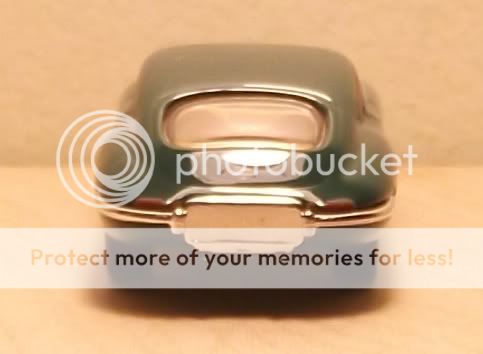
Today's car of the day comes from Firehawk73's collection and is GreenLight (High Speed)'s 1961 Jaguar E-Type.
The Jaguar E-Type (UK) or XK-E (US) is a British automobile, manufactured by Jaguar between 1961 and 1975. Its combination of good looks, high performance, and competitive pricing established the marque as an icon of 1960s motoring. More than 70,000 E-Types were sold during its lifespan.
In March 2008, the Jaguar E-Type ranked first in the Daily Telegraph's list of the "100 most beautiful cars" of all time. In 2004, Sports Car International magazine placed the E-Type at number one on their list of Top Sports Cars of the 1960s.
For more information and pictures of the real car please visit: Jaguar E-Type
The Series 1 was introduced, initially for export only, in March 1961. The domestic market launch came four months later in July 1961. The cars at this time used the triple SU carburetted 3.8 litre six-cylinder Jaguar XK6 engine from the XK150S. The first 300 cars built had flat floors and external hood (bonnet) latches. These cars are rare and more valuable. After that, the floors were dished to provide more leg room and the twin hood latches moved to inside the car. The 3.8-litre engine was increased to 4.2 litres in October 1964.
All E-Types featured independent coil spring rear suspension with torsion bar front ends, and four wheel disc brakes, in-board at the rear, all were power-assisted. Jaguar was one of the first vehicle manufacturers to equip cars with disc brakes as standard from the XK150 in 1958. The Series 1 can be recognised by glass-covered headlights (up to 1967), small "mouth" opening at the front, signal lights and tail-lights above bumpers and exhaust tips under the number plate in the rear.
3.8-litre cars have leather-upholstered bucket seats, an aluminium-trimmed centre instrument panel and console (changed to vinyl and leather in 1963), and a Moss four-speed gearbox that lacks synchromesh for first gear ("Moss box"). 4.2-litre cars have more comfortable seats, improved brakes and electrical systems, and an all-synchromesh four-speed gearbox. 4.2-litre cars also have a badge on the boot proclaiming "Jaguar 4.2 Litre E-Type" (3.8 cars have a simple "Jaguar" badge). Optional extras included chrome spoked wheels and a detachable hard top for the OTS.
A 2+2 version of the coupé was added in 1966. The 2+2 offered the option of an automatic transmission. The body is 9 in (229 mm) longer and the roof angles are different with a more vertical windscreen. (this is an incorrect assumption, the S1 OTS, coupe and 2+2 had identical rake windshields). The roadster remained a strict two-seater.
Less widely known, right at the end of Series 1 production and prior to the transitional "Series 1½" referred to below, a very small number of Series 1 cars were produced with open headlights. Production dates on these machines vary but in right hand drive form production has been verified as late as March 1968. The low number of these cars produced make them amongst the rarest of all production E Types.
Following the Series 1 there was a transitional series of cars built in 1967–1968, unofficially called "Series 1½", which are externally similar to Series 1 cars. Due to American pressure the new features were open headlights, different switches, and some de-tuning (with a downgrade of twin Zenith-Stromberg carbs from the original triple SU carbs) for US models. Some Series 1½ cars also have twin cooling fans and adjustable seat backs. Series 2 features were gradually introduced into the Series 1, creating the unofficial Series 1½ cars, but always with the Series 1 body style.
An open 3.8-litre car, actually the first such production car to be completed, was tested by the British magazine The Motor in 1961 and had a top speed of 149.1 mph (240.0 km/h) and could accelerate from 0 to 60 mph (0 to 97 km/h) in 7.1 seconds. A fuel consumption of 21.3 miles per imperial gallon (13.3 L/100 km; 17.7 mpg-US) was recorded. The test car cost £2,097 including taxes.
Thursday, March 1, 2012
Car Of The Day: March 1, 2012
Today's car of the day is Majorette's 2009 Renault Mégane Coupé.
The Renault Mégane is a small family car produced by the French automaker Renault since 1995. It is offered in 3- and 5-door hatchback, saloon, coupé, convertible and estate bodystyles. The Renault Scénic (launched 1996) is the first modern compact MPV to be built in Europe, and is based on the Mégane floorpan.
For more information and pictures of the real car please visit: Renault Mégane Coupé
Newer Majorettes are still absent from the USA which is a shame. Hopefully they return soon!
The third generation of Mégane was launched in late 2008 to keep the range competitive with newer rivals. It however lacks the distinctive hatchback acquired during its second generation.
In September 2008, both the Renault Mégane Berline 5-door hatchback & Mégane Coupé were presented officially. The two models feature quite a different design, the Coupé having a very aggressive and sporty design while the 5-door model is more conservative. In this generation, no automatic transmission is offered, replaced by a continuously variable transmission. The Coupé can be considered as a shooting brake due to its coupé-like design.
The phase I version of Megane II was well known for reliability issues, especially with the engine management system. Renault has now spent much more time and mileage testing the new model which is therefore expected to have improved reliability.
The electric version of the Mégane saloon that Renault is building will come with a lifetime warranty, and payment will follow the model established by the mobile-phone industry. After buying the car, owners will subscribe to a battery-replacement and charging plan based on their anticipated mileage. Recharging will be done at one of 500,000 spots that Project Better Place will build and maintain.
Subscribe to:
Posts (Atom)