A blog focusing on 1/64 diecast from such popular brands as Hot Wheels, Matchbox, Johnny Lightning, M2 Machines, GreenLight, Tomica, Yat Ming, Majorette, MotorMax, Siku, Corgi, Guisval, Playart, Ertl, Zylmex, Racing Champions, & many more. Swifty's Garage features a daily Car Of The Day and news updates from your favorite brands!
Friday, August 12, 2011
Car Of The Day: August 11, 2011 (Belated)
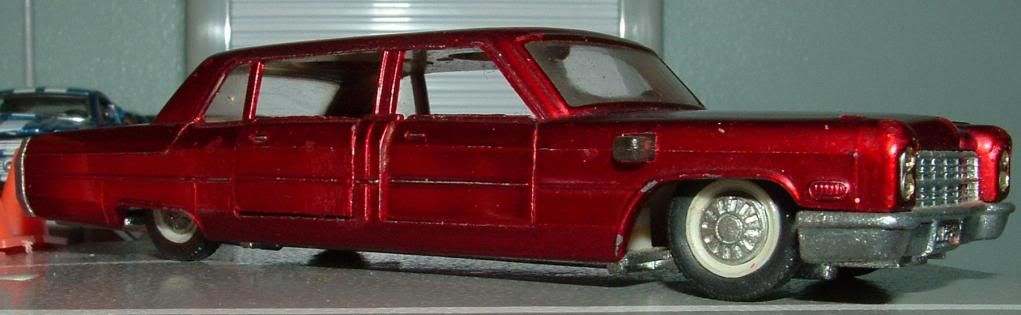
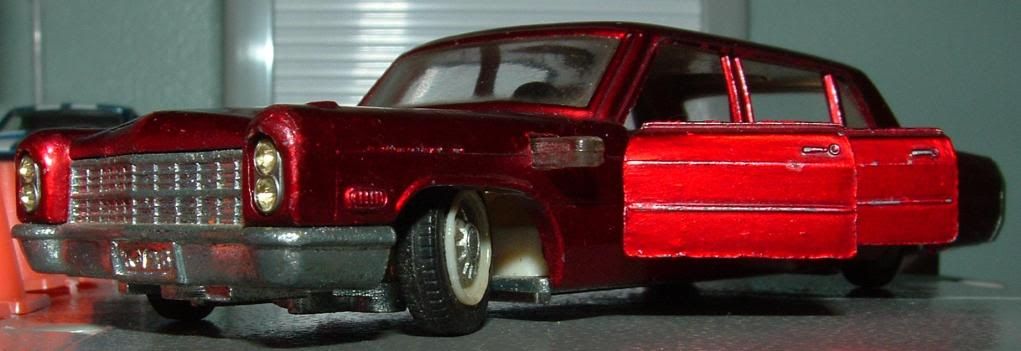
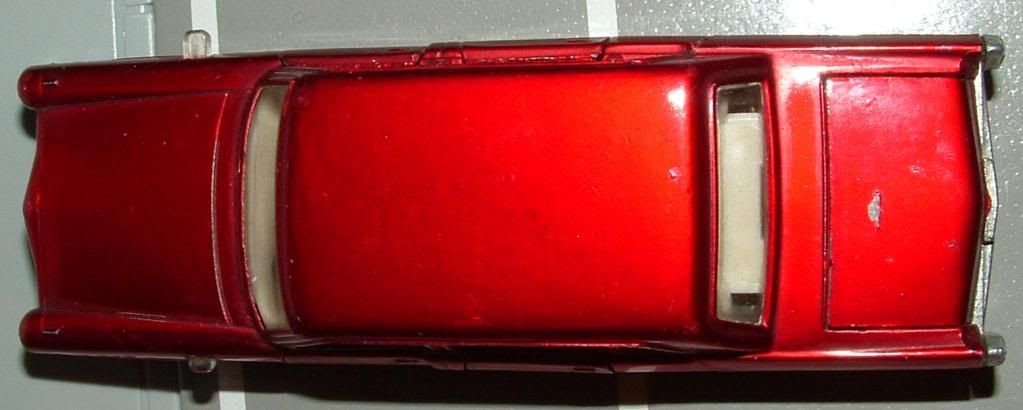
Today's car of the day is Siku's 1966 Cadillac Fleetwood 75.
The Cadillac Fleetwood was a full-size luxury vehicle manufactured by Cadillac in America from 1947 to 1996. The name Fleetwood was first used with the Series 60 Special Fleetwood nameplate. The car was designated as the flagship model when it was first introduced and continued in that position for a number of decades. Over its lifespan it always had an automatic transmission as standard and an option of multiple V8 and V6 engines were offered over the generations. It also came in a range different bodystyles including a coupé, convertible, sedan and a limousine was first offered in 1977 as an option.
For more information and pictures of the real car please visit: Cadillac Fleetwood 75
This is one massive piece of diecast. It's the standard 1/55 scale from Siku, and its a Cadillac limo. I wouldn't say the real car is massive... but I got into one in Philadelphia, walked all the way to the back, and got out in New York City. Four opening doors, an opening trunk, and jeweled lights complete the look. What a great model! The little nobs sticking out the sides of the front fenders actually steer the front wheels. This model has lots of play value! The flaws are there, however- the front fascia is not particularly accurate.
For 1965, the Eldorado and Sixty Special officially became part of the Fleetwood line along with the Seventy-Five. A new Fleetwood Brougham line was also added as an upscale Sixty Special. The Brougham featured footrests, writing tables (through 1967), special rear reading lamps, and a vinyl roof to distinguish it from the standard Sixty Special. A glass partition was also available to separate the front and rear passengers.
A little belated, hopefully the subject matter will make up for the lack of punctuality?
Wednesday, August 10, 2011
Car Of The Day: August 10, 2011
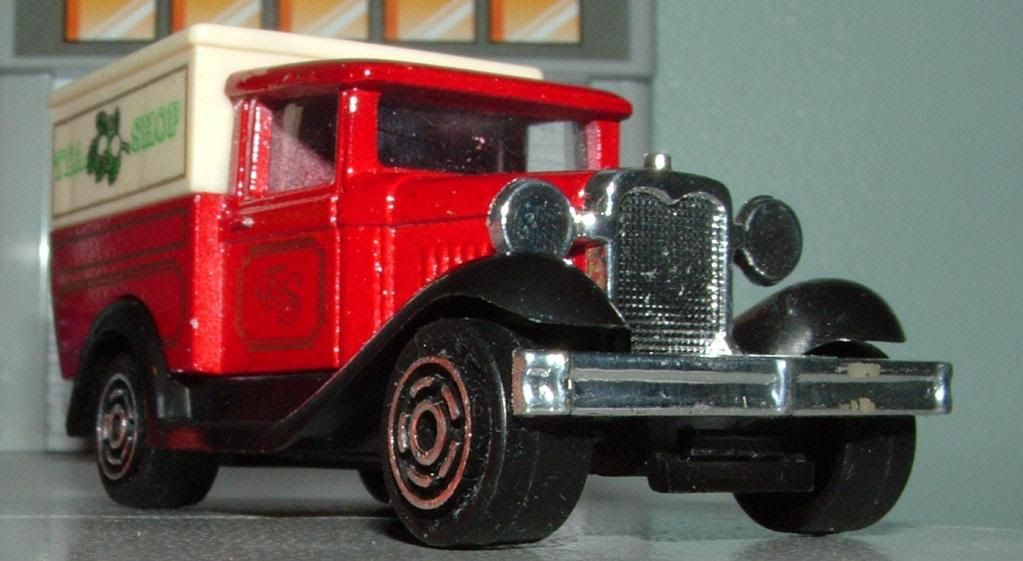
Today's car of the day is Majorette's 1929 Ford Model A.
The Ford Model A of 1927–1931 (also colloquially called the A-Model Ford or the A, and A-bone among rodders and customizers) was the second huge success for the Ford Motor Company, after its predecessor, the Model T. First produced on October 20, 1927, but not sold until December 2, it replaced the venerable Model T, which had been produced for 18 years. This new Model A (a previous model had used the name in 1903–1904) was designated as a 1927 model and was available in four standard colors, but not black.
By 4 February 1929, one million Model As had been sold, and by 24 July, two million. The range of body styles ran from the Tudor at US$500 (in grey, green, or black) to the Town Car with a dual cowl at US$1200. In March 1930, A sales hit three million, and there were nine body styles available.
The Model A was produced through 1931. When production ended in March, 1932, there were 4,849,340 Model As made in all styles. Its successor was the Model B, which featured an updated 4-cylinder engine, followed by the Model 18 which introduced Ford's new Flathead V8 engine.
For more information and pictures of the real car please visit: Ford Model A
I found this one recently... in my collection. I have no idea where it came from, how it ended up in my collection or even how long I've had it. But this one was a pleasant surprise to find, even if the casting itself is a 'me too!' response to the hot rodded Model A delivery done by Matchbox. The Majorette is more pleasing to my eyes.
Prices for the Model A ranged from US$385 for a roadster to $1400 for the top-of-the-line Town Car. The engine was a water-cooled L-head 4-cylinder with a displacement of 201 cu in (3.3 l). This engine provided 40 horsepower (30 kW). Typical fuel consumption was between 25 and 30 mpg (U.S.) (8 to 12 kilometres per litre or 8-9 L/100 km) using a Zenith one-barrel up-draft carburetor,with a top speed of around 65 mph (104 km/h). It had a 103.5 in (2,630 mm) wheelbase with a final drive ratio of 3.77:1. The transmission was a 3-speed sliding gear manual unit with a 1-speed reverse. The Model A had 4-wheel mechanical drum brakes. The 1930 and 1931 editions came with stainless steel radiator cowling and headlamp housings.
The Model A came in a wide variety of styles: Coupe (Standard and Deluxe), Business Coupe, Sport Coupe, Roadster Coupe (Standard and Deluxe), Convertible Cabriolet, Convertible Sedan, Phaeton (Standard and Deluxe), Tudor Sedan(Standard and Deluxe), Town Car, Fordor (2-window) (Standard and Deluxe), Fordor (3-window) (Standard and Deluxe), Victoria, Station Wagon, Taxicab, Truck, and Commercial.
The Model A was the first Ford to use the standard set of driver controls with conventional clutch and brake pedals; throttle and gearshift. Previous Ford models used controls that had become uncommon to drivers of other makes. The Model A's fuel tank was located in the cowl, between the engine compartment's fire wall and the dash panel. It had a visual fuel gauge, and the fuel flowed to the carburetor by gravity. In cooler climates, owners could purchase an aftermarket cast iron unit to place over the exhaust manifold to provide heat to the cab. A small door provided adjustment of the amount of hot air entering the cab. Model A was the first car to have safety glass in the windshield.
The Soviet company GAZ, which started as a cooperation between Ford and the Soviet Union, made a licensed version of the Model A from 1932-1936. This itself was the basis for the FAI and BA-20 armored car, which saw use as scout vehicles in the early stages of World War II.
In addition to the United States, Ford made the Model A in plants in Argentina, Canada, France, Germany and the United Kingdom.
In Europe, where cars were taxed according to engine size, Ford equipped the Ford Model A with a 2,033 cc motor providing a claimed output of just 40 hp. However, the engine size was still large enough to equate to a fiscal horsepower rating of 24 hp and attracted a punitive annual car tax levy of £24 in the UK and similar penalties in other principal European markets, leaving the car unable to compete in the newly developing mass market. It therefore was expensive to own and too heavy and thirsty to achieve volume sales, but also too crude to compete as a luxury product. European manufactured Model As failed to achieve the sales success in Europe that would greet their smaller successor on the assembly lines in England and Germany.
Tuesday, August 9, 2011
Car Of The Day: August 9, 2011
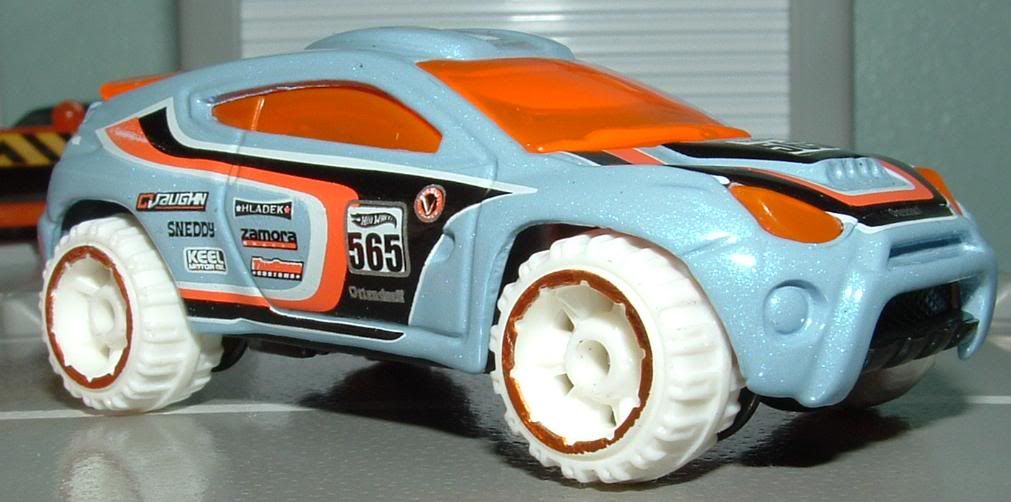
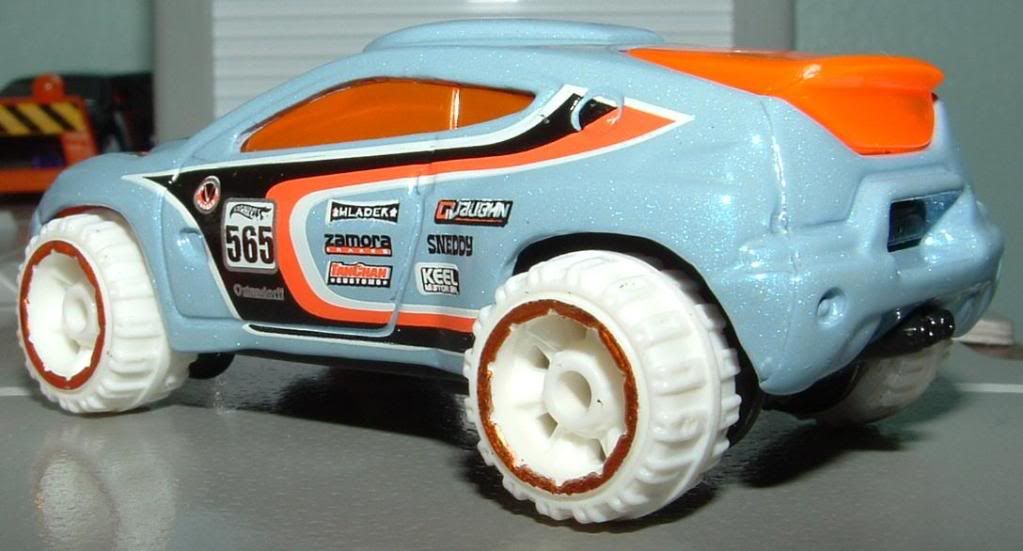
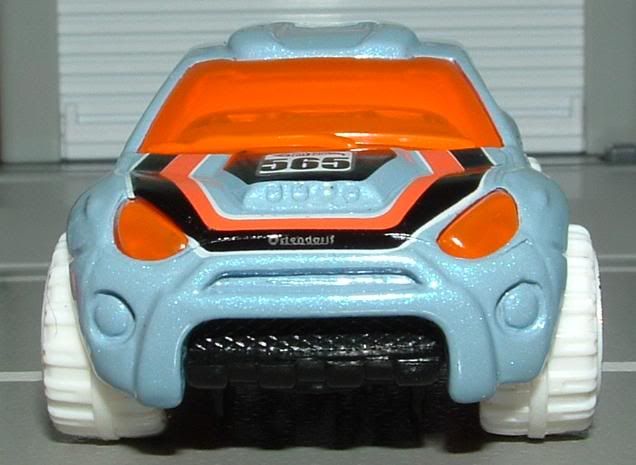
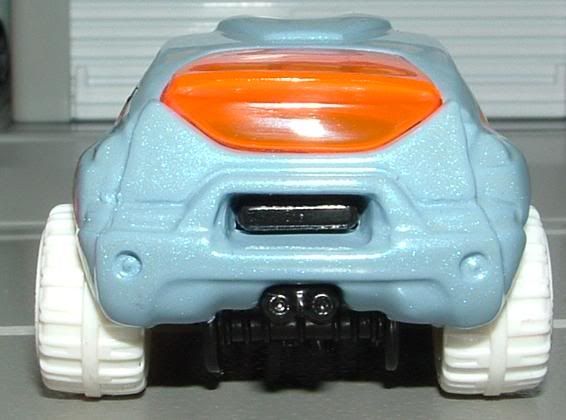
Today's car of the day is Hot Wheels' 2001 Toyota RSC concept car.
The Toyota RSC ("Rugged Sport Coupe") was a Toyota 2-door SUV concept car that was first shown at the February 2001 Chicago Auto Show.
The RSC was designed by Calty as a 'pure concept vehicle', with no intention to go into production but to 'connect emotionally with young buyers'. Design cues came from rally cars used in the World Rally Championships, with functional lines, a lack of luxury features and 'designed to convey the sparse, functional simplicity of a race car'. The RSC was based on the RAV4.
The RSC was never made into a production vehicle.
For more information and pictures of the real car please visit: Toyota RSC
Toyota apparently thought the idea of a 4x4 sports car was interesting, but not economically viable. Oddly enough, Matchbox plans on introducing a generic 4x4 sports car to their line for 2012. It was a bad idea for Toyota and it will be a bad idea for Matchbox too...
Where do I begin on this one? The atomic orange glass? I'll let Ivan tear that part to shreds. The white tires? No, this isn't a White Lightning wannabe, but instead this is supposed to be an ice racer. Apparently racing on ice turns your tires completely white, including the rims! It's not even a great casting- it seems the taillights are completely missing.
Sunday, August 7, 2011
Truck of the Day:August 8, 2011
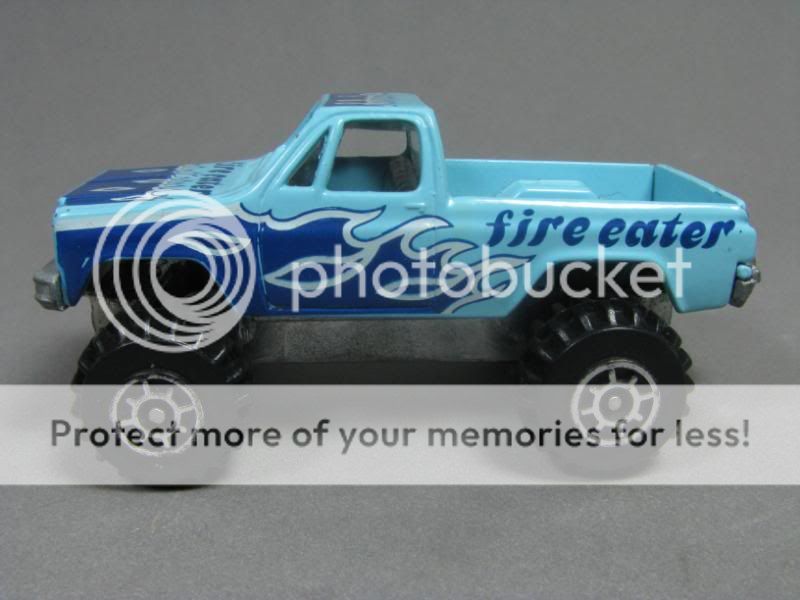
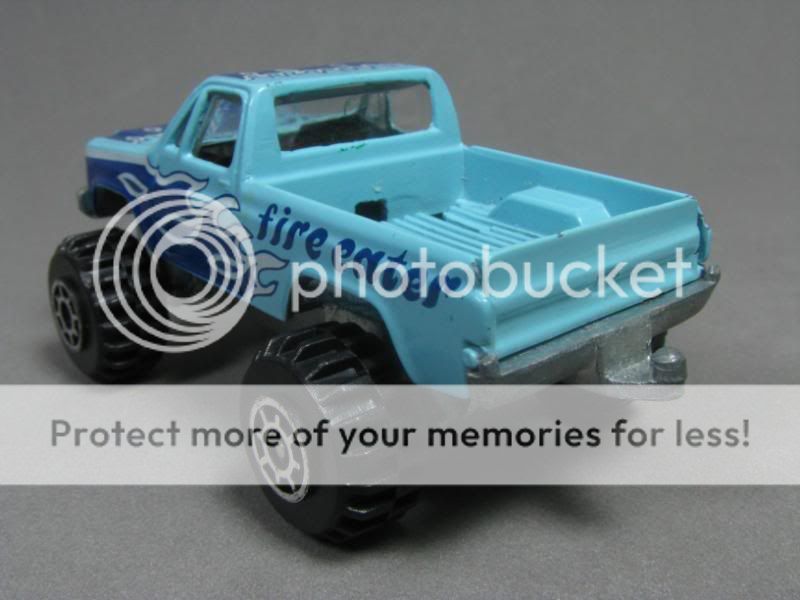
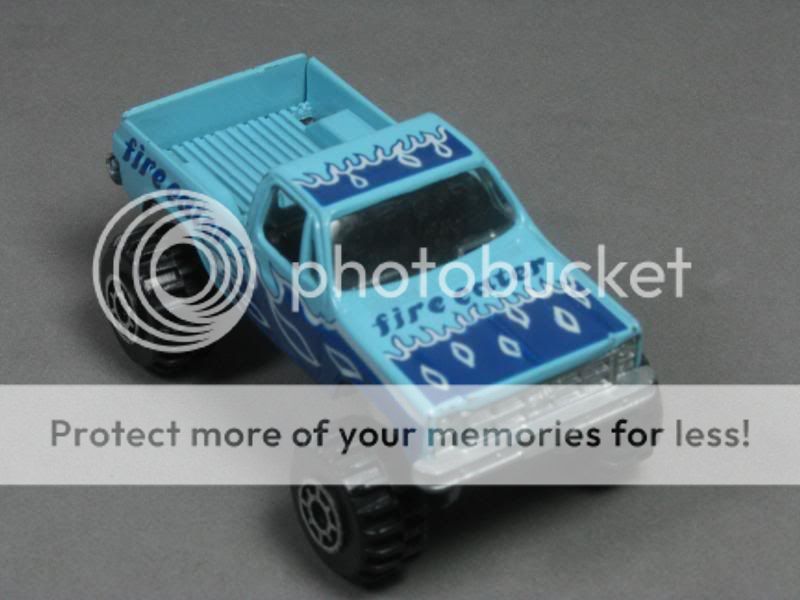
The truck for today is Road Champ's 1980 GMC C/K.
The C/K is the name for Chevrolet and GMC's full-size pickup truck line from 1960 until 1999 in the United States.
An all-new clean sheet redesign of General Motor’s (GM) Chevrolet and GMC brand C/K-Series pickups débuted in 1972 for the 1973 model year. Development of the new third generation trucks began in 1968, four years prior to production in 1972, with vehicle components undergoing simulated testing on computers, before the first prototype pickups were even built for real world testing.[1] The redesign was revolutionary in appearance at the time, particularly the cab, departing from typical American pickup truck designs of the era. As a result, the third generation quickly became known as the "rounded-line" generation; although some people refer to them as "square bodys", given that the trucks appear square-like by more modern standards.
Third generation rounded-line C/K-Series pickups gained an all-new, high tensile strength carbon steel ladder type frame with "drop center" design.[5][9][10] Driver control systems included hydraulic variable power assisted steering and hydraulic Hydro-Boost 4-wheel power assisted brakes, which consisted of front self adjusting disc brakes and rear finned drum brakes.[1] Engines choices initially consisted of six or eight cylinder engines with either manual or Turbo Hydra-Matic transmissions.
C-Series pickups included standard two-wheel drive with an independent front suspension (IFS) featuring contoured lower control arms to improve durability and ride comfort. The standard rear live axle came with leaf springs in addition to staggered shock absorber placement to help reduce the wheel hop during hard acceleration.
Some 1980 models had a new grille, others did not; high-trim Chevys had both a new surround that incorporated near-flush square headlights and revised turn signals with a new, squarer grille pattern, while a GMC base model was entirely carryover, base Chevys had the new center section in the 1979 surround while GMCs with uplevel trims or the separate RPO V22 option had the new square-light surround with the main grille introduced in 1977. Blue interiors were a darker shade than before, and cloth-upholstered deluxe models had a new seat fabric.
To learn more, visit http://en.wikipedia.org/wiki/GMC_C/K
This is an old survivor from my childhood collection. I also have a purple version of the same casting as well as a yellow construction GMC too. Pretty sure the blue one shown with flames had a bed camper top but I removed that as a kid. Really like this model for the same reasons I loved it as a kid. With oversized tires, 4x4 stance, metal base and working suspension it's a winner then as well as now.
Saturday, August 6, 2011
SUV of the Day: August 7, 2011
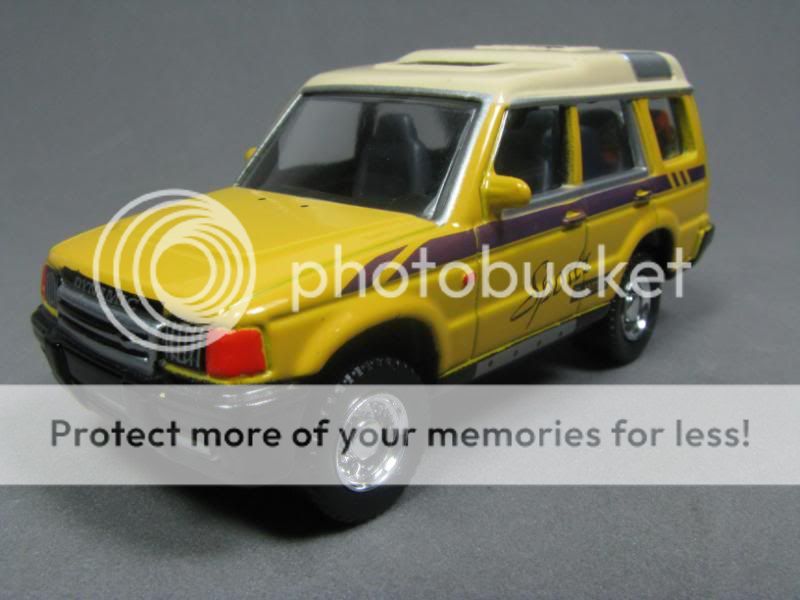
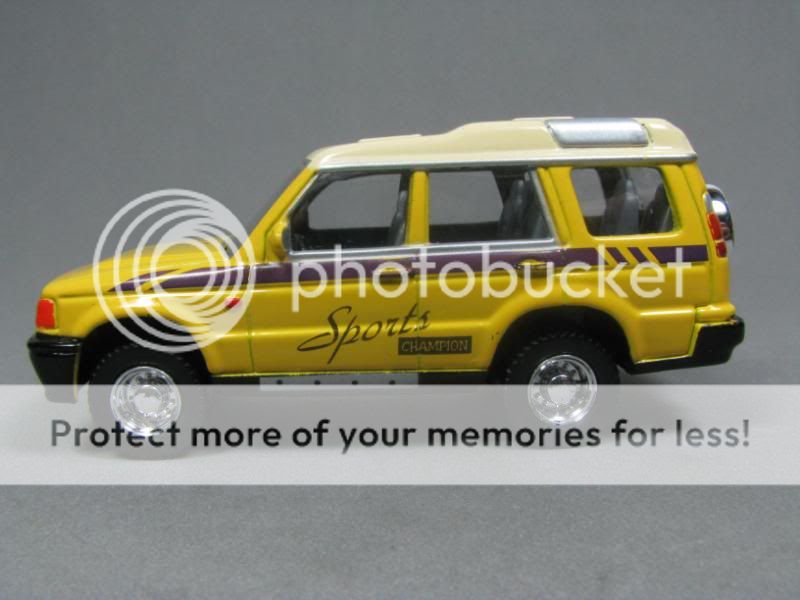
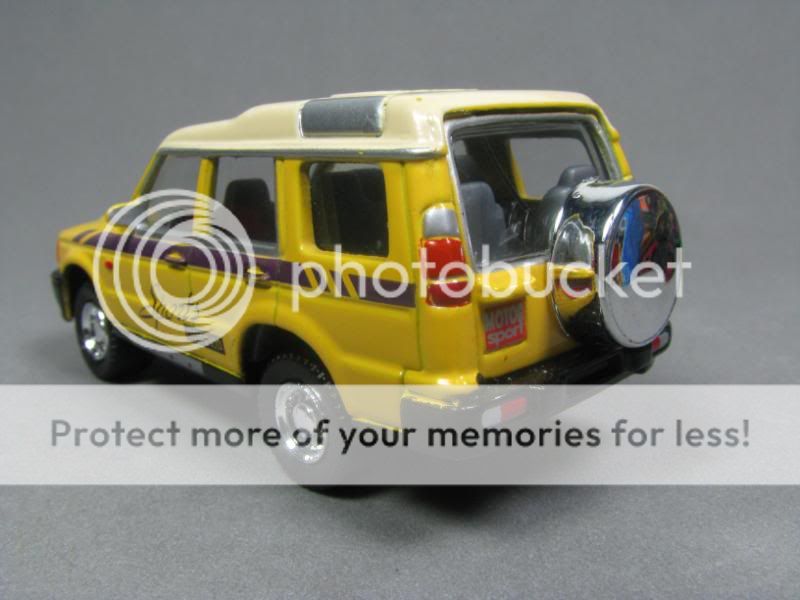
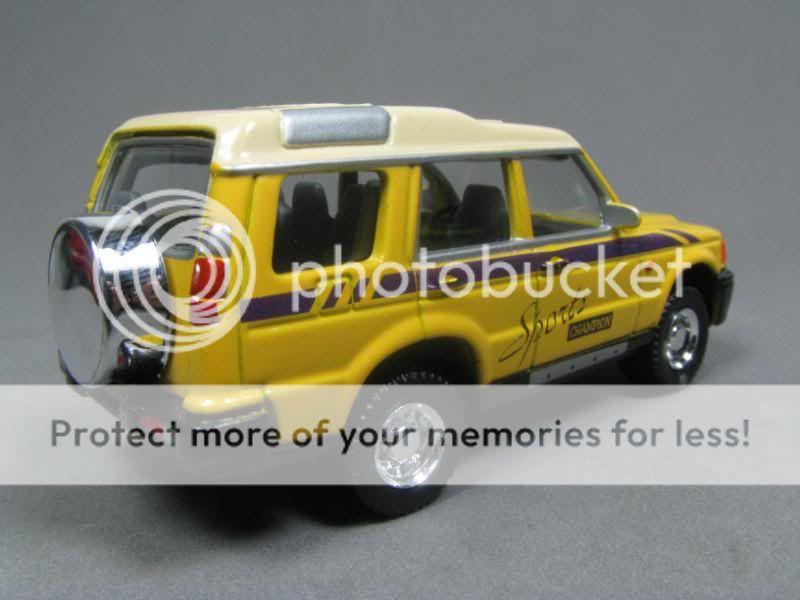
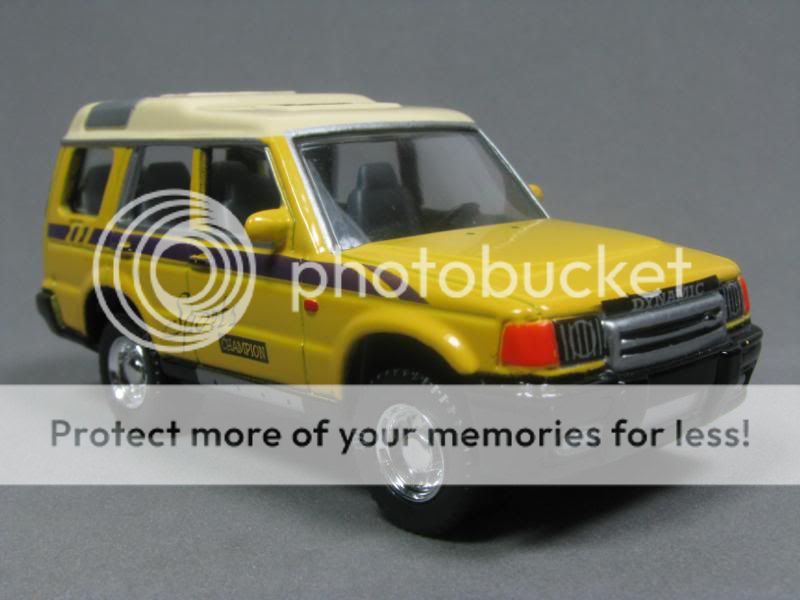
The SUV for today is the Real Toys' Land Rover Discovery II.
The Land Rover Discovery is a mid-size SUV, with off-road capabilities, from the British car maker Land Rover. There have been four generations of the vehicle, which was first introduced in 1989. The current Discovery 4 is marketed in North America as the LR4.
The Series II Discovery debuted in autumn 1998 and in the US in 1999. Land Rover promoted that the Discovery Series II had been modified with 720 'differences'. The interior and exterior was re-worked to be less utilitarian, but it was still similar to the Series I. Every body panel was new except the rear door outer skin. The rear body was extended to improve load space but at the expense of added rear overhang, which adversely impacted off-road ability. Changes to the diesel engined models saw the 2495 cc Td5 (in-line direct-injected 5 cylinder) engine introduced, in line with the updated Defender models. This electronically managed engine was smoother, producing more usable torque at lower revs than its 300 Tdi predecessor. The Td5 engine is often mistakenly attributed to BMW but the engine was derived from the Rover L-series passenger car engine and developed by Land Rover.
Check out http://en.wikipedia.org/wiki/Land_Rover_Discovery#Discovery_Series_II to learn more.
Jermaine sent this as part of a large trade box he sent back in late spring. It nearly doubled my Real Toys collection. The tampo work and 'chrome' spare tire cover are pretty nice work for a non brand x model.
Car of the Day: August 6, 2011
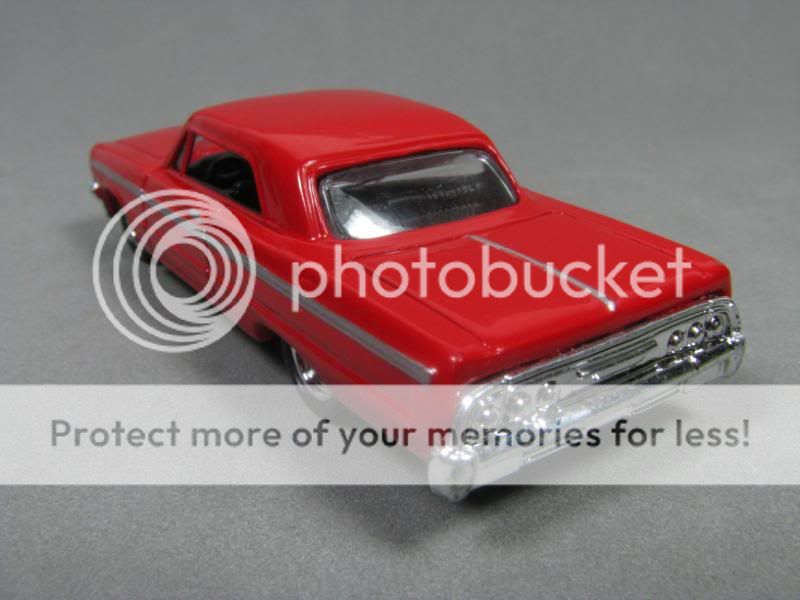
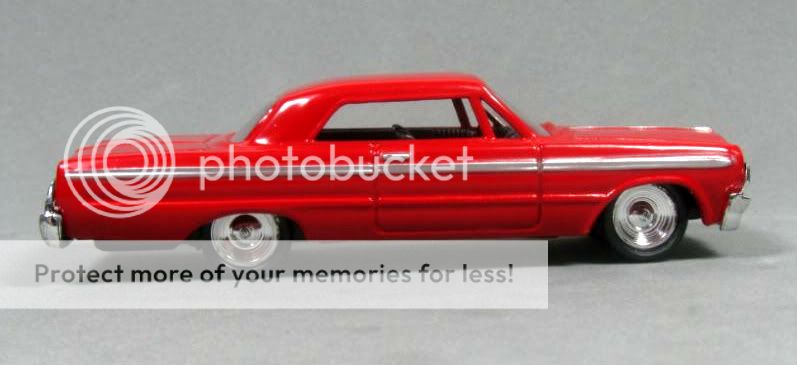
The car for today is the Imperial Toy's 1964 Chevy Impala.
The Chevrolet Impala is a full-size automobile built by the Chevrolet division of General Motors introduced for the 1958 model year. Deriving its name from the southern African antelope, Chevrolet's most expensive passenger model through 1965 had become the best-selling automobile in the United States, competing against the Ford Galaxie 500 and the Plymouth Fury when full-size models dominated the market. The Impala was distinguished for many years by its symmetrical triple taillights.
For 1964, the Impala was slightly restyled, reverting to a more rounded, softer look. The signature taillight assembly had an "upside-down U" shaped aluminum trim strip above the taillights, but the lights themselves were surrounded by a body-colored panel. The 409-cubic-inch (6.7 L) returned as the big-block option, as well as the 2X4 carburetor setup for the 425 horsepower motors. SS models continued to feature the engine-turned aluminum trim. Rooflines were carried over from '63 unchanged.
Learn more about the Impala by visiting http://en.wikipedia.org/wiki/Chevrolet_Impala
This is an older purchase at the now defunct KB Toys Store in Tuscola, IL. It was part of a set along with a blue Vette on the back of a semi truck. These were sold under the Buddy L name at KBs.
Friday, August 5, 2011
Car Of The Day: August 5, 2011
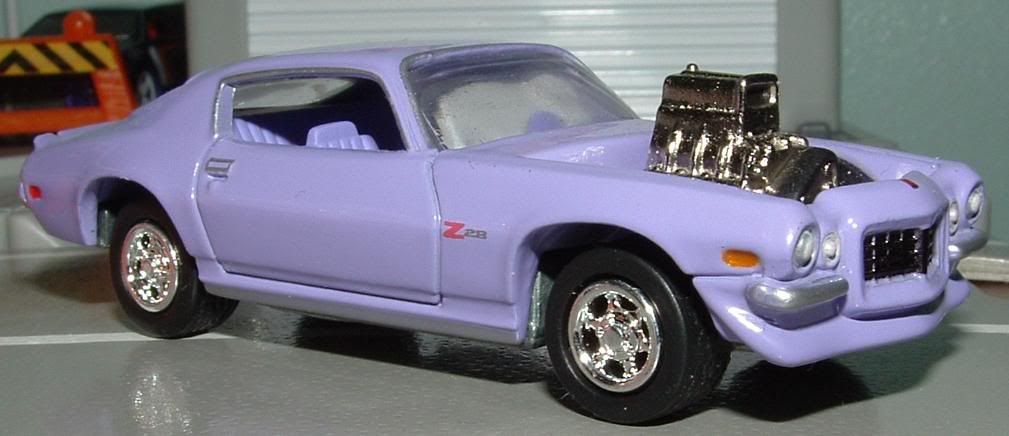
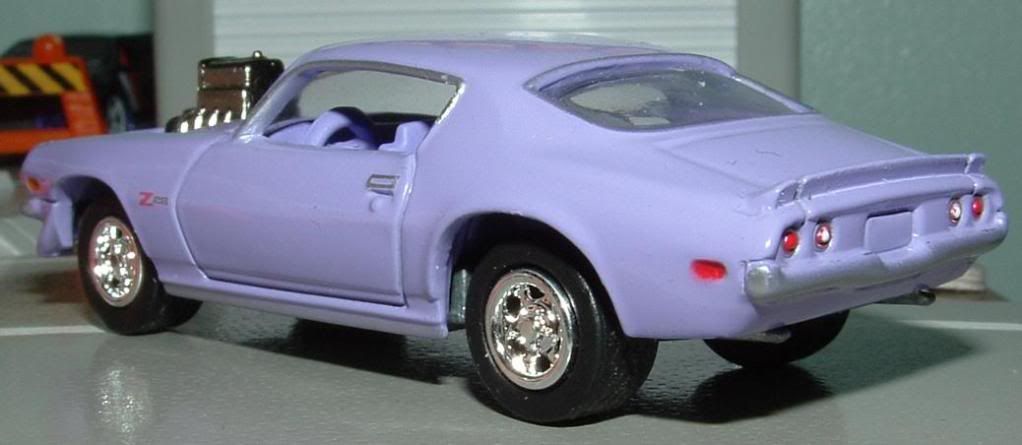
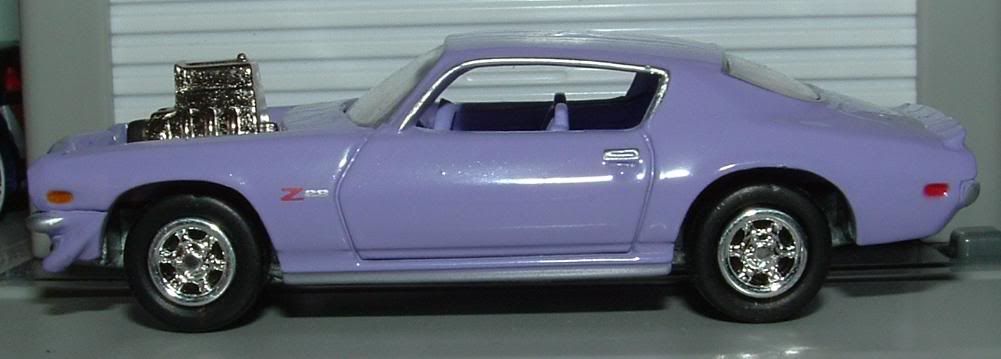
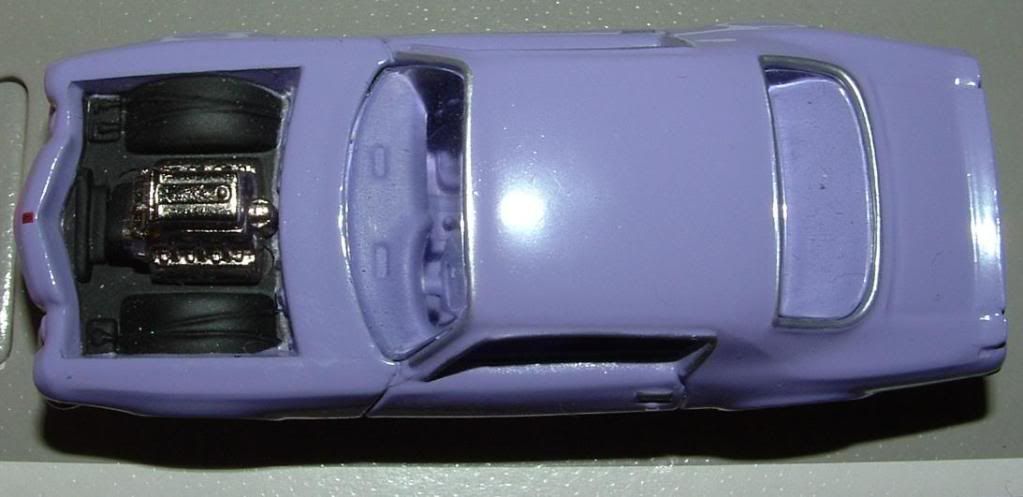
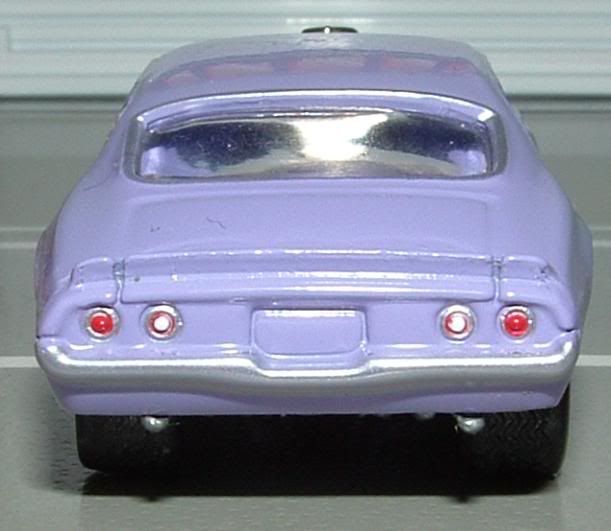
Today's car of the day is Johnny Lightning's 1971 Chevrolet Camaro.
The second generation Chevrolet Camaro is a pony car by the Chevrolet division of General Motors produced for the 1970 through 1981 model years. It was introduced February 26, 1970 It was longer, lower, and wider than the first generation Camaro, and is "widely considered the best all-around domestic musclecar ever produced." A convertible body-type was no longer available. GM engineers have said the second generation is much more of "A Driver's Car" than its predecessor.
For more information and pictures of the real car please visit: Chevrolet Camaro
Some cars can wear purple, pink, or orchid in style. Unfortunately, this isn't one of them. I love the color, but it looks out of place on a Camaro in all honesty, and would likely be better suited to either a Mopar or Mustang from the same era.
Dubbed "Super Hugger", the second generation Camaro was developed without the rush of the first generation and benefited from a greater budget in light of the success of the first generation. Although it was an all-new car, the basic mechanical layout of the new Camaro was familiar, engineered much like its predecessor with a unibody structure utilizing a front subframe, A-arm and coil spring front suspension, and rear leaf springs. The chassis and suspension of the second generation were greatly refined in both performance and comfort; base models offered significant advances in sound-proofing, ride isolation, and road-holding. Extensive experience Chevrolet engineers had gained racing the first-generation led directly to advances in second-generation Camaro steering, braking, and balance. Although it began its run with a number of high performance configurations, as the 1970s progressed, the Camaro grew less powerful, succumbing, like many production cars of the era, to the pressures of tightening emissions regulations and a fuel crisis. Major styling changes were made in 1974 and 1978; 1981 was the final model year for the second generation Camaro.
Thursday, August 4, 2011
Car Of The Day: August 4, 2011
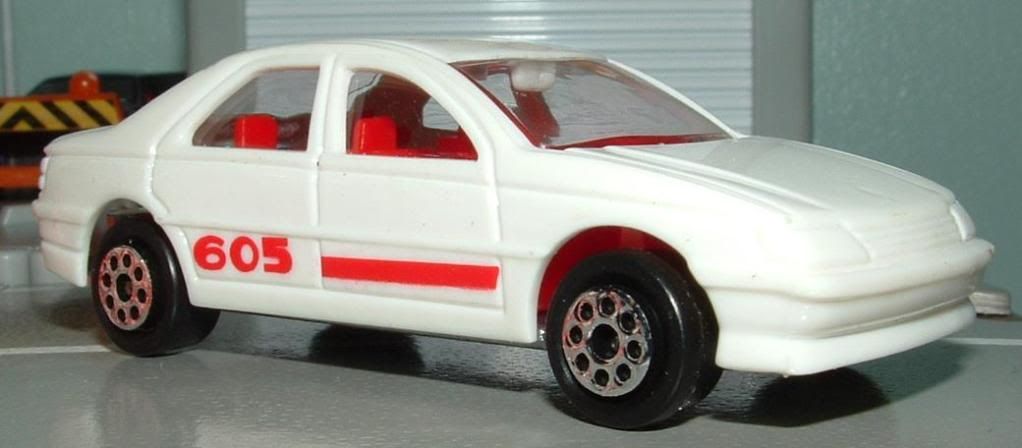
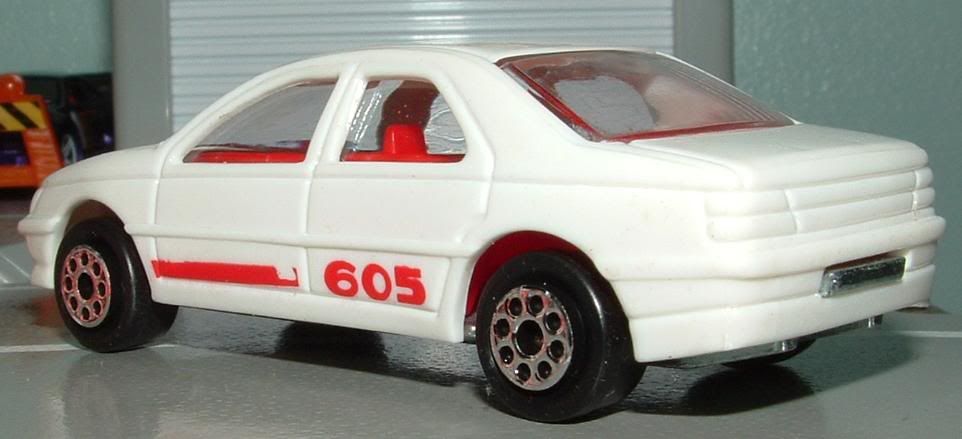
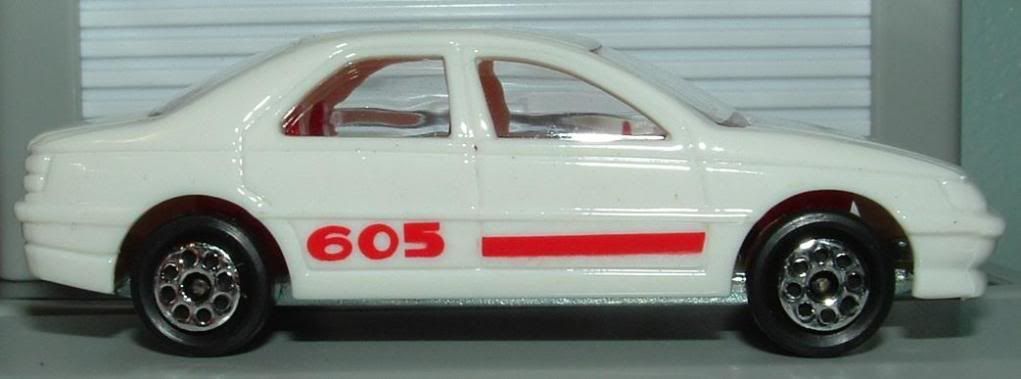
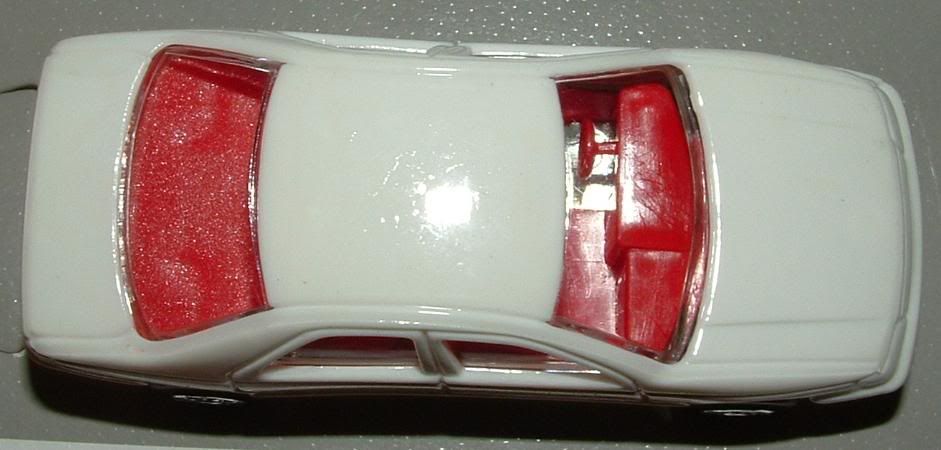
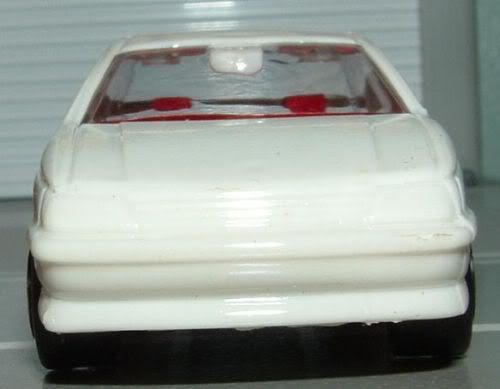
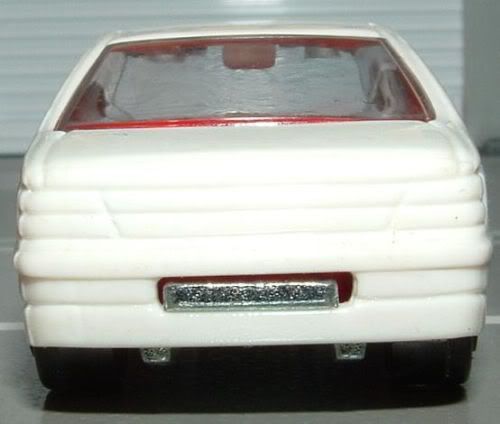
Today's car of the day is Novacar's 1989 Peugeot 605.
The Peugeot 605 is an executive car produced by the French manufacturer Peugeot between 1989 and 1999, with a facelift in 1995.
For more information and pictures of the real car please visit: Peugeot 605
Instead of tampoing the "605" on the side of this model, the two tampo hits should have gone to giving this model detailed front and rear fascias. The plain white plastic looks sadly incomplete and photographs poorly...
The 605 was a saloon/sedan built on the same platform as the Citroën XM, and was successor to the unsuccessful Peugeot 604 which went out of production 4 years earlier. The popular Peugeot 505 model was thus replaced by two cars - the large family car 405, and the executive car 605.
High equipment levels, a luxurious interior, a smooth ride, and exceptional handling were strong points for the 605. But Peugeot has always struggled to succeed with large cars outside France, and the 605 was no different. It was too similar in design and appearance to the smaller Peugeot 405 to command a price premium, while its dashboard also drew criticism for its uninspired design.
Also like the XM, 605 suffered from grave build quality issues that resulted in a large number of breakdowns or malfunctions (particularly with the ambitious electrics), which severely damaged the car's reputation. It took Peugeot three years to improve these disappointing levels of quality. In 1995, Peugeot tried to solve the problems by unveiling an extensively revamped 605 (known as the "Phase 2" model); it received a facelift which looked modern at its time, but also the interior was vastly improved by giving it more ergonomic controls and a refreshed look. Performance and handling were improved as well and many of the reliability issues were solved. Technological advances were made, most remarkably the side airbags.
PSA Peugeot Citroën like Vauxhall/Opel has not been able to address the "luxury-brand" issue effectively - the automobile market rewards such segmentation, by brands from one factory - like Lexus/Toyota, Acura/Honda, and Audi/Volkswagen. Consumers demand a certain exclusivity from luxury cars that commodity producers cannot provide.
After the launch of the well-received Peugeot 406 (that was larger than the 405 it replaced) in 1995, 605 sales dropped to near-insignificant levels, and the 605 was quietly dropped in 1999. Cars built after 1992 generally have good build quality and are often surprisingly good bargains on the second-hand market because the model's poor reputation keeps prices down.
The 605's successor, the Peugeot 607, went into production in late 1999 and has been slightly more successful on the domestic and export markets.
The end of 605 production spelled the end of "05" generation Peugeots in Europe after more than twenty years; this generation had started back in 1977 (UK market 1978) with the 305.
Subscribe to:
Posts (Atom)