Monday, February 20, 2012

Car Of The Day: February 20, 2012


Today's car of the day is Welly's 1981 Porsche 935 Kremer K3.


The Porsche 935 was introduced in 1976, as the factory racing version of the Porsche 911 turbo prepared for FIA-Group 5 rules. It was an evolution of the Porsche Carrera RSR 2.1 turbo prototype, the second place overall finisher in the 1974 24 Hours of Le Mans.

Beginning with the 1977 season, Porsche offered the 935 to customers entering the World Championship for Makes, in the IMSA GT championship and in the German Deutsche Rennsport Meisterschaft (DRM). The 935 went on to win the 1979 24 Hours of Le Mans overall, and other major endurance races, including Sebring, Daytona, and the 1000 km Nürburgring. Of the 370 races it was entered, it won 123.

Usually, no other make could challenge the Porsche 935, due to the availability of customer models. Each race, at the time, typically featured at least five 935s. As racing became a crowd-pleaser, the diversity of the marque suffered. The large turbocharger was used with mechanical fuel injection which caused turbo lag followed shortly by a fireball spitting from the exhaust and an enormous amount of power (up to 800 hp). The dominance of the 935 was ended by the FIA rules changes coming in effect in 1982, when the six numbered groups were replaced by only three groups, A, B and C.


For more information and pictures of the real car please visit: Porsche 935


I'm pretty sure this one is a Tomica copy.  The seperate cast wing is interesting, but it is not an opening feature.


For 1976, endurance racing had two World Championships: the 1976 FIA World Championship for Makes for Gr. 5 Special Production Cars, and the 1976 World Sportscar Championship season for Group 6 prototypes up to 3.0L. Accordingly, the 935 and the new Porsche 936 were the two-pronged Porsche effort for 1976. Each championship had 7 races, with only Dijon hosting both at the same weekend, while on two other weekends, the races were even run in different countries, which forced Porsche to divide its resources. Jacky Ickx and Jochen Mass were the main drivers, if F1 schedule permitted. Rolf Stommelen, who was recovering from his bad crash in the 1975 Spanish GP, was the backup, along with Manfred Schurti.

Under Group 5 rules, also known as Silhouette rules, several significant modifications were allowed (including bodywork modifications, larger wings, wider axles and water cooling), provided that the basic silhouette of the car remain unchanged when viewed from the front. The 935 engine was a 560 hp (420 kW) (at 7900 rpm) version of the regular 3.0 L flat-6, with 60 mkp torque at 5400 rpm. Boost was between 1,35 and 1,55, consumption 52 litre per 100 km. Capacity was reduced to 2.85 L, and with the turbo charging penalty factor of 1.4, it fit into the 4.0 L class which had a prescribed minimum weight of only 970 kg (2,100 lb). Porsche, having lots of experience in lightweight cars, had managed to get the Carrera RSR prototype under 800 kg. The empty 935 tipped the scales at 900 kg, and weight distribution could be balanced with additional 70 kg. Preseason testing at the fast Paul Ricard circuit showed a top speed of 295 km/h.

Also, in addition to the naturally aspirated 340 hp (250 kW) Carrera RSR introduced in 1974, Porsche offered a customer racing version of the 911 Turbo prepared for the more standard Group 4 rules, the 485 hp (362 kW) Porsche 934. Some customer teams modified their 934 to Gr. 5 rules with body kits supplied by Porsche, these were often designated 934/5. Cologne-based Kremer Racing entered a 935 K1 built on a factory shell which in the first race, the 6h Mugello, finished 2nd behind the Martini Racing sponsored factory entry of Mass/Ickx. Porsches occupied the first seven places ahead of a BMW in 8th, which according to the 20-15-12-10-8-6-4-3-2-1 scheme meant that Porsche had now 20 points, and BMW 3. The factory 935 also scored pole, fastest lap and win at the 6h Vallelunga, where a BMW was second, though, with the best 934 being only 5th.

After the second race, the CSI rule makers insisted that the whale tail hood of the road-going 930 must fit on the race car. The air-to-air intercooler setup under the rear hood had to be altered to a more compact air-to-water layout, which cost Porsche several weeks of testing and half a Million Deutsche Mark.
The hastily modified 935 set again pole and fastest lap at the 6h Silverstone, but due to a clutch problem at the start, the Martini car could finish only 10th, with the 2nd-placed Kremer 935 collecting valuable points for Zuffenhausen. A private BMW 3.5 CSL had beaten it to the finish by a second. Even more worrisome was the fact that BMW Motorsport had entered also a turbo, a 3.2 CSL driven by Ronnie Peterson and Gunnar Nilsson. That new BMW had qualified only 1 second behind the factory 935, but two seconds ahead of the third placed Kremer 935. The powerful BMW did not last long in the race due to gearbox problems.

Initially, Porsche ran the 935 with the 911's original fender-mounted headlights, in two different guises: a sprint version with a wider version of its wheel arches, and a high speed version with modified aerodynamics. The sprint setup was rarely used. However, after carefully studying the rulebooks, Porsche engineers, namely Norbert Singer, discovered a loophole regarding the modifications of fenders that gave them the liberty to remove the headlights to reduce drag and create more downforce, to which the venting slits contribute. This flat nose (also known as the slant nose), with headlights in the front spoiler, became the distinguishing feature of the 935 and was later offered on the roadgoing 930 as the Flachbau, or "flatnose", part of Porsche's Sonderwunsch, or "special wish" program. Also, the 935 now had extended long tail rear fenders, similar to the low drag setup seen years ago on Carrera RS. These fenders also offered more space for engine periphery and efficient cooling.

The 1000 km Nürburgring, usually consisting of 44 laps, was run in 1976 as a 47 lap 1073 km race, putting even more strain on the new Gr. 5 machinery. With Mass and Ickx being at the 1976 Monaco Grand Prix, Rolf Stommelen and Manfred Schurti stepped in to drive the 935 which by now had the new look it became famous with. Probably with the help of higher turbo boost, Stommelen qualified the 935 on Pole with a stunning 7:37,5 (see List of Nordschleife lap times (racing)), while the BMW turbo did not take part. The fastest of only 9 race laps was just over 8min, though, as the engine was not sorted out set, and vibrations caused ignition failure. Again, a reliable Schnitzer Motorsport-entered normal BMW CSL took the win, with the customer 934 of Loos salvaging valuable second place points for Porsche.

The 1976 24 Hours of Le Mans counted towards neither World Championship, but Le Mans is often considered the real championship. For that race, it was possible to use the 935's well-tested original engine setup. The main battle was between the sportscars, with a Renault Alpine setting the pole. The 935 driven by Stommelen/Schurti qualified 3rd and despite the weight and drag of a Group 5 silhouette, finished 4th overall, with one of the Porsche 936 taking the win.

At Zeltweg, Ickx was back, setting the pole, but the throttle link broke before mid race. Derek Bell set fastest lap in the Kremer 935, but nonetheless two BMW Coupés won ahead of a private 934. Porsche had still a narrow lead in the points standings, but only the best 5 of the 7 events would count. BMW had now 3 wins compared to Porsche's two, which meant that Porsche had to win the final two races. The new engine setup was tested at Weissach in a modified 934 while the race cars were shipped overseas. At Watkins Glen, the regular race chassis 002 of Mass/Ickx needed an extra stop for new pads at the Porsche 917 derived brakes, and the test chassis 001 of Stommelen/Schurti won, with the best BMW being 4th. Porsche now had 3 wins and two seconds equaling 90 points, which meant that only another win could add 5 more points to their tally. BMW had also 3 wins, but only one second and a fourth, equaling 85 points. Without a competitive third brand, the winner of the final round would take the World Championship.

In Dijon, the turbo of BMW Motorsport was back, now with 3.5L, and this time the fast Swedes Peterson/Nilsson put it on pole, half a second ahead of Ickx. Again, the transmission was not as strong as the Bavarian Motor Works 750 hp engine, failing before the first of the 6 hours had passed. Three 935 plus two Gr. 5 spec 934/5 won ahead of the best normally aspirated BMW. The 935 and 936 had each won its Championship, and Le Mans, too. The age of turbo engines had begun in endurance racing.


As Porsche hesitated to sell their Evolution models, some teams developed their own ideas, especially Kremer Racing from Cologne, Germany. Parallel to the factory in 1976, they had built a 935 K1, and in 1977, modified their customer 935 to the K2. For 1979, they introduced the 935 K3 (for "Kremer Type 3"; the derivative of the successful K2). Driven mainly by Klaus Ludwig, it won the 24 Hours of Le Mans in 1979, beating all prototypes, in heavy rain, which is usually considered a disadvantage for race cars with windshields. Coming in second was a factory spec model, driven by Rolf Stommelen, and supported by team owner Dick Barbour and actor Paul Newman.

Facing strong competition in the 1980 DRM by the big Zakspeed Ford Capri, the K4 was introduced in mid 1981, for 400 000 Deutsche Mark. Porsche supplied an 3,1L engine with 750-800 hp at 1,5 bar boost for 91 000 DM in total.

Sunday, February 19, 2012

Car Of The Day: February 19, 2012


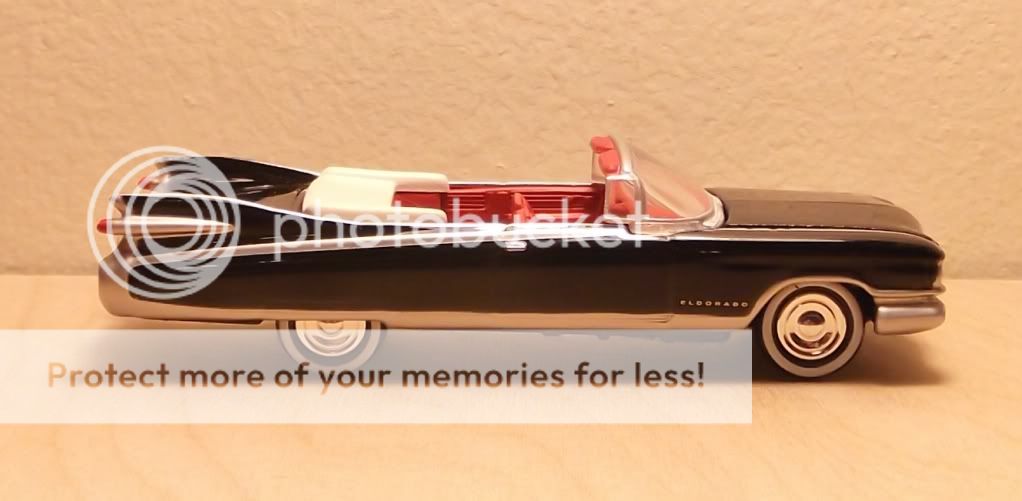
Today's car of the day comes from Firehawk73's collection and is Johnny Lightning's 1959 Cadillac Eldorado.


The Eldorado model was part of the Cadillac line from 1953 to 2002. The Cadillac Eldorado was the longest running American personal luxury car as it was the only one sold after the 1999 model year. Its main competitors included the Lincoln Mark Series and the lower-priced Buick Riviera.
Although cars bearing the name varied considerably in body style and mechanical layout during this long period, the Eldorado models were always near the top of the Cadillac line. Nevertheless, and except for the Eldorado Brougham models of 1957–1960, the most expensive models were always the opulent, long wheel-based Series 75 sedans and limousines, not the Eldorado.


For more information and pictures of the real car please visit: Cadillac Eldorado


A different Eldorado Brougham was sold for 1959 and 1960. These cars were not quite so extravagantly styled but were very unusual pieces in themselves. Priced at $13,075, they cost $1 more, each, than their older siblings. The design was 100% Cadillac but the company contracted out the assembly to Pininfarina of Italy, with whom the division has had a long-running relationship, and these Eldorados were essentially hand-built in Italy. Discreet, narrow taillights integrated into modest tailfins, and a squared-off rear roof line caused the Italian-built Brougham to contrast sharply to the rounded roof lines, and especially the new "rocketship" taillights and flamboyant fins of the standard 1959 Cadillacs, which are a feature only of that year. The Brougham's styling cues would prove to indicate where standard Cadillac styling would head from 1960 through the early-mid 1960s. The Brougham build-quality was not nearly to the standard of the Detroit hand-built 1957–1958 models, and thus the 1959–1960 Broughams did not sell as well as their forebears. However, collector interest and values for these cars remain high. The Eldorado Brougham was moved to its own unique Series 6900 for its remaining two years.

Both the Eldorado Biarritz and Eldorado Seville were their own separate Series 6400 for 1959 and 1960. The last Eldorado Seville was built in 1960.

Saturday, February 18, 2012

Car Of The Day: February 18, 2012


Today's car of the day comes from Firehawk73's collection and is Hot Wheels' 1962 Chevrolet Corvette.


The Chevrolet Corvette (C1) is the first generation of the sports car by the Chevrolet division of General Motors introduced late in the 1953 model year and produced through 1962. It is commonly referred to as the "solid-axle" generation, as the independent rear suspension didn't appear until the 1963 Sting Ray. The Corvette was rushed into production for its debut model year to capitalize on the enthusiastic public reaction to the concept vehicle, but expectations for the new model were largely unfulfilled. Reviews were mixed and sales fell far short of expectations through the car's early years. The program was nearly canceled, but Chevrolet would ultimately stay the course and Harley Earl and company would transform the Corvette into a true world-class sports car.


For more information and pictures of the real car please visit: Chevrolet Corvette


Four taillights appeared on the 1961, a treatment that continues to this day. Engine displacement remained at 283 cubic inches, but power output increased for the two fuel-injected engines to 275 hp and 315 hp. Power ratings for the dual-four barrel engines did not change (245 hp and 270 hp) but this was the last year of their availability. This was the last year for contrasting paint colors in cove areas, and the last two-tone Corvette of any type until 1978. Rare options: RPO 353 275 hp engine (118), RPO 687 heavy-duty brakes and steering (233), 15x5.5 wheels (357), power convertible top (442).

The 1962 model year was the last Corvette with a solid-rear-axle suspension that was used from the beginning. With two new engines it was also the quickest. Engine displacement increased to 327 cubic inches, but dual 4-barrel carburetor engines were no longer available. Hydraulic valve lifters were used in the base 250 hp and optional 300 hp engines, solid lifters in the optional carbureted 340 hp and fuel-injected 360 hp (268 kW) versions. Rocker panel trim was seen for the first time, exposed headlights for the last, until 2005. This was the last Corvette model to offer an optional power convertible top mechanism. Rare options: 24-gallon fuel tank (65), RPO 687 heavy-duty brakes and steering (246), power convertible top (350), 15x5.5 wheels (561).

Friday, February 17, 2012

Truck Of The Day: February 17, 2012


Today's car of the day comes from Firehawk73's collection and is Jada's 1947 Ford COE.


Cab-over, also known as COE (Cab Over Engine), cab forward, or forward control, is a body style of truck or van that has a vertical front or "flat face", with the cab of the truck sitting above the front axle. This truck configuration is currently common among European and Japanese truck manufacturers, because the laws governing overall vehicle lengths are strict and the body style allows longer trailers or a longer cargo area for the same overall length.

Although popular among United States heavy truckers and trucking companies during the 1970s because of strict length laws in many states, when those length laws were repealed, most heavy-truck makers moved to other body styles. It is, however, still very popular in the light- and medium-duty truck segment, with models such as the Isuzu NPR series or the Mitsubishi Fuso FE and FK/FM series.

Most Japanese minivans like the Suzuki Carry, Toyota Hiace and Mitsubishi Delica also use this body layout. It was also used for the (rear engined) Volkswagen Type 2 van, and in military vehicles such as the Land Rover 101 Forward Control and the Pinzgauer High Mobility All-Terrain Vehicle.


For more information and pictures of the real car please visit: Cab over engine


The Sternberg company of Wisconsin produced cab-over trucks as early as 1907, though by 1914 only their seven-ton model was a cab-over. They reintroduced the cab-over layout in 1933 with their "Camel Back" model, which allowed the cab to be tilted to access the engine.

The introduction of the first modern cab-over layout in the U.S. is credited to industrial designer Viktor Schreckengost, who with engineer Ray Spiller designed a cab-over truck for the White Motor Company in 1932.

The laws of the time limited truck length to 42 feet (12.8 m) on highways. Sitting the cab over the engine saved several feet of cab length, which was added to the trailer capacity. Schreckengost patented the design in 1934.

White-Freightliner introduced its first tilting cab-over design in 1958, which allowed the entire cab to tilt forward for access to the engine.

Thursday, February 16, 2012

Police Car Of The Day: February 16, 2012


Today's car of the day comes from Firehawk73's collection and is Jada's 1957 Chevrolet 150.


The Chevrolet One-Fifty, or 150 was the economy/fleet model of the Chevrolet car from 1953 to 1957. It took its name by shortening the production series number (1500) by one digit in order to capitalize on the numerical auto name trend of the 1950s. The numerical designation "150" was also sporadically used in company literature. It replaced the Styleline Special model available in previous years. This model was dropped following the 1957 model year and replaced by the Delray.


For more information and pictures of the real car please visit: Chevrolet 150


The One-Fifty was mainly conceived as a fleet model and little effort was spent marketing it to the average car buyer of the day, although sales weren't limited to fleets. It was most popular with police, state governments, small businesses, economy-minded consumers and hot rodders. Chevrolet sold substantially fewer One-Fifties than Two-Tens or Bel Airs in every year of its life.

True to Chevrolet's vision, the 150 was no-frills basic transportation. It had limited options, stark trim, solid colors, plain heavy duty upholstery and rubberized flooring. Small things like ashtrays, cigarette lighters and even mirrors were extra cost options. Compared to the mid-level Two-Ten or premium Bel Air models, the One-Fifty was stark and bland. However, the model became a little more stylish in the last years of existence with previous year's Bel Air stainless steel side trim and an improved interior, due to more standard equipment being included in all Chevrolets.

Body style choices were also limited to sedans, Handyman wagons (four-door in 1953–1954, two-door in 1955–1957) and (until 1955) the club coupe. The only body styles specific to the One-Fifty were decidedly fleet oriented — the sedan delivery (a 2-door wagon without rear windows and the rear seat removed) and the business sedan — a 2-door sedan with immobile rear windows and back seat removed. Powertrain choices were limited to manual transmissions and low output engines until 1954. In 1957, a full race-ready version was also available, commonly known as the "Black Widow" for its black-and-white paint color. It was equipped with 4-wheel heavy-duty brakes, 6-lug wheels and dual shock absorbers.

Wednesday, February 15, 2012

Car Of The Day: February 15, 2012


Today's car of the day comes from Firehawk73's collection and is Johnny Lightning's 1961 Lincoln Continental.


The Lincoln Continental is an automobile which was produced by the Lincoln division of Ford Motor Company from 1939 to 1948 and again from 1956 to 2002. Despite often sharing underpinnings with less-expensive Fords in more recent years, the Lincoln Continental had usually been a distinctively platformed and styled, highly equipped luxury car in the course of its long history.

The flagship Lincoln model during most of its run, the Continental name conveyed special cachet in the product line. During the 1980s, the Continental was downsized from a full-size to a mid-size Ford Taurus platform; this introduced the Continental to a wider range of competition from Europe and Japan. After the Continental was discontinued in 2002, it was largely replaced by the Lincoln LS and eventually the Lincoln MKS.


For more information and pictures of the real car please visit: Lincoln Continental


In 1961, the Continental was completely redesigned by Elwood Engel. For the first time, the names Lincoln and Continental would be paired together outside the Mark Series; along with replacing the Continental Mark V, the 1961 Continental replaced the Lincoln Capri and Premiere, consolidating Lincoln into a single product line. Originally intended to be the 1961 Ford Thunderbird, the design was enlarged and slightly altered before being switched to the Lincoln line by Robert McNamara. One of the most striking features of the new Continental was its size. It was 14.8 in (380 mm) shorter than its predecessor. So much smaller was this car, that advertising executives at Ford photographed a woman parallel parking a sedan for a magazine spread. The new Continental's most recognized trademark, front opening rear doors, was a purely practical decision. The new Continental rode on a wheelbase of 123 inches (3,100 mm), and the doors were hinged from the rear to ease ingress and egress. When the Lincoln engineers were examining the back seats that styling had made up, the engineers kept hitting the rear doors with their feet. Hinging the doors from the rear solved the problem. The suicide doors were to become the best-known feature of 1960s Lincolns. To simplify production (in the beginning, anyway), all cars were to be four-door models, and only two body styles were offered, sedan and convertible. The 1961 model was the first car manufactured in the U.S. to be sold with a 24,000 mi (39,000 km) or 2-year bumper-to-bumper warranty. It was also the first postwar four-door convertible from a major U.S. manufacturer. Walnut-paneling was on the doors.

Despite the smaller exterior dimensions, at 4,927 lb (2,235 kg), the new sedan was only 85 lb (39 kg) lighter than the lightest 1960 Lincoln four-door sedan (2 lb less than a two-door); at 5,215 lb (2,365 kg), the convertible outweighed its 1960 predecessor by 39 lb (18 kg). As a result (save for their respective nine-passenger models) the new Lincoln was still heavier than anything from Cadillac. or Imperial. This solid construction led to a rather enviable reputation as "Corporate management was determined to make it the finest mass-produced domestic automobile of its time and did so."

The 1961 Continental was Elwood Engel's Magnum Opus, as he was responsible for the complete design of the car. It was a sales success, with 25,160 sold during the first year of production.

This generation of Continental is favored by collectors and has appeared in many motion pictures, such as The Matrix, The Last Action Hero, Kalifornia and the Inspector Gadget films. It has also appeared in the television series Pushing Daisies, and recently in the opening sequence of the television series Entourage. Ford produced several concept cars which recalled this design. In 2007, Lincoln's Navigator and MKX SUV lines adopted chrome grilles in the style of these Continentals.

This so-called "slab-side" design ran from 1961 to 1969 with few changes from year to year. Lincoln dealers began to find that many people who bought 1961 and post-1961 models were keeping their cars longer. In 1962, a simpler front grille design with floating rectangles and a thin center bar was adopted. Sales climbed over 20% in 1962, to 31,061.

Due to customer requests, for 1963 the front seat was redesigned to improve rear-seat legroom; the rear deck lid was also raised to provide more trunk space. The floating rectangles in the previous year's grille became a simple matrix of squares. The car's electrical system was updated this model year when Ford replaced the generator with an alternator. For 1963, another 31,233 were sold.

The wheelbase was stretched 3 in (76 mm) in 1964 to improve the ride and add rear-seat legroom, while the roofline was squared off at the same time. The dash was also redesigned, doing away with the pod concept. Flat window glass was for additional interior space. The gas tank access door, which had been concealed at the rear of the car in the rear grille, was now placed on the driver's side rear quarter panel. The exterior "Continental" script was changed and the rear grille replaced by a simple horizontally elongated Continental star on the rear deck lid. 36,297 were sold that year.

The convex 1962–1964 grille was replaced by a flatter, squared-off one for 1965. The car was given front disc brakes to improve stopping distances. For the first time, parking lamps and front turn signals were integrated into the front quarter panels instead of the bumper. Taillights were fitted with a ribbed chrome grille on each side. With the facelift, sales improved about 10%, to 40,180 units. An oil pressure gauge was added. Front seat belts with retractors were now standard.

A two-door pillarless hardtop version was launched in 1966, the first two-door Lincoln since 1960, and the MEL engine was expanded from 430 cu in (7.0 L) to 462 cu in (7.6 L) cubic inches. The car was given all-new exterior sheet metal and a new interior. Parking lights and front turn signals went back into the front bumper, and taillights set in the rear bumper for the first time. The length was increased by 4.6 in (117 mm) to 220.9 in (5,611 mm), the width by 1.1 in (28 mm) to 79.7 in (2,024 mm), and the height (on the sedan) by 0.8 in (20 mm) to 55.0 in (1,397 mm) high. Curved side glass returned, however tumblehome was less severe than in earlier models. The convertible saw a few technical changes related to lowering and raising the top. Lincoln engineers separated the hydraulics for the top and rear deck lid (trunk) by adding a second pump and eliminating the hydraulic solenoids. A glass rear window replaced the plastic window used previously. To lure potential Cadillac buyers, 1966 Continental prices were reduced almost US$600 without reducing equipment levels. It succeeded, helping boost sales to 54,755 that year, an increase of 36%, all of it due to the new two-door; sales of both four-door models slipped slightly. Product breakdown for the year consisted of 65% sedans, 29% coupes, and just under 6% for the four-door convertible. 1966 was the first year a tape player was available and a new tilt steering wheel.

The 1967 Continental was almost identical to the 1966. The most obvious external difference is that the 1966 model has the Lincoln logo on each front fender, ahead of the front wheel; this does not appear on the 1967 model. It was also the end for the four-door convertible, down to just 2,276 units, a drop of 28% over 1966. In addition to being the last production four-door convertible; at 5,505 pounds (2,497 kg) the 1967 convertible holds the distinction of being the heaviest Lincoln since the Model K, and was even 55 pounds heavier than the Cadillac Fleetwood Series 75 Limousine of that year. Total production was 45,667. Warning lights on the dash included a cruise control on, truck open, and an oil pressure light.

Safety came to the forefront in 1967–68 and resulted in energy-absorbing steering columns, "safety" padded interiors, and lap safety belts for all passengers. 1968 saw shoulder belts for outboard front passengers as well.

1968 brought some exterior changes. The parking lights, taillights, and front turn signals were once again in a wraparound design on the fenders to satisfy Federal standards for side marker lights, but looked very different from those of the 1965 model. The new 460 cu in (7.5 l) Ford 385 engine was to be available initially, but there were so many 462 cu in (7.57 l) Ford MEL engine engines still available, the 460 was phased in later that year. In April, the new Mark III made its debut, as a 1969 model. Total sales would be down to just 39,134.

1969 was the last production year with rear-opening "suicide doors", with few changes from 1968 (including the addition of federally-mandated head restraints). Sales held steady at 38,383 for the Continental, plus another 30,858 for the new Continental Mark III.

In the CBS television situation comedy Green Acres (1965–1971), in which the cars were furnished by Ford Motor Company, lead character Oliver Wendell Douglas (Eddie Albert) is shown driving a 1965 Continental convertible and then in later episodes owns a 1967 model.

Tuesday, February 14, 2012

Car Of The Day: February 14, 2012


Today's car of the day comes from Firehawk73's collection and is Maisto's 1969 Pontiac Firebird.


The Pontiac Firebird was built by the Pontiac division of General Motors between 1967 and 2002. The Firebird was introduced the same year as the automaker's platform-sharing model, the Chevrolet Camaro. This coincided with the release of the 1967 Mercury Cougar, which shared its platform with another pony car, the Ford Mustang.

The vehicles were powered by various four-cylinder, six-cylinder, and V8 engines sourced from several GM divisions. While primarily Pontiac-powered until 1977, Firebirds were built with several different engines from nearly every GM division until 1982 when GM began to discontinue engines it felt were unneeded and either spread successful designs from individual divisions among all divisions or use new engines of corporate architecture.

For more information and pictures of the real car please visit: Pontiac Firebird


The first generation Firebirds had a characteristic Coke bottle styling. Unlike its cousin, the Chevrolet Camaro, its bumpers were integrated into the design of the front end and its rear "slit" taillights were inspired by the Pontiac GTO. Both a two-door hardtop and a convertible were offered through the 1969 model year. Originally the car was a "consolation prize" for Pontiac, who had initially wished to produce a two-seat sports car of its own design, based on the original Banshee concept car. However, GM feared such a vehicle would directly compete with Chevrolet's Corvette, and the decision was made to give Pontiac a piece of the pony car market by having them share the F-body platform with Chevrolet.

The base model Firebird came equipped with the OHC inline-6 and a single-barrel carburetor. The next model, the Sprint, had a four-barrel carburetor, developing 215 hp (160 kW). Most buyers opted for one of the V8 engines: the 326 CID (5.3 L) with a two-barrel carburetor producing 250 hp (186 kW); the "H.O." (High Output) engine of the same displacement, but with a four-barrel carburetor and producing 285 hp (213 kW); or the 400 CID (6.6 L) from the GTO with 325 hp (242 kW). A "Ram Air" option was also available in 1968, providing functional hood scoops, higher flow heads with stronger valve springs, and a different camshaft. Power for the Ram Air package was the same as the conventional 400 H.O., but the engine peaked at a higher RPM. The 230 CID (3.8 L) engines were subsequently replaced by 250 CID (4.1 L) ones, the first developing 175 hp (130 kW) using a single-barrel carburetor, and the other 215 hp (160 kW) with a four-barrel carburetor. Also for the 1968 model, the 326 CID (5.3 L) engine was replaced by one with a displacement of 350 CID (5.7 L). An "H.O." version of the 350 CID with a revised cam was also offered starting in that year, developed 320 hp (240 kW). Power output of the other engines was increased marginally. In 1969, a $725 optional handling package called the "Trans Am Performance and Appearance Package,", named after the Trans Am Series, which included a rear spoiler, was introduced. Of these first "Trans Ams," only 689 hardtops and eight convertibles were made. There was an additional Ram Air IV option for the 400 CID engine during that year, complementing the Ram Air III; these generated 345 and 335 hp (250 kW) respectively. The 350 "H.O." engine was revised again with a different cam and cylinder heads resulting in 330 hp (250 kW). During 1969 a special 303 cu in (5.0 L) engine was designed for SCCA road racing applications that was not available in production cars.

The styling difference from the 1967 to the 1968 model was the addition of Federally mandated side marker lights: for the front of the car, the blinkers were made larger and extended to wrap around the front edges of the car, and on the rear, the Pontiac (V-shaped) Arrowhead logo was added to each side. The front door vent-windows were replaced with a single pane of glass. The 1969 model received a major facelift with a new front end design made of an Endura bumper housing the headlights and grilles. The instrument panel and steering wheel were revised. The ignition switch was moved from the dashboard to the steering column with the introduction of GM's new locking ignition switch/steering wheel.

Due to engineering problems that delayed the introduction of the all-new 1970 Firebird beyond the usual fall debut, Pontiac continued production of 1969 model Firebirds into the early months of the 1970 model year (the other 1970 Pontiac models had been introduced on September 18, 1969). By late spring of 1969, Pontiac had deleted all model-year references on Firebird literature and promotional materials, anticipating the extended production run of the then-current 1969 models.

Monday, February 13, 2012

Car Of The Day: February 13, 2012


Today's car of the day comes from Firehawk73's collection and is Racing Champions' custom 1957 Buick Century.


Buick Century is the model name used by the Buick division of General Motors for a line of full-size performance vehicles from 1936 to 1942 and 1954 to 1958, and from 1973 to 2005 for a mid-size car.

The model name Century came about when Buick was designing its first production automobile capable of reaching a speed of 100 mph. The division needed to come up with a name. One of the Buick executives had returned from a recent trip to the British isles and told the other executives that the British referred to going 100 mph as "doing the century". The executives liked the Century name and it stuck.
The Century was sold as the Buick Regal in Japan, as Toyota owns the right to the name Century.


For more information and pictures of the real car please visit: Buick Century


In 1954, Buick reintroduced the Century using the same formula of mating the smaller, lighter Buick Special body to its largest and most powerful 322 cubic inch V8 engine with the intent of giving Buick a performance vehicle. Included in the model lineup during this period was a station wagon model, a body style that had been unavailable during the Century's first production period of 1936 to 1942.
In 1955, the California Highway Patrol placed a large fleet order for Century 2-door sedans, a body style unavailable to the general public. It combined the Special 2-door sedan body shell with Century powertrain and trim. Broderick Crawford was shown driving a 2-door Century sedan during the first season of his popular syndicated TV series "Highway Patrol". (In later seasons he'd drive a four-door Century, like his real life counterparts in the California Highway Patrol.)

The Century remained Buick's performance line, with engine power rising from 200 (SAE gross) in 1954, to 236 in 1955, to 255 in 1956, and topping out at 300 from a bored-out 364 cu in (6.0 L) engine in 1957-58, the last model years for the full sized Century line.

Because the Century was considered the senior "small Buick", the model received GM's only hardtop station wagon, the Century Caballero, from 1957 through 1958. The Caballero's expensive tooling, plus its limited sales appeal, caused GM to abandon the hardtop station wagon body style going into its planned 1959 divisional-wide new design program.

For 1959, Buick renamed the Century the Invicta.

Sunday, February 12, 2012

Car Of The Day: February 12, 2012


Today's car of the day comes from Firehawk73's son Jacob's collection and is Hot Wheels' 1972 Volkswagen SP2.


The SP2 was a sports car developed by Volkswagen do Brasil for that market, from 1972 to 1976; the name is an abbreviation of "São Paulo".


For more information and pictures of the real car please visit: Volkswagen SP2


In the 70s, the Brazilian market was closed for imports. The only sports car officially made there was the aging (and by then retired) Karmann Ghia, and its failed successor, the Karmann Ghia TC. Only independent car makers were able to fill the gap, notably Puma, Santa Matilde and Miura.

The Volkswagen subsidiary in Brazil always had some degree of independence from Wolfsburg, so in 1969 they decided to start a new project of their own. A team led by Senor Schiemann and supported by Rudolf Leiding (the CEO of the subsidiary and later of the entire company) started work on a so called "Project X", and presented a prototype in a 1971 fair. But it would take another year before the car reached the streets.
The SP, the final name of the car, was built on the frame of a Variant, with the same Volkswagen air cooled engine, but upgraded to 1700 cc, it developed 75 hp (56 kW), 160 km/h (100 mph) and made 10 L/100 km (28 mpg-imp; 24 mpg-US).

When the car was presented, it quickly drew media attention, with its many improvements over the local "air cooled" VW line, an impressive interior, its many extra features and its superb finishing.

A car named SP1 was also built, but due to its very poor performance (only 65 hp (48 kW) with a 1600 cc engine), it was soon discontinued. The same problem plagued the SP2. In fact, a malicious joke at that time was to relate the "SP2" name with "Sem Potência" ("Without Power", in Portuguese).

Despite its revolutionary look, the car failed to beat the Puma in performance. Although they used similar engines, the fiberglass Puma was much lighter. This resulted in low sales, and the SP was discontinued in February 1976.

With a total of 10,205 units made (670 of them exported, the majority 155 went to Nigeria with only one going to Europe, Portugal), the car is now sought-after as a valuable collector's item. One of them, in white, is in the VW museum on public display. While prices during the production time frame were roughly the same as the Beetle, the price of a well-preserved example today is considerably higher than contemporary VW models.

Saturday, February 11, 2012

Car Of The Day: February 11, 2012


Today's car of the day comes from Firehawk73's son Jacob's collection and is Johnny Lightning's 1966 Buick Skylark.


The Buick Skylark is a passenger car produced by the Buick division of General Motors. The model was made in six production runs. In each run, the car design varied dramatically due to changing technology and tastes, as well as new standards implemented over the years.


For more information and pictures of the real car please visit: Buick Skylark


Beginning with the 1964 model year, the Buick Skylark, along with the lower-priced Special from which it was derived, would move to a new intermediate-size chassis that was shared with the Oldsmobile F-85, Pontiac Tempest, and the new Chevrolet Chevelle. The new chassis had a wheelbase of 115 in (2,921 mm) and the Buick Special and Skylark had a length of 203.5 in (5,169 mm). The 215 cubic-inch-displacement aluminum block V8 engine was discontinued, and the associated tooling eventually was sold to the British manufacturer, Rover. That company would produce the engine in several versions for use in its sedans and Land Rover sport utility vehicles and trucks.

The standard Skylark engine was now a 225 cubic-inch all cast iron block V6 with a Rochester 1-barrel carburetor that generated 155 hp (116 kW) at 4400 rpm. This engine was introduced in 1964, very similar to the earlier V6 beginning with the 1962 model year which had a smaller displacement of 196 cubic-inch. This engine was basically a Buick V8 300 CID engine with two cylinders sawed-off. The optional engine was a 300 cubic inch cast iron block and aluminum heads V8 with a Rochester 2-barrel carburetor that generated 210 hp (160 kW) at 4600 rpm. An optional V8 version of the 300 CID engine was offered with a 11:1 compression and a 4-barrel carburetor generating 250 hp (190 kW). A long-throw, 4-speed Hurst shifter was available. For the 1965 model cast iron blocks and heads were used for all engines.

In addition to the two-door convertible and hardtop coupe body-styles, a Skylark four-door sedan became available for the first time. Skylarks, however, would continue to have higher levels of exterior and interior trim compared to the Special and Special Deluxe from which they were derived. All-vinyl bucket seats would be standard on the convertible and optional on the hardtop coupe. The sedan would come with cloth-and-vinyl seats standard, and an all-vinyl interior would be optional. The Sylark Coupe had a lower profile, sitting lower to the road than the Buick Special models.

The Skylark in 1964-1965 were available in a pillar-less coupe (Hard Top) two-door sedan version, as the Specials and Special Deluxes only came in pillared coupe versions. Beginning with the 1964 model year, a two-door sedan (pillared coupe) was added to the Skylark lineup. Inspired in no small part by the sales success of the 1964 Pontiac Tempest, LeMans, GTO, the Gran Sport option became available in mid 1965 for the three two-door Skylark models. The Gran Sport option featured Buick’s 401 cubic-inch-displacement V8 engine using a Carter 4-barrel carburetor that produced 325 hp (242 kW) at 4400 rpm (it was listed as 400 cubic inches in sales literature, supposedly to escape a General Motors mandate that engines larger than 400 cubic inches should not be used in intermediate-sized cars). Other Gran Sport features were unique Gran Sport badging, a heavy-duty radiator, and dual exhaust.

In the 1966 model year, the four-door (pillared) sedan was replaced by a four-door (pillarless) hardtop sedan. The convertible, hardtop coupe, and two-door sedan continued to be available. The 1966 two-door Skylark was available with the optional "Wildcat 375", 340 ci engine which produced 260 hp (194 kW) and 365 ft·lb (495 N·m). torque with a 4-barrel Carter carb.

The four-door sedan would rejoin the lineup for the 1967 model year, making a total of five Skylark body styles. Beginning with the 1967 model year, only the Skylark two-door sedan would be available with the Buick V6 engine as standard. The 300 cubic inch V8 would be standard on all other models, with the exception of the four-door hardtop sedan, which came with a 340 cubic-inch-displacement V8 engine using a Rochester 2-barrel carburetor and producing 220 hp (160 kW) at 4400 rpm.

The previous Buick Skylark Gran Sport was relabeled as the Buick Skylark Gran Sport 400 to reflect its engine. The new model was the Buick Skylark Gran Sport 340,which also used the 340-cubic-inch V8 that was standard on the Skylark four-door hardtop. The Gran Sport 340 was available only as a two-door hardtop coupe.

The 1968 model year was one of significant change for the Buick Skylark. Although still using the same basic chassis, all of GM’s mid-sized cars adopted a policy of using two different length wheelbases. Two-door models used a shorter wheelbase of 112 in (2,845 mm), while four-door models used a longer wheelbase of 116 in (the Buick Sport Wagon and Oldsmobile Vista Cruiser used an even longer wheelbase of 121 in). All of GM's mid-sized cars received all-new sheet metal.

The Gran Sport, previously an option package available on the Skylark, became a separate series. In a reshuffling of models in the lineup, the Special Deluxe replaced the previous Special. The Skylark nameplate was shuffled down a notch to replace the previous Special Deluxe. The previous Skylark was replaced by a new Skylark Custom.

The basic Skylark was available as a two-door hardtop coupe or a four-door sedan. The Skylark Custom came as a two-door convertible coupe, two-door hardtop coupe, four-door hardtop sedan, or four-door sedan.

The previous V6 was discontinued and the associated tooling was sold to Kaiser Industries, which used the V6 in its Jeep trucks and sport utility vehicles. The base engine in Buick Skylarks (and Buick Special sedans) became a 250-cubic-inch inline six-cylinder engine using a 1-barrel Rochester carburetor (borrowed from Buick’s sister Chevrolet division) that produced 155 hp (116 kW) at 4200 rpm.
Optional on the Skylark and standard on the Skylark Custom was a new 350 cubic inch V8 engine using a 2-barrel Rochester carburetor that produced 230 hp (170 kW) at 4400 rpm. This engine was based on the previous 300- and 340-cubic inch-displacement V8 engines. The Buick Special name was dropped after the 1969 model year.

For 1970, the mid-sized Buicks once again received new sheet metal and the Buick Skylark name was moved down another notch, replacing the previous Buick Special. The Skylark became the entry-level Buick available in two- and four-door sedans with the 250-cubic-inch inline-6 as standard and the 350 cubic inch V8 (260 horsepower at 4600 rpm) available as an option.

Replacing the previous Buick Skylark was the Buick Skylark 350, available as a two-door hardtop coupe or four-door sedan with the 350 cubic inch V8 as standard equipment. This 350 cubic inch engine was a different design than the Chevy's 350 CID engine (4.000 in × 3.48 in) the Buick design had a longer stroke and smaller bore (3.80 X 3.85 in) allowing for lower-end torque, deep skirt block construction, higher nickel-content cast iron, 3.0 in (76 mm) crank main journals, and 6.5 in (165 mm) connecting rods, the distributor was located in front of the engine (typical of Buick), the oil pump was external and mounted in the front of the engine, the rocker arm assembly had all rocker arms mounted on a single rod and were not adjustable. The Skylark Custom continued to be available, also using the 350 cubic inch V8 as standard equipment and still available as a two-door convertible coupe, two-door hardtop coupe, four-door hardtop sedan, and four-door sedan. Buick Gran Sport models continued to be available as a separate series. The Buick Sport Wagon name was now used on a conventional four-door station wagon that no longer featured a raised roof with glass panels over the cargo area, or a longer wheelbase, as in the past. It now used the same 116 in (2,946 mm) wheelbase as the Buick Skylark four-door sedan and the now-discontinued Buick Special four-door Station Wagon. It became, in effect, a Buick Skylark four-door station wagon in all respects but the name.

For the 1971 model year, the base Skylark was available only with the inline-6, now only putting out 145 hp (108 kW) due to emission control devices, but in a two-door hardtop coupe body-style (in addition to the previous two- and four-door sedans). The Skylark 350 had a V8 engine that put out only 230 hp (170 kW). It was now available as a two-door sedan in addition to the previous two-door hardtop coupe and four-door sedan.

1972 was the last model year for the mid-sized Buick Skylark. During this model year many pollution controls were added to the Engines, Compression was lowered, engines had to accept leaded and unleaded gas, and spark timing was retarded (no vacuum advance in lower gears) while driving in lower gears to reduce emissions. For 1972, the base Buick Skylark used the 350 cubic inch V8 with the 2-barrel Rochester carburetor (now putting out 145 horsepower) as standard equipment. A new federally mandated system to calculate power was put into effect that year, and the actual engine performance was probably comparable but slightly lower because of pollution controls in the 1972 model year to the 230 hp (170 kW) that was listed for the previous year. The Skylark 350 now used a version of the same V8 engine as the base Skylark, but with a 4-barrel Rochester carburetor that generated 170 hp (130 kW).

An interesting limited-production model was the 1972 Buick Skylark 350 Sun Coupe, which was a Skylark 350 Hardtop Coupe that featured a sliding vinyl sunroof, with a vinyl covering over the front portion of the roof (a landau design). Special striping and "Sun Coupe" badges on the rear pillars completed the package. Conversion work was subcontracted to the American Sunroof Company (ASC). Production of the Sun Coupe was approximately 3,950 units.

Skylark Customs were available with the same 350 cubic inch V8 engines available in the basic Skylark and the Skylark 350. The Custom had an upgraded interior and dash with some extra chrome. Convertibles only came in the Skylark Customs and the Skylark 350s.

For the 1973 model year, the Buick Gran Sports, Skylarks, and Sport Wagons would all be replaced by the new mid-sized Buick Century. Since Centuries were available with Gran Sport trim, the Gran Sport name was once again reduced to being an option package.