Monday, May 21, 2012

Race Car Of The Day: May 21, 2012


Today's car of the day comes from Firehawk73's collection and is Hot Wheels' 1971 Ferrari 512M.


Ferrari 512 S was the designation of 25 five litre sports cars built until January 1970, related to the Ferrari P sports prototypes. The V12-powered cars were entered in the 1970 International Championship for Makes by the factory Scuderia Ferrari and private teams. Later that year, modified versions resembling the main competitor Porsche 917 were called Ferrari 512 M (for modificata). In the 1971 International Championship for Makes, the factory focused on the new Ferrari 312PB and abandoned the 512 which was only entered by privateers. From 1972 onwards, the 512 (as the 917) was withdrawn from the world championship following a change in the regulations, and some 512 in private hands were entered in CanAm and Interserie races.


For more information and pictures of the real car please visit: Ferrari 512


Just in time for the 24h of Daytona, Ferrari in January 1970 presented the required number of 25 512S, as 17 complete cars and 8 assembly kits, to the homologation authorities. Of those cars, fitted with the traditional even chassis numbers, ranging from 1002 to 1050, 19 were raced in 1970, 5 of them being spyders. Unlike Porsche, which has built over 50 917s in total, Ferrari could not sell off all surplus cars, and chassis 1046 was given to Pininfarina to be turned into a show car, the Ferrari 512 S Modulo.

The only 512 chassis winning major races in 1970 were 1026 (Sebring) and 1010 (Kyalami).
Of the 25 cars manufactured for the 1970 season, but not raced that year, the 1020 was converted at the end of the season as a 512M and sold to NART, which entered it in competition in 1971. The 1024 remained unsold in 1970, was transformed into a 512M and sold one year later to the Scuderia Brescia Corse. The 1036 was used as test car by the racing division of Ferrari. Later it was sold to Solar Productions for Steve McQueen's Le Mans, also known as French Kiss with Death.

The 1040, sold to Chris Cord and Steve Earle, was entered in 1971 by Penske at Daytona, Sebring, Le Mans and Watkins Glen, setting the pole positions at the American tracks. The 1046 had been disassembled for parts, used for the construction of the Pininfarina Ferrari Modulo, and likely remains under that body in Pininfarina's museum. The 1048 was sold as test car to Scuderia Filipinetti but not raced in 1970. The 1050 was sold to Corrado Manfredini (but only as chassis plus body), combined with parts of 1022 and 1032, transformed into a 512M and raced in 1971.

Sunday, May 20, 2012

Car Of The Day: May 20, 2012


Today's car of the day is Johnny Lightning's 1981 Chevrolet Citation.


The Chevrolet Citation was a compact car sold by the Chevrolet brand of American automaker General Motors (GM) for model years 1980-1985. The Citation (originally to be named the "Condor") and its X-body siblings (Buick Skylark, Oldsmobile Omega, and Pontiac Phoenix) were among GM's first front wheel drive compact cars, following the trend of front drive compacts such as the Honda Accord and Volkswagen Dasher. 1,642,587 were produced.


For more information and pictures of the real car please visit: Chevrolet Citation


Every once in awhile a casting comes along that completely takes you by surprise.  When this casting was announced I was flabbergasted (especially because the picture showed a five door, which would have been even cooler than this three door model!).  While I'm not surprised we ended up with the three door instead, I was pleasantly surprised to see how good this casting is, and as an added bonus it has an opening hood with engine detail (I really didn't expect that since this isn't a model known for performance engine by a long shot!  Oh, and this one's blue!  So you know I'm loving it!  It doesn't hurt that I've got a soft spot for the Citation.


In anticipating consumer demand for smaller cars, GM switched from V8 engines to smaller, more economical V6 and 4-cylinder engines. The X-body cars were some 800 lb (360 kg) lighter than the rear-drive compacts they replaced. The Citation was Motor Trend magazine's Car of the Year for 1980, a decision later criticized by the staff of Car and Driver in 2009, citing that the poor build quality and mechanical reliability were not deserving of such an award in hindsight. 1980 model sales were brisk and the production lines were unable to keep up with the demand, causing significant delays in delivery to customers; some had to wait nine months to receive their vehicle. The Citation was also Chevrolet's first front-wheel drive car. Planning for this family of vehicles started in April 1974. The first prototypes were created in mid-summer 1976, with the intent of releasing it as a 1978 model. This did not happen, largely due to problems with supply of parts that up to that point, had never before been produced. Thus, the Citation was released in April 1979 as an early 1980 model. The Citation's initial retail price was under US$6,000. Three body styles were available, a 2-door coupe, also known as a notchback, 3-door hatchback and a 5-door hatchback. The front wheel drive design and hatchback bodies were a radical departure for the American industry, and GM was widely praised for the X-body's efficient packaging and smaller engines. Helped by an April 1979 release, the 1980 Citation sold around 800,000 units.

The X-body cars were the target of an unsuccessful lawsuit by the U.S. National Highway Traffic Safety Administration (NHTSA), which cited a tendency to lose control under heavy braking and power steering problems. The X-body cars were, however, recalled many times and the Citation's reputation took a beating, resulting in decreasing sales every year. The 1984 and 1985 models were badged Citation II in a halfhearted attempt to convince consumers that the vehicle's problems had been overcome to the extent that the car deserved a new name. The introduction of Chrysler's similarly packaged, but more conventionally styled K-cars (the Dodge Aries and Plymouth Reliant) for 1981, along with the GM J platform models (introduced in 1982) also ate into sales of the Citation. The slow selling 2-door coupe was dropped for 1981. However, it was reintroduced for 1982.


In addition to the X platform, GM also created a new line of engines for the Citation and its sisters. The 2.8 L LE2 V6 was the first of the 60°Family of engines. The X platform was used in 1982 as the basis for the new front-wheel drive A-body cars. The X platform was also the basis for the future L-body and N-body cars.

Car and Driver and several other car magazines at the time were duped when GM lent them specially modified versions of the x-body vehicles in which the often noted torque steer (for which they became famous) had been engineered out. Patrick Bedard of Car and Driver later admitted that they were completely surprised when they later drove a production version.

The Citation was dropped after the 1985 model year, ultimately replaced by the L-body Beretta coupe and Corsica sedan in 1987.

Saturday, May 19, 2012

Car Of The Day: May 19, 2012


Today's car of the day is Road Champs' 1987 Chevrolet Corvette convertible.


The Chevrolet Corvette is a sports car by the Chevrolet division of General Motors that has been produced in six generations. The first model, a convertible, was designed by Harley Earl and introduced at the GM Motorama in 1953 as a concept show car. Myron Scott is credited for naming the car after the type of small, maneuverable warship called corvette. Originally built in Flint, Michigan and St. Louis, Missouri, the Corvette is currently built in Bowling Green, Kentucky and is the official sports car of the Commonwealth of Kentucky. The National Corvette Museum documents the car's worldwide history and hosts the annual event.


For more information and pictures of the real car please visit: Chevrolet Corvette


Now this is a relative rarity in 1/64 scale- a convertible with the roof cast in the up position.  This was not among the cars Road Champs offered with removable tops, so the top up version seen here is the only way to get this particular casting (they also did the regular C4 Corvette hatchback- with opening hatch!).  You can see the ribs in the roof to simulate the folding top from the overhead picture.


The Chevrolet Corvette (C4) is a sports car produced by the Chevrolet division of General Motors for the 1984 through 1996 model years. The editors of Consumer Guide stated: "The first fully redesigned Corvette in 15 years was more sophisticated and more practical than the beloved Shark. And like previous generations, the new C4 only got better in time." The convertible returned, as did higher performing engines, exemplified by the 405 hp (302 kW) LT5 found in the ZR-1. In early March 1990, the ZR-1 would set a new record for the highest 24 hour-5,000 mile land-speed by going over 175 mph (282 km/h). Though prices rose even as sales declined, the fourth generation Corvette won its own loyal following as one of the world's most desirable sports cars. The last C4 was produced on June 20, 1996.


The C4 Corvette was known for its evolved, sleek and modern look. In a departure from the fiberglass panels of its forebearers, the c4's rear bumpers and panels were made from molding plastics, a sheet molding compound. The C4 coupe was the first general production Corvette to have a glass hatchback (the limited edition 1982 Collector Edition being the first Corvette equipped with this feature) for better storage access. It also had all new brakes with aluminum calipers. The Corvette C4 came standard with an electronic dashboard with a digital liquid crystal display dash, with graphics for speed and RPM and digital displays for other important engine functions.

The C4 represented a clean break and a better, newer look with the previous generation of Corvette. Since emissions regulations were still changing and electronic engine management was in its infancy, horsepower was, compared to earlier generations, comparatively low. Therefore the primary design emphasis, at least for the launch, was on handling. The price of this no-holds-barred emphasis on handling was ride comfort, especially with the Z51 performance handling package. The unit-body frame used in the C4 was prone to rattles and squeaks due to minimal sound deadening. Also due to the external unit-body frame, the door sills were quite deep, with entry and exit likened by contemporary auto journals to a "fall in and climb out" experience. The emergency brake, located between the door sill and the drivers seat, was moved lower and toward the rear of the car in 1988 for easier entry and exit.

From 1984 through 1988, the Corvette was available with a Doug Nash "4+3" transmission - a 4-speed manual coupled to an automatic overdrive on the top three gears. This unusual transmission was a synergy that allowed Corvette to keep a stout 4 speed, but add an overdrive. As technology progressed, it was replaced by a modern ZF 6-speed manual. However, the C4 performance was hampered by its L98 250 hp (186 kW) engine until 1992, when the second-generation Chevy small block, LT1, was introduced, markedly improving the C4s performance. 1996 was a high point of small block Chevrolet development and the 330 hp (246 kW) LT4 was introduced in all manual transmission cars.

The 1986 Corvette saw the reintroduction of the convertible and was named as the Pace Car for the Indianapolis 500. GM had created the Pass Key I, wherein each key contained a special pellet that could be detected and identified by the car's computer system by detecting electrical resistance. Being early in the rollout of this new technology, there were only 15 different resistance values available, which, once thieves discovered this weakness, markedly reduced the value of this early system.

44 Corvettes were manufactured with a 1983 Vehicle Identification Number (VIN), but none were released to the public as official production vehicles. All were destroyed except one, VIN 1G1AY0783D5100023 (white with medium blue interior), L83 350 cu in (5.7 L), 250 hp (186 kW) V8, 4-speed automatic transmission and was retired to the National Corvette Museum in Bowling Green, Kentucky. (MY1984 Corvettes were produced for 17 months.)

Friday, May 18, 2012

Car Of The Day: May 18, 2012


Today's car of the day is Racing Champions' 1980 Ford Bronco.


The Ford Bronco is a sport utility vehicle that was produced from 1966 to 1996, with five distinct generations. Broncos can be divided into two categories: early Broncos (1966–77) and full-size Broncos (1978–96).

The Bronco was introduced in 1966 as a competitor to the small four-wheel-drive compact SUVs such as the Jeep CJ-5 and International Harvester Scout, and built on its own platform. A major redesign in 1978 moved the Bronco to a larger size, and it was built using a shortened Ford F-Series truck chassis to compete with the similarly adapted Chevrolet K5 Blazer.

The full-size Broncos and the successor Expedition were produced at Ford's Michigan Truck Plant in Wayne, Michigan.

The Bronco permanently entered popular culture on June 17, 1994, as a white 1993 model owned and driven by Al Cowlings with O. J. Simpson, who was wanted for the murders of his ex-wife and her friend, attempted to elude the Los Angeles Police Department in a low-speed chase. With an estimated television audience of 95 million, the event was described "as the most famous ride on American shores since Paul Revere's".


For more information and pictures of the real car please visit: Ford Bronco


A nice Bronco from Racing Champions, this is the from the Speed Wheels range (there's an even nicer version from the collectible lines).  I admit, I was quite surprised to see a 1980 Bronco show up in the Racing Champions line in the late 1990s.  Hot Wheels' Bronco was still used in their range on a yearly basis at that point and by then it was dated, but not yet a classic.  The Racing Champions casting is superior to the Hot Wheels however.


The Bronco received a major redesign for 1980, coinciding with the F-Series. The new Bronco was shorter, and had cosmetic changes along with powertrain, suspension and other odds and ends. Most notably, the live front axle was replaced by a Dana 44 Twin Traction Beam (TTB) setup in the front end for an independent front suspension. The TTB is a hybrid of a true independent front suspension and a solid front axle, with a "solid" axle that pivots around the differential and uses coil springs instead of leaf springs. The TTB system offered a higher degree of control and comfort both on and off road, but sacrificed wheel travel, and is notorious for being difficult to keep aligned when larger than stock tires are used.
With a smaller Bronco and fuel economy in mind, Ford offered a 300 cu in (4.9 L) straight six as the base engine. Although this engine came with more torque than the 302 cu in (4.95 L) V8 and comparable to the 351 cu in (5.75 L) V8 (until the High Output model), the engine was limited by a 1-bbl carburetor and restrictive single-out exhaust manifolds. Electronic emissions equipment added in 1984 further restricted the power of the inline six. Ford used up their remaining stock of 351M engines before switching over to the 351W in mid-model year 1982. A "High Output" version of the 351W became an option in 1984 and continued into the 1987 model year until the introduction of fuel injection. Output was 210 hp (157 kW) at 4000 rpm vs the standard 2-bbl 351W which made 156 hp (116 kW) at 4000 rpm. The 302 was the first engine to receive electronic fuel-injection, starting in the 1985 model year, as well as a four-speed automatic overdrive transmission. The Eddie Bauer trim package started in 1985 as well. From 80-84 some Broncos had sliding topper windows.

Cosmetically, Ford returned to using its "blue oval" logo on the front of a slightly redesigned grille, and removed the "F O R D" letters from the hood in 1982. Power Low Mount Swing Lock mirrors were first offered in 1981. Classic square mirrors and the optional power low mount swing lock mirrors were dropped in 1986.

Thursday, May 17, 2012

Car Of The Day: May 17, 2012


Today's car of the day is Kyosho's 1997 Nissan Skyline GT-R.


The Nissan Skyline GT-R is a Japanese sports car based on the Nissan Skyline range.
The first GT-Rs were produced from 1969–1973. After a 16 year hiatus since the KPGC110 in 1972, the GT-R name was revived in 1989 with the Skyline R32. This car was nicknamed "Godzilla" by the Australian motoring publication Wheels in its July 1989 edition. The R32 GT-R dominated the motorsport in Japan, winning 29 straight victories out of 29 races. The GT-R proceeded to win the JGTC Group A series championship 4 years in a row, and also had success in the Australian Touring Car Championship winning from 1990–1992, until a regulation change excluded the GT-R in 1993. The Skyline GT-R (R33) was also the first production car to lap the legendary Nürburgring in under eight minutes.

The Skyline GT-R became the flagship of Nissan performance, showcasing many advanced technologies including the ATTESA-ETS 4WD system and the Super-HICAS four-wheel steering. The GT-Rs remained inexpensive compared to its European rivals, with a list-price of ¥4,500,000 (US$31,000). Today, the car is popular for import Drag Racing, Circuit Track, Time Attack and events hosted by tuning magazines. The GT-R is the winner in the 2007 Tsukuba Time Attack held in Japan—the M-Speed GT-R (9 out of the top 15 cars consists of GT-Rs). Production of the Skyline GT-R ended in August 2002. The car was replaced by the GT-R, an independent vehicle not sold as a Skyline.

The Skyline GT-R was never manufactured outside of Japan, and the sole export markets were Hong Kong, Australia and New Zealand, in 1991, and the UK (in 1997, thanks to the Single Vehicle Approval scheme) as used Japanese imports. Despite this the car has become an iconic sports car, including in countries from the Western World (mainly the United Kingdom, Australia, New Zealand, Ireland and Canada). It has become notable through pop culture such as cinema and video games like The Fast and the Furious series, Initial D, Shakotan Boogie, Wangan Midnight, and Gran Turismo.

The car was named by BBC's Top Gear as the only true Japanese contribution in the line of supercars, and by Jeremy Clarkson as one of the best cars in the world.


For more information and pictures of the real car please visit: Nissan Skyline GT-R


When Kyosho announced a series of Skylines I yawned.  Boring.  Everyone else has done them to death.  But then they went and included sedans, which have definitely not been done to death.  So about half the series came home with me after all.


The E-BCNR33 (R33) was developed in 1995 as a successor to the venerable R32 model. The engine in the R33 was nearly identical to the R32. It used the same turbochargers and the same specification for the manual gearbox, although the syncros were made to be stronger. The engine corrected the R32's weak oil pump drive collar, which tended to fail in higher power applications, with a wider collar. The base model R33 GT-R weighs 1,540 kg (3,400 lb).

The R33 GT-R launched in January 1995 with the base model GT-R and the V-spec model. The V-spec model weighed in 10 kg (22 lb) heavier, and had sportier suspension resulting in lower ground clearance. The V-spec also featured the newer ATTESA E-TS Pro all wheel drive system, which included an Active Limited Slip differential. The V-spec model also included a four wheel independent channel anti-lock braking system.

At the same time as the release of the R33 GT-R and GT-R V-spec, Nissan released the R33 GT-R V-spec N1 model. Changes made in the R33 N1 are similar to those in the R32 N1. The car was made lighter by removing the ABS, air conditioning, sound system, rear wiper and trunk carpet. The R33 GT-R V-spec N1 received the slightly revised R33 N1 engine.

Wednesday, May 16, 2012

Car Of The Day: May 16, 2012


Today's car of the day is Hot Wheels' 1964 Ford Galaxie.


The Ford Galaxie was a full-size car built in the United States by the Ford Motor Company for model years 1959 through 1974. The name was used for the top models in Ford’s full-size range from 1959 until 1961, in a marketing attempt to appeal to the excitement surrounding the Space Race. In 1962, all full-size Fords wore the Galaxie badge, with "500" and "500/XL" denoting the higher series. The Galaxie 500/LTD was introduced for 1965 followed by Galaxie 500 7-Litre in 1966. The Galaxie 500 part was dropped from the LTD in 1966, and from the XL in 1967; however the basic series structuring levels were maintained. The "regular" Galaxie 500 continued below the LTD as Ford’s mid-level full-size model from 1965 until its demise at the end of the 1974 model year.

The Galaxie was the high volume counterpart to the Chevrolet Impala. Some Galaxies were high-performance, racing specification machines, a larger forebear to the muscle car era. Others were plain family sedans.

A version of the car was also produced in Brazil under the names Galaxie 500, LTD and Landau from 1967 to 1983.

The similarly named Ford Galaxy is a large car/minivan available in the European market. The vehicle's name is taken from the original Ford Galaxie.


For more information and pictures of the real car please visit: Ford Galaxie


The Ford Galaxie is often overlooked in small scale.  The few examples out there tend to be NASCAR stockers or hot rods (like this one).  Matchbox did a sedan as a fire chief back when the real cars were still in showrooms.


The 1960 Galaxie was all-new in style, abandoning the ostentatious ornamentation of the 1950s for a futuristic, sleek look. A new body style this year was the Starliner, featuring a huge, curving rear observation window on a pillarless, hardtop bodyshell. The formal roofed 2-door hardtop was not available this year, but the roofline was used for the Galaxie 2-door pillared sedan, complete with chromed window frames. It had been the most popular body style in the line in 1959, and sales dropped off sharply. Contrary to Ford's tradition of pie-plate round taillghts, the 1960 featured "half-moon" lenses turned downward. The "A" pillar now swept forward instead of backward, making entering and exiting the car more convenient. The appearance seems to be influenced by the flowing lines of the 1955 Crown Victoria while eliminating the "basket handle", also called the "B" pillar.

For 1961, the bodywork was redone again, although the underpinnings were the same as in 1960. This time, the tailfins were almost gone; the small blade-like fins capped smaller versions of 1959's "pie-plate" round taillamps once again. Performance was beginning to be a selling point, and the 1961 Galaxie offered a new 390 CID (6.4 L) version of Ford's FE series pushrod V8, which was available with either a four-barrel carburetor or, for serious performance, three two-barrel carburetors. The latter was rated at 401 hp (298 kW), making even such a heavy car quite fast indeed. The 352 was downgraded in favor of the 390; it was equipped with a 2-barrel carburetor and single exhaust. The Starliner was again offered this year, and Ford promoted this model with lots of luxury and power equipment, but it was dropped at the end of the year, as the re-introduced square-roof hardtop coupe took the bulk of sales.

For 1962, the Galaxie name was applied to all of Ford's full size models, as the Fairlane moved to a new intermediate and Custom was temporarily retired. New top-line Galaxie 500 (two-door sedan and hardtop, four-door sedan and hardtop, and "Sunliner" convertible). In an effort to stimulate midseason sales, Ford introduced a group of sporty cars along with its now-famous "Lively Ones" campaign. These models featured the bucket seats and console that was popularized by the Chevrolet Corvair Monza, and included a Fairlane 500 Sports Coupe, and a Falcon Futura. The full-size line got a new bucket-seats-and-console "Lively One," the Galaxie 500/XL (two-door hardtop and convertible). The 292 cu in (4.8 l) V8 was standard on the 500/XL. The XL had as sportier trim inside and out as part of the package. This model was Ford's response to Chevrolet's Super Sport option for the big Impala, which was introduced the previous year and saw a significant rise in sales for 1962. Performance was not ignored either, with an even larger 406 cu in (7 l) engine being available, again in single four-barrel or triple-carbureted "six-barrel" form. At the other end of the spectrum, of course, the 223 cu in (3.7 l) "Mileage Maker" 6-cylinder engine was still available for the more budget-minded driver. Tailfins were gone, giving the 1962 models a more rounded, softer rear end look. Taillights were set lower into the rear panel and were partially sunken into the newly sculpted rear bumper.

The 1962 models, however, were overweight by comparison to the Super Duty Pontiacs with their aluminum body panels and larger-displacement engines, so late in the production run, Ford's Experimental Car Garage was ordered to put the Galaxie on a diet. It produced 11 "lightweight Galaxies", making use of fiberglass panels, as well as aluminum bumpers, fender aprons, and brackets; the result was a Galaxie weighing in at under 3,400 lb (1,542 kg) (The base 2-door Club Sedan was 3,499 lb (1,587 kg).) It was an improvement. For 1963, Ford saw no reason to radically change a good thing, and the 1963 model was essentially unchanged save for some freshening and added trim; windshields were reshaped and a four-door hardtop 500/XL was added. A lower, fastback roofline was added mid-year to improve looks and make the big cars more competitive on the NASCAR tracks with the added downforce. This 1963½ model, the industry's first official "½ year" model, was called the "Sports Roof" or "Fastback" (it shared this feature with the in '63½ Falcon). Galaxie buyers showed their preference as the new SportsRoof models handily outsold the "boxtop" square-roof models. The SportsRoof was available in both Galaxie 500, and Galaxie 500/XL trim. As to be expected, sister Mercury also received the SportsRoof in Monterey, Montclair, and Park Lane models. A base-model Galaxie was offered for 1963 only, badged as the Ford 300. The "Swing-away" steering wheel became optional.

While not much changed for the everyday buyer, for the performance oriented things were a little different. Partway through this year and in limited quantities there became available Ford's new racing secret weapon, the 427, replacing the 406. It was intended to meet NHRA and NASCAR 7-liter maximum engine size rules. This engine was rated at a conservative 425 hp (317 kW) with 2 x 4 barrel Holley carburetors and a solid lifter camshaft. Ford also made available aluminum cylinder heads as a dealer option. The 1963½ was still overweight, however. To be competitive in drag racing Ford produced 212 (around 170 from Ford Norfolk, about 20 from Ford Los Angeles) lightweight versions of the "R" code 427, in the Galaxie 500 Sport Special Tudor Fastback. Available only in Corinthian White with red vinyl interior, and with a list price of about US$4,200 (when a base Galaxie 300 went for US$2,324, and XL Fastback was US$3,268), these cars came stock with Borg-Warner T-10 four-speed, 4.11:1 rear axle, heavy-duty suspension and brakes, and were fitted with a fiberglass hood (a flat piece at first, late in '63 the popular blister hood also used on the Thunderbolt), trunk, front fenders, and fender aprons, as well as aluminum bumpers and mounting brackets, transmission cases, and bellhousing. Hood springs, heater, trunk lining and mat, spare wheel and tire (and mounting bracket), trunk lid torsion bar, jack, lug wrench, one horn (of the stock two), armrests, rear ashtrays, courtesy lights, and dome light were removed to reduce weight. The first 20 cars had functional fiberglass doors, which shaved 25 lb (11 kg); these were deleted because of Ford's concern for safety if used on the highway. The cars had all sound deadening removed, lightweight seats and floormats, and no options. Contrary to myth, they were not factory equipped with cold-air induction, as the Thunderbolt would be. In addition, they were built on the 45 lb (20 kg)-lighter Galaxie 300 chassis, originally intended for a smaller-displacement V8. In all, the 427s were 375 lb (170 kg) lighter than before (425 lb (193 kg) with the fiberglass doors).

The first two lightweight Galaxies, using 289 cu in (5 l) bodies, were assembled at Wayne, Michigan, late in January 1963, to be tested at the 1963 Winternats. They were delivered to Tasca Ford (East Providence, R.I.) and Bob Ford (Dearborn, MI). Bill Lawton's Tasca Galaxie turned the best performance, with a 12.50 pass at 116.60 mph (187.65 km/h). It was not enough against the 1963 Chevrolet Impala Z-11s in Limited Production/Stock, however. Three more were assembled from parts and tested at Ford's Experimental Car Garage in Dearborn. One of the next two, the last Winternationals test cars, was prepared by Bill Stroppe in Long Beach, California, for Les Ritchey; it was featured in the July 1963 issue of Hot Rod. For all their efforts, Ford discovered the Galaxies were still too heavy, and the project was abandoned. Some of these cars competed in England, Australia and South Africa after being modified by Holman and Moody who fitted them with disc brakes and other circuit racing components. Jack Sears won the British Touring Championship in 1963 and the racing Galaxies were also driven by Sir Jack Brabham, Graham Hill and other notable drivers of the period. The heavy Galaxies suffered from persistent brake failure that led to a number of crashes, and in late 1963 started using the 12" disc brakes off the Ford GT40 program. By this time the Lotus Cortinas were being developed and the big Galaxie became uncompetitive. Some of these race cars survive in England and in Australia where they compete in Historic Touring Car racing. A new 260 cu in (4.3 l) V8, derived from the 1962 Fairlane engine, replaced the Y-block 292 cu in (4.8 l) as the entry level V8. Later in the year, the 260 was replaced with an enlarged version displacing 289 cubic inches.
Model year 1964 was the fourth and final year of this body style. Interior trim was much altered, and the exterior featured a more sculpted look which was actually designed to make the car more aerodynamic for NASCAR. The formal-roof "boxtop" style was replaced by a slanted-roof design for all non-wagon or convertible models, including sedans. Ford's quality control, spotty when the first Galaxie was introduced, was now as good as it ever was, and many 1964 Fords passed the 100,000-mile (160,000 km) mark intact. The 1964 models gained an enviable reputation as durable, comfortable cars that offered decent handling and road-ability at a reasonable price, so it is no wonder they sold so well. Of the XL models, the 1964 hardtop coupe takes the prize for the most produced. The base 300 was replaced by a line of Custom and Custom 500 models. The 289 continued as the base V8 and was standard in the XL series. XL models got new thin-shell bucket seats with chrome trim. They were designed to cradle the driver better than the previous style, and Federal regulations now required lap-style safety belts for both front outboard occupants.

Under the hood, the 427 cu in (7.0 l) engine carried on the high performance duties. Ford again took the 427-equipped Galaxie to the racetracks in serious fashion in 1964, building 50 lightweight fiberglass-equipped cars just for the purpose of drag racing. These competed with success in North America but were still too heavy and Ford introduced the lightweight Fairlane Thunderbolt which used the 427 engine and was immediately competitive. The 427 was the powerplant of the dominant Ford GT40 Mk II.

Late in the year Ford introduced their new engine challenger, the SOHC 427 "Cammer". Though not documented, it is believed a few may have found their way onto the street (this engine was only available to racers through the dealer network or from the manufacturer; none were ever factory installed). Rated at over 600 hp (450 kW), this is possibly the most powerful engine ever fitted to a production car by an American manufacturer. NASCAR changed the rules, however, requiring thousands (rather than hundreds) of production examples in service to qualify for the next season and Ford decided against producing the Cammer in that quantity. Fears of liability concerns and the bad publicity possibilities in giving the public a car that dangerously powerful are often cited as reasons, but it might simply have been that Ford doubted that an engine so unsuited to street use could sell in such numbers.

It should be noted that the Ford Country Squire station wagon, while wearing "Country Squire" badging for many years, was actually part of the Galaxie 500 line. Some Country Squires had "Galaxie 500" badging on the glovebox indicating the series name. These wagons featured the same tinware as Galaxie 500s inside and out, and were a step up from the base-model Country Sedan.

Tuesday, May 15, 2012

Van Of The Day: May 15, 2012


Today's car of the day is Matchbox's 1986 Ford Transit.


The Ford Transit is a range of panel vans, minibuses, and pickup trucks, produced by the Ford Motor Company in Europe.

The Transit has been the best-selling light commercial vehicle in Europe for 40 years, and in some countries the term "Transit" has passed into common usage as a generic term applying to any light commercial van in the Transit's size bracket.

Although the Transit name has been in use by Ford since 1953, the first definitive Transit platform was launched in 1965. Since then, six million Transits have been produced across three basic platform generations (first debuting in 1965, 1986 and 2000, respectively), with various "facelift" versions of each, carrying various generation and model designators depending on market.

The global, fourth-generation Transit will be officially unveiled in April 2012, and will partially replace the Ford E-Series range in North American markets.

The Transit is a commercial vehicle, while the Ford Tourneo, however, is a minibus entirely based on the Transit featuring back seats and back windows as an ordinary car. Both the Tourneo and Transit run on parallel, so if for instance there is a new/facelifted Transit introduced, the Tourneo will get the same.


For more information and pictures of the real car please visit: Ford Transit


Australian livery on a British van owned by an American company.  It's a small world after all!


The second generation Transit platform appeared in January 1986 and was notable for its all-new bodyshell which was of "one-box" design (i.e. the windscreen and bonnet are at the same angle), and the front suspension was changed to a fully independent configuration on SWB versions. The engine range was carried over largely unchanged from the last of the 1978-85 generation models, although in 1989 the high-performance 3.0 V6 petrol was replaced by the Cologne 2.9 EFI V6. A subtle facelift in 1992 saw the fully independent front suspension adopted across the range, whilst a redesigned floor plan allowed the use of single, rather than paired, rear wheels on the LWB derivative, further increasing payload—these models are identifiable by the slightly more rounded front headlamps.

Monday, May 14, 2012

Truck Of The Day: May 14, 2012


Today's car of the day is Majorette's 1980 Jeep CJ-5.


The Willys CJ (later Jeep CJ) (or "Civilian Jeep") is a public version of the famous Willys Military Jeep from World War II.

The first CJ prototype (the Willys CJ-2) was introduced in 1944 by Willys, and the same basic vehicle stayed in production through seven variants and three corporate parents until 1986.

A variant of the CJ is still in production today under license. The last CJs, the CJ-7 and CJ-8, were replaced in 1987 by the Jeep Wrangler.

Also available were two-wheel-drive variants, known as DJs.


For more information and pictures of the real car please visit: Jeep CJ-5


A great model of the iconic Jeep from Majorette.  Very few manufacturers have not done at least one Jeep at some point in their history.


The Willys CJ-5 (after 1964 Jeep CJ-5) was influenced by new corporate owner, Kaiser, and the Korean War M38A1 Jeep. It was intended to replace the CJ-3B, but that model continued in production. The CJ-5 repeated this pattern, continuing in production for three decades while three newer models appeared. "The CJ-5 has the distinct honor of being a vehicle that was hard to kill off... equaling the longest production run of note." A total of 603,303 CJ-5s were produced between 1954 and 1983.
From 1961 to 1965, optional for the CJ-5 and CJ-6 was the British-made Perkins 192 cu in (3.15 L) Diesel I4 with 62 gross horsepower (46 gross kW) at 3000 rpm and 143 gross torque at 1350 rpm.
In 1965, Kaiser bought the casting rights to the Buick 225 cu in (3.7 L) V6 Dauntless and the CJ-5 and CJ-6 got a new engine with 155 hp (116 kW) supplementing the four-cylinder Willys Hurricane engine. Power steering was a $81 option.

A similar but two-wheel drive model, the Jeep DJ, was based on the CJ.

Side-marker lights were added in 1969.

The company was sold to American Motors (AMC) in 1970, and the GM engine was retired after the 1971 model year. (GM's Buick division repurchased the engine tooling in the early 1970s which served as the powerplant in several GM vehicles.) The "Trac-Lok" limited-slip differential replaced the "Powr-Lok" in 1971.

American Motors began using their own engines in 1972. Replacing the Hurricane was the one-barrel 232 cu in (3.8 L) (except in California). Optional was a one-barrel 258 cu in (4.2 L) (standard in California). Both engines used the Carter YF carburetor. Also in 1972, AMC's 304 cu in (5.0 L) V8 engine became available in the same tune as a base V8 muscle car. To accommodate the new engines the fenders and hood were stretched 5 inches (127 mm) starting in 1972 and the wheelbase was stretched 3 inches (76 mm). Other drive train changes took place then as well, including the front axle becoming a full-floating Dana 30. In 1973, a new dash was used, with a single gauge in the center of the dash housing the speedometer, fuel and temp. gauges.

In 1976 the tub and frame were modified slightly from earlier versions. The frame went from an open channel to boxed in front of the rear axle, and the body tub became more rounded. The windshield frame and windshield angle were also changed, meaning that tops from 1955 to 1975 will not fit a 1976-1983 CJ-5 and vice-versa. The rear axle was also changed in 1976 from a Dana model 44 to an AMC-manufactured model 20 which had a larger-diameter ring gear but used a two-piece axleshaft/hub assembly instead of the stronger one-piece design used in the Dana.

For 1977, power disc brakes and the "Golden Eagle" package(which included a tachometer) were new options.

In 1979, the standard engine became the 258 cu in (4.2 L) I6 that now featured a Carter BBD two-barrel carburetor.

An AM/FM radio became optional in 1981.

From 1980 to 1983, the CJ-5 came standard with a "Hurricane"-branded version of the GM Iron Duke I4 with an SR4 close-ratio four-speed manual transmission. The 258 cu in (4.2 L) I6 remained available as an option, but the transmission was changed from the Tremec T-150 3-speed to a Tremec T-176 close-ratio four-speed. The Dana 30 front axle was retained, but the locking hubs were changed to ones using a five-bolt retaining pattern.

Sunday, May 13, 2012

Car Of The Day: May 13, 2012


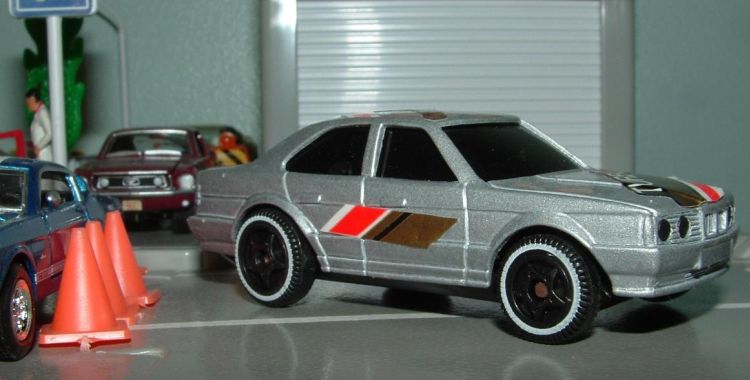
Today's car of the day is Poliguri's 1989 BMW 5 Series.


The BMW 5 Series is a mid-size / executive car manufactured by BMW since 1972. The car, now in its sixth generation, is sold in sedan and touring body styles. It is BMW's second best-selling model after the 3-Series but represents about 50% of the company's profits.

On January 29, 2008, the 5 millionth 5 Series was manufactured, a 530d Saloon in Carbon Black Metallic.


For more information and pictures of the real car please visit: BMW 5 Series


From the wheels and base of this car, you would expect it to be a pullback or motorized in some way, but this car is completely free-rolling.


The BMW E34 is the version of the BMW 5 Series automobile built from February 1988 to 1995 with the Touring model ending June 1996. It replaced the BMW E28 in 1988 and was replaced by the E39 in 1996.

In the North-American market the E34 succeeded the BMW E28 in May 1988 with two models. The 525i used the BMW M20 engine while the 535i used the larger M30. The cars were a blend of BMW tradition and modern technology. BMW's traditional FR layout and straight-6 were used, providing the smooth engine and optimal weight distribution BMW customers had come to expect. New 5-series also had a much stiffer body and was more streamlined than its predecessor, and had design cues introduced in 1986 7-series.

The E34 was among the most reliable luxury cars on the market, earning the best-in-class ratings from Intellichoice in 1991, and still considered one of the most reliable BMWs ever made. It was also one of the safest cars on the road during its production, providing airbags, 4-wheel anti-lock brakes, and a very rigid body structure to protect occupants in the event of an accident. It was also equipped with automatic stability control (ASC) or traction control (ASC+T) in later years on higher-specification variants.