Saturday, January 7, 2012

Race Car Of The Day: January 7, 2012


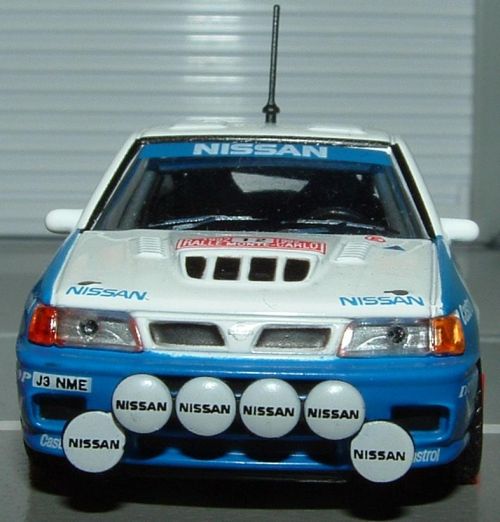
Today's car of the day is CM's 1992 Nissan Pulsar GTI-R.


The Nissan Pulsar GTI-R (chassis code RNN14 - aka GTiR, i-R and 'R) is a homologated 2 litre turbo-charged AWD vehicle manufactured by Nissan in Japan between 1990 and 1994 in order to enter the WRC under Group A rules. The body is based on the Nissan Pulsar (aka Sunny) N14 3-door hatchback model, but distinguished by the large rear wing and bonnet scoop. It has an ATTESA 4WD system (also used on some U12 & U13 Bluebird models), and a unique variant (coded 54C) of the SR20DET engine (not used on any other car).


For more information and pictures of the real car please visit: Nissan Pulsar GTI-R


A recent addition from diecastdingo (thanks Patrick!) this racer ran the Rallye Automobile de Monte Carlo in 1992.


After producing the minimum required 5,000 examples (500 of them being homologation models), Nissan entered the GTI-R under Group A rules in the FIA WRC as a factory team (Nissan Motorsport Europe - NME) in 1991 & 1992.

Based in Milton Keynes, NME only competed in selected rallies during both years (ones they thought had the highest potential for good results), but the initial success expected by Nissan Japan was not forthcoming, and they abandoned the campaign in 1992 after only 9 rallies. Factory development stopped there, and the GTI-R never won a WRC Group A rally. Nissan redirected funding to Le Mans and the development of the R390, and NME moved to the FWD Sunny GTI in the WRC F2 category (A7 class) where they had better success with Alister McRae winning the 1995 BRC. Much has been written about the reason for the GTI-R Group-A failure. The most notable being the uncompetitive Dunlop tyres, the inefficiency of the top-mounted intercooler when engine power was increased to Group A standards (especially in hot weather), and the political and cultural issues between Nissan Japan and the newly created NME (Nissan Motorsport Europe).

Friday, January 6, 2012


Today's car of the day is M2 Machines' 1969 Chevrolet Camaro.


The Chevrolet Camaro is an automobile manufactured by General Motors under the Chevrolet brand, classified as a pony car and some versions also as a muscle car. It went on sale on September 29, 1966, for the 1967 model year and was designed as a competing model to the Ford Mustang. The car shared its platform and major components with the Pontiac Firebird, also introduced for 1967.

Four distinct generations of the Camaro were developed before production ended in 2002. The nameplate was revived again on a concept car that evolved into the fifth-generation Camaro; production started on March 16, 2009.


For more information and pictures of the real car please visit: Chevrolet Camaro


M2's take on one of the most replicated cars in 1/64, the 1969 Camaro.  This one, unfortunately, has some quality control issues.  The hood won't shut (I even unscrewed it and tweaked it but it didn't make a difference) and the left taillight is crooked.


The first-generation Chevrolet Camaro appeared on September 26, 1966, for the 1967 model year on an all brand new rear-wheel drive GM F-body platform and would be available as a 2-door, 2+2 seat, coupe or convertible with a choice of six-cylinder and V8 powerplants. The first-gen Camaro would last up through the 1969 model year.

The Camaro's standard drivetrain was a 230 cu in (3.8 L) straight-6 engine rated at 140 hp (104 kW) and backed by a Saginaw three-speed manual transmission. There were between 8 (in 67) and 12 (in 69) different engines available in 67-69 Camaros. And there were several transmission options. A four-speed manual was available. The two-speed "Powerglide" automatic transmission was a popular option in 1967 and 1968 until the three-speed "Turbo Hydra-Matic 350" automatic became available starting in 1969. The larger Turbo 400 three-speed automatic was an option on SS396 cars.

There was a plethora of other options available all three years, including three main packages:
The RS was an appearance package that included hidden headlights, revised taillights with back-up lights under the rear bumper, RS badging, and exterior bright trim. It was available on any model.

The SS performance package consisted of a 350 or 396 cu in V8 engine and chassis upgrades for better handling and to deal with the additional power. The SS featured non-functional air inlets on the hood, special striping, and SS badging.

The Z/28 performance package was designed (with further modifications) to compete in the SCCA Trans-Am series. It included a solid-lifter 302 V8, Muncie 4-speed transmission, and power disc brakes.


The 1969 Camaro carried over the previous year's drivetrain and major mechanical components, but all-new sheetmetal, except the hood and trunk lid, gave the car a substantially sportier look. The grille was redesigned with a heavy "V" cant and deeply inset headlights. New door skins, rear quarter panels, and rear valance panel also gave the car a much lower, wider, more aggressive look. This styling would serve for the 1969 model year only. Collectors often debate the merits of smooth, rounded lines of 1967 and 1968 model versus the heavily creased and sportier looks of the 1969.

To increase competitiveness in the SCCA Trans Am racing series, optional four wheel disc brakes with four-piston calipers were made available during the year, under RPO JL8, for US$500.30. This system used components from the Corvette and made for a major improvement in the braking capability and was a key to winning the Trans Am championship. The option was expensive and only 206 units were produced.
The Rally Sport (RS) option, RPO Z22, includes special black painted grille with concealed headlights and headlight washers, fender striping (except when sport striping or Z28 Special Performance Package is specified), simulated rear fender louvers, front and rear wheel opening moldings, black body sill, RS emblems on grille, steering wheel and rear panel, Rally Sport front fender nameplates, bright accented taillights, back-up lights below rear bumper; also includes bright roof drip moldings on Sport Coupe. $131.65, 37,773 built. This option could be added to any other option IE- SS or Z/28, making the model an RS/SS or a RS/Z28.

The Z28 option was still available with the 302 cid small block. It was backed by Muncie four-speed with a new-for-69 standard Hurst shifter and connected to a 12-bolt rear axle with standard 3.73 gears. The 302 featured 11:1 compression, forged pistons, forged steel crankshaft and connecting rods, solid lifter camshaft, and Holley carburetion on a dual-plane intake manifold. A dual four-barrel crossram intake manifold was available as a dealer-installed option.

The 1969 model year was exceptionally long, extending into November 1969, due to manufacturing problem that delayed the introduction of the second generation model planned for 1970. It is a popular myth late-'69 Camaros were sold as 1970 models (due to GM publicity pictures of the '69 Camaro labeled as a 1970), but they were all assigned 1969 VIN codes.

Thursday, January 5, 2012


Today's car of the day is Konami's 1967 Toyota Corona 1600 GT5.


The Toyota Corona is an automobile manufactured by the Japanese automaker Toyota between 1957 and 2002. Traditionally, the competitor from Nissan was the Nissan Bluebird. The word Corona is Latin for "crown". It was sold at Toyopet Store dealership channels in Japan.
The Corona became massively successful in export markets: confusion easily arises because Toyota (like Volkswagen with their Passat and Mitsubishi with their Colt) applied model names inconsistently in different places. Following the 1969 parallel introduction of the Corona Mark II (which in certain markets mutated into the Cressida in 1977) there were disparate models sharing the Corona name. As time went by, models branded in much of Asia as Coronas turned up in European markets as Carinas, while ten years later in North America the Corona was successfully replaced by the larger Camry. In addition, because of the similarities in names, it is a very common mistake to confuse the Corona with the much smaller Toyota Corolla.


For more information and pictures of the real car please visit: Toyota Corona


Konamis are beautiful.  It's a pity they were only available for a few short years.  And yes, this is the same Konami that's most famous in the USA for making video games.


The third generation was introduced September 1964, and was known in Japan for its range of body styles offered. Aside from the sedan, variants included a two-door hardtop, a three-door van, a five-door station wagon (also as a van), two pickup variants, one of which had an extended cab with a canopy, and a five-door hatchback, which looked reminiscent of a Renault 16. The Corona appeared with a distinctly different appearance on the front of the vehicle, utilizing a slanted front and encompassing quad headlights within the boundaries of the grille. Previous generations used a single, two-way headlight installed on top and separate from the grille. The Italian designer Battista Farina assisted in the appearance of the new Corona. The 40-43 series were reserved for sedans, while commercial vehicles (and wagons) were in the 46 and 47 series. Hardtops received 50-55 series model codes, while 56 was reserved for the five-door hatchback.

A public demonstration of the new Corona's performance was done on the Meishin Expressway, where the new model was tested to 100,000 kilometres (62,137.1 mi), and was able to sustain speeds of 140 km/h (87 mph). The Corona was released one year after the debut of the Corona's traditional competitor, the Nissan Bluebird. Toyota introduced a smaller vehicle to address the market that needed a more fuel efficient vehicle, called the Toyota Corolla in March 1968. This allowed the Corona to increase in size and offer more passenger and cargo room over previous generations. 0–97 km/h (0–60 mph) time was 15.1 seconds.
Originally, commercial models (three-door van, pickup, and double-cab pickup) utilized the 1,198 cc 2P engine, with 55 PS (40 kW) at 5,000 rpm. This allowed for a maximum load of 500 kg (1,100 lb) for the two-seater versions and 300 kg (660 lb) for the five-seaters. Top speed for the 1.2 litre Corona is 110 km/h (68 mph). In January 1967 this also became available as a five-door van. In May 1967, the larger and more powerful 3P (1.35 litre) and 2R (1.5 litre) engines became available, replacing the lesser 2P in most markets. Power of these were 77 and 65 PS (57 and 48 kW) respectively.

The Toyota automatic transmission, dubbed Toyoglide, was introduced on this version of the Corona. The 4R (12R in Australian versions) engine that had a displacement of 1,587 cc was equipped with a twin SU carburetor (Australian models with 12R engine had one double barrel Aisin downdraft carburetor), and was capable of 90 bhp (67 kW; 91 PS). Disc brakes were also introduced for the front wheels. Exports of this Corona proved popular in the USA and Europe, with increased engine performance and durability improvements over previous versions. In September 1967 alone, Toyota produced 80,000 cars, with 30,000 being Coronas.

In 1967 in Japan, the 1,587 cc DOHC 9R engine was available in the RT55 1600GT 2-door coupe. This engine was essentially the 4R engine with a new twincam head based on the same technology as the twincam engine in the 2000GT.

This was the first Corona assembled in New Zealand, from February 1967 at Steel Brothers' Motor Assemblies in Christchurch.

Wednesday, January 4, 2012

Car Of The Day: January 4, 2012


Today's car of the day is Majorette Deluxe's 1989 Ferrari F40.


The Ferrari F40 is a mid-engine, rear-wheel drive, two-door coupé sports car produced by Ferrari from 1987 to 1992 as the successor to the Ferrari 288 GTO. From 1987 to 1989 it was Ferrari's fastest, most powerful, and most expensive car. The car had no traction control, and was one of the few to utilize turbochargers.

The car debuted with a factory suggested retail price of approximately US$400,000, although some buyers were reported to have paid as much as US$1.6 million. A total of 1,315 F40s were produced.


For more information and pictures of the real car please visit: Ferrari F40


Majorette's Deluxe series was the beginning of the trend of higher-priced diecast offerings.  Although these failed in the marketplace competitors like Matchbox's World Class and Premiere series' thrived, and new competitors (such as Johnny Lightning and 100% Hot Wheels) soon joined them in the diecast aisles.  Unfortunately this car looks much better in person than it does here in these pictures.  Part of that is the plastic body- while it allows for a higher level of detail it really doesn't photograph as nicely as metal.  Jeweled lights, and opening doors and hood to reveal that beautiful Ferrari motor put this one into the win category.


Ostensibly, the F40 was conceived as the successor to the 288 GTO and designed to compete with vehicles such as the Porsche 959 and Lamborghini Countach;[citation needed] for Ferrari management, the vehicle was a major statement piece. Over a period of several years prior to the F40's conception, the company's dominance in racing had waned significantly, and even in Formula One, an arena they had once dominated, victories had become sparse. Enzo Ferrari had recently turned 90 years old, and was keenly aware that time was not on his side. He wanted his new sports car to serve as his final statement-maker, a vehicle encompassing the best in track-developed technology and capable of being a showcase for what the Ferrari engineers were capable of creating. The company's upcoming 40th anniversary provided just the right occasion for the car to debut.

As Enzo had predicted it would be, the F40 was the last car to be commissioned by him before his death.


The F40 was designed with aerodynamics in mind. For speed the car relied more on its shape than its power. Frontal area was reduced, and airflow greatly smoothed, but stability rather than terminal velocity was a primary concern. So too was cooling as the forced induction engine generated a great deal of heat. In consequence, the car was somewhat like an open-wheel racing car with a body. It had a partial undertray to smooth airflow beneath the radiator, front section, and the cabin, and a second one with diffusers behind the motor, but the engine bay was not sealed. Nonetheless, the F40 had an impressively low Cd of 0.34 with lift controlled by its spoilers and wing.

Tuesday, January 3, 2012

Car Of The Day: January 3, 2012


Today's car of the day is Kyosho's 1974 Honda Civic.


Honda began selling the 1169 cc (70 in³) transversely mounted inline four-cylinder Civic for about US$2,200. The car produced roughly 50 hp (37 kW) and included power front disc brakes, vinyl seating, reclining bucket seats, and a woodgrain-accented dashboard. The hatchback version added a fold-down rear seat, an AM radio, and cloth upholstery. The car had front and rear independent suspension. A four-speed manual transmission was standard. Options for the Civic were kept to a minimum, consisting of air conditioning, an automatic transmission called the Hondamatic, radial tires, and a rear wiper for the hatchback. The car could achieve 40 mpg-US (5.9 L/100 km; 48 mpg-imp) on the highway, and with a small 86.6-inch (2,200 mm) wheelbase and 139.8-inch (3,550 mm) overall length, the vehicle weighed 1,500 pounds (680 kg).

The four-door sedan version of this bodystyle was not available in the USA, and the sedan was not a hatchback until 1978, just before the introduction of the second generation. In the USA, the advertising campaign used to introduce the Civic was, "Honda, we make it simple."


For more information and pictures of the real car please visit: Honda Civic


This is the car that put Honda on the radar of most American car buyers.  Previous efforts were mostly ignored in the USA; but this model was the perfect car at the perfect time.


The Civic's features allowed it to outperform American competitors such as the Chevrolet Vega and Ford Pinto. When the 1973 oil crisis struck, many Americans turned to economy cars. Reviews of American economy car quality were poor and getting worse due to spiraling costs for manufacturers. Japanese culture had a long-standing tradition of demanding high-quality economy cars, and the growing American desire in the 1970s for well-made cars that had good fuel mileage benefited the standing of the Honda Civic, Toyota Corolla and Datsun B210 in the lucrative U.S. market.

For 1974, the Civic's engine size grew slightly, to 1237 cc and power went up to 52 hp (39 kW). In order to meet the new 5 mph (8 km/h) bumper impact standard, the Civic's bumpers grew 7.1 inches (18 cm), increasing overall length to 146.9 inches (373 cm). The CVCC (Compound Vortex Controlled Combustion) engine debuted in 1975 and was offered alongside the standard Civic engine. The optional 53 hp (40 kW) CVCC engine displaced 1488 cc and had a head design that promoted cleaner, more efficient combustion. The CVCC design eliminated the need for catalytic converters or unleaded fuel to meet changing emissions standards, unlike nearly every other U.S. market car. Due to California's stricter emissions standards, only the CVCC powered Civic was available in that state. This created a sales advantage in Honda's favor in that CVCC equipped Honda products afforded the buyer the ability to choose any type of fuel the buyer wanted, and due to emissions equipment not being damaged by using leaded fuel, the buyer could use any gasoline products available. This was also an advantage due to some regions of North America having to ration available gasoline supplies due to periodic shortages at the time. TV commercial for CVCC Civic. A five-speed manual transmission became available in 1974, as did a Civic station wagon (only with the CVCC engine), which had a wheelbase of 89.9 inches (228 cm) and an overall length of 160 inches (406 cm). Civic sales also increased and topped 100,000 units for this year.
1978 brought slight cosmetic changes: the grille was black; the rear-facing hood vents replaced the sideways vents; and turn indicators were mounted in the bumper instead of in the grille. The CVCC engine was now rated at 60 hp (45 kW).

The first generation Honda Civics were notorious for rusting in less than three years from purchase where salt was used in the winter. The U.S. importer, American Honda Motor Company, signed a final consent decree with the Federal Trade Commission that provided owners of 1975-1978 Civics with rusted fenders the right to receive replacements or cash reimbursements. In the end, almost 1 million Honda owners were notified that their fenders could be repaired or replaced by the automaker at no charge. About 10% of all Hondas sold were to be inspected by a dealer, and the automaker had 180 days to replace front fenders and supporting parts that showed rust within the first three years of use.

The Hondas were so vulnerable to corrosion that the National Highway Traffic Safety Administration (NHTSA) also issued a safety recall . This was because the car's lateral suspension arms, front crossbeam, and strut coil spring lower supports could weaken with exposure to salt. A total of 936,774 vehicles built between 9-1-1972 and 8-1-1979 were subject to extensive repairs since Honda had to replace the suspension components, or the automaker bought back entire cars with serious body corrosion.

At the time, Honda's rust recall was the largest safety action among all the brands imported into the U.S. Civics became known for their "typical Honda rust" in the used car market.


What's wrong with the above picture?  Could it be the two subcompacts that are exactly the same length of the full-size models in their respective lineups?  Why yes!  Yes it can be.  Since these are generally designed as toys, the cars are designed to fit the blisterpack for a multitude of cost-saving reasons.  They don't require new, smaller wheels to be made specifically for this one casting.  They don't require a special blisterpack to compensate for their small size.  And supposedly they appeal to people looking for cars because they don't feel like they're getting ripped off on a tiny car when the rest of the models are twice the size.


Now if you know me, you know I'm a true scale enthusiast.  I like my big cars big and my tiny cars tiny.  Which leads us to these pictures.  These were all marketed as adult collectibles as opposed to toys.  So we get a giant SUV and a tiny subcompact.  Just the way it should be on the toy end but can't be for the reasons stated earlier.


Surprisingly, even though we've dealt with three different diecast manufacturers so far this year (GreenLight, Hot Wheels 100%, and today's Kyosho) and three very different types of car (classic muscle, gargantuan SUV, and subcompact) all three have one thing in common- they are true to scale with one another.


Yes, you can even pack up the Civic and take it along as a spare in case the Hummer breaks down....or more likely runs out of gas in the middle of nowhere.

Monday, January 2, 2012

SUV Of The Day: January 2, 2012


Today's car of the day is 100% Hot Wheels' 1997 Hummer H1.


The Hummer H1 is a civilian off-road vehicle based on the M998 Humvee, which was created by AM General. The vehicle was produced from 1992 through 2006, and was the first of what became the Hummer line. It was initially known only as the "Hummer"; however, in 1999 in a joint venture between General Motors and AM General, GM began marketing the Hummer H2, which was built on the Chevrolet Tahoe chassis. It was at this point that the original Hummer was given the H1 designation. For collectors, the most desirable model is the H1 Alpha, produced in the final model year of 2006. It had the most powerful engine and the best fuel mileage of the H1 vehicles. Overall, the H1 was a very limited production vehicle.
"Originally designed strictly for military use the four-wheel-drive utility vehicle was released to the civilian market due to popular demand. Boasting 16 inches (40 cm) of ground clearance as well as super-aggressive approach and departure angles, the Humvee could clamber over a 22-inch (56 cm) high obstacle, handle a 60 percent grade and wade through up to 30 inches (76 cm) of water."


For more information and pictures of the real car please visit: Hummer H1


This is a recent purchase from Firehawk73 (thanks Paul!).  South Texas lists this casting as having debuted in 2000, but the base copyrights the vehicle to AM General, not General Motors (making things really complicated in the naming department the "M" in AM General is also short for "Motors" so yes, that means American Motors General built these for General Motors).  Since GM took over the Hummer name and trademarks in 1998, I'm calling this one a 1997 model.  AM General was still building them, however.  If you really want to get a Hummer owner's goat, just explain that the company responsible for their behemoth SUV is also responsible for the Gremlin and Pacer.  Perhaps it's a good thing the Hummer brand was discontinued.  With the way GM was going there eventually would have been a badge-engineered Chevy Aveo as the Hummer H7.


Originally released in the civilian market in 1992, the Hummer H1 owed its birth to the popularity of photos from Operation Desert Storm and the enthusiastic campaign from actor-politician Arnold Schwarzenegger, who owns several variants of Hummer vehicles. AM General announced that 2006 would be the last model year for the Hummer H1, with production winding down in June 2006 due to a new emission law for diesel engine vehicles, which took effect in 2007.


The Hummer H1 has three common variants: a convertible-like soft top, a four-door hard top Sport Utility Truck and an Alpha Wagon body version. Other less known variants include a two-door pickup truck, most commonly seen in the military sporting Anti-Air turrets and other launchers, or used as troop and cargo transports, and a four-door slantback, which shares the same body style of the Humvee employed by the U.S. Military. The convertible/soft top and the station wagon versions were the last ones available in the mass market. The two door and four door pickup versions are only available in fleet livery.

The Hummer H1 shares some common driveline parts with its HMMWV brethren. Items like brakes, axles, frame and major body panels (hood, tailgate and quarter panels) are identical between the HMMWV and the Hummer H1. All Hummer H1s and HMMWVs come off the same assembly line, and then civilian H1s get painted and finished in a separate building across the parking lot.

Hummer H1s are unique in the way they handle off road, and in their interior arrangement. Passenger and highway comfort are sacrificed for maximum mobility compared to civilian SUVs, with features much more radical than the original Jeep, though they do share a similarly cut simple grille opening. They are inherently very stable, thanks to their wide track. They can ford 30 inches (76 cm) of water and climb a 22-inch (56 cm) step. Their stock ground clearance of 16 inches (41 cm) is made possible by tucking driveline components inside a channel in the central space between the left and right seats. They have high approach/departure angles of 72/37.5 degrees. Most H1s are equipped with a Central Tire Inflation System (CTIS), which enables the driver to increase or decrease the tire air pressure at the push of a button, since lower tire pressures are more suited for off road, and higher tire pressures are desirable on-road.
Hummer H1s have many unusual features. They use inboard brakes. They have portal gears, allowing the drivetrain's half shafts to be up high for greater clearance. The radiator is up high, sloping back over the engine on a forward hinged hood. The air intake is mounted high, enabling fording waist-level water. Rather than using simple runflat tires, magnesium-aluminum alloy or rubber inserts are an optional feature for runflat ability. A chemical agent resistant coating, or CARC, is available only on the military version.

Car Of The Day: January 1, 2012


Today's car of the day is GreenLight's 1968 Ford Mustang.


The first-generation Ford Mustang is the original pony car, manufactured by Ford Motor Company from 1964 until 1973.

It was initially introduced as a hardtop and convertible with the fastback version put on sale the following year. At the time of its introduction, the Mustang, sharing its underpinnings with the Falcon, was slotted into a compact car segment.

With each revision, the Mustang saw an increase in overall dimensions and in engine power. As a result, by 1971, the Mustang had entered the muscle car segment. After an initial surge, sales were steadily declining and Ford began working on a new generation Mustang. When the oil crisis hit in 1973, Ford was prepared, having already designed the smaller Mustang II. This car had no common components with preceding models.


For more information and pictures of the real car please visit: Ford Mustang


This is a recent RAOK from tsarlitto (thanks Tom!) and well, I'll let him tell the story himself.  It's on the back of the blistercard, photographed below.


The 1967 model year Mustang was the first model to feature a major redesign with the installation of a big-block V8 engine. The overall size, interior and cargo space were increased. Exterior trim changes included concave taillights, side scoop (1967) and chrome (1968) side ornamentation, square rear-view mirrors, and usual yearly wheel and gas cap changes. The high-performance 289 option was placed behind the newer 320 hp (239 kW) 390 cu in (6.4 L) FE engine from the Ford Thunderbird, which was equipped with a four-barrel carburetor. A 390 GT engine, and a 4-speed manual transmission recorded quarter mile times of approximately 13 seconds and trap speeds of over 105 mph (169 km/h). During the mid-1968 model year, a drag racer for the street could be ordered with the optional 428 cu in (7.0 L) Cobra Jet engine which was officially rated at 335 hp (250 kW) all of these Mustangs were issued R codes on their VIN#'s.

The 1967 and 1968 models discontinued the "Pony Interior" in favor of a new deluxe interior package, which included special color options, brushed stainless steel (1967) or woodgrain (1968) trim, seat buttons, a tilt steering wheel, and special interior paneling. The 1968 models that were produced during 1968 were also the first year to incorporate 3 point lap belts as opposed to the standard lapbelts The air-conditioning option was fully integrated into the dash, the speakers and stereo were upgraded, and unique center and overhead consoles were options. The fastback model offered the option of a rear fold-down seat, and the convertible was available with folding glass windows. Gone too was the Rally-Pac, since the new instrument cluster had provisions for an optional tachometer and clock. Its size and shape also precluded the installation of the accessory atop the steering column.

The California Special Mustang, or GT/CS, was visually based on the Shelby model and was only sold in Western states. Its sister, the 'High Country Special', was sold in Denver, Colorado. While the GT/CS was only available as a coupe, the 'High Country Special' model was available in fastback and convertible configurations in 1966 and 1967 and only as a coupe in 1968.

The Mustang fastback gained popular culture status when used in the crime thriller Bullitt (1968). Lt. Frank Bullitt, played by actor Steve McQueen, drove a modified Highland Green 1968 Mustang GT fastback with 390 cu in (6.4 L) 4V engine, chasing two hitmen in a black 1968 Dodge Charger in the film's car chase through the streets of San Francisco.